
Bertrand Russell 1872 1970 Leo R Sandy Bertrand
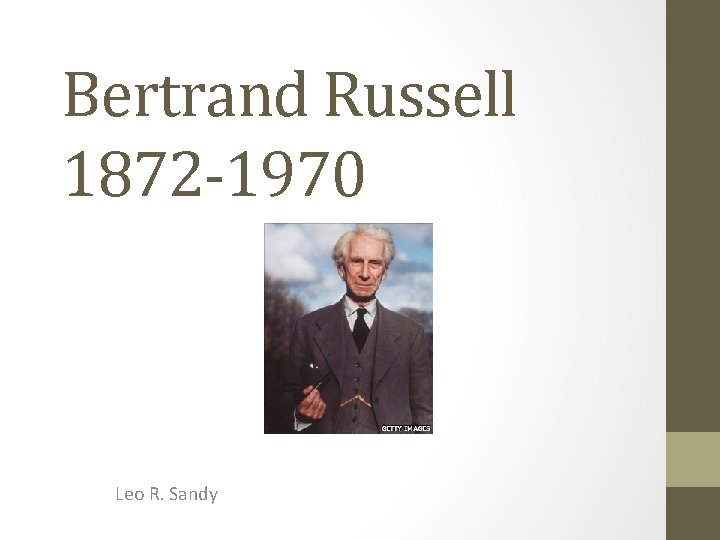
Bertrand Russell 1872 -1970 Leo R. Sandy
Bertrand Russell • Despite being a renowned philosopher, Bertrand Russell is perhaps best known for his political activism and altercations with the British government. • Considered a pioneer in the field of philosophy, Bertrand Russell was awarded the Nobel Prize in Literature in 1950 for his numerous writings. He is perhaps better known, though, for his political activism. A prominent anti-war activist, he has been imprisoned twice by the British government. • As a philosopher, mathematician, educator, social critic and political activist, Bertrand Russell authored over 70 books and thousands of essays and letters addressing a myriad of topics. Russell was a fine literary stylist, one of the foremost logicians ever, and a gadfly for improving the lives of men and women.
Russell cont’d • Born in 1872 into the British aristocracy and educated at Cambridge University, Russell gave away much of his inherited wealth. But in 1931 he inherited and kept an earldom. His multifaceted career centered on work as a philosophy professor, writer, and public lecturer. • He was arguably the greatest philosopher of the 20 th century and the greatest logician since Aristotle. Analytic philosophy, the dominant philosophy of the twentieth century, owes its existence more to Russell than to any other philosopher. • Russell was involved, often passionately, in numerous social and political controversies of his time. For example, he supported suffragists, free thought in religion and morals, and world government; he opposed World War I and the Vietnam War, nationalism, and political persecution. He was jailed in 1918 for antiwar views and in 1961 for his anti-nuclear weapons stance.
Russell cont’d • He was married 4 times and had 3 children. With Dora Russell, he founded the experimental Beacon Hill School. He knew or worked with many of the most prominent figures in late 19 th and 20 th century philosophy, mathematics, science, literature, and politics. • Active as a political and social critic until his end, Russell died in 1970 at the age of 97.
Russell cont’d • Bertrand Arthur William Russell was born at Trelleck on 18 th May, 1872. His parents were Viscount Amberley and Katherine, daughter of 2 nd Baron Stanley of Alderley. At the age of three he was left an orphan. • His father had wished him to be brought up as an agnostic; to avoid this he was made a ward of Court, and brought up by his grandmother. Instead of being sent to school he was taught by governesses and tutors, and thus acquired a perfect knowledge of French and German. • In 1890 he went into residence at Trinity College, Cambridge, and after being a very high Wrangler and obtaining a First Class with distinction in philosophy he was elected a fellow of his college in 1895. But he had already left Cambridge in the summer of 1894 and for some months was attaché at the British embassy at Paris.
Russell cont’d • In December 1894 he married Miss Alys Pearsall Smith. After spending some months in Berlin studying social democracy, they went to live near Haslemere, where he devoted his time to the study of philosophy. • In 1900 he visited the Mathematical Congress at Paris. He was impressed with the ability of the Italian mathematician Peano and his pupils, and immediately studied Peano's works. In 1903 he wrote his first important book, The Principles of Mathematics, and with his friend Dr. Alfred Whitehead proceeded to develop and extend the mathematical logic of Peano and Frege. • From time to time he abandoned philosophy for politics. In 1910 he was appointed lecturer at Trinity College. After the first World War broke out, he took an active part in the No Conscription fellowship and was fined £ 100 as the author of a leaflet criticizing a sentence of two years on a conscientious objector.
Russell cont’d • His college deprived him of his lectureship in 1916. He was offered a post at Harvard university, but was refused a passport. He intended to give a course of lectures (afterwards published in America as Political Ideals, 1918) but was prevented by the military authorities. • In 1918 he was sentenced to six months' imprisonment for a pacifistic article he had written in the Tribunal. His Introduction to Mathematical Philosophy (1919) was written in prison. His Analysis of Mind (1921) was the outcome of some lectures he gave in London, which were organized by a few friends who got up a subscription for the purpose. • In 1920 Russell had paid a short visit to Russia to study the conditions of Bolshevism on the spot. In the autumn of the same year he went to China to lecture on philosophy at the Peking university. On his return in Sept. 1921, having been divorced by his first wife, he married Miss Dora Black.
Russell cont’d • They lived for six years in Chelsea during the winter months and spent the summers near Lands End. In 1927 he and his wife started a school for young children, which they carried on until 1932. He succeeded to the earldom in 1931. • He was divorced by his second wife in 1935 and the following year married Patricia Helen Spence. In 1938 he went to the United States and during the next years taught at many of the country's leading universities. • In 1940 he was involved in legal proceedings when his right to teach philosophy at the College of the City of New York was questioned because of his views on morality. When his appointment to the college faculty was cancelled, he accepted a five-year contract as a lecturer for the Barnes foundation, Merion, Pa. , but the cancellation of this contract was announced in Jan. 1943 by Albert C. Barnes, director of the foundation.
Russell cont’d • Russell was elected a fellow of the Royal Society in 1908, and reelected a fellow of Trinity College in 1944. He was awarded the Sylvester medal of the Royal Society, 1934, the de Morgan medal of the London Mathematical Society in the same year, the Nobel Prize for Literature, 1950. • In a paper "Logical Atomism" (Contemporary British Philosophy. Personal Statements, First series. Lond. 1924) Russell exposed his views on his philosophy, preceded by a few words on historical development. • A prolific writer, he published numerous articles and books including The Analysis of Mind, 1921, The Problem of China, 1922; The ABC of Atoms, 1923; On Education, 1926; Which Way to Peace, 1936; and Marriage and Morals, 1929
Quotes • The trouble with the world is that the stupid are cocksure and the intelligent are full of doubt • The good life is one inspired by love and guided by knowledge. • The fact that an opinion has been widely held is no evidence whatever that it is not utterly absurd. • The only thing that will redeem mankind is cooperation. • War does not determine who is right - only who is left. • Most people would sooner die than think; in fact, they do so.
Quotes cont’d • The demand for certainty is one which is natural to man, but is nevertheless an intellectual vice. • Fear is the main source of superstition, and one of the main sources of cruelty. To conquer fear is the beginning of wisdom. • It is preoccupation with possessions, more than anything else, that prevents us from living freely and nobly. • Patriotism is the willingness to kill and be killed for trivial reasons.
Video • Betrand Russell: Face-to-Face Interview BBC 1959
References • Bertrand Russell – Biographical. Retrieved from http: //www. nobelprize. org/nobel_prizes/literature/laureates/1950/ russell-bio. html • BIO: Bertrand Russell. Retreived from http: //www. biography. com/people/bertrand-russell-40493 • The Bertrand Russell Society – About Betrand Russell. Retrieved from https: //users. drew. edu/jlenz/brs-about-br. html
- Slides: 13