
BERNOULLIS PRINCIPLE FLUID FLOW PES 1000 PHYSICS IN

BERNOULLI’S PRINCIPLE & FLUID FLOW PES 1000 – PHYSICS IN EVERYDAY LIFE
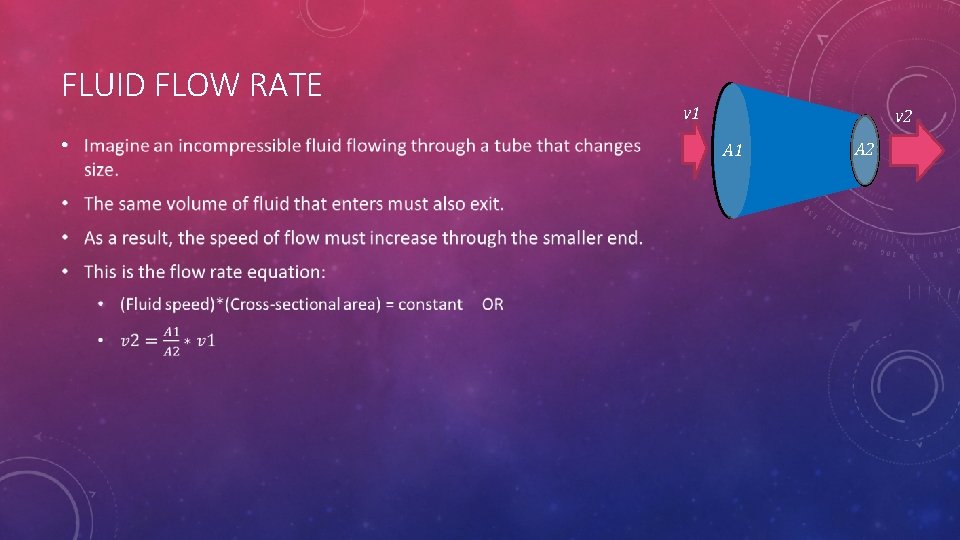
FLUID FLOW RATE • v 1 v 2 A 1 A 2
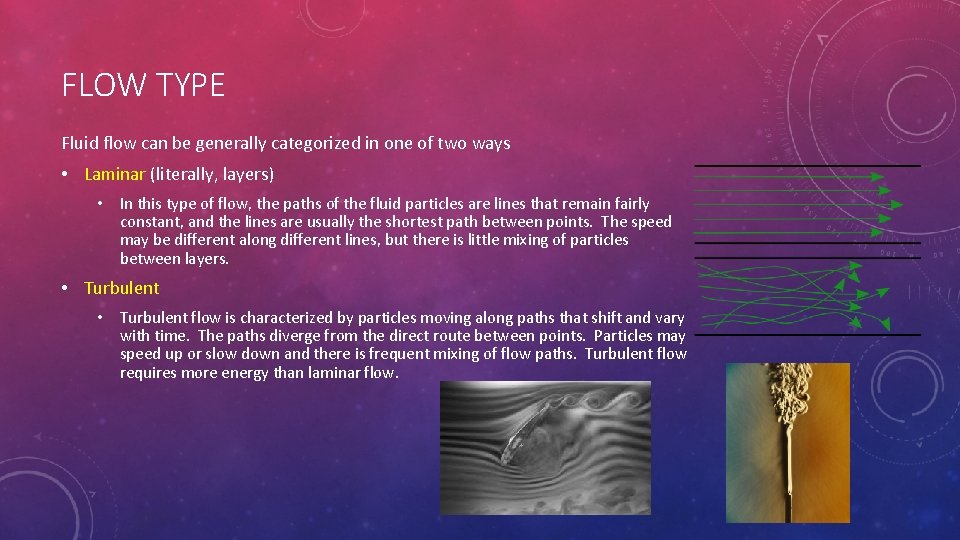
FLOW TYPE Fluid flow can be generally categorized in one of two ways • Laminar (literally, layers) • In this type of flow, the paths of the fluid particles are lines that remain fairly constant, and the lines are usually the shortest path between points. The speed may be different along different lines, but there is little mixing of particles between layers. • Turbulent flow is characterized by particles moving along paths that shift and vary with time. The paths diverge from the direct route between points. Particles may speed up or slow down and there is frequent mixing of flow paths. Turbulent flow requires more energy than laminar flow.
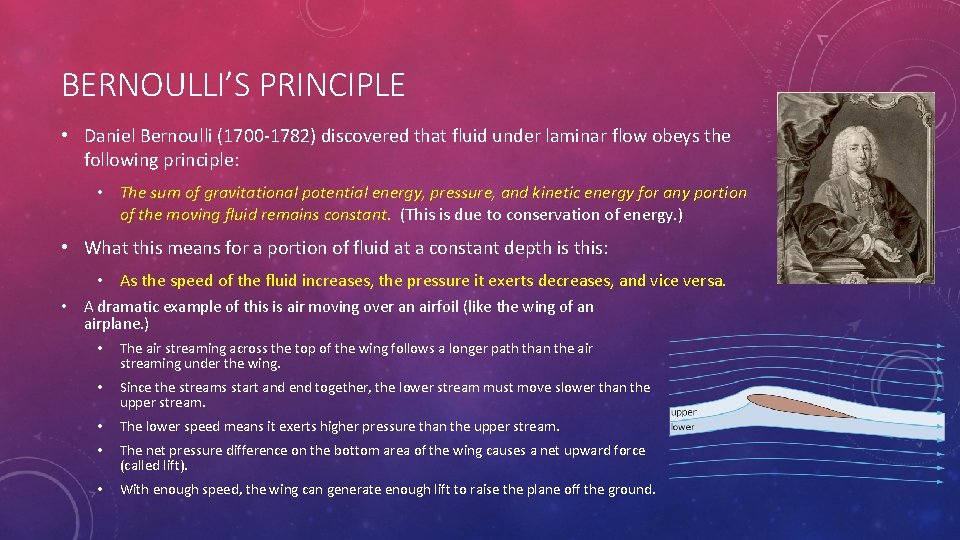
BERNOULLI’S PRINCIPLE • Daniel Bernoulli (1700 -1782) discovered that fluid under laminar flow obeys the following principle: • The sum of gravitational potential energy, pressure, and kinetic energy for any portion of the moving fluid remains constant. (This is due to conservation of energy. ) • What this means for a portion of fluid at a constant depth is this: • As the speed of the fluid increases, the pressure it exerts decreases, and vice versa. • A dramatic example of this is air moving over an airfoil (like the wing of an airplane. ) • The air streaming across the top of the wing follows a longer path than the air streaming under the wing. • Since the streams start and end together, the lower stream must move slower than the upper stream. • The lower speed means it exerts higher pressure than the upper stream. • The net pressure difference on the bottom area of the wing causes a net upward force (called lift). • With enough speed, the wing can generate enough lift to raise the plane off the ground.
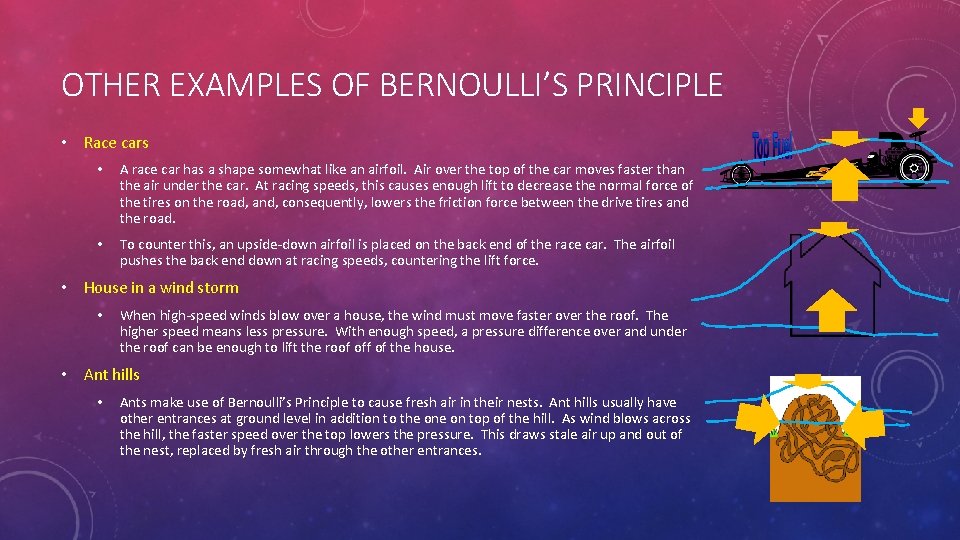
OTHER EXAMPLES OF BERNOULLI’S PRINCIPLE • Race cars • A race car has a shape somewhat like an airfoil. Air over the top of the car moves faster than the air under the car. At racing speeds, this causes enough lift to decrease the normal force of the tires on the road, and, consequently, lowers the friction force between the drive tires and the road. • To counter this, an upside-down airfoil is placed on the back end of the race car. The airfoil pushes the back end down at racing speeds, countering the lift force. • House in a wind storm • When high-speed winds blow over a house, the wind must move faster over the roof. The higher speed means less pressure. With enough speed, a pressure difference over and under the roof can be enough to lift the roof of the house. • Ant hills • Ants make use of Bernoulli’s Principle to cause fresh air in their nests. Ant hills usually have other entrances at ground level in addition to the on top of the hill. As wind blows across the hill, the faster speed over the top lowers the pressure. This draws stale air up and out of the nest, replaced by fresh air through the other entrances.
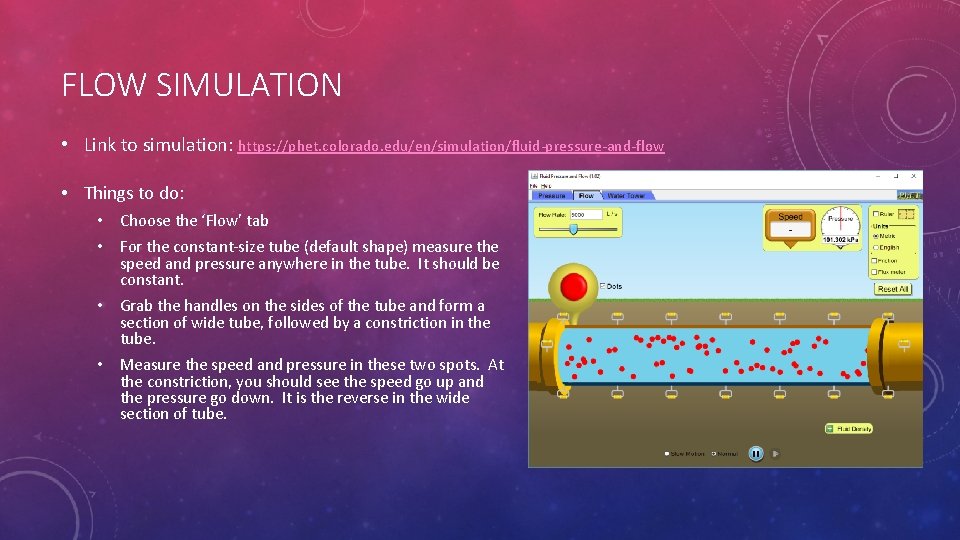
FLOW SIMULATION • Link to simulation: https: //phet. colorado. edu/en/simulation/fluid-pressure-and-flow • Things to do: • Choose the ‘Flow’ tab • For the constant-size tube (default shape) measure the speed and pressure anywhere in the tube. It should be constant. • Grab the handles on the sides of the tube and form a section of wide tube, followed by a constriction in the tube. • Measure the speed and pressure in these two spots. At the constriction, you should see the speed go up and the pressure go down. It is the reverse in the wide section of tube.
CONCLUSION • In a tube of flowing fluid, the flow speed increases when cross-sectional area decreases. • Flowing fluid can be laminar or turbulent. • Bernoulli’s Principle states that: • The sum of gravitational potential energy, pressure, and kinetic energy for any portion of the moving fluid remains constant. • Restated: As the speed of the fluid increases, the pressure it exerts decreases. • When air moves over airfoil shapes, the different speeds of air layers over top and bottom cause a pressure difference, and therefore a lift force. • The phenomenon of air moving at different speeds causing pressure differences shows up in other designs, both man-made and natural.
- Slides: 7