
BEREAVEMENT CARE AWARENESS SECTION 1 Introduction GROUND RULES
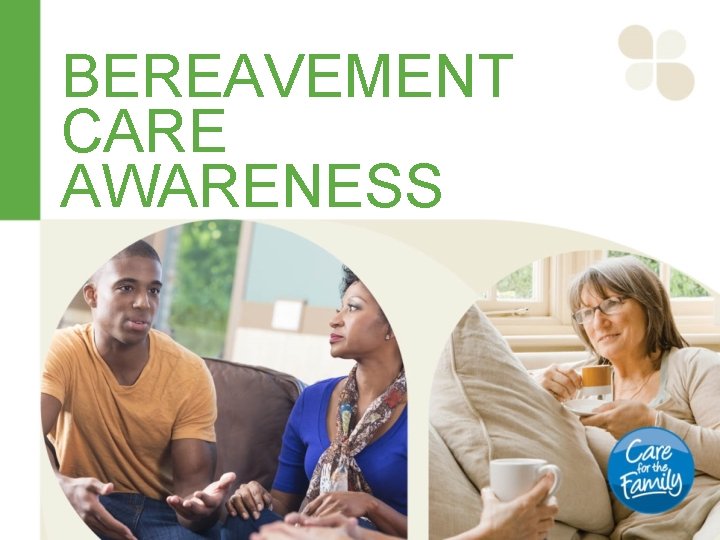
BEREAVEMENT CARE AWARENESS
SECTION 1 Introduction
GROUND RULES What ground rules do we want in the group to help it run smoothly?
BEREAVEMENT CARE AWARENESS AIMS TO: Develop knowledge, skills and understanding of how churches can be involved in providing appropriate levels of ongoing support to those who are bereaved.
OUTCOMES On completion of this training you will: • Gain basic information of the impact bereavement has in people’s lives and the different ways in which individuals commonly respond. • Have had the opportunity to reflect on your own experience of bereavement. • Be able to identify key factors in providing effective support.
OUTCOMES • To identify the key factors that are essential for churches to provide effective bereavement support. • To gain information on support services that are available locally and nationally.
KEY FACTS AND FIGURES • Over half a million people die in the UK each year. • 88% of funerals have some ‘religious’ content – although the number of secular funerals is increasing rapidly. • Information on the availability of bereavement support is not routinely given by funeral directors, registrars and NHS professionals – or churches.
SECTION 2 Death, society and the Church
DEATH AND SOCIETY • Discussing and thinking about death and dying has become society’s last taboo. • Until they are bereaved themselves, it doesn’t touch many people’s lives closely. • Most people no longer understand the support that bereaved people need and hope that they will ‘get over it’ soon. • This leaves bereaved people unsure and ignorant of available support.
DEATH AND THE CHURCH • Many people who would not consider themselves churchgoers still turn to the church in a time of bereavement. • Some churches see their role merely as one of liaising with the family at the time of the bereavement and organising the funeral.
DEATH AND THE CHURCH • Many churches gave limited support around the time of the funeral or with an annual memorial service. • Few did anything beyond this. • Most wanted to do more but were limited because of lack of resources. • Few knew much about the availability of bereavement support organisations or other resources. • The most pressing needs were for information, resources and training.
DEATH AND THE CHURCH • Jesus wept with Lazarus’s family at his death (John 11) and was ‘filled with compassion’ at the grief of the Widow of Nain (Luke 7). • The early church was greatly exercised to give support to widows and orphans (James 1).

BREAK
SECTION 3 Reactions to bereavement

PERSONAL EXPERIENCES
EXPRESSIONS OF GRIEF • • • Emotional Physical Psychological Behavioural Spiritual
FACTORS AFFECTING GRIEF Grief is complex and influenced by a number of factors: • The quality and type of relationship they have with the person who has died. • How, when and where the person died. • The age, gender, personality and level of understanding of the grieving person. • Their previous experience of significant loss. • Their cultural and religious beliefs and influences.
FACTORS AFFECTING GRIEF • Their involvement in mourning rituals. • Their family and social support network. • Their other concurrent stressors. • Their upbringing (learnt behaviour).
CASE STUDIES

DELEGATE PACK

BREAK
SECTION 4 Understanding bereavement
THEORIES AND MODELS OF GRIEF Worden • accept • experience • adjust • reinvest
THEORIES AND MODELS OF GRIEF Dual process model • moving between loss and recovery
THEORIES AND MODELS OF GRIEF Continuing bonds • keeping healthy connections
THEORIES AND MODELS OF GRIEF Tonkin’s model • life can grow around grief
SECTION 5 Working with bereaved people
DEALING WITH STRONG EMOTIONS
CASE STUDY
DEALING WITH STRONG EMOTIONS Anger and guilt are two strong emotions that are frequently experienced by bereaved people.
COMPLEX AND COMPLICATED GRIEF The features of complex and complicated grief: • Prolonged and intense yearning and longing for the person who has died • Recurrent intrusive and distressing thoughts • Difficulty concentrating and accepting what has happened • Difficulty moving beyond acute state of mourning • Feeling that life is now meaningless and holds no future happiness or satisfaction
COMPLEX AND COMPLICATED GRIEF Complex grief is more likely in these situations: • The death of a child • Suicide • ‘Lifestyle’ deaths − for example, drugs overdose • Sudden, traumatic death • Death of a relatively young person • Death where there is no body • Murder or manslaughter • Multiple bereavements
EFFECTIVE COMMUNICATION We can demonstrate care and understanding and the desire to help through: • The words we say • The tone of our voice • Our body language
RESPONSES TO LOSS

BREAK
SECTION 6 Conclusion
THE NEEDS OF BEREAVED PEOPLE Needs that are common to most are: • For their grief to be ‘normalised’. • To understand a little more about the journey they are on and to be given strategies to help them while they are on it. • To understand that their journey is unique to them, that they will get through (not over!) it and that there is no time limit. • To feel understood, listened to and supported. • To have the opportunity to explore spiritual issues.
THE NEEDS OF BEREAVED PEOPLE • To know that there is hope for the future and that there can be a new ‘normal’ life that is not the same as before, yet can still be good. • To be given information on the availability of and how to access support services. • To receive practical support – particularly in the days and weeks after the death.
HOW THE CHURCH CAN MEET THESE NEEDS
WIDER CONSIDERATIONS • Dependency • Children and grief • Self-care
FURTHER INFORMATION For information and resources on bereavement support visit www. careforthefamily. org. uk/bereavement. For more information about our marriage and parenting resources visit www. careforthefamily. org. uk.
PERSONAL REFLECTION We have: • Considered the impact bereavement has in people’s lives and the different ways in which individuals commonly respond • Reflected on our own experience of bereavement • Identified the basic needs of bereaved people • Identified the skills, structure and safeguards needed to provide appropriate levels of support to bereaved people • Looked at the different models of bereavement support
CHURCH REVIEW AND PLANNING

THANK YOU FOR COMING
- Slides: 44