
BERA DR SUPREET SINGH NAYYAR AFMC 16 07
BERA DR. SUPREET SINGH NAYYAR, AFMC 16 -07 -2012 www. nayyar. ENT. com 1 For more presentations, visit www. nayyar. ENT. com

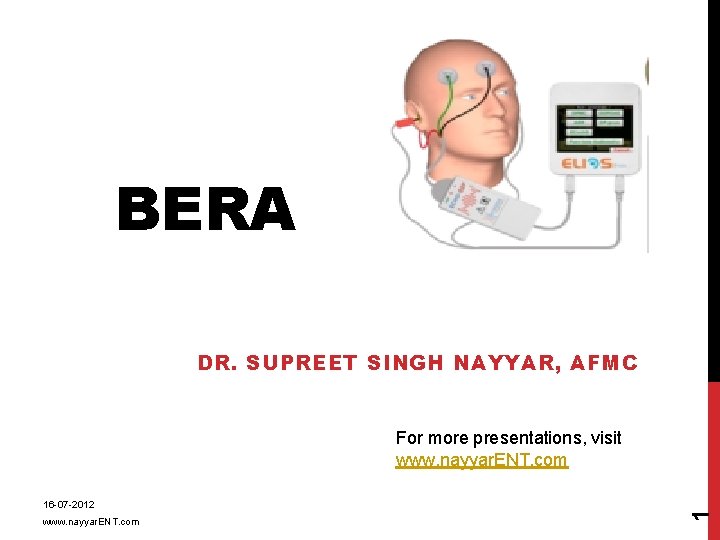
Recording of the synchronous electrical activity recorded by a far-field electrode placed on the scalp in response to a sound presented to the cochlea. 16 -07 -2012 www. nayyar. ENT. com 2 Changes produced by the passage of electrical stimulus generated in the cochlea through the neural pathway
HISTORY 16 -07 -2012 www. nayyar. ENT. com 3 First described by Jewett and Williston in 1971, ABR audiometry is the most common application of auditory evoked responses.
USES OF BERA 16 -07 -2012 www. nayyar. ENT. com 4 Detection & quantification of deafness in difficult to test patients Detection of the nature of deafness Identification of the site of leshion in retrocochlear pathologies Study of central auditory disorders Study of maturity of nervous system in newborns Objective identification of brain death Assessing prognosis in comatose patients

USES OF INTRAOPERATIVE AUDITORY BRAINSTEM RESPONSE 16 -07 -2012 www. nayyar. ENT. com 5 Monitoring cochlear function directed at hearing preservation: Cerebellopontine angle tumor resection (acoustic neuroma surgery) Vascular decompression of trigeminal neuralgia Vestibular nerve section for the relief of vertigo Exploration of the facial nerve for facial nerve decompression Endolymphatic sac decompression for Mèniére disease Monitoring brainstem integrity: Brainstem tumor resection Brainstem aneurysm clipping or arteriovenous malformation resection
16 -07 -2012 www. nayyar. ENT. com 6 PRINCIPLE OF BERA

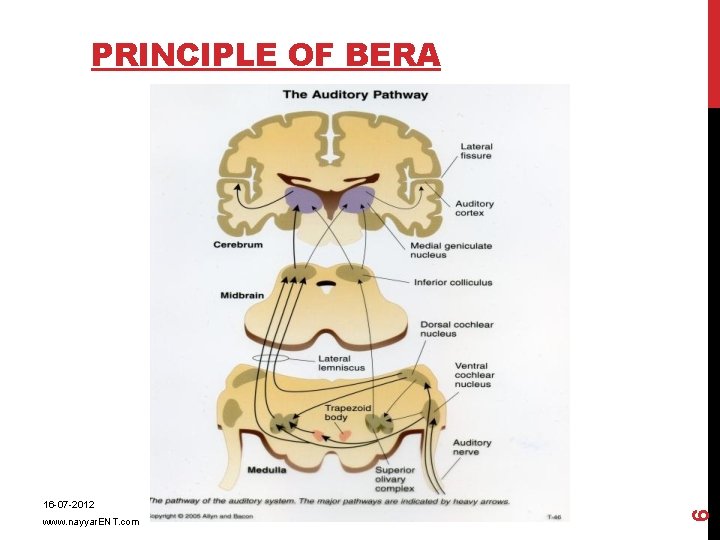
PRINCIPLE OF BERA Processing at different levels Generates electrical activity Monitored by surface electrode Graphic recording presents a waveform 16 -07 -2012 www. nayyar. ENT. com 7 Depends on the functional integrity of the pathway

PRINCIPLE OF BERA Process becomes difficult due to the background potential generated by the brain Separation of the 2 activities by summation & averaging Sound evoked electrical potential: time specific 16 -07 -2012 www. nayyar. ENT. com 8 Electrical activity of brain: occurs randomly
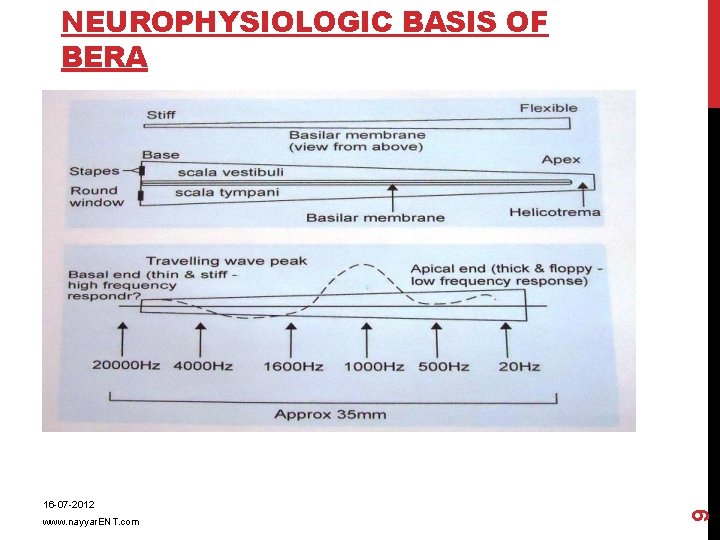
16 -07 -2012 www. nayyar. ENT. com 9 NEUROPHYSIOLOGIC BASIS OF BERA
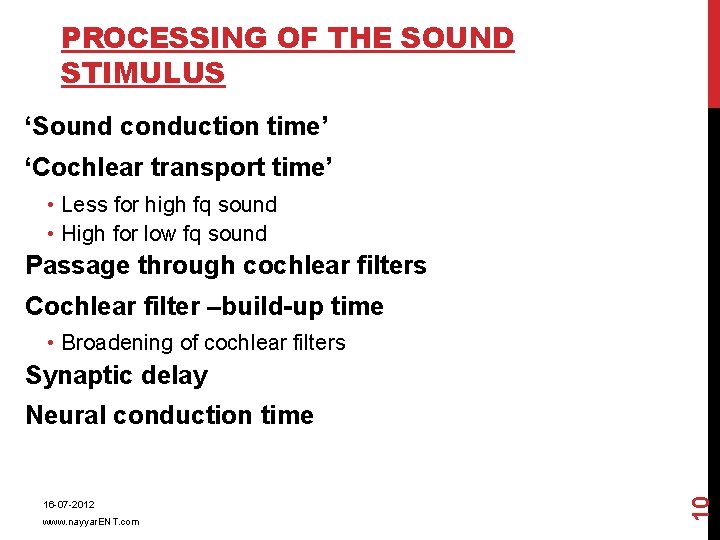
PROCESSING OF THE SOUND STIMULUS ‘Sound conduction time’ ‘Cochlear transport time’ • Less for high fq sound • High for low fq sound Passage through cochlear filters Cochlear filter –build-up time • Broadening of cochlear filters Synaptic delay 16 -07 -2012 www. nayyar. ENT. com 10 Neural conduction time
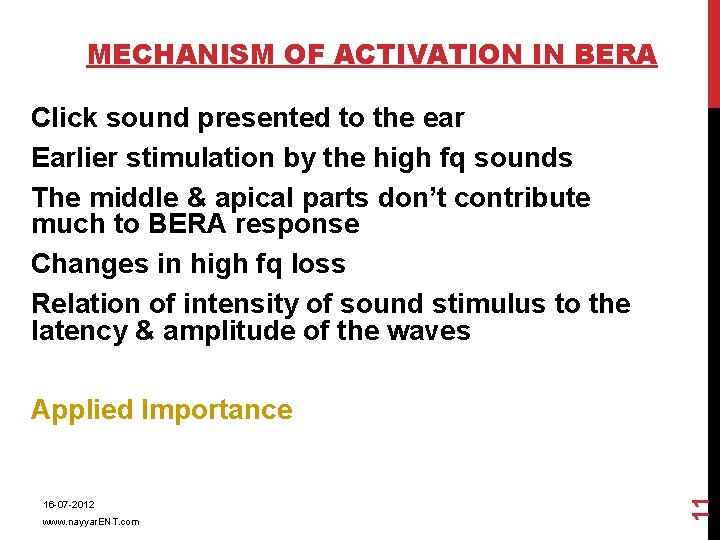
MECHANISM OF ACTIVATION IN BERA Click sound presented to the ear Earlier stimulation by the high fq sounds The middle & apical parts don’t contribute much to BERA response Changes in high fq loss Relation of intensity of sound stimulus to the latency & amplitude of the waves 16 -07 -2012 www. nayyar. ENT. com 11 Applied Importance
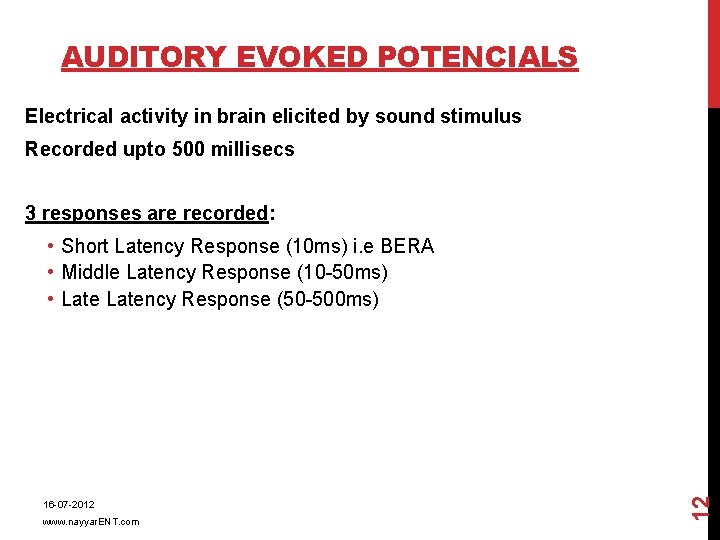
AUDITORY EVOKED POTENCIALS Electrical activity in brain elicited by sound stimulus Recorded upto 500 millisecs 3 responses are recorded: 16 -07 -2012 www. nayyar. ENT. com 12 • Short Latency Response (10 ms) i. e BERA • Middle Latency Response (10 -50 ms) • Latency Response (50 -500 ms)
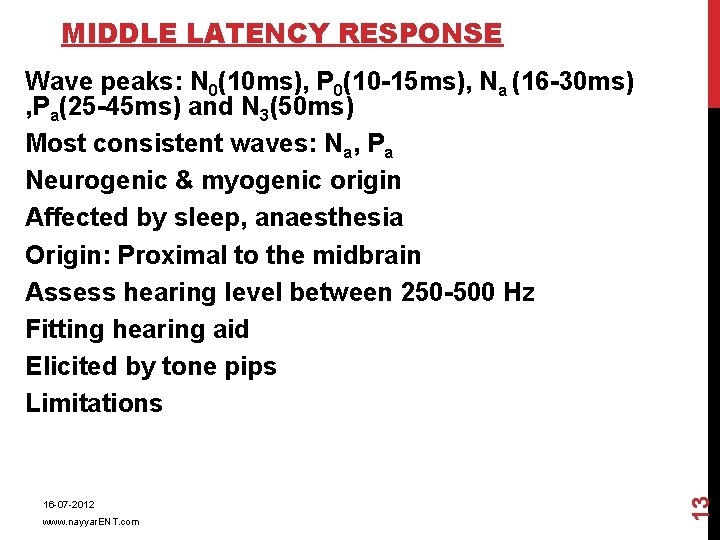
MIDDLE LATENCY RESPONSE 16 -07 -2012 www. nayyar. ENT. com 13 Wave peaks: N 0(10 ms), P 0(10 -15 ms), Na (16 -30 ms) , Pa(25 -45 ms) and N 3(50 ms) Most consistent waves: Na, Pa Neurogenic & myogenic origin Affected by sleep, anaesthesia Origin: Proximal to the midbrain Assess hearing level between 250 -500 Hz Fitting hearing aid Elicited by tone pips Limitations
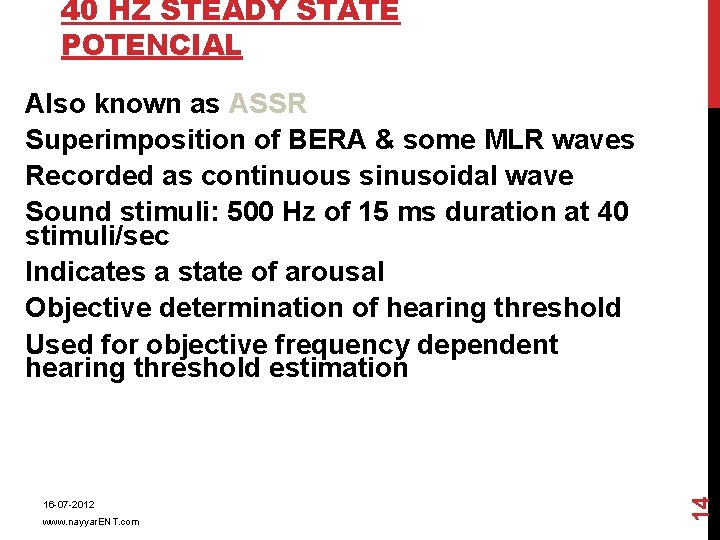
40 HZ STEADY STATE POTENCIAL Also known as ASSR Superimposition of BERA & some MLR waves Recorded as continuous sinusoidal wave Sound stimuli: 500 Hz of 15 ms duration at 40 stimuli/sec Indicates a state of arousal Objective determination of hearing threshold Used for objective frequency dependent hearing threshold estimation 16 -07 -2012 www. nayyar. ENT. com 14
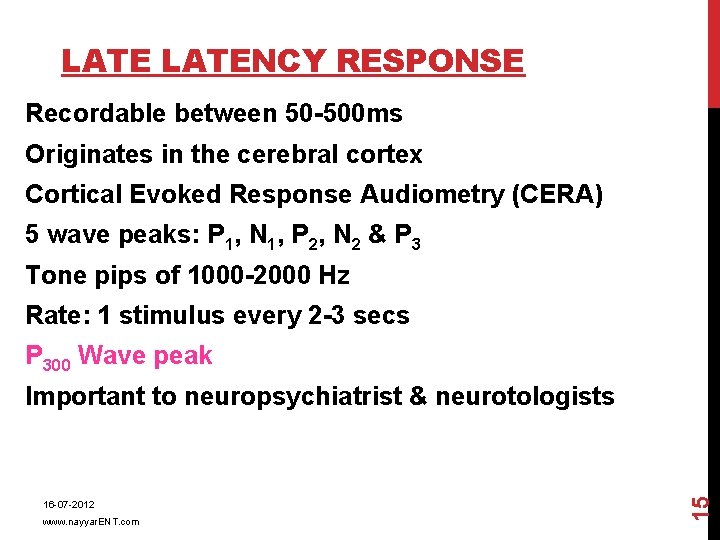
LATENCY RESPONSE Recordable between 50 -500 ms Originates in the cerebral cortex Cortical Evoked Response Audiometry (CERA) 5 wave peaks: P 1, N 1, P 2, N 2 & P 3 Tone pips of 1000 -2000 Hz Rate: 1 stimulus every 2 -3 secs P 300 Wave peak 16 -07 -2012 www. nayyar. ENT. com 15 Important to neuropsychiatrist & neurotologists
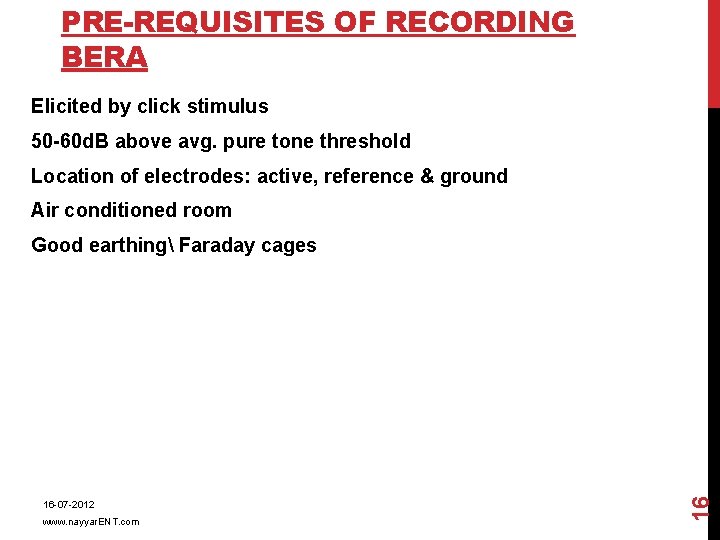
PRE-REQUISITES OF RECORDING BERA Elicited by click stimulus 50 -60 d. B above avg. pure tone threshold Location of electrodes: active, reference & ground Air conditioned room 16 -07 -2012 www. nayyar. ENT. com 16 Good earthing Faraday cages
PRE-REQUISITES OF RECORDING BERA Position of patient Relaxed Sedation in infants & children Prior PTA 16 -07 -2012 www. nayyar. ENT. com 17 Sound stimulus: Broad Band Clicks (100 microsecs duration)
ADVANTAGES OF BBC 16 -07 -2012 www. nayyar. ENT. com 18 Synchronous stimulation of large no. of neurons Clear, sharp well- marked tracing Very rapid onset & fall Easy latency & amplitude measurement Lowest fq: 100 -150 Hz Highest fq: 3000 -5000 Hz Total recordings: 2000 -4000 Stimulus rate: 10 -40 clickssec (11. 1/sec)
RECORDING Graph plotted with amplitude (in microvolts) on the ordinate & time (in msec) on the abscissa 5 -7 peakswaves within 8 -10 millisecs BERA waves: 5 prominent & 2 small 16 -07 -2012 www. nayyar. ENT. com 19 Numbered I-VII
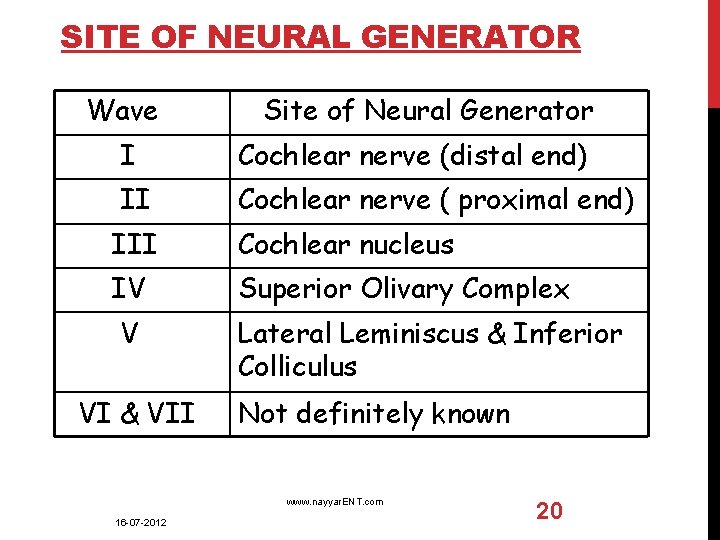
SITE OF NEURAL GENERATOR Wave Site of Neural Generator I Cochlear nerve (distal end) II Cochlear nerve ( proximal end) III Cochlear nucleus IV Superior Olivary Complex V Lateral Leminiscus & Inferior Colliculus VI & VII Not definitely known www. nayyar. ENT. com 16 -07 -2012 20
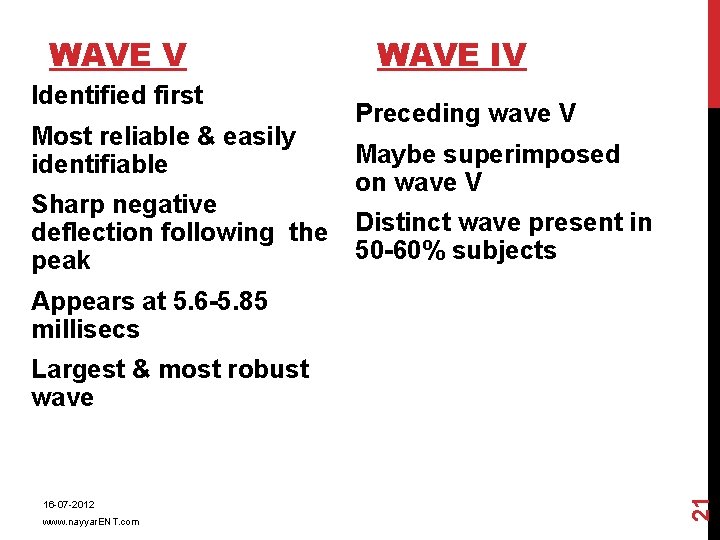
WAVE V Identified first Most reliable & easily identifiable WAVE IV Preceding wave V Maybe superimposed on wave V Sharp negative deflection following the Distinct wave present in 50 -60% subjects peak Appears at 5. 6 -5. 85 millisecs 16 -07 -2012 www. nayyar. ENT. com 21 Largest & most robust wave
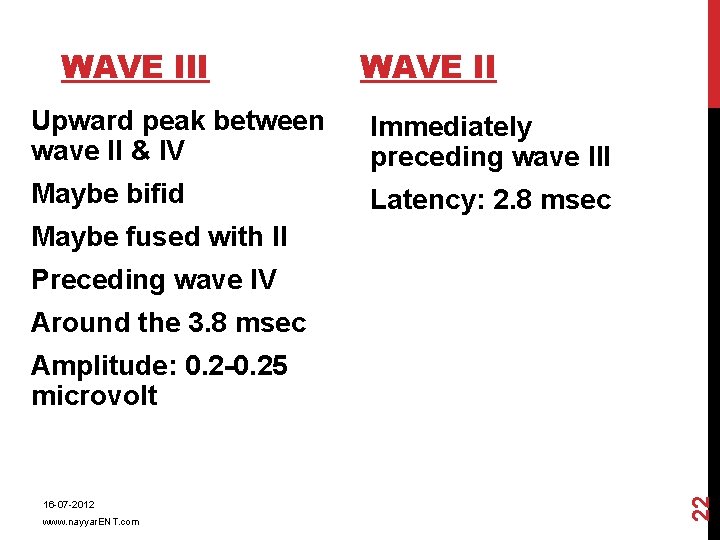
WAVE III WAVE II Upward peak between wave II & IV Immediately preceding wave III Maybe bifid Latency: 2. 8 msec Maybe fused with II Preceding wave IV Around the 3. 8 msec 16 -07 -2012 www. nayyar. ENT. com 22 Amplitude: 0. 2 -0. 25 microvolt
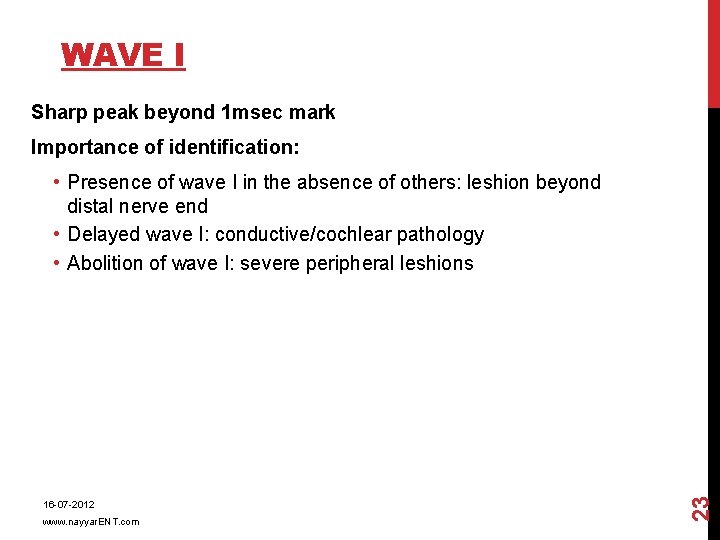
WAVE I Sharp peak beyond 1 msec mark Importance of identification: 16 -07 -2012 www. nayyar. ENT. com 23 • Presence of wave I in the absence of others: leshion beyond distal nerve end • Delayed wave I: conductive/cochlear pathology • Abolition of wave I: severe peripheral leshions

16 -07 -2012 www. nayyar. ENT. com 24 NORMAL BERA TRACING
PARAMETERS STUDIED Latency of the wave(s)- absolute, interwave, interaural Amplitude of the wave(s)- absolute & relative (amplitude ratio) Wave-form morphology 16 -07 -2012 www. nayyar. ENT. com 25 Latency-intensity functions of wave V
LATENCY STUDIES 16 -07 -2012 www. nayyar. ENT. com 26 Time interval between onset of stimulus & peak of the wave Measured in millisecs Also known as Absolute Latency Most important for clinical measurements Latency of wave V depends on intensity of sound stimulus Interwave Latency Interaural Latency
AMPLITUDE STUDIES Variable Studies are not very reliable Used as supplementary evidence Measured in microvolts Known as Absolute amplitude of a wave 16 -07 -2012 www. nayyar. ENT. com 27 Relative Amplitude Ratio
STUDY OF WAVE MORPHOLOGY Shape of the graph Normal graph Graph in newborns Conditions altering the morphology of the graph: 16 -07 -2012 www. nayyar. ENT. com 28 • Acoustic neuroma • Leshion in the auditory pathway • Variation in rateintensity of stimulus
NON CLINICAL FACTORS AFFECTING BERA Stimulus rate Stimulus phase or polarity Intensity of sound stimulus Binauralmonoaural stimulation Filter characters of BERA machine Nature of sound used 16 -07 -2012 www. nayyar. ENT. com 29 Sexage of the patient

STIMULUS RATE No. of clicks presented to the ear/sec Recommended rate: 10 -40/sec Normally used: 1. 1 clicks/sec Rate >25/sec: increased latency & decreased amplitude Children: >50/sec 16 -07 -2012 www. nayyar. ENT. com 30 High stimulus rate: Multiple sclerosis
STIMULUS PHASE OR POLARITY Condensation & rarefaction phase Affects latency, amplitude, morphology of waves Routine studies: rarefaction waves are used 16 -07 -2012 www. nayyar. ENT. com 31 Alternate phase: reduces the artifacts & also the sharpness of waves
INTENSITY OF SOUND STIMULUS 60 d. B suprathreshold Low intensity: increased absolute latency & decreased amplitude First to disappear: wave I 16 -07 -2012 www. nayyar. ENT. com 32 Most stable: wave V
FILTER CHARACTRISTICS Recording of fixed range of frequencies Low fq filter: 100 -150 Hz High fq filter: 3000 -5000 Hz 16 -07 -2012 www. nayyar. ENT. com 33 Frequencies of the recorded electrical stimulus

NORMAL VALUES & CRITERIA FOR ABNORMALITY Parameter measured Normal value (ms) Criteria for abnormality (ms) I to III IPL 2 More than 2. 4 III to V IPL 2 More than 2. 4 I to V IPL 4 More than 4. 4 Interaural difference of wave V Less than 0. 3 More than 0. 3 Morphology of wave V Present Absent www. nayyar. ENT. com 16 -07 -2012 34
16 -07 -2012 www. nayyar. ENT. com 35 Clinical uses of BERA
ESTIMATION OF HEARING THRESHOLD Useful in newborns, infants, difficult patients Estimation of hearing threshold Estimation of type & degree of hearing loss Avg. pure tone threshold = 0. 6 (BERA threshold) Comparison of latency of wave V at different intensity sounds 16 -07 -2012 www. nayyar. ENT. com 36 Frequency specific audiogram cannot be obtained
IDENTIFICATION OF NATURE OF DEAFNESS Analysis of latency-intensity function Conductive, sensory or neural Latency of wave V is recorded for different intensities Plotted graphically Conductive loss: upward & parallel shift Sensory loss: shallow configuration 16 -07 -2012 www. nayyar. ENT. com 37 Neural: steep sloping graph
IDENTIFICATION OF RETROCOCHLEAR PATHOLOGIES Most reliably identified Parameters: 16 -07 -2012 www. nayyar. ENT. com 38 • Increased interaural latency difference of wave V • Increase interaural interwave/interpeak latenct between wave I to V • Interwave latency between wave I & III/V
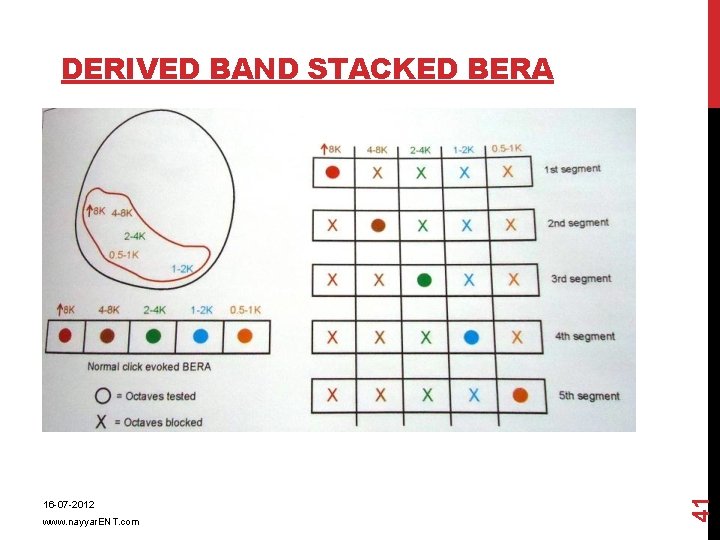
DERIVED BAND STACKED BERA Elicit response from several discrete regions of cochlea Composite picture of neural activity Increases sensitivity of the test 16 -07 -2012 www. nayyar. ENT. com 39 Cochlea is divided into 5 segments & response from each is noted
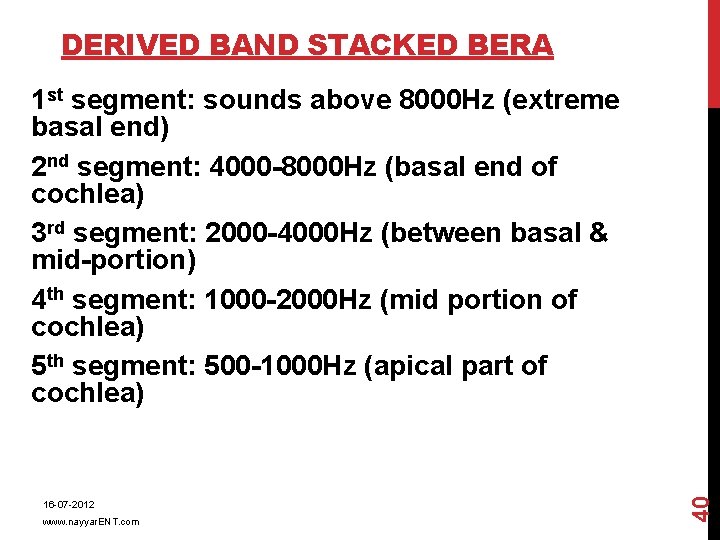
DERIVED BAND STACKED BERA 16 -07 -2012 www. nayyar. ENT. com 40 1 st segment: sounds above 8000 Hz (extreme basal end) 2 nd segment: 4000 -8000 Hz (basal end of cochlea) 3 rd segment: 2000 -4000 Hz (between basal & mid-portion) 4 th segment: 1000 -2000 Hz (mid portion of cochlea) 5 th segment: 500 -1000 Hz (apical part of cochlea)
16 -07 -2012 www. nayyar. ENT. com 41 DERIVED BAND STACKED BERA
STACKED BERA Improvement of derived band BERA Increases the sensitivity & specificity of BERA for small tumours Aligning 5 wave Vs of derived band BERA & adding the amplitudes Reduced in presence of tumours 16 -07 -2012 www. nayyar. ENT. com 42 Useful in patients with U/L SNHL with normal BERA

16 -07 -2012 www. nayyar. ENT. com 43 ASSR
Auditory Steady State Response Objective determination of frequency specific hearing threshold Overcomes the limitations of BERA: • Idea of hearing threshold for higher frequencies (20004000 Hz) • Insensitive for hearing loss above 75 -80 Db Importance in providing hearing aid 16 -07 -2012 www. nayyar. ENT. com 44 Advantage over LLR & LLR
MODULATION OF SOUND Modulation of pure tone sound: • Amplitude domain (alternate off & on) • Frequency domain (warbling of tone) Amplitude modulation of 100% is used Frequency modulation of 20% is used Restricted narrow area of basilar membrane is stimulated 16 -07 -2012 www. nayyar. ENT. com 45 Frequency specific threshold is determined
RATE OF MODULATION Rate of modulation: • <20 per sec: response from cortical areas • 20 -50 per sec: subcortical areas • >60 per sec: brain stem Recording in sedated infants Carrier frequency: test frequency 16 -07 -2012 www. nayyar. ENT. com 46 Modulation frequency: no. of times CF is modulated

METHOD OF RECORDING Pure tone sounds (500/1000/2000/4000 Hz) Modulation: 90 times/sec Evoked neural response is pre-amplified, filtered, sampled & analyzed 90 Hz component of evoked response is measured 16 -07 -2012 www. nayyar. ENT. com 47 Phase coherence is commonly measured
Consistency of response Individual presentation of different frequencies Measurement of fq dependent hearing threshold Time taken: 45 mins Determination of behavioral threshold: 16 -07 -2012 www. nayyar. ENT. com 48 • Click evoked BERA: 10 d. B more • Tone evoked BERA: 20 -30 d. B more
MEASUREMENT OF RESPONSE Discrepancy is more in the lower than higher frequencies Better correlation in high frequency hearing loss Regression formula for overcoming this 16 -07 -2012 www. nayyar. ENT. com 49 Overcomes the subjective visual factor
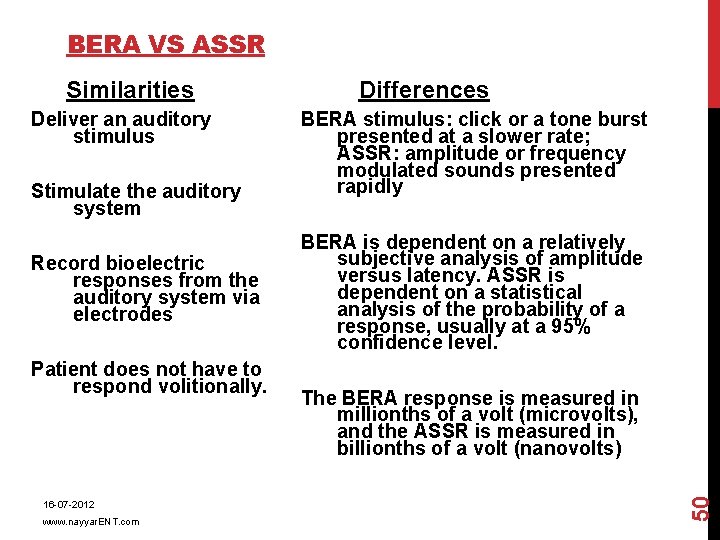
BERA VS ASSR Similarities Differences Deliver an auditory stimulus BERA stimulus: click or a tone burst presented at a slower rate; ASSR: amplitude or frequency modulated sounds presented rapidly Record bioelectric responses from the auditory system via electrodes Patient does not have to respond volitionally. 16 -07 -2012 www. nayyar. ENT. com BERA is dependent on a relatively subjective analysis of amplitude versus latency. ASSR is dependent on a statistical analysis of the probability of a response, usually at a 95% confidence level. The BERA response is measured in millionths of a volt (microvolts), and the ASSR is measured in billionths of a volt (nanovolts) 50 Stimulate the auditory system
THANK YOU 16 -07 -2012 www. nayyar. ENT. com 51 For more ENT topics, please visit www. nayyar. ENT. com
- Slides: 51