
Beowulf Background Geography Germanic tribes battled for control
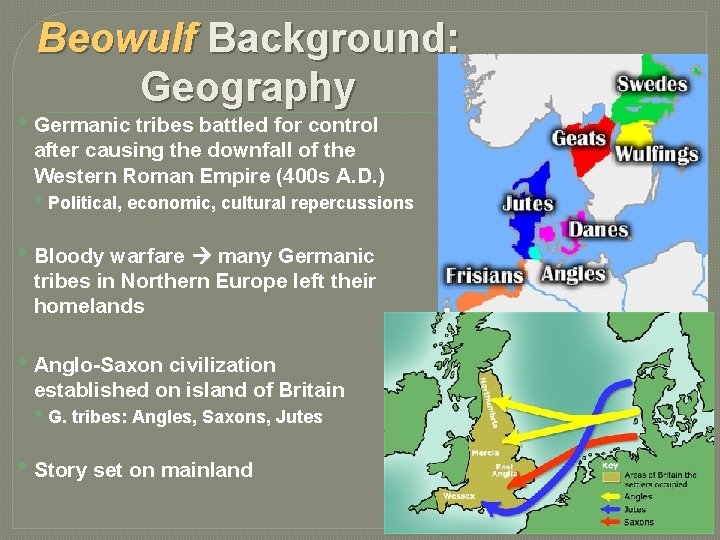
Beowulf Background: Geography • Germanic tribes battled for control after causing the downfall of the Western Roman Empire (400 s A. D. ) • Political, economic, cultural repercussions • Bloody warfare many Germanic tribes in Northern Europe left their homelands • Anglo-Saxon civilization established on island of Britain • G. tribes: Angles, Saxons, Jutes • Story set on mainland

Beowulf Background: Religion and Culture • Paganism in northern Germanic tribes • Mead halls • Warrior culture • Strength, courage, loyalty – principal values • Center of community, culture & entertainment; offered safety • Large wooden buildings - men • Drank mead (alcoholic beverage) • Storytelling • long epic poems & verse narratives • Scops – poet-singers, chanted from memory, usually played harp too

Beowulf Background: The Epic Poem • Beowulf = Geat warrior • crosses the sea to aid Danes in battle • (B’s father helped by Hrothgar) returns to Sweden to succeed his uncle, Hygelac, as king of the Geats • Hygelac was a real historical figure, led a military raid around 525 AD. • Historians believe the action of Beowulf is set shortly after Hygelac’s raid in 525. • Takes place on mainland, not in Britain. • Danes (PD Denmark), Geats (PD Sweden)
Beowulf Background: The Epic Poem • Originally written in Old English, the language spoken in Britain during Anglo-Saxon period • Old English poetry has a strong rhythm with each line divided into two parts by a pause (caesura) –indicated by an extra space. • In translation, commas used to reproduce effect of the caesuras • Old English doesn’t look or sound like modern English • Usually translated and/or heavily noted for modern readers • Text written between 8 th and 10 th centuries • After Anglo-Saxon conversion to Christianity • Tells story of mostly pagan society (~525 AD) • Most famous early Germanic heroic poem to survive ( oral tradition)
Beowulf Background: The Poet and the Poem • Exact author is unknown, only inferred information • Educated, familiar with ancient epics such as Aeneid by Virgil • Knowledgeable about Christianity and the Bible • Differences in scholarly opinions • Northern England – eighth century AD • Southwestern England – tenth century AD • Only one copy of original manuscript has survived • Dates back to 1000 AD • Preserved by Christian monks who copied manuscripts • Housed in British Library in London (present day) • Damaged by various disasters, including fires Does not follow the plot of the poem so don’t rely on it for any information for this course. • Electronic Beowulf Project • 2007 film - Ray Winstone, Angelina Jolie, Christian Glover
Beowulf: Literary Terms Alliteration the repetition of consonant sounds at the beginning of words, used to help storytellers memorize poems in oral tradition Caesura a pause that divides a line of poetry; (modern translations use commas, not extra space) Epithet Adjectives that point out special traits of particular people or things; fits metrically into a line Kenning descriptive phrase or compound word that substitutes for simple nouns, common in Germanic poetry; type of metaphor “frost bound the earth and hail would fall, the coldest seeds” (“The Seafarer” lines 31 -33)
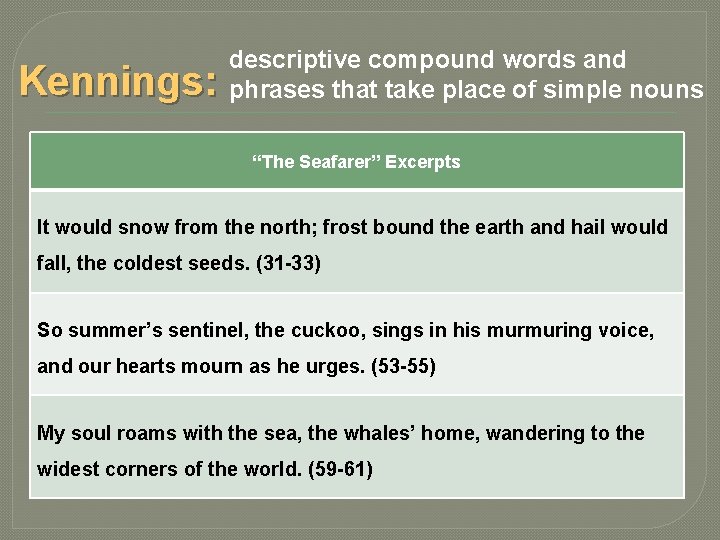
Kennings: descriptive compound words and phrases that take place of simple nouns “The Seafarer” Excerpts It would snow from the north; frost bound the earth and hail would fall, the coldest seeds. (31 -33) So summer’s sentinel, the cuckoo, sings in his murmuring voice, and our hearts mourn as he urges. (53 -55) My soul roams with the sea, the whales’ home, wandering to the widest corners of the world. (59 -61)
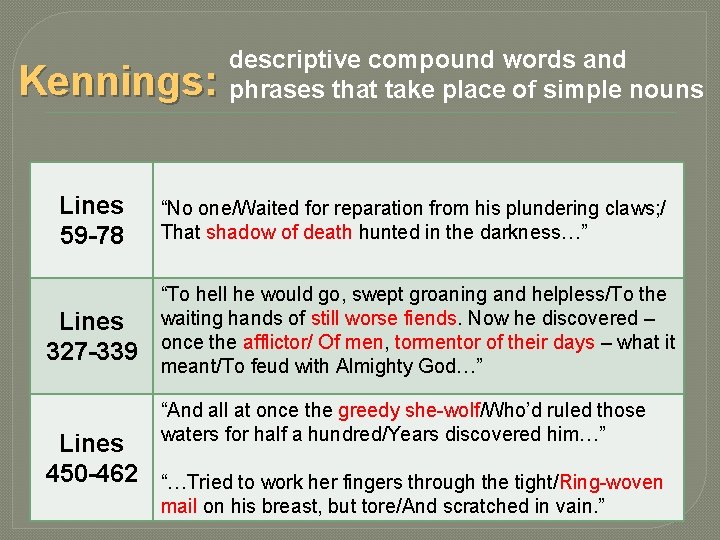
Kennings: descriptive compound words and phrases that take place of simple nouns Lines 59 -78 “No one/Waited for reparation from his plundering claws; / That shadow of death hunted in the darkness…” Lines 327 -339 “To hell he would go, swept groaning and helpless/To the waiting hands of still worse fiends. Now he discovered – once the afflictor/ Of men, tormentor of their days – what it meant/To feud with Almighty God…” Lines 450 -462 “And all at once the greedy she-wolf/Who’d ruled those waters for half a hundred/Years discovered him…” “…Tried to work her fingers through the tight/Ring-woven mail on his breast, but tore/And scratched in vain. ”
- Slides: 8