
Beowulf and the AngloSaxon World Beowulfs Homeland The
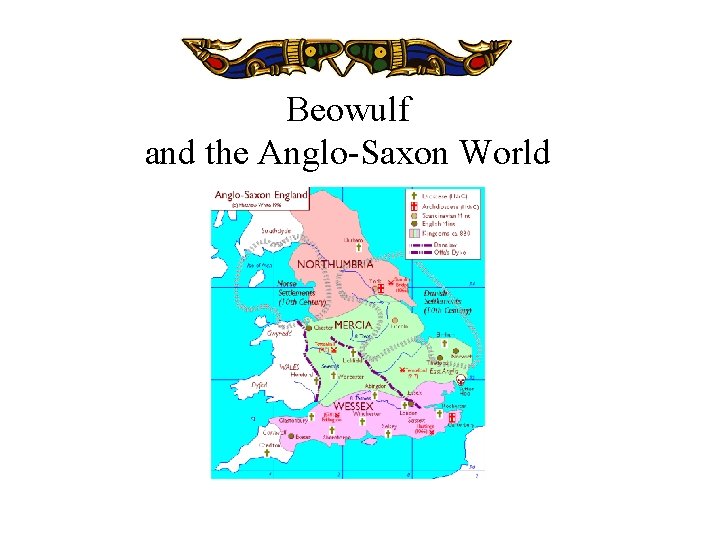
Beowulf and the Anglo-Saxon World
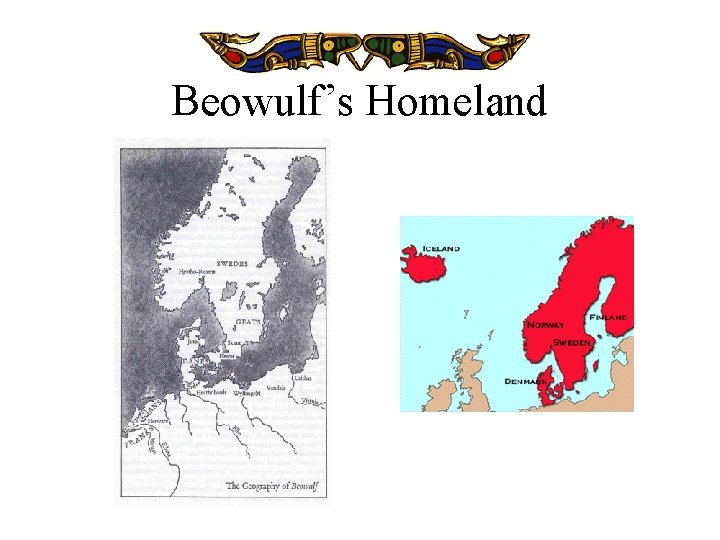
Beowulf’s Homeland
The Anglo-Saxon Invasion • 410 AD: The Romans leave Britain • 449 AD: Hengest and Horsa arrive, invited by King. Vortigern to be his allies against the Picts • Hengest and Horsa defeat the Picts and then turn on Vortigern, beginning the invasion • Thus goes the legend, but the invaders actually came as early as the 3 rd century • Major groups: Angles (Denmark), Saxons (Germany) and Jutes (Jutland Rhineland) • By the mid-5 th century, Germanic kings controlled much of Britain, particularly the eastern sections
Religion among the Anglo-Saxons • Pre-Roman Celtic origins: – supreme goddess was Nerthus, the earth mother, surrounded by pantheon of goddesses (Frea, Esotre, Rheda) • Early Anglo-Saxon religion: – Supreme god was Woden (from Viking roots) – The Wild Hunt: souls of dead warriors ride to Valhalla to join Woden’s host of champions – Frey was an important god, symbolized by a boar – Shrines in natural places rather than churches or temples • Christianity: – Absorbed earlier customs and beliefs and began the process of “Christianizing” both life and literature
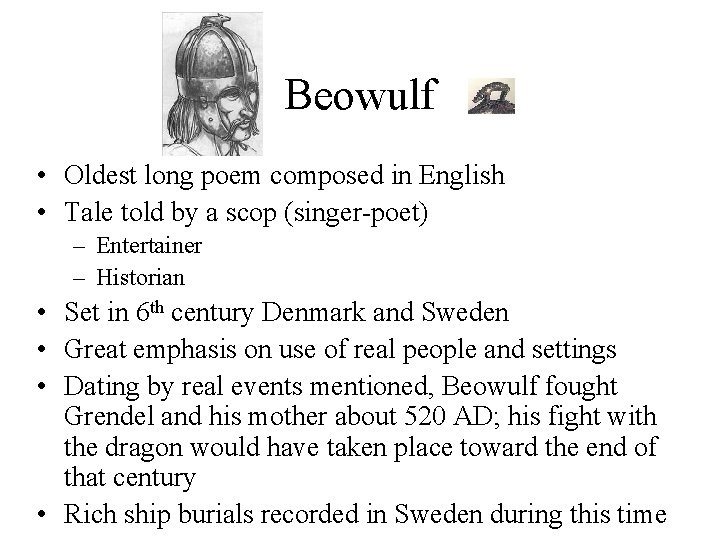
Beowulf • Oldest long poem composed in English • Tale told by a scop (singer-poet) – Entertainer – Historian • Set in 6 th century Denmark and Sweden • Great emphasis on use of real people and settings • Dating by real events mentioned, Beowulf fought Grendel and his mother about 520 AD; his fight with the dragon would have taken place toward the end of that century • Rich ship burials recorded in Sweden during this time
Who wrote Beowulf? • Author unknown, probably a Christian monk working with older versions of the story • Only manuscript dated 1000 AD • Probably composed in 7 th or 8 th centuries, while memories of Germanic tales and traditions still alive • East Anglia, where ship burials were found, likely to be the place of composition
Themes/Motifs • • • Fame/deeds Loyal dependency Loyality/self-sacrifice Fate Struggle of good vs. evil • Value of courage and heroic deeds
Anglo-Saxon Cultural Beliefs • Comitatus (The lord-thane relationship, governed by protection and loyalty) • Wergild (the price of a man) • Wyrd (fate) • Immortality (fame) • Gift Giving • Fragility of human life (Nature as dark force) • Mead Hall • Scop/bard
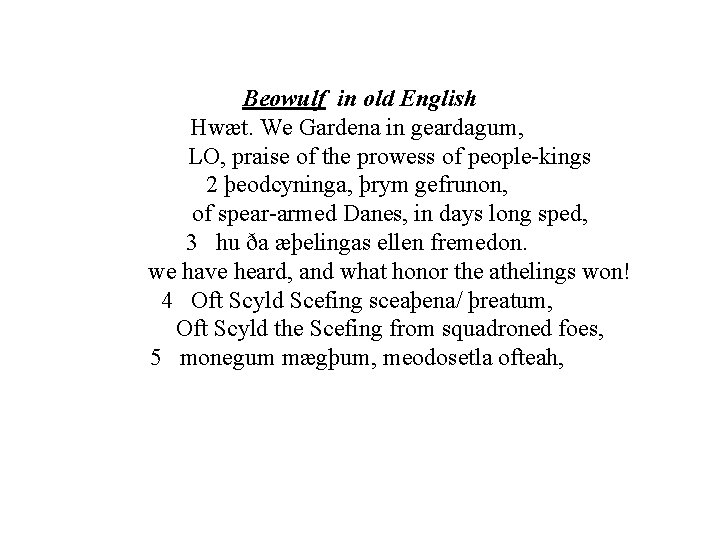
Beowulf in old English Hwæt. We Gardena in geardagum, LO, praise of the prowess of people-kings 2 þeodcyninga, þrym gefrunon, of spear-armed Danes, in days long sped, 3 hu ða æþelingas ellen fremedon. we have heard, and what honor the athelings won! 4 Oft Scyld Scefing sceaþena/ þreatum, Oft Scyld the Scefing from squadroned foes, 5 monegum mægþum, meodosetla ofteah,
- Slides: 9