
BENIGN PROSTATIC HYPERPLASIA DR BGR GAUDJI UROLOGY STEVE
BENIGN PROSTATIC HYPERPLASIA DR BGR GAUDJI UROLOGY STEVE BIKO ACADEMIC HOSPITAL
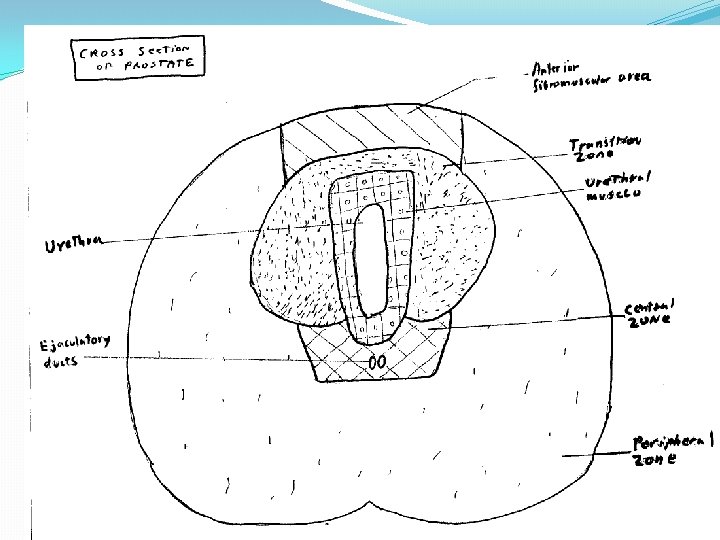
PROSTATE ANATOMY �Ant. Fibromuscular tissue �peripheral zone (PIN, ASAP, CA) �central zone �transition zone (BPH, low grade cancers) �Peri-urethral zone
BENIGN PROSTATIC HYPERPLASIA � 17% of men age 50 -59 (require Rx) � 27% of men age 60 -69 (require Rx) � 35% of men age 70 -79 (require Rx) �Some genetic and racial susceptibility to symptom severity (autosomal dominant) �Diet high in saturated fats, zinc and low in fruits and vegetables. �Sedentary life style.
BPH Proposed Etiologies �Reawakening of the urogenital sinus(mullerian duct) � Alterations in the testosterone/estrogen balance �Induction of prostatic growth factors �Increased stem cells/decreased stromal cell death
BPH Pathophysiology �Slow and insidious changes over time �Complex interactions between prostatic urethral resistance, intra-vesical pressure, detrusor function, nerves damage.
BPH Pathophysiology early/late �Initial hypertrophy detrusor decompensation poor tone diverticula formation increasing urine volume hydronephrosis upper tract dysfunction, renal failure.
BPH SYMPTOMS Obstructive and Irritative �Hesitancy �Intermittency �Weak stream �straining �Terminal dribbling �Incomplete emptying �Nocturia �Frequency �Urge incontinence �Dysuria
Other late presenting signs/symptoms �Abdominal/flank pain with voiding �Uremia fatigue, anorexia, somnolence �Hernias, hemorroids, bowel habit change �UTI’s �Bladder calculi �Hematuria
Other Relevant History �GU History (trauma, STD, PSHx) �Other disorders ( diabetes, parkinson dx) �Medications (anti-cholinergics) �Clinical performance status
BPH Clinical Findings �Late signs of renal failure ( eg. anemia, HTN) �Abdominal exam hydronephrosis/pyelonephritis �GU exam hernia, stricture, phimosis ? �DRE a smooth enlargement, “non-palpable” nodularity with a loss of distinction between the lobes. A soft/firm consistency, underestimates enlargement.
BPH �Prostate : size , firm �Surface , irregular , unequal lobes �Consistency , induration ? �Tenderness ? �Stony hard prostate �Any palpable nodular abnormality suggests cancer and warrants investigation
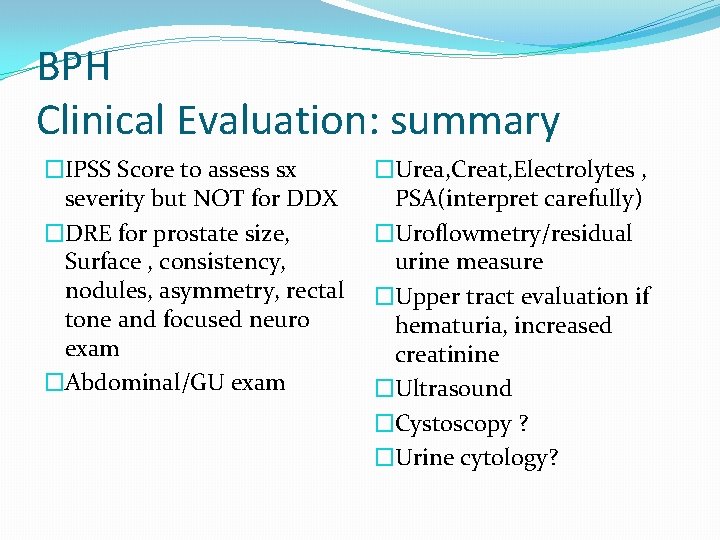
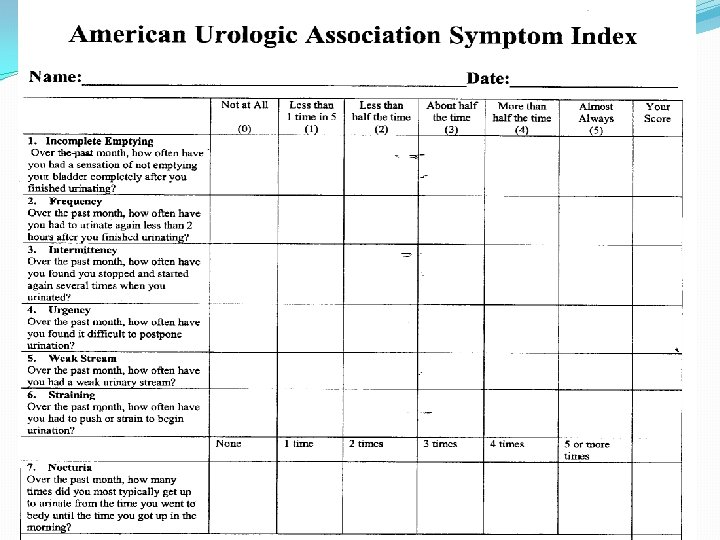
BPH Clinical Evaluation: summary �IPSS Score to assess sx severity but NOT for DDX �DRE for prostate size, Surface , consistency, nodules, asymmetry, rectal tone and focused neuro exam �Abdominal/GU exam �Urea, Creat, Electrolytes , PSA(interpret carefully) �Uroflowmetry/residual urine measure �Upper tract evaluation if hematuria, increased creatinine �Ultrasound �Cystoscopy ? �Urine cytology?
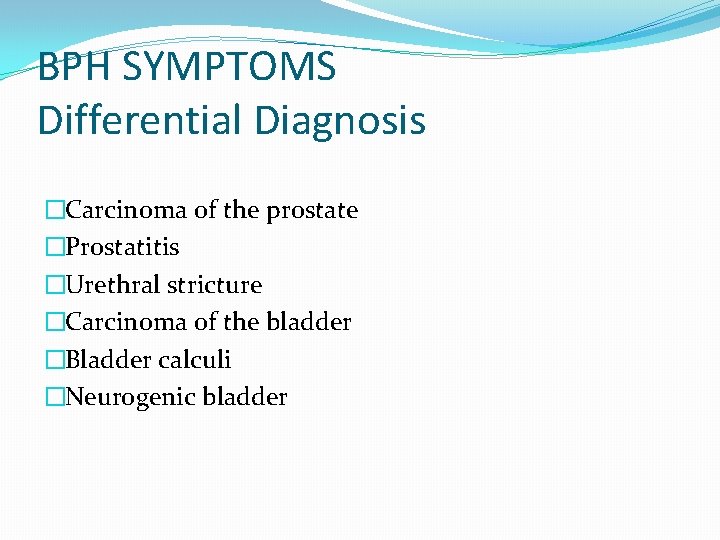
BPH SYMPTOMS Differential Diagnosis �Carcinoma of the prostate �Prostatitis �Urethral stricture �Carcinoma of the bladder �Bladder calculi �Neurogenic bladder
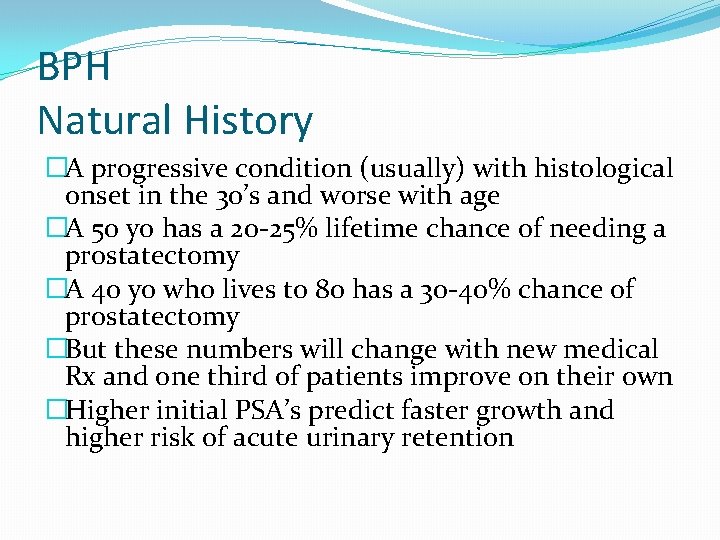
BPH Natural History �A progressive condition (usually) with histological onset in the 30’s and worse with age �A 50 yo has a 20 -25% lifetime chance of needing a prostatectomy �A 40 yo who lives to 80 has a 30 -40% chance of prostatectomy �But these numbers will change with new medical Rx and one third of patients improve on their own �Higher initial PSA’s predict faster growth and higher risk of acute urinary retention
BPH TREATMENT INDICATIONS Absolute vs Relative �Severe obstruction �Urinary retention �Signs of upper tract dilatation and renal insufficiency �Moderate symptoms of prostatism �Recurrent UTI’s �Hematuria �Quality of life issues
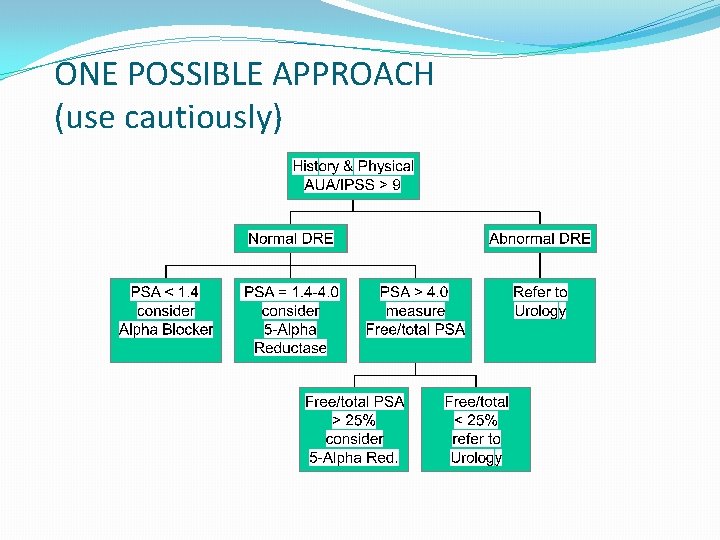
ONE POSSIBLE APPROACH (use cautiously)
BPH TREATMENT NON-SURGICAL �Watchful waiting, AUA score < 7, 1/3 improve on own. �Herbal Phytotherapy (eg. Saw Palmetto) �Alpha-1 -adrenergic antagonists (terazosin, doxazosin, tamsulosin, alfuzosin) � 5 -Alpha-reductase inhibitors (finasteride, dutasteride) �Combination Rx most effective for most severe. �Medical Rx has likely reduced Medicare claims for BPH surgery by 50%.
BPH TREATMENT Surgical �Indicated for AUA/IPSS score >16 �Transurethral Prostatectomy(TURP): 18% morbidity with. 2% mortality. 80 -90% improvement at 1 year but 60 -75% at 5 years and 5% require repeat TURP. �Transurethral Incision of Prostate (TUIP): less morbidity with similar efficacy indicated for smaller prostates. �Open Prostatectomy: indicated for glands > 60 grams or when additional procedure needed : stones , diverticulum.
BPH TREATMENT New Modalities �Minimally invasive: (Prostatic Stents, TUNA, TUMT, HIFU, Water-induced Thermotherapy) �Laser prostatectomy (VLAP , Ho. LRP) �Electrovaporization (TUVP )
PROSTATITIS DR BGR GAUDJI UROLOGY STEVE BIKO ACADEMIC
Prostatitis �Inflammation of prostate gland surrounding tissue due to infection �Acute or chronic �Rare in young males �Commonly associated with recurrent infections in persons >30 years of age �Up to 50% of males develop some form of prostatitis 23
Prostatitis �Acute prostatitis �acute infectious disease �sudden onset �fever, tenderness, urinary symptoms, constitutional symptoms �Chronic prostatitis �recurring infection with same organism �incomplete eradication of bacteria �few prostate related symptoms �difficulty urinating, low back pain, perineal pressure 24
Pathogenesis and Etiology �Mechanism of prostate bacterial infection not well understood �Possible causes of prostate gland infection �intraprostatic reflux of urine �sexual intercourse �indwelling urethral and condom catheterization �urethral instrumentation �transurethral prostatectomy 25
Pathogenesis and Etiology �Functional abnormalities in bacterial prostatitis �altered prostate secretory functions �normal prostatic fluid contains prostatic antibacterial factor heat-stable, low-molecular-weight cation � zinc-complexed polypeptide � bactericidal to most urinary tract pathogens � antibacterial activity related to prostatic fluid zinc content � �prostate fluid zinc levels and antibacterial factor activity diminished in prostatitis and elderly patients; not known whether changes are cause or effect of prostatitis 26
Pathogenesis and Etiology �Prostatic secretion p. H altered in prostatitis �normal p. H 6. 6 to 7. 6 �more alkaline with increasing age �alkaline p. H of 7 to 9 with prostate inflammation �Changes suggest generalized prostate secretory dysfunction �can affect pathogenesis �can influence mode of therapy 27
Pathogenesis and Etiology �Gram-negative enteric organisms most frequent pathogens in acute bacterial prostatitis �E. coli predominant in 75% of cases �other frequently isolated gram-negative organisms � K. pneumoniae � P. mirabilis �less frequently � P. aeruginosa � Enterobacter spp. � Serratia spp. �gonococcal and staphylococcal prostatitis uncommon 28
Pathogenesis and Etiology �E. coli most common cause of chronic bacterial prostatitis �Other gram-negative organisms less common �Importance of gram-positive organisms in chronic bacterial prostatitis controversial; isolated in some studies �S. epidermidis �S. aureus �CMV, TB, CANDIDA 29
Prostatitis Clinical Presentation Signs and symptoms Acute bacterial prostatitis: high fever, chills, malaise, myalgia, localized pain (perineal, rectal, sacrococcygeal), frequency, urgency, dysuria, nocturia, and retention Chronic bacterial prostatitis: voiding difficulties (frequency, urgency, dysuria), low back pain, and perineal and suprapubic discomfort Physical examination Acute bacterial prostatitis: swollen, tender, tense, or indurated gland Chronic bacterial prostatitis: boggy, indurated (enlarged) prostate in most patients Laboratory tests Bacteriuria Bacteria in expressed prostatic secretions 30
Prostatitis: Clinical Presentation �Physical examination often normal �Acute bacterial prostatitis: diagnosis made from clinical presentation and significant bacteriuria �Chronic bacterial prostatitis: more difficult to diagnose and treat �typically recurrent UTI with same pathogen �most common cause of recurrent UTI in males �clinical presentation varies widely �many adults asymptomatic 31
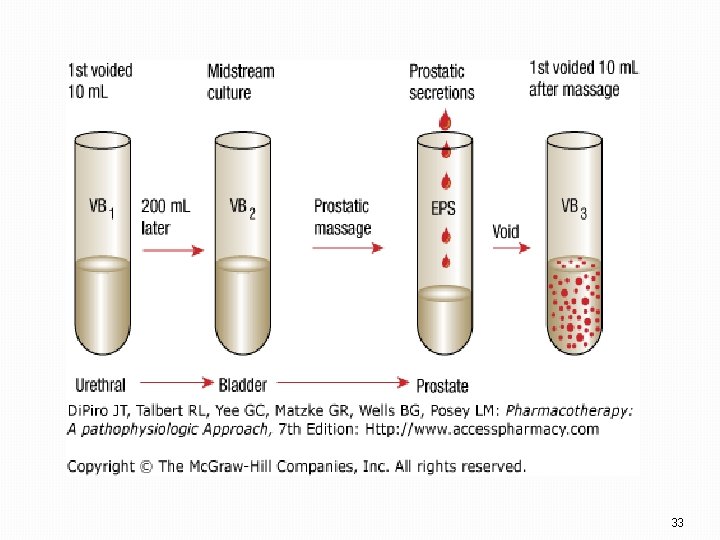
Prostatitis: Clinical Presentation �Quantitative localization culture is diagnostic standard for chronic bacterial prostatitis diagnosis �compare bacteria in sequential urine and prostatic fluid cultures �collect 1 st 10 m. L of voided urine (voiding bladder 1, or VB 1): constitutes urethral urine �after ~200 m. L of urine voided, collect 10 -m. L midstream sample (VB 2): represents bladder urine �after voiding, massage prostate and collect expressed prostatic secretions (EPS) �void after prostatic massage; collect 10 m. L of urine (VB 3) 32
33
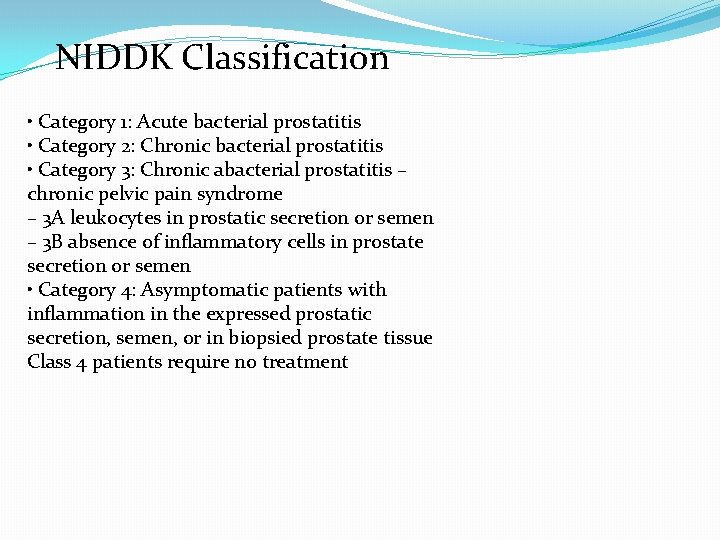
NIDDK Classification • Category 1: Acute bacterial prostatitis • Category 2: Chronic bacterial prostatitis • Category 3: Chronic abacterial prostatitis – chronic pelvic pain syndrome – 3 A leukocytes in prostatic secretion or semen – 3 B absence of inflammatory cells in prostate secretion or semen • Category 4: Asymptomatic patients with inflammation in the expressed prostatic secretion, semen, or in biopsied prostate tissue Class 4 patients require no treatment
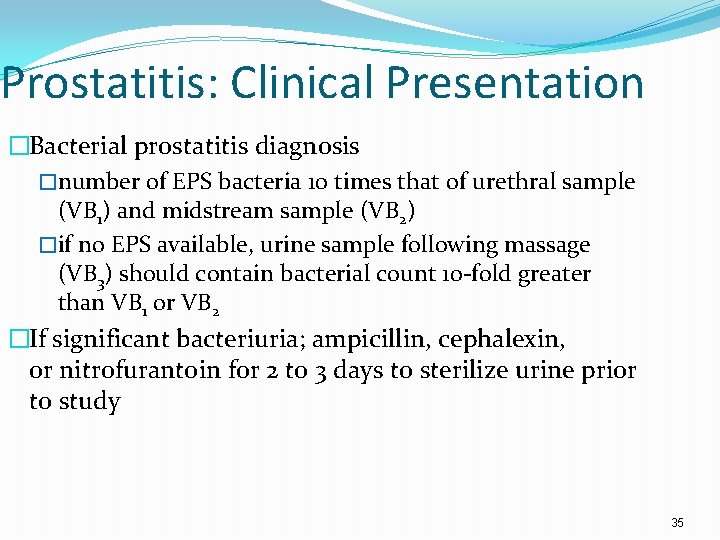
Prostatitis: Clinical Presentation �Bacterial prostatitis diagnosis �number of EPS bacteria 10 times that of urethral sample (VB 1) and midstream sample (VB 2) �if no EPS available, urine sample following massage (VB 3) should contain bacterial count 10 -fold greater than VB 1 or VB 2 �If significant bacteriuria; ampicillin, cephalexin, or nitrofurantoin for 2 to 3 days to sterilize urine prior to study 35
Prostatitis Treatment
Prostatitis Treatment �Treatment goals same as for UTIs �Acute bacterial prostatitis responds well to empirical antimicrobial therapy �Antimicrobials penetrate the prostate: acute inflammatory reaction alters cellular membrane barrier between the bloodstream and prostate �Most patients managed with Per os antimicrobials �trimethoprim-sulfamethoxazole �fluoroquinolones (e. g. , ciprofloxacin, levofloxacin) 37
Prostatitis Treatment �Other effective agents �cephalosporins �β-lactam–β-lactamase combinations �IV therapy rarely necessary for total treatment �IV to PO sequential therapy with trimethoprimsulfamethoxazole or fluoroquinolones appropriate �consider PO conversion after patient afebrile for 48 hours or after 3 to 5 days of IV therapy 38
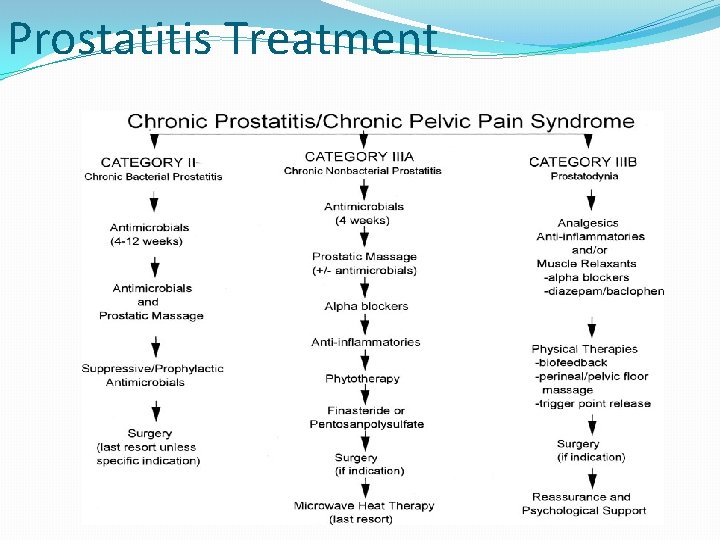
Prostatitis Treatment � 4 weeks of antibiotic therapy to reduce chronic prostatitis risk �May treat chronic prostatitis for 6 to 12 weeks �Initiate long-term suppressive therapy for recurrent infections �ciprofloxacin three times weekly �trimethoprim-sulfamethoxazole regular-strength daily �nitrofurantoin 100 mg daily 39
Prostatitis Treatment �Chronic bacterial prostatitis rarely cured �Bacteria persist in prostatic fluid despite antibiotic serum concentrations greater than minimal inhibitory concentrations �inability of antibiotics to reach sufficient concentrations in prostatic fluid �inability of antimicrobials to cross prostatic epithelium 40
Prostatitis Treatment �Factors that determine antibiotic diffusion into prostatic secretions �lipid solubility �degree of ionization in plasma � only unionized molecules cross prostatic cell lipid barrier � drug p. Ka determines fraction of unchanged drug �gradient of > 1 p. H unit between separate compartments allows ion trapping � as unionized drug crosses into prostatic fluid, it becomes ionized � allows less drug to diffuse back across lipid barrier 41
Prostatitis Treatment �Fluoroquinolones best options for chronic bacterial prostatitis �Trimethoprim-sulfamethoxazole also effective �sulfamethoxazole penetrates poorly; contributes little to trimethoprim efficacy �Initial therapy 4 to 6 weeks �longer treatment in some cases �if therapy fails, consider chronic suppressive therapy or surgery 42
Prostatitis Summary �Acute bacterial prostatitis responds well to 4 to 6 weeks of empirical antimicrobial therapy �Chronic bacterial prostatitis rarely cured �Best option for chronic bacterial prostatitis: fluoroquinolones �Long-term suppressive therapy needed for recurrent infections 43
- Slides: 43