
Benign and malignant epithelial tumors Done by Dr

Benign and malignant epithelial tumors Done by : Dr / Samar Usama Hassan Demonstrator of Pathology Qena Faculty of Medicine
General Definition of “Tumor” A tumor is an abnormal mass of tissue resulting from autonomous, progressive, excessive proliferation of body cells not integrated into normal tissue.
Tumors: �Benign : �These are limited circumscribed tumors that do not metastasize into other regions of the body, do not recur after resection, and do not have a fatal outcome. �Malignant : �These are ill-defined tumors that invade surrounding tissue and can metastasize into other regions of the body, recur after resection, and invariably lead to a fatal outcome if left untreated.
Tumorigenesis �Tumors arise from division of a mother cell in which mutation causes inadequate activation of protooncogenes and often genes regulating development, together with the inactivation of tumor suppressor genes and differentiation genes that regulate developmental growth and tissue repair.
Carcinoma in Situ �Definition and morphology: Severe epithelial atypia and loss of polarity are present with an intact basement membrane and histologic findings of noninvasive carcinoma

Differentiation and Anaplasia �Anaplastic cells display marked pleomorphism (i. e. , marked variation in size and shape). �Characteristically the nuclei are extremely hyperchromatic and large. �The nuclear-cytoplasmic ratio may approach 1: 1 instead of the normal 1: 4 or 1: 6. �Giant cells that are considerably larger than their neighbors may be formed and possess either one enormous nucleus or several nuclei. �Mitoses are often numerous and atypical.

Benign Vs Malignant
Tumor Dissemination: A benign tumor remains within its tissue of origin and cannot extend across long distances into other organs. In contrast, the spread of malignant tumors exhibits the following four characteristics: �Infiltration: The tumor cells penetrate the surrounding tissue. �Invasion: The tumor cells penetrate lymph and blood vessels. �Tissue destruction occurs in the vicinity of the tumor as a result. �Metastasis: Tumor cells colonize other tissues far from the original tumor site.

Metastasis �Definition: Dissemination of tumor cells from one part of the body to another remote location, where they establish themselves and grow into secondary tumors. �Lymphatic metastasis (dissemination of tumor cells via the lymphatic system) �Hematogenous metastasis (dissemination of tumor cells via bloodstream) �Cavitary metastasis (tumor cells invade a body cavity such as the pleura, peritoneum etc)
Tumor Classification �Staging: The stage of neoplastic disease is defined according to three criteria. Together, they comprise what is known internationally as the TNM system. �T refers to local tumor growth. �N refers to spread to regional lymph nodes. �M refers to distant metastasis.
�Typing: Tumors are classified as follows according to their tissue of origin: � Epithelial tumors; � Nonepithelial tumors: � Tumors of connective tissue � Leukemias and lymphomas � Melanocytic tumors � Brain and nerve sheath tumors

Epithelial Tumors
Epithelial Tumors �Benign epithelial tumors �–Papillomas �–Adenomas �Malignant epithelial tumors �–carcinomas �–Adenocarcinomas
Papillomas �Definition: Benign tumor of protective surface epithelium, the tumor appears on the surface as non-caspsulated papillary growth.

Types of papilloma �Types: �Squamous cell papilloma (skin, oral cavity, nose, nasopharynx, and larynx). �Columnar cell Papilloma (exocrine glands and breast) �Transitional cell papilloma (urinary tract)
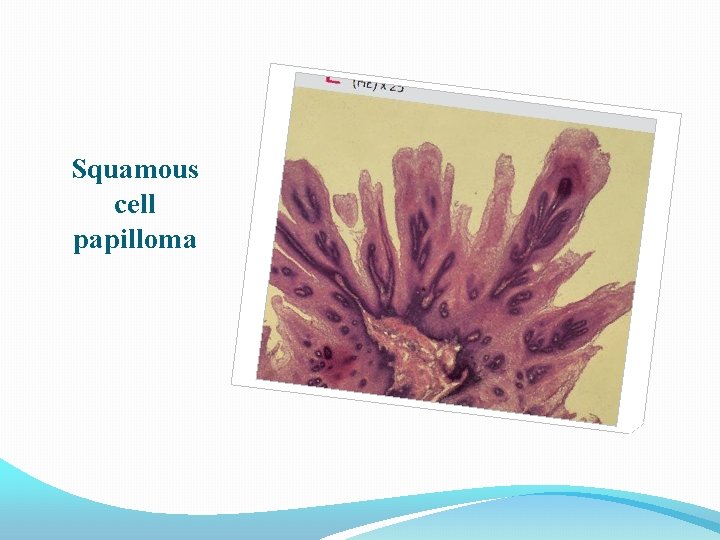
Squamous cell papilloma
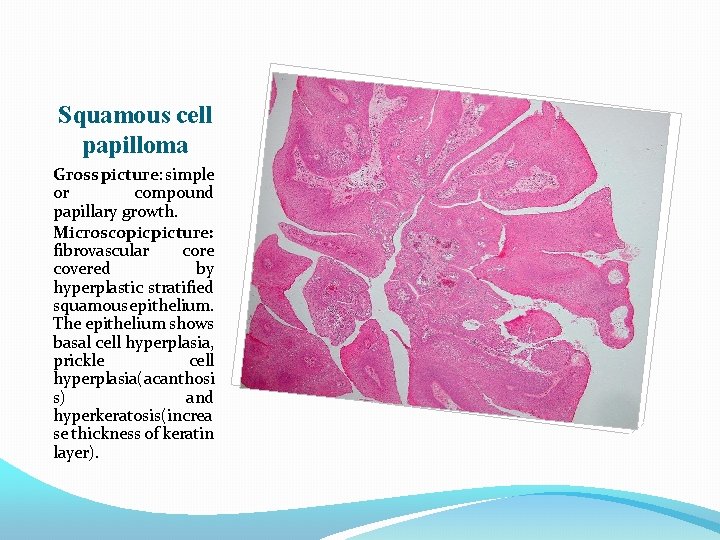
Squamous cell papilloma Gross picture: simple or compound papillary growth. Microscopic picture: fibrovascular core covered by hyperplastic stratified squamous epithelium. The epithelium shows basal cell hyperplasia, prickle cell hyperplasia(acanthosi s) and hyperkeratosis(increa se thickness of keratin layer).


Thank you
- Slides: 19