
Benha University Hospital EGYPT Email elnashar 53hotmail com

Benha University Hospital, EGYPT E-mail: elnashar 53@hotmail. com
• Recurrent or persistent involuntary contraction of the outer third of the vagina interfering with sexual intercourse • It is involuntary reflex precipitated by real or imagined
• It consists of: Phobia of penetration of the vagina & Involuntary spasm of the lower third of the vagina

In general population: The exact prevalence rate is not known. Rare(1%) In family planning clinic in Iran: 12%
1. Primary (never able to have intercourse) or secondary (past history of vaginal penetration without problems). Secondary vaginismus is often
2. Global (unable to place any thing in the vagina) or situational (able to use a tampon & can tolerate a pelvic examination but cannot
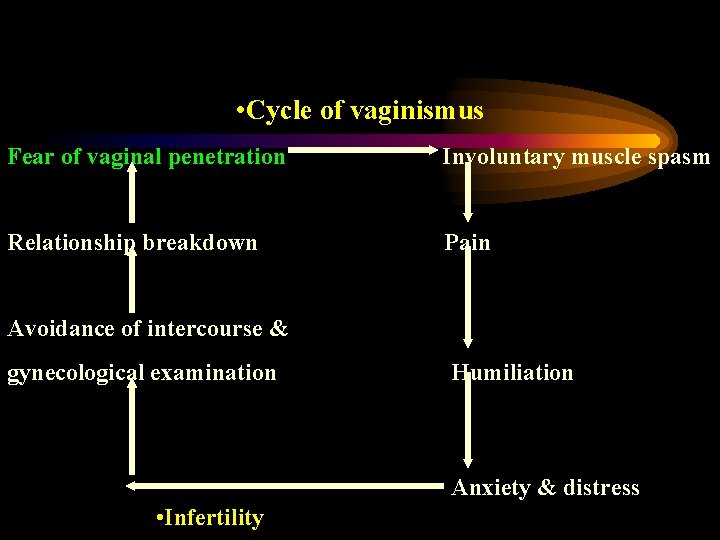
• Cycle of vaginismus Fear of vaginal penetration Involuntary muscle spasm Relationship breakdown Pain Avoidance of intercourse & gynecological examination Humiliation Anxiety & distress • Infertility
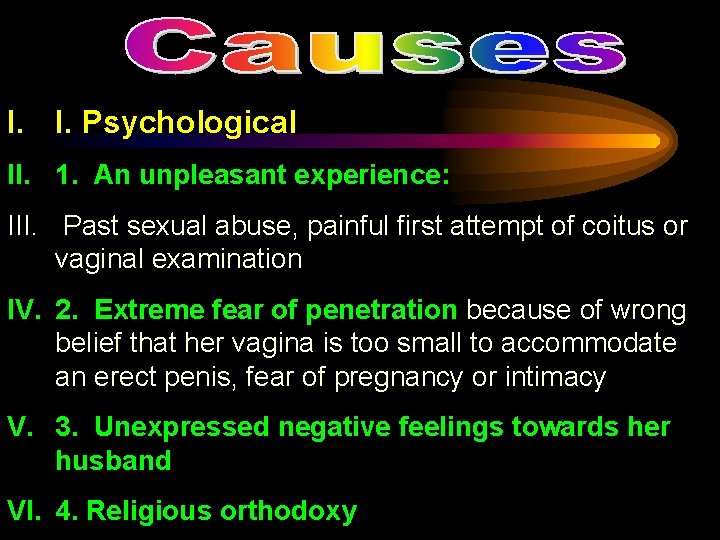
I. I. Psychological II. 1. An unpleasant experience: III. Past sexual abuse, painful first attempt of coitus or vaginal examination IV. 2. Extreme fear of penetration because of wrong belief that her vagina is too small to accommodate an erect penis, fear of pregnancy or intimacy V. 3. Unexpressed negative feelings towards her husband VI. 4. Religious orthodoxy
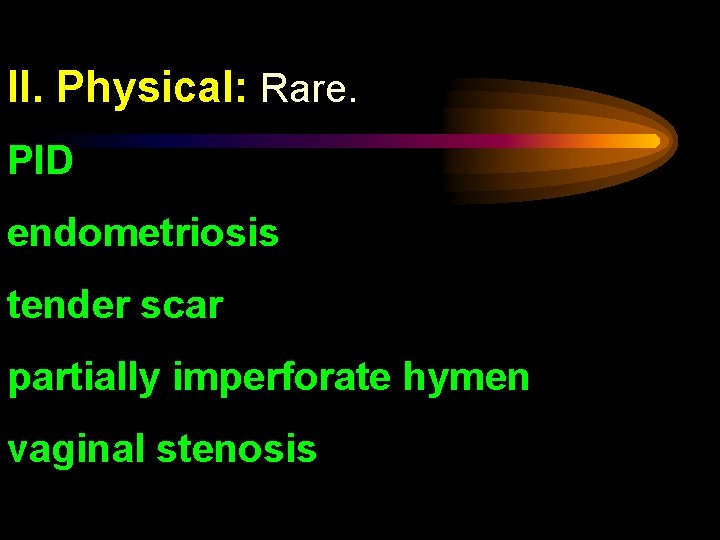
II. Physical: Rare. PID endometriosis tender scar partially imperforate hymen vaginal stenosis
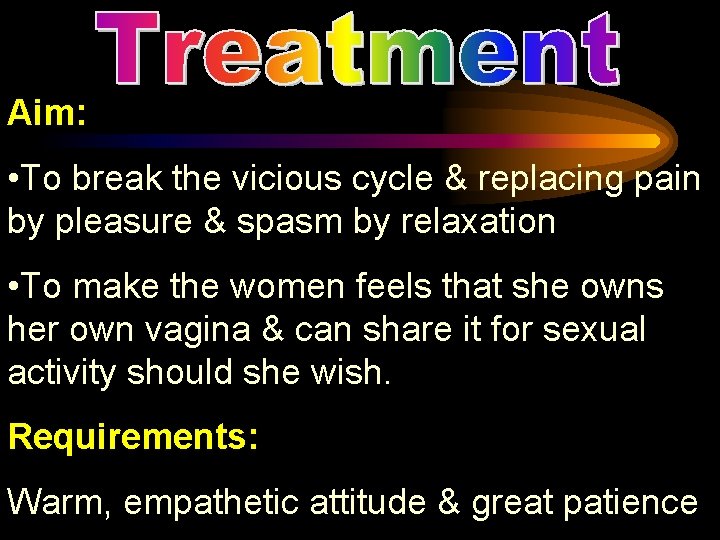
Aim: • To break the vicious cycle & replacing pain by pleasure & spasm by relaxation • To make the women feels that she owns her own vagina & can share it for sexual activity should she wish. Requirements: Warm, empathetic attitude & great patience
Lines of treatment: 1. 1. Exploration of phobia 2. 2. Sex education 3. 3. Guided tour 4. 4. Control of muscles: Adductor muscles 5. & P
5. Systematic vaginal desensitization: Step 1: Insertion of a trainers under controlled relaxation Step 2: Sharing of control with husband Step 3: Insertion of penis with the woman in control Step 4: Transfer control of insertion of penis to husband 6. Drugs 7. Surgical treatment

1. Exploration of phobia. It is the most difficult part of the treatment. Psychological causes should be addressed. If there is a history of childhood traumatic experience, this has to be recalled & the emotions which accompanied it relived in order to

2. Sex education • How their genital organs are put together & how they both function. • Genital anatomy • Sexual physiology &
3. Self exploration of sexual anatomy (guided tour) Patient in semi-sitting position & legs apart & mirror placed in front of her vulva, she explores her genitalia with the doctor explaining the
4. Control of muscles a. Relaxation exercises to the adductor muscles b. To help her to relax when anticipates vaginal penetration. c. The doctor hold the woman ‘s knees together firmly while she attempts to separate them, then slowly she is allowed to succeed. d. During these maneuvers she learns muscle relaxation & eventually allows

b. Contraction /relaxation exercise (Kegel ‘s exercise) to gain control over the muscles surrounding her introits. The patient must learn first how to identify the muscle for herself. She is advised to sit on the toilet with her legs spread as far apart as possible. If she then starts & stops the flow of urine, she becomes aware of the pubococcygeus action.

Once the muscle is identified, the woman can practice contracting it repeatedly whenever she has time. She simply flexes this muscle 20 times in a row 3 to 5 times every day till it is firm.

5. Systematic vaginal desensitization of the fear of vaginal penetration Vaginal dilatation exercises are a misnomer because the vagina is not physically stretched Trainers: fingers, commercial dilators, tampons, of gradually increasing diameter, specifically designed specula such as Simms, Amiell, Stanley.
Approaches 1. Gradual using vaginal self-dilatation or Rapid using vaginal mould insertion. Duration: 26 weeks Rapid desensitization is preferred (Biswas & Ratnam, 1995) 2. In-vitro: The dilator is introduced by the doctor or In-vivo: the dilator is introduced by the patient According to Cochrane library, 2002, No discernable differences between the 2 forms
Program Step 1: Insertion of a trainers under controlled relaxation: • In private, in a relaxed & nonsexual setting. The protocol for use of dilators is explained to the patient while she is in the office, but the actual placement of the dilators is done by the patient when she is at home. • The dilators should be covered with a warm, water soluble lubricant. If she is unable to relax enough to place the smallest dilator in her vagina propranolol, or alprazolam may also help reduce anxiety. Once the patient has been able to place the smallest dilator in her vagina, she can progressively insert the largest dilators,
Step 2: Sharing of control with husband. When she is comfortable inserting the larger dilators, she can instruct her husband how to place the dilator in her vagina while she maintains control how quickly the dilator are placed. The husband becomes active in the vaginal dilatation exercises only when the patient is emotionally & physically
Step 3: Insertion of penis with the woman in control. Sitting or kneeling over husband, female superior position
Step 4: Transfer control of insertion of penis to husband During sex therapy the patient are advised to refrain from coitus. The patient is told to perform the exercise for 10 to 15 minutes, 5 times per week. Therapy sessions are conducted every 2 weeks to follow & support the progress made in the treatment, to reduce resistance & to provide large dilator according to
6. Drugs Anxiolytics & antispasmodics have nothing to offer (Guirguis, 1984). The only indication for drugs when vaginismus is a part of a more generalized syndrome of sexual phobia. A trial of imipramine 30 -75 mg daily Benzodiazepines to aid both relaxation & interviews (Mikhail, 1976)

7. Surgical treatment Almost never required & may be detrimental to achieving success. The resulting scar may aggravate the condition. Indications to remove an organic cause: septum, stricture,

1. Vaginismus is recurrent or persistent involuntary contraction of the outer third of the vagina interfering with sexual intercourse. 2. Vaginismus causes marked stress, anxiety, break down of marital relationship & infertility 3. Vaginismus is caused mainly by psychological factors
. Lines of treatment of vaginismus are: Exploration of phobia, sex education, guided tour, control of the adductors & P coccygeus muscles, systematic vaginal desensitization & drugs . Surgical treatment is almost never required & may be detrimental to achieving success

Benha University Hospital, EGYPT E-mail: elnashar 53@hotmail. com
- Slides: 29