
Benefits of Implementing a Safe Resident Handling Program
Benefits of Implementing a Safe Resident Handling Program in Nursing Homes
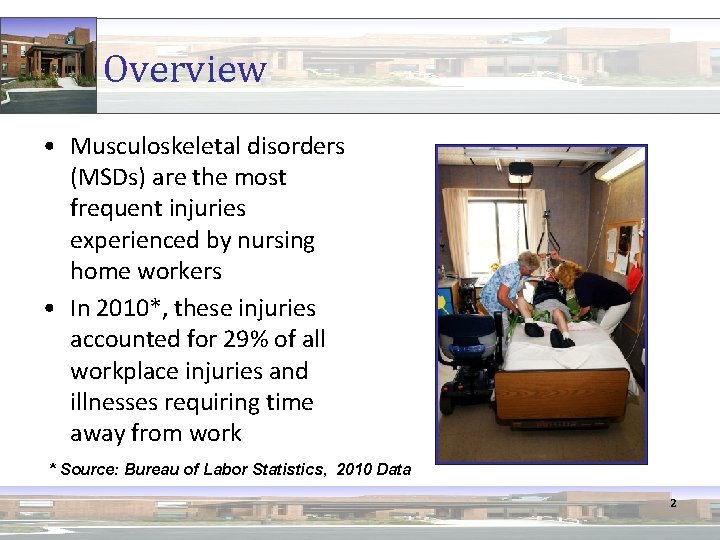
Overview • Musculoskeletal disorders (MSDs) are the most frequent injuries experienced by nursing home workers • In 2010*, these injuries accounted for 29% of all workplace injuries and illnesses requiring time away from work * Source: Bureau of Labor Statistics, 2010 Data 2

Overview (cont’d) • Studies* have shown that nursing homes that implemented safe resident lifting and repositioning programs have achieved many benefits such as: – – reduced work-related injuries reduced workers’ compensation costs improved employee morale increased resident comfort *Source: Association of Occupational Healthcare Professionals in Healthcare (AOHP) 3
Overview (cont’d) The goal of this presentation is to highlight five nursing homes that have successfully implemented safe resident handling programs, including the results they achieved 4
Success Story #1* • • State – Florida Company – Veterans’ Health Administration Employees – 15, 000, staff in 23 high risk units 800 The Problem – Workers in high risk units suffered injuries resulting in disability and high workers’ compensation costs • The Solution – A targeted back prevention program was developed and implemented resulting in a program to redesign high risk activities *Source: Results from VISN-Wide Deployment of Back Injury Prevention Program for Nurses (Nelson, Fragala, Matz, 2003) 5
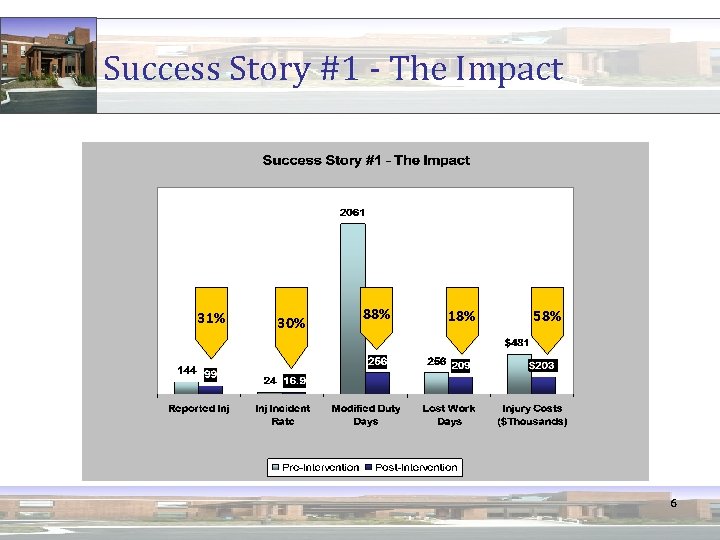
Success Story #1 - The Impact 31% 30% 88% 18% 58% 6
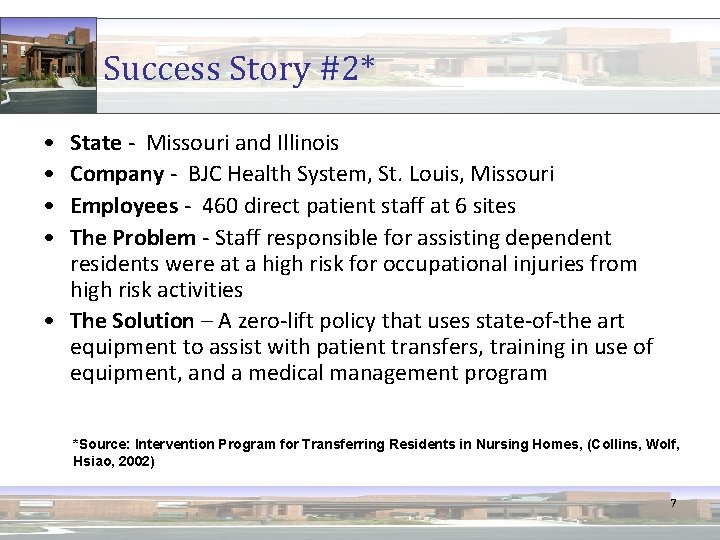
Success Story #2* • • State - Missouri and Illinois Company - BJC Health System, St. Louis, Missouri Employees - 460 direct patient staff at 6 sites The Problem - Staff responsible for assisting dependent residents were at a high risk for occupational injuries from high risk activities • The Solution – A zero-lift policy that uses state-of-the art equipment to assist with patient transfers, training in use of equipment, and a medical management program *Source: Intervention Program for Transferring Residents in Nursing Homes, (Collins, Wolf, Hsiao, 2002) 7
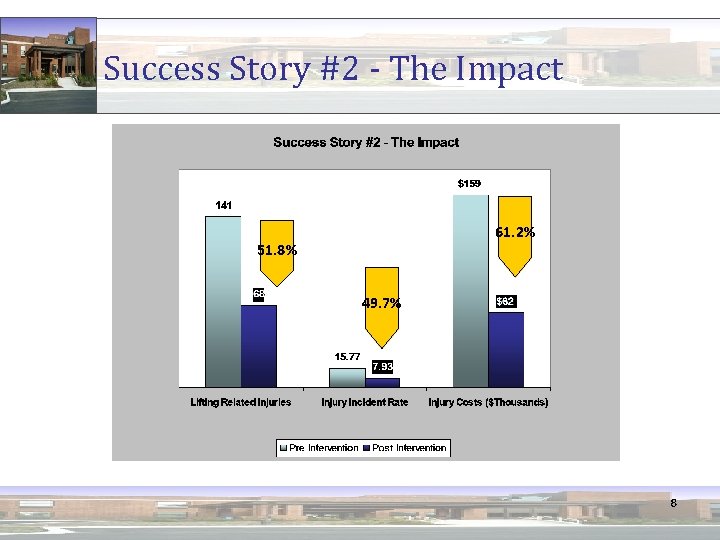
Success Story #2 - The Impact 61. 2% 51. 8% 49. 7% 8
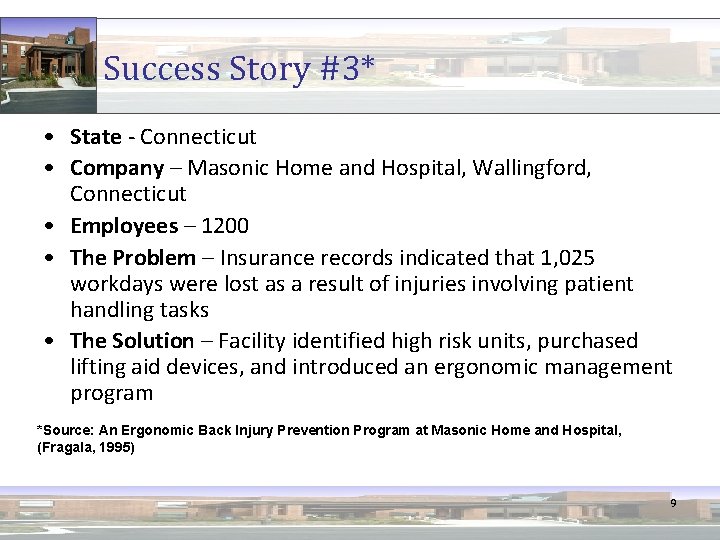
Success Story #3* • State - Connecticut • Company – Masonic Home and Hospital, Wallingford, Connecticut • Employees – 1200 • The Problem – Insurance records indicated that 1, 025 workdays were lost as a result of injuries involving patient handling tasks • The Solution – Facility identified high risk units, purchased lifting aid devices, and introduced an ergonomic management program *Source: An Ergonomic Back Injury Prevention Program at Masonic Home and Hospital, (Fragala, 1995) 9
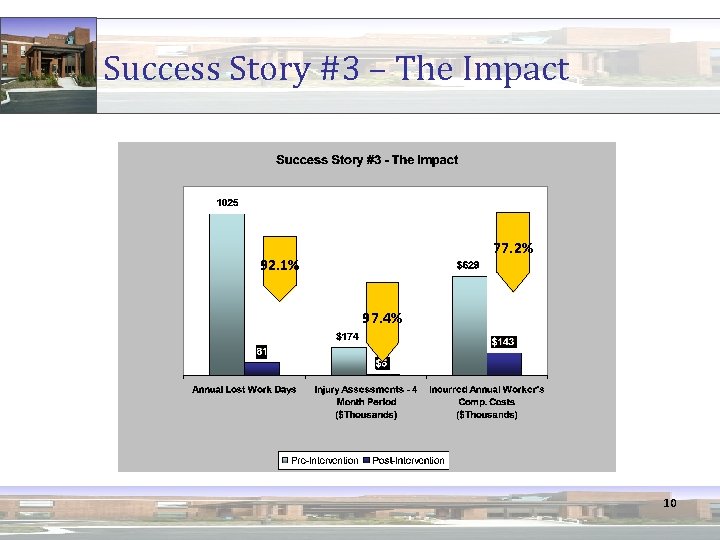
Success Story #3 – The Impact 77. 2% 92. 1% 97. 4% 10
Success Story #4* • State – Multiple • Company – Diamond Insurance Group, insuring three skilled nursing facility chains which were Heritage Enterprise, Dynamic Healthcare, and Christian Homes • Employees – Multiple locations 1, 000 plus • The Problem – Lost work days due to injury and illness were 2. 5 times the average for all private industry in U. S. • The Solution – Implemented limited lift policy consisting of four distinct phases resulting in a reduction of recordable injuries, lost workdays, and workers’ compensations costs *Source: Limit Liability with Lift Programs (Moreno, 2003) 11
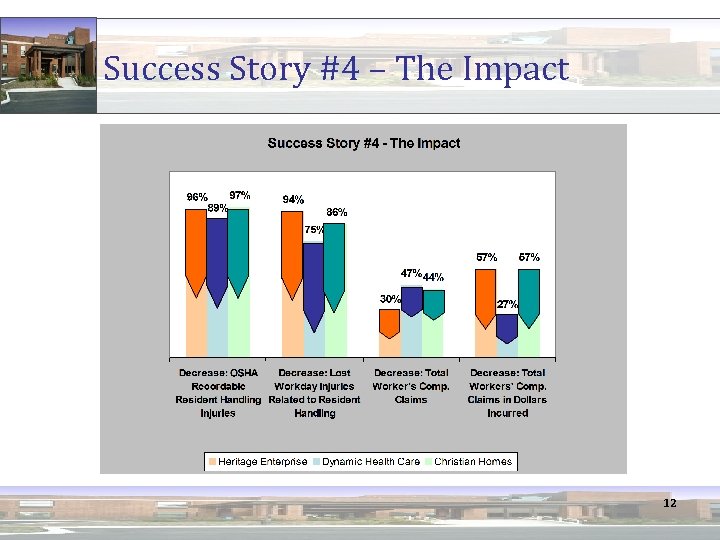
Success Story #4 – The Impact 12
Success Story #5* • • State – Wheeling, West Virginia Company – Good Shepherd Nursing Home Employees – 240 full time and part time employees The Problem –Lifting of residents caused many staff back injuries • The Solution – A safety committee analyzed injuries/ incidents and bought mechanical lifting devices resulting in a decrease in injury and illness rates *Source: OSHA’s Small Business Success Stories Page 13
Success #5 - The Impact • Good Shepherd dramatically reduced its injury and illness rate from 31 to 2. 1 with assistance from OSHA On-site Consultation Program • In addition, Good Shepherd’s workers’ compensation rate declined, and workers’ compensation insurance premiums were reduced by nearly $2, 000 dollars 14
Summary • Benefits of Implementing a Safe Resident Handling Program – reduced work-related injuries – reduced workers’ compensation costs – improved employee morale – increased resident comfort 15
Summary (cont’d) The real QUESTION is… “Whether it is too expensive NOT to implement a Safe Resident Handling program? ” 16
What Should You Do Now? • Develop a management process to reduce MSDs that includes: – Identifying jobs and job tasks which stress body parts beyond limits – Identifying and developing solutions to change these tasks demands – Use a well thought out process to implement changes into your workplace – Monitor and evaluate results 17
Resources OSHA’s Nursing Home and Personal Care Facilities Page: http: //www. osha. gov/SLTC/nursinghome/index. ht ml OSHA Ergonomics Success Stories: http: //www. osha. gov/SLTC/ergonomics/success_s tories. html Guidelines for Nursing Homes: http: //www. osha. gov/ergonomics/guidelines/nursin ghome/index. html 18
- Slides: 18