
Benefits of a GO integrated analysis environment Problem
Benefits of a GO integrated analysis environment
Problem 1: Selecting and effectively using tools • Enrichment analysis is a ‘killer app’ for GO – Should be more central to what we do – Also other tools: e. g. function prediction • Problem: – Multiple tools with different characteristics • Statistical method • Environment / customizability • Visualization – Can we better help users: • Select the right tool(s) for the job • Run their analysis • Build scalable workflows that allow replication http: //geneontology. org 2
Problem 2: Evaluating improvements in GO • How do we know how well we’re doing? – Progress in GO difficult to quantify – Same enrichment analysis may give completely different results one year to the next http: //geneontology. org 3
Solution: GO Tools Environment • Tools: – Selecting the right tool • Solution: Detailed, accurate, up-to-date metadata on each tool – Galaxy: A standard platform for running analyses • ‘operating system’ for bioinformatics analyses • allows plug and play – Combining tools • Common community interchange standards for GO analysis tools – Common term enrichment result format plus converters • Evaluation of GO: – Use Term Enrichment Analyses (TEAs) and standard gene sets to evaluate GO http: //geneontology. org 4
Tool metadata: background • We have ~130 GO tools registered – ~50 TEA tools – We don’t have all of them – Some info out of date • We need to capture more metadata – We want to be able to quickly answer queries like • Find an EA tool that – – – uses hypergeometric tests can be used for <my species> has not updated their annotation sets in > 6 mo has visualization I can use for my RNAseq data http: //geneontology. org 5
Tool metadata: progress/tasks • Progress: – Infrastructure migration: • Migrated from custom tool metadata format and web infrastructure • using curated NIF registry – Built on semantic mediawiki • Ongoing tasks: 1. 2. 3. • • Add more fields (curated and automated) Recommendations? Integrate with go-help Improve integration with main GO website seamlessness allow intuitive filtering of tools See Seth’s presentation http: //geneontology. org 6
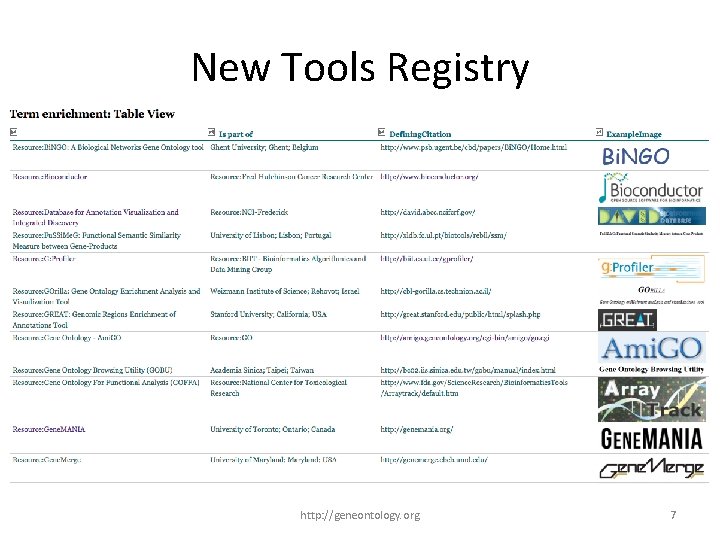
New Tools Registry http: //geneontology. org 7
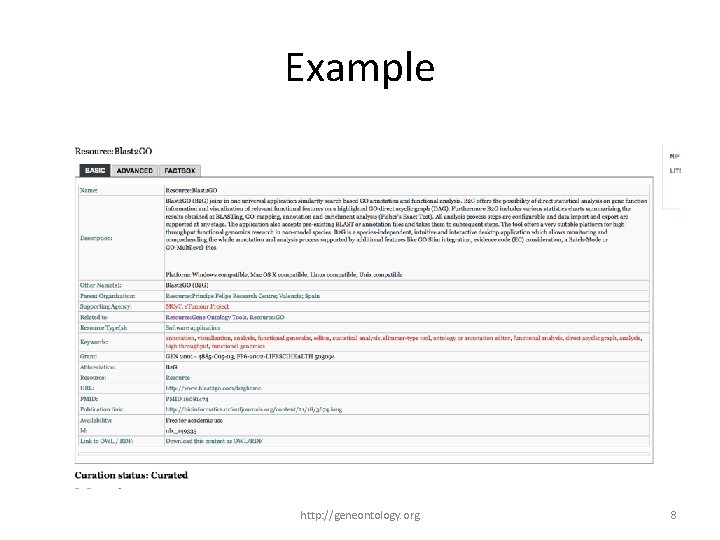
Example http: //geneontology. org 8
Standard Term Enrichment Analysis Platform: background • Tools run in their own environment – Difficult to • Compare • Integrate into larger workflows • Provide uniform interface • Solution: – Standard workflow environment • Variety of workflow systems – Kepler – Galaxy – Taverna • Galaxy has a number of advantages – Simple to set up and extend – heavily used for next-gen analyses – Tools for intermine etc http: //geneontology. org 9
Standard Term Enrichment Analysis Platform: progress/tasks • Progress – proof of concept prototype of GO environment • http: //galaxy. berkeleybop. org • Ongoing tasks 1. 2. 3. 4. • • Stabilize environment Add more enrichment tools Seamless integration with GO website Outreach User documentation Bio-curators 2013 presentation ONTO-Tool. Kit: enabling bio-ontology engineering via Galaxy E Antezana, A Venkatesan, C Mungall, V Mironov, M Kuiper BMC bioinformatics 11 (Suppl 12), S 8 2010 http: //geneontology. org 10
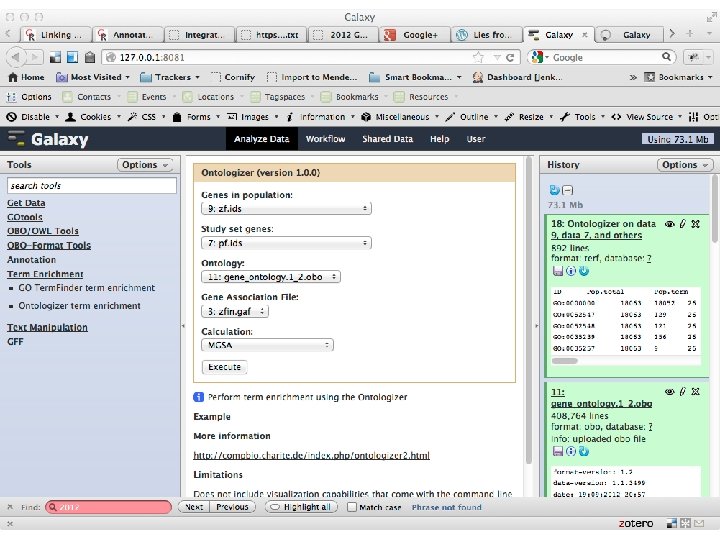
Screenshot http: //geneontology. org 11
Interchange Standards: Outline • We need a Term Enrichment Result Format (TERF) – Standard output format for TE tools • Compliant tools will export TERF • We will write wrappers for non-compliant tools • Allows capture of detailed metadata about each result set • Example of use: 1. User runs gene set through tool X 2. User takes output of tool X and feeds it into visualizer Y http: //geneontology. org 12
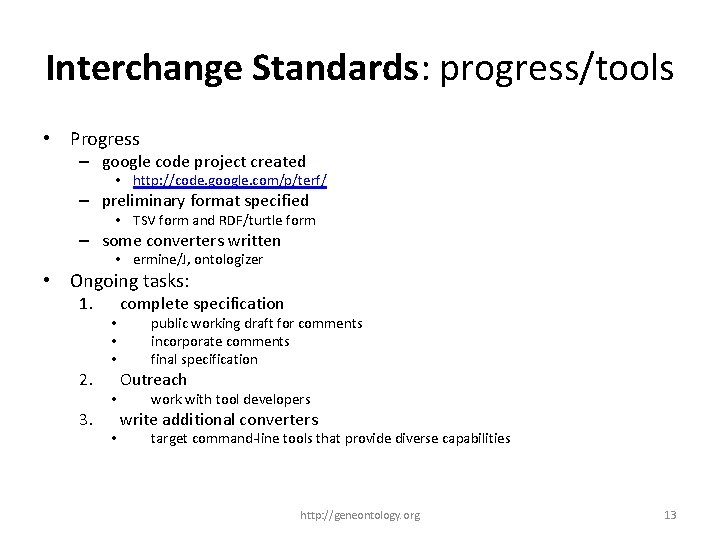
Interchange Standards: progress/tools • Progress – google code project created • http: //code. google. com/p/terf/ – preliminary format specified • TSV form and RDF/turtle form – some converters written • ermine/J, ontologizer • Ongoing tasks: 1. 2. 3. • • • complete specification public working draft for comments incorporate comments final specification Outreach work with tool developers write additional converters target command-line tools that provide diverse capabilities http: //geneontology. org 13
GO evaluation: background • How do changes in the GO affect user’s queries and analyses? – We would hope that concerted ontology and annotation improvements would yield more complete and informative results – But we don’t know! http: //geneontology. org 14
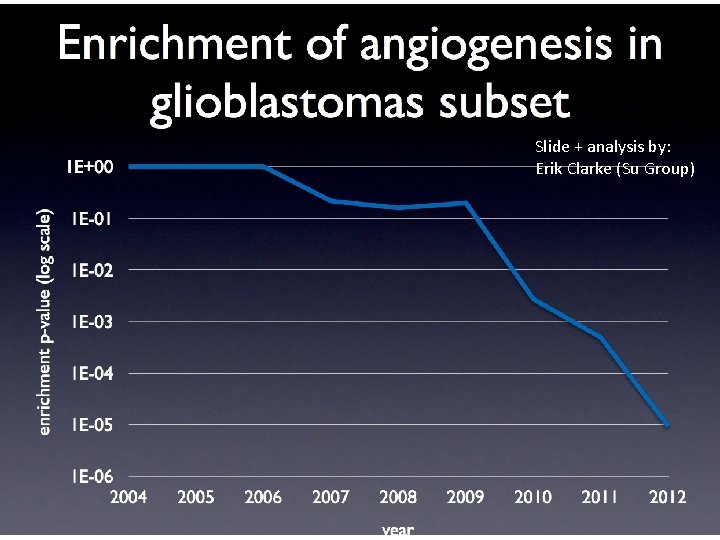
GO evaluation: background • How do changes in the GO affect queries and analyses? ESlvaluation Slide + analysis by: – We don’t know! Erik Clarke (Su Group) – We would hope that concerted ontology and annotation improvements would yield more informative results – TE results are frequently reported in papers but rarely replicated • If we had a repository of gene sets we could systematically reanalyze these with different variables – version of GO, version of annotations – different tools • If these gene sets were annotated with ‘expected’ results we could systematically determine if GO was delivering expected answers – danger of overfitting, but still useful http: //geneontology. org 15
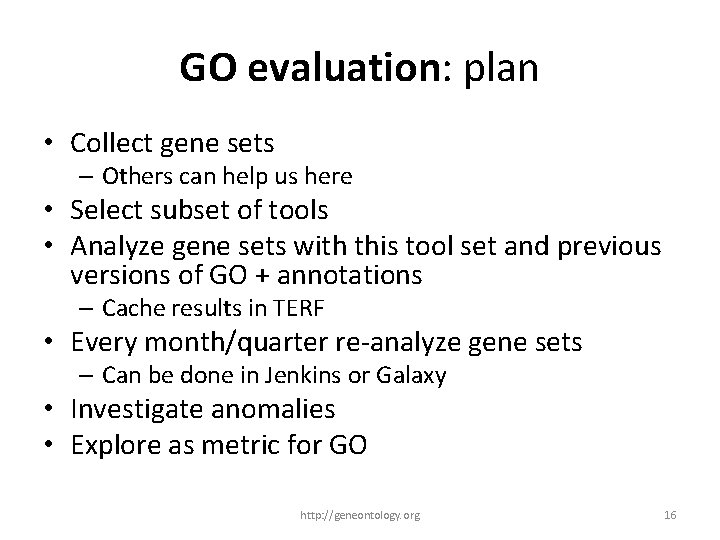
GO evaluation: plan • Collect gene sets – Others can help us here • Select subset of tools • Analyze gene sets with this tool set and previous versions of GO + annotations – Cache results in TERF • Every month/quarter re-analyze gene sets – Can be done in Jenkins or Galaxy • Investigate anomalies • Explore as metric for GO http: //geneontology. org 16
Conclusions • An integrated analysis environment can help – Users – The GOC • More work to be done – Need to dedicate resources http: //geneontology. org 17

http: //geneontology. org 18
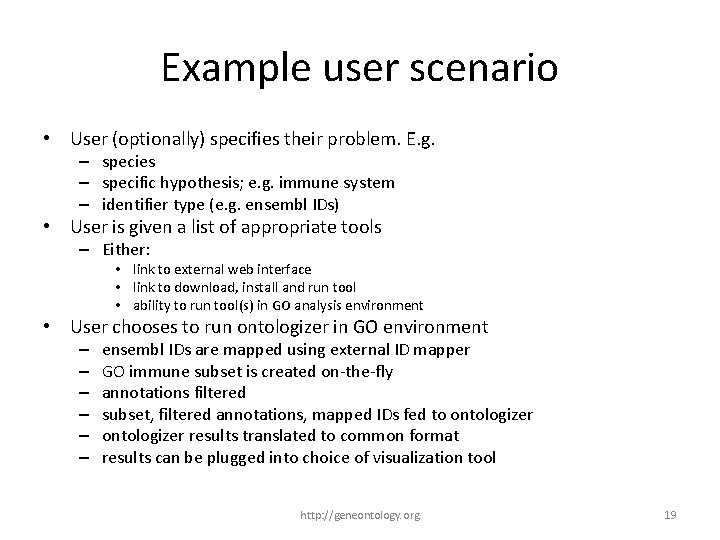
Example user scenario • User (optionally) specifies their problem. E. g. – species – specific hypothesis; e. g. immune system – identifier type (e. g. ensembl IDs) • User is given a list of appropriate tools – Either: • link to external web interface • link to download, install and run tool • ability to run tool(s) in GO analysis environment • User chooses to run ontologizer in GO environment – – – ensembl IDs are mapped using external ID mapper GO immune subset is created on-the-fly annotations filtered subset, filtered annotations, mapped IDs fed to ontologizer results translated to common format results can be plugged into choice of visualization tool http: //geneontology. org 19
- Slides: 19