
Benefits obtained following a 12 week Pulmonary Rehabilitation
Benefits obtained following a 12 week Pulmonary Rehabilitation programme One Year follow up. A Sciriha, D Bilocca, C Fsadni, P Fsadni, E Gerada, C Gouder, L Camilleri S Lungaro-Mifsud, S Montefort
Introduction � Pulmonary rehabilitation (PR) : - Scientifically based diagnostic management and evaluation option - Multidisciplinary programme - Exercise and education.
- Recommended standard of care - Based on a growing body of scientific evidence. - Benefits recognised in numerous guidelines and listed in the top priorities for improving the care of COPD patients.
American Thoracic Society/European Respiratory Society Statement on Pulmonary Rehabilitation – Nici et al (2005) Pulmonary Rehabilitation – Joint ACCP/AACVPR Evidence Based Clinical Practice Guidelines – Ries et al (2009) Optimizing pulmonary rehabilitation in chronic obstructive pulmonary disease – practical issues: A Canadian Thoracic Society Clinical Practice Guideline – Marcinuk et al (2010) The British Thoracic Society Guideline on Pulmonary Rehabilitation in Adults British Thoracic Society Pulmonary Rehabilitation Guideline Development Group (2013)
- No consensus of opinion reached regarding optimal duration with programmes: - as short as 10 days (Votto et al 1996) - as long as 18 months (Berry et al 2003; Foy et al 2001; Green et al 2001; Troosters et al 2000). - Short term studies have not established the manner in which the benefits decrease over time. - A patient’s severity acting as part of the inclusion criteria for such programmes is still debatable. � In this study a 12 week rehabilitation programme was looked into.
Method - 75 patients: (59 male; 16 female) - Age: 40 to 75 years. - 60 of these 75 subjects eligible to participate - A baseline assessment was carried out before the patients were enrolled - Re assessed at 4, 8 and 12 weeks during rehabilitation and 28 and 52 weeks on completion. - Two classes per week for twelve weeks
Outcome measures � Spirometry readings � DLCO and plethysmography � 6 minute walking test � Blood investigations -CRP, ESR, CBC, TFTs, LFTs, Hba 1 c, Vitamin. B 12, Ferritin, Folate. � MRC score � Bode index � Body Mass Index � Borg Scale � Heart Rate � St George’s Respiratory Questionnaire � Hospital anxiety and depression score
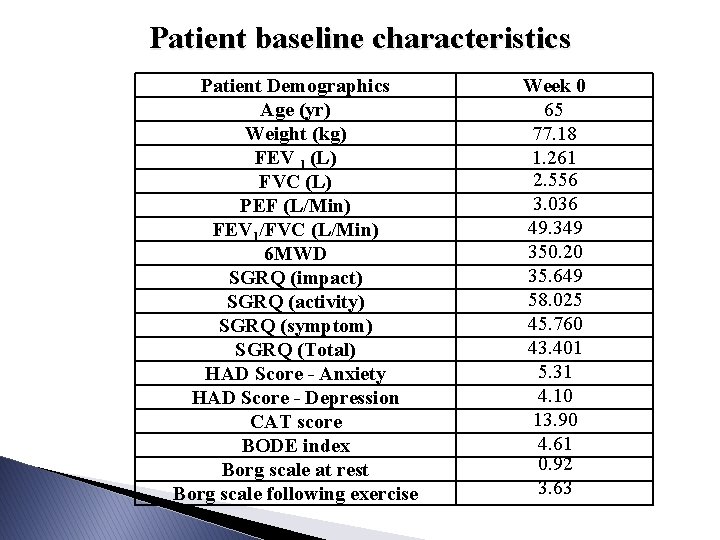
Patient baseline characteristics Patient Demographics Age (yr) Weight (kg) FEV 1 (L) FVC (L) PEF (L/Min) FEV 1/FVC (L/Min) 6 MWD SGRQ (impact) SGRQ (activity) SGRQ (symptom) SGRQ (Total) HAD Score - Anxiety HAD Score - Depression CAT score BODE index Borg scale at rest Borg scale following exercise Week 0 65 77. 18 1. 261 2. 556 3. 036 49. 349 350. 20 35. 649 58. 025 45. 760 43. 401 5. 31 4. 10 13. 90 4. 61 0. 92 3. 63
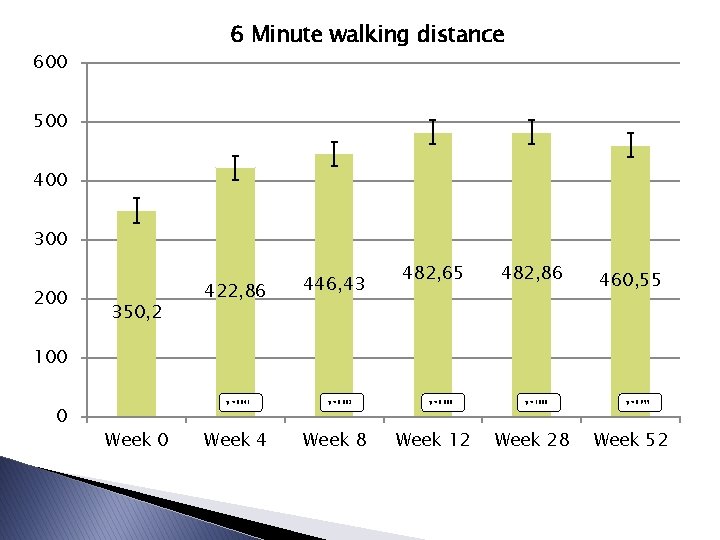
6 Minute walking distance 600 500 400 300 200 350, 2 422, 86 446, 43 482, 65 482, 86 460, 55 100 0 p < 0. 041 Week 0 Week 4 p < 0. 002 Week 8 p < 0. 000 Week 12 p < 1. 000 Week 28 p < 0. 955 Week 52

6 Minute walk test per Medical Respiratory Council (MRC) Score 600 500 400 MRC 2 300 MRC 3 200 MRC 5 MRC 4 100 0 Week 4 Week 8 Week 12 Week 28 Week 52
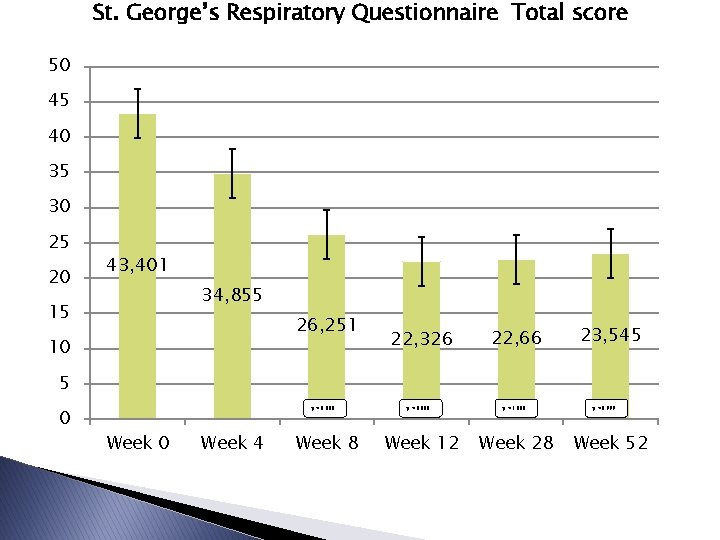
St. George’s Respiratory Questionnaire Total score 50 45 40 35 30 25 20 43, 401 34, 855 15 26, 251 10 22, 326 22, 66 23, 545 5 0 p < 0. 000 Week 4 Week 8 p < 0. 000 Week 12 p < 1. 000 Week 28 p < 0. 999 Week 52

St George’s Respiratory Questionnaire Total score per MRC grading 60 50 40 MRC 2 30 MRC 3 20 MRC 5 MRC 4 10 0 Week 4 Week 8 Week 12 Week 28 Week 52

St George’s Respiratory Questionnaire Symptom score per MRC grading 60 50 40 MRC 2 30 MRC 3 20 MRC 5 MRC 4 10 0 Week 4 Week 8 Week 12 Week 28 Week 52
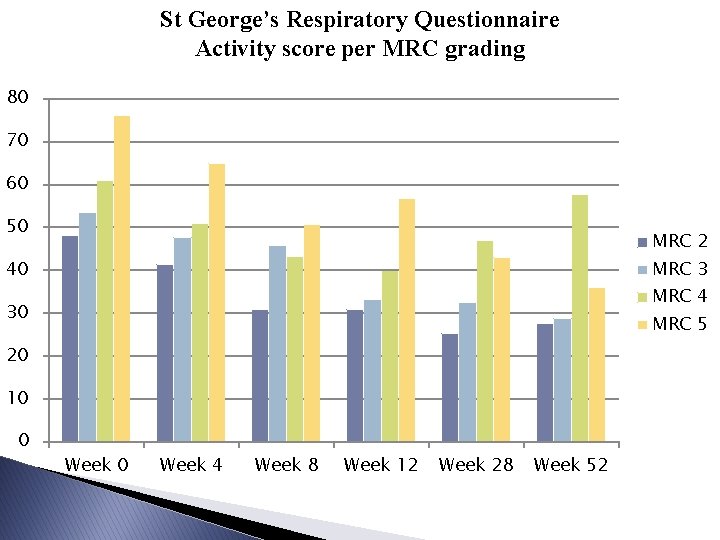
St George’s Respiratory Questionnaire Activity score per MRC grading 80 70 60 50 MRC 2 MRC 3 40 MRC 4 30 MRC 5 20 10 0 Week 4 Week 8 Week 12 Week 28 Week 52
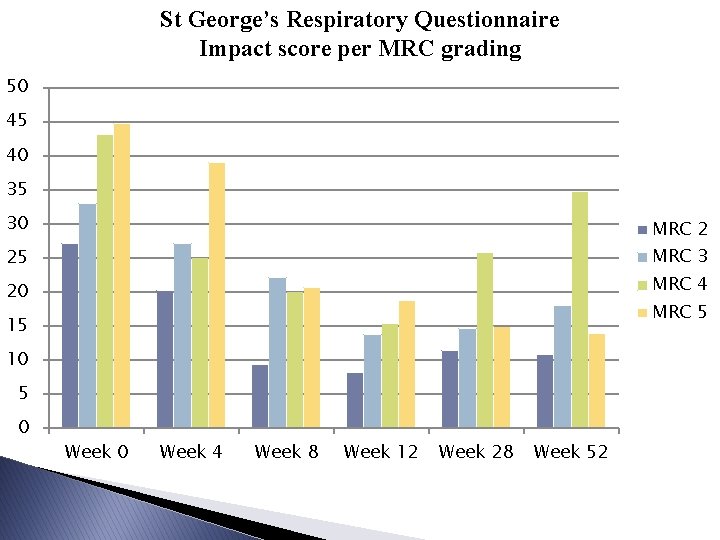
St George’s Respiratory Questionnaire Impact score per MRC grading 50 45 40 35 30 MRC 2 MRC 3 25 MRC 4 20 MRC 5 15 10 5 0 Week 4 Week 8 Week 12 Week 28 Week 52
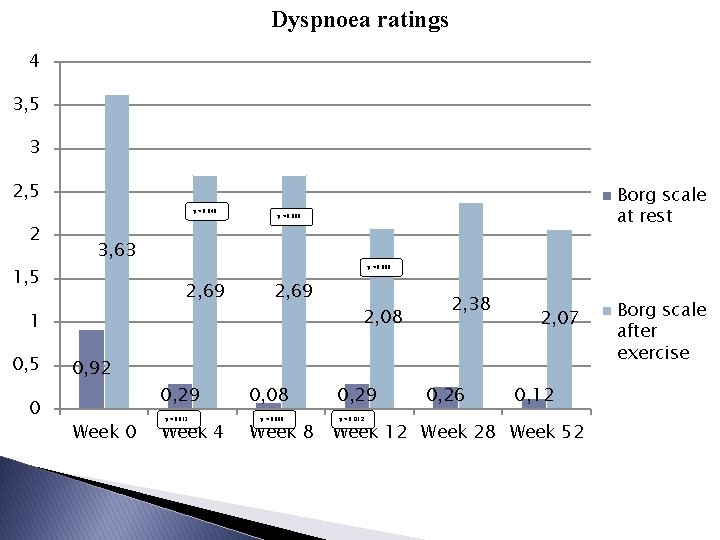
Dyspnoea ratings 4 3, 5 3 2, 5 p < 0. 048 2 1, 5 p < 0. 000 3, 63 p < 0. 000 2, 69 1 0, 5 0 Borg scale at rest 0, 92 Week 0 0, 29 p < 0. 012 Week 4 0, 08 p < 0. 000 Week 8 2, 08 0, 29 p < 0. 012 2, 38 0, 26 2, 07 0, 12 Week 28 Week 52 Borg scale after exercise
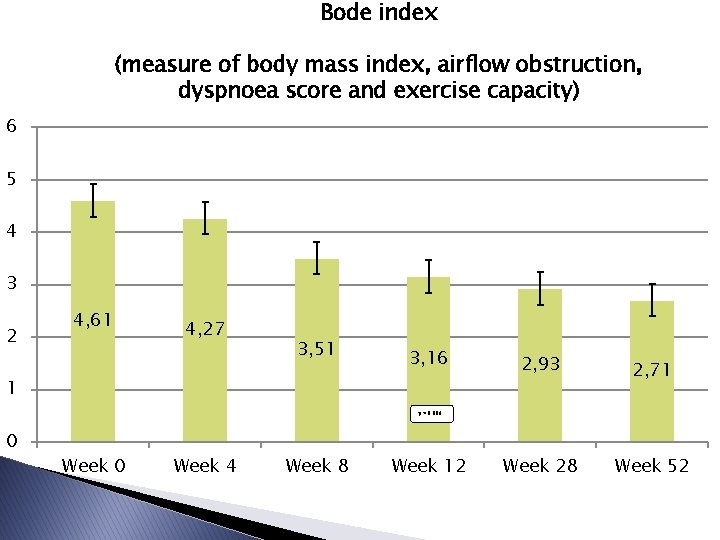
Bode index (measure of body mass index, airflow obstruction, dyspnoea score and exercise capacity) 6 5 4 3 2 4, 61 4, 27 3, 51 3, 16 1 2, 93 2, 71 Week 28 Week 52 p < 0. 006 0 Week 4 Week 8 Week 12
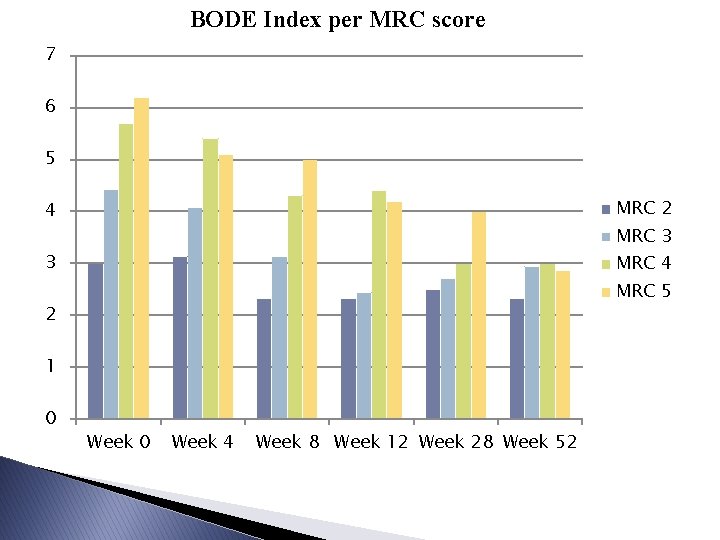
BODE Index per MRC score 7 6 5 4 MRC 2 3 MRC 4 MRC 3 MRC 5 2 1 0 Week 4 Week 8 Week 12 Week 28 Week 52
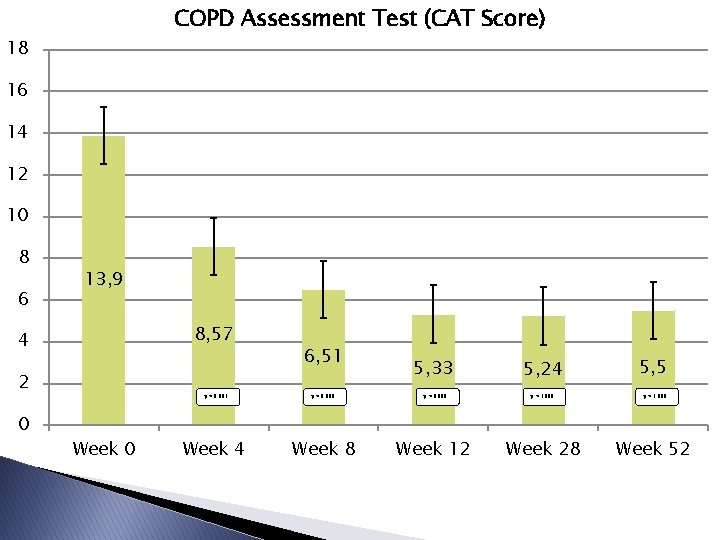
COPD Assessment Test (CAT Score) 18 16 14 12 10 8 6 13, 9 8, 57 4 2 0 p < 0. 001 Week 0 Week 4 6, 51 p < 0. 000 Week 8 5, 33 p < 0. 000 Week 12 5, 24 5, 5 p < 1. 000 Week 28 Week 52
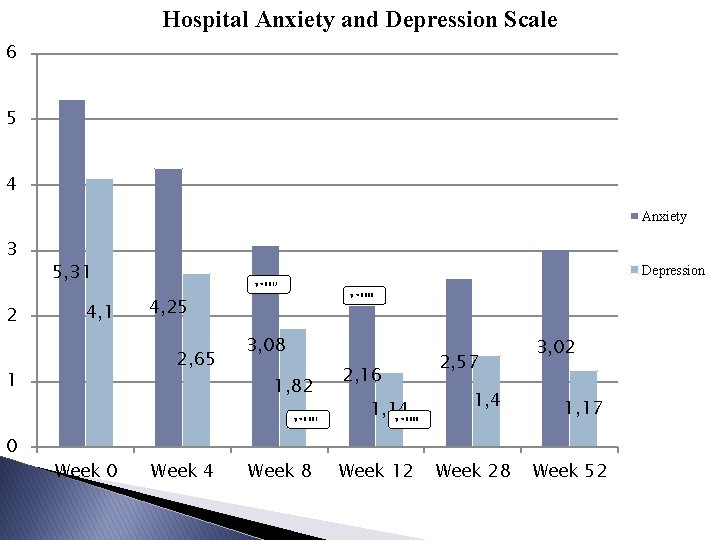
Hospital Anxiety and Depression Scale 6 5 4 Anxiety 3 2 5, 31 4, 1 Depression p < 0. 017 4, 25 2, 65 1 p < 0. 000 3, 08 1, 82 p < 0. 001 0 Week 4 Week 8 2, 57 2, 16 1, 14 1, 4 p < 0. 000 Week 12 Week 28 3, 02 1, 17 Week 52
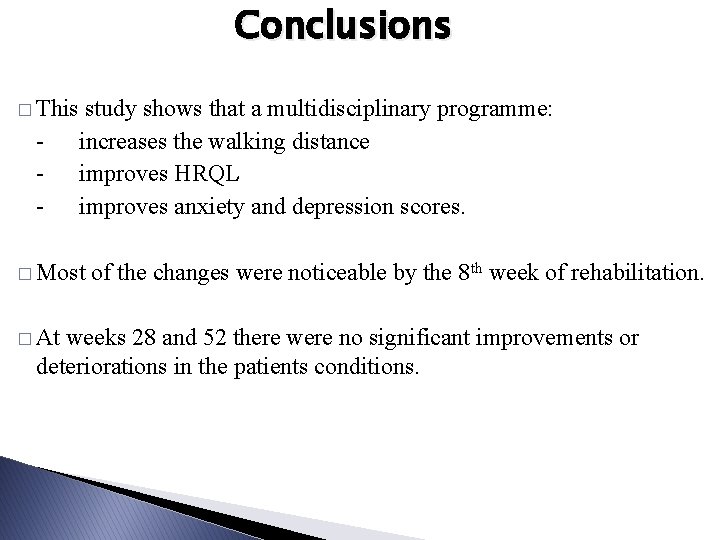
Conclusions � This - study shows that a multidisciplinary programme: increases the walking distance improves HRQL improves anxiety and depression scores. � Most � At of the changes were noticeable by the 8 th week of rehabilitation. weeks 28 and 52 there were no significant improvements or deteriorations in the patients conditions.
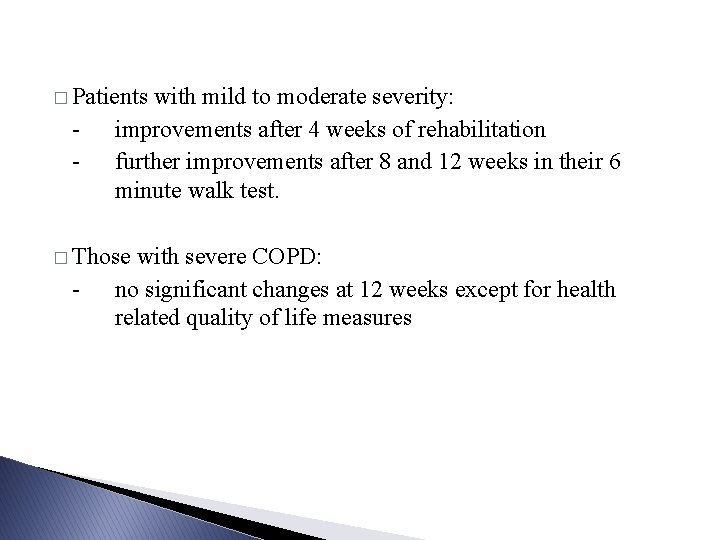
� Patients - with mild to moderate severity: improvements after 4 weeks of rehabilitation further improvements after 8 and 12 weeks in their 6 minute walk test. � Those - with severe COPD: no significant changes at 12 weeks except for health related quality of life measures
Acknowledgements � Supervisor: Prof S Montefort � Co – Supervisor: Dr Stephen Lungaro Mifsud � Physiotherapy Department FHS: Dr Mark Sacco Mr Tonio Agius Ms Nadine Spiteri Gingell Mr John Xerri De Caro � Medical Team: Dr David Bilocca Dr Eleanor Gerada Dr Carolyn Gouder � MDT PR Team � Family � Colleagues and friends
- Slides: 23