
Benefits from GSICS algorithms for FY23 calibration Presented
Benefits from GSICS algorithms for FY-2/3 calibration Presented by Lei Yang Contributor: Xiuqing Hu, Na Xu, Hanlie Xu, Lin Chen, Ronghua Wu, Ling Wang, Yuan Li, Ling Sun, Chengli Qi, Peng Zhang National Satellite Meteorological Center(NSMC), CMA Sep 22, 2015 GSICS Users Workshop 2015, Toulouse, France 2021/9/16 1
Outline • FY-2 GEO-LEO and FY-3 C LEO-LEO IR toward demonstration products • FY-2/FY-3 VIS/NIR inter-calibration • FY 2 and FY-3 Lunar calibration • FY-3 C/MERSI Nonlinear correction from inter-calibration • Other progresses in CMA GPRC – – – Data group and Data sharing sever IR Solar contamination of FY-3 instruments Spectral response error and retrieval VIS/NIR PICS monitoring Instrument Performance monitoring IPM 2021/9/16 2
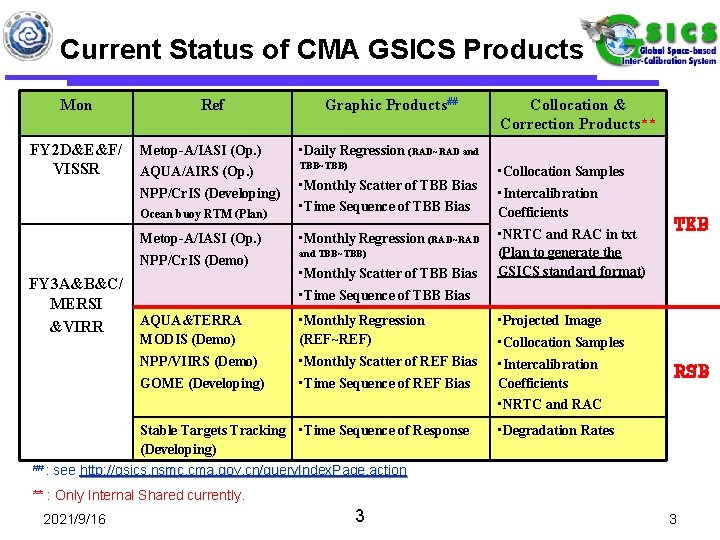
Current Status of CMA GSICS Products Mon FY 2 D&E&F/ VISSR Ref Metop-A/IASI (Op. ) • Daily Regression (RAD~RAD and AQUA/AIRS (Op. ) TBB~TBB) NPP/Cr. IS (Developing) FY 3 A&B&C/ MERSI &VIRR Graphic Products## • Monthly Scatter of TBB Bias Ocean buoy RTM (Plan) • Time Sequence of TBB Bias Metop-A/IASI (Op. ) • Monthly Regression (RAD~RAD NPP/Cr. IS (Demo) and TBB~TBB) • Monthly Scatter of TBB Bias Collocation & Correction Products** • Collocation Samples • Intercalibration Coefficients • NRTC and RAC in txt (Plan to generate the GSICS standard format) TEB • Time Sequence of TBB Bias AQUA&TERRA MODIS (Demo) • Monthly Regression (REF~REF) • Projected Image NPP/VIIRS (Demo) • Monthly Scatter of REF Bias GOME (Developing) • Time Sequence of REF Bias • Intercalibration Coefficients • Collocation Samples RSB • NRTC and RAC Stable Targets Tracking • Time Sequence of Response (Developing) ## : • Degradation Rates see http: //gsics. nsmc. cma. gov. cn/query. Index. Page. action ** : Only Internal Shared currently. 2021/9/16 3 3
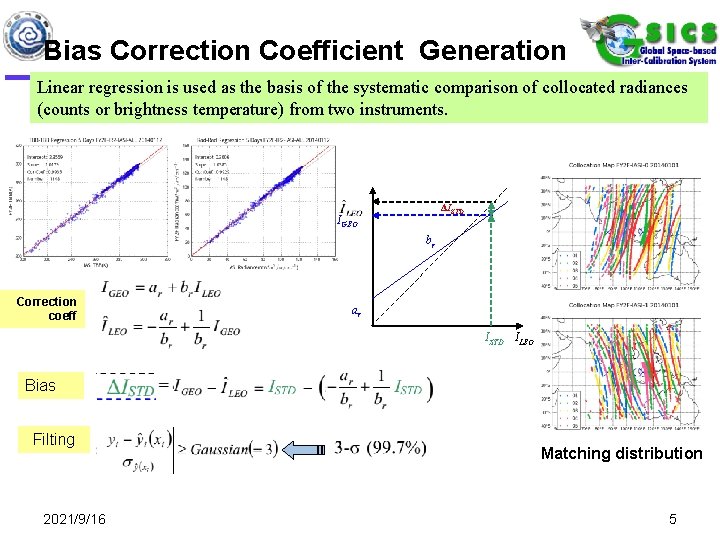
Bias Correction Coefficient Generation Linear regression is used as the basis of the systematic comparison of collocated radiances (counts or brightness temperature) from two instruments. ΔISTD IGEO br Correction coeff ar ISTD ILEO Bias Filting 2021/9/16 Matching distribution 5

FY-3 C LEO-LEO IR calibration GSICS monitoring FY-3 C/VIRR IR GSICS 2021/9/16 Red: FY 3 C/VIRR-Cr. IS Blue: FY 3 C/VIRR-IASI 6
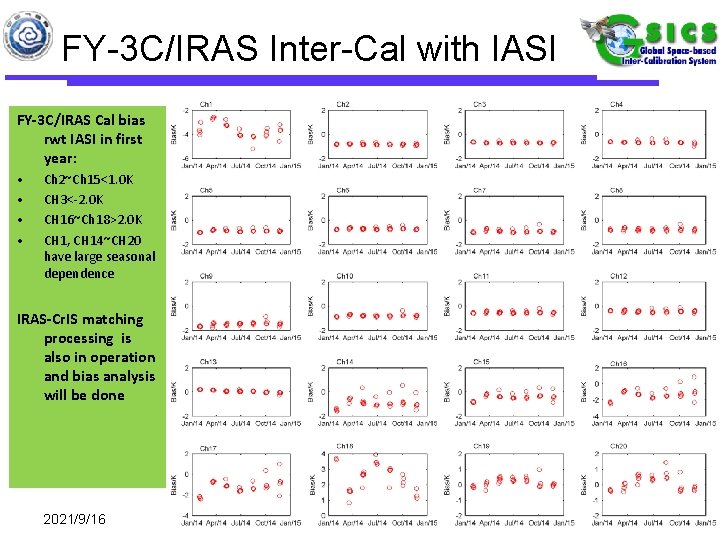
FY-3 C/IRAS Inter-Cal with IASI FY-3 C/IRAS Cal bias rwt IASI in first year: • • Ch 2~Ch 15<1. 0 K CH 3<-2. 0 K CH 16~Ch 18>2. 0 K CH 1, CH 14~CH 20 have large seasonal dependence IRAS-Cr. IS matching processing is also in operation and bias analysis will be done 2021/9/16 7
CMA GSICS Towards demo products • Theoretical Basis for FY-2 -AIRS/IASI Inter-Calibration Algorithm for GSICS – Na Xu (CMA) – Version : 2015 -01 -30 • Theoretical Basis for the FY-3 MERSI/VIRR/IRAS- IASI/Cr. IS Inter-Calibration Algorithm for GSICS – Hanlie Xu (CMA), Chengli Qi (CMA) – Version: 2015 -02 -09 • Submission for review will be done after GSICS 2015 annual meeting 2021/9/16 8
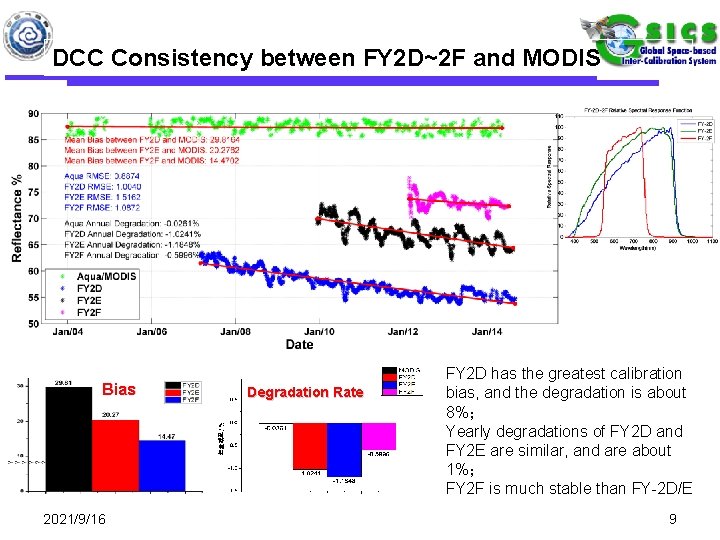
DCC Consistency between FY 2 D~2 F and MODIS Bias 2021/9/16 Degradation Rate FY 2 D has the greatest calibration bias, and the degradation is about 8%; Yearly degradations of FY 2 D and FY 2 E are similar, and are about 1%; FY 2 F is much stable than FY-2 D/E 9
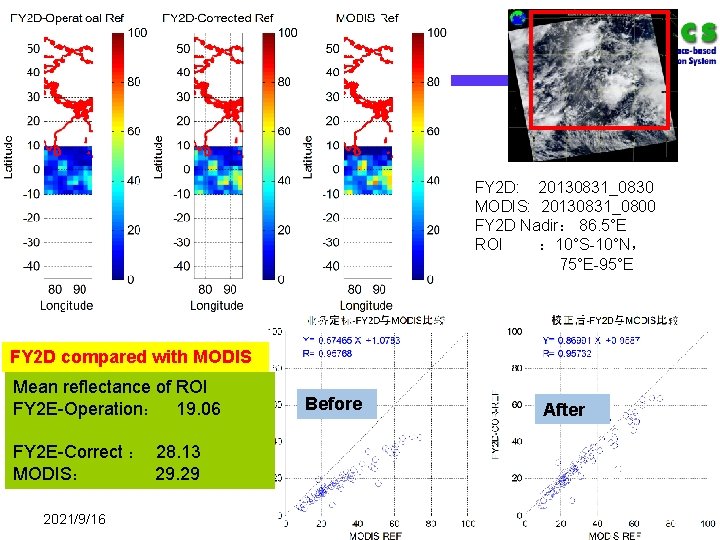
FY 2 D: 20130831_0830 MODIS: 20130831_0800 FY 2 D Nadir: 86. 5°E ROI : 10°S-10°N, 75°E-95°E FY 2 D compared with MODIS Mean reflectance of ROI FY 2 E-Operation: 19. 06 Before After FY 2 E-Correct : 28. 13 MODIS: 29. 29 2021/9/16 10
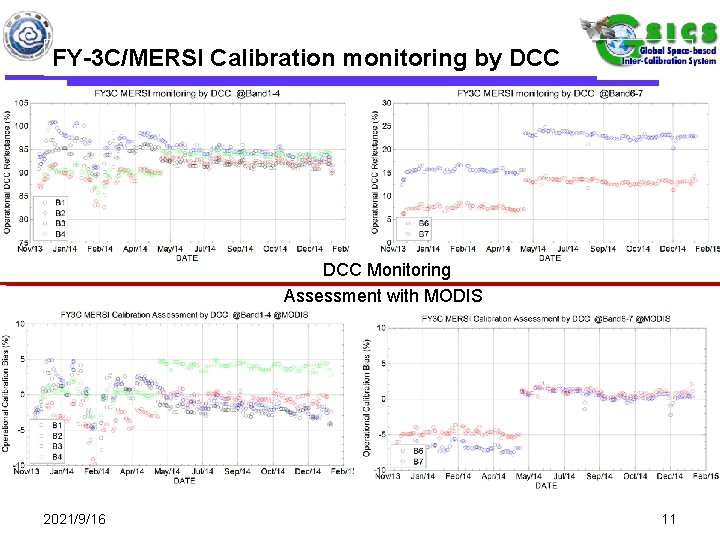
FY-3 C/MERSI Calibration monitoring by DCC Monitoring Assessment with MODIS 2021/9/16 11
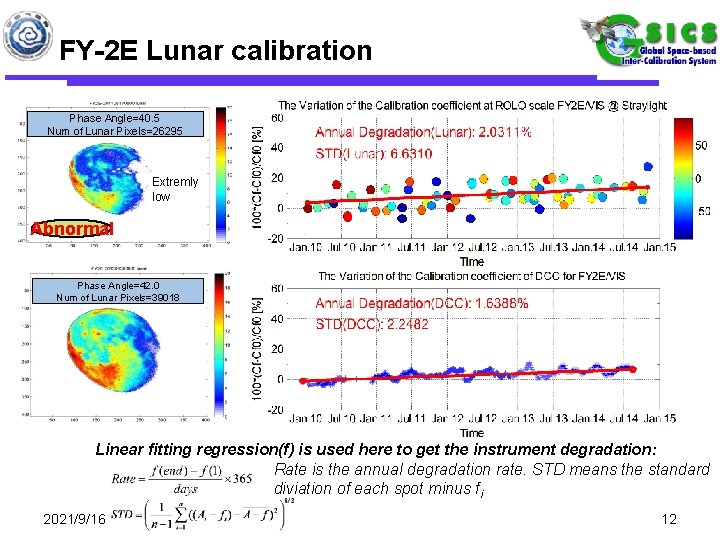
FY-2 E Lunar calibration Phase Angle=40. 5 Num of Lunar Pixels=26295 Extremly low Abnormal Phase Angle=42. 0 Num of Lunar Pixels=39018 Linear fitting regression(f) is used here to get the instrument degradation: Rate is the annual degradation rate. STD means the standard diviation of each spot minus fi 2021/9/16 12
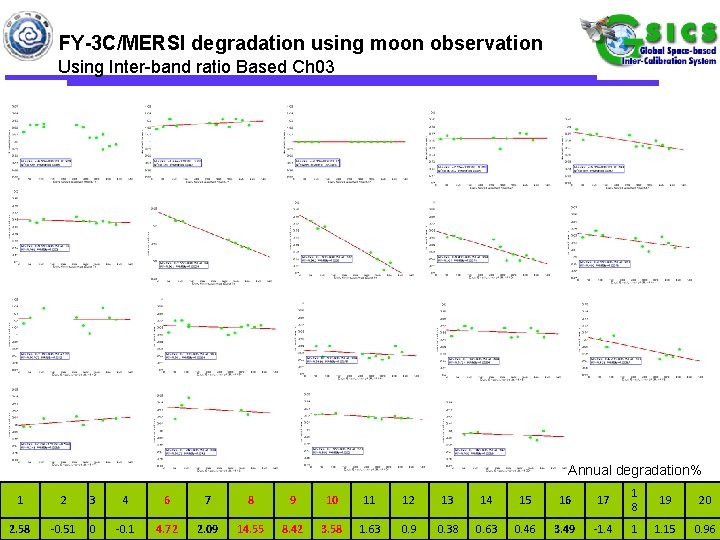
FY-3 C/MERSI degradation using moon observation Using Inter-band ratio Based Ch 03 Annual degradation% 1 2. 58 2 3 2021/9/16 -0. 51 0 4 6 7 8 9 10 11 12 13 14 15 16 17 1 8 19 -0. 1 4. 72 2. 09 14. 55 8. 42 3. 58 1. 63 0. 9 0. 38 0. 63 0. 46 3. 49 -1. 4 1 1. 15 13 20 0. 96
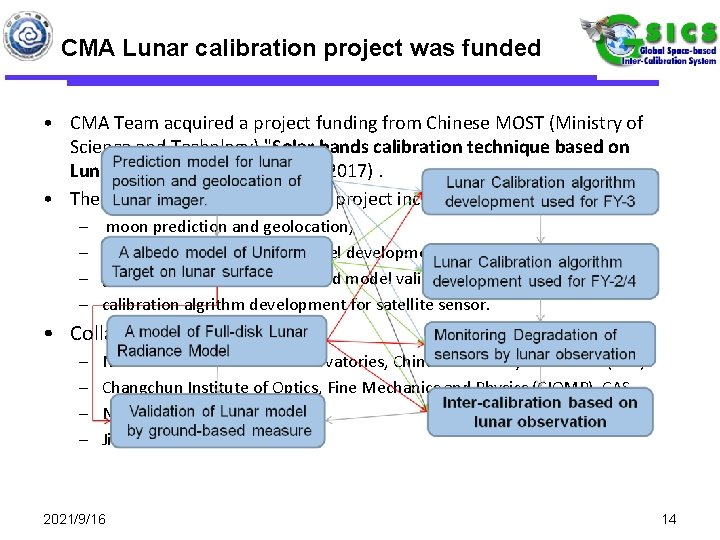
CMA Lunar calibration project was funded • CMA Team acquired a project funding from Chinese MOST (Ministry of Science and Technlogy) "Solar bands calibration technique based on Lunar radiance source” (2015~2017). • The main research points of this project include: – – moon prediction and geolocation, lunar radiance/irradiance model development, ground-based measurement and model validation and calibration algrithm development for satellite sensor. • Collaboration partners: – – National = Astronomical Observatories, Chinese Academy of Sciences(CAS) Changchun Institute of Optics, Fine Mechanics and Physics (CIOMP), CAS Nanjing University Jilin University 2021/9/16 14
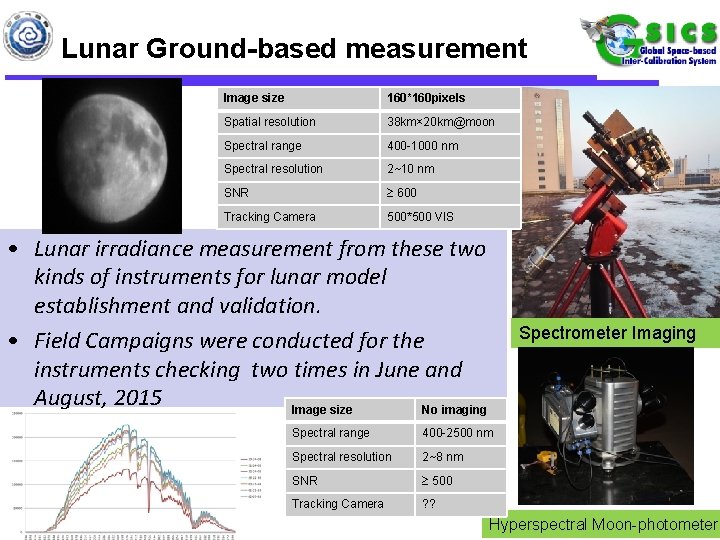
Lunar Ground-based measurement Image size 160*160 pixels Spatial resolution 38 km× 20 km@moon Spectral range 400 -1000 nm Spectral resolution 2~10 nm SNR 600 Tracking Camera 500*500 VIS • Lunar irradiance measurement from these two kinds of instruments for lunar model establishment and validation. • Field Campaigns were conducted for the instruments checking two times in June and August, 2015 Image size No imaging 2021/9/16 Spectrometer Imaging Spectral range 400 -2500 nm Spectral resolution 2~8 nm SNR 500 Tracking Camera ? ? 15 Hyperspectral Moon-photometer
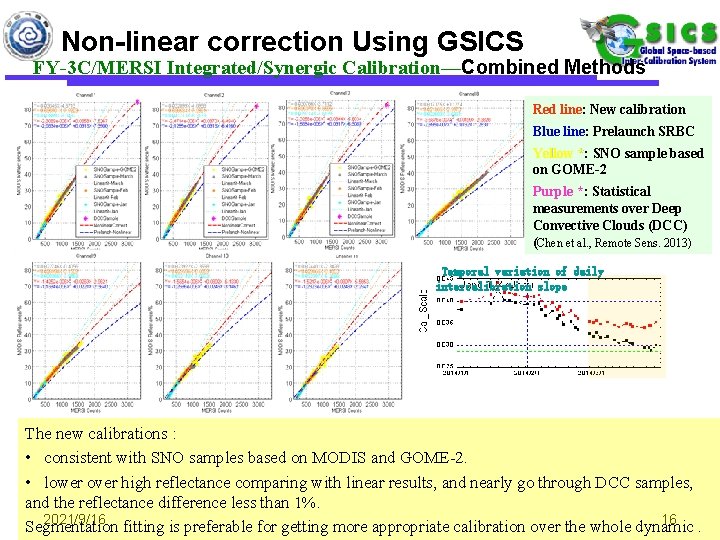
Non-linear correction Using GSICS FY-3 C/MERSI Integrated/Synergic Calibration—Combined Methods Red line: New calibration Blue line: Prelaunch SRBC Yellow *: * SNO sample based on GOME-2 Purple *: Statistical measurements over Deep Convective Clouds (DCC) (Chen et al. , Remote Sens. 2013) Temporal variation of daily intercalibration slope The new calibrations : • consistent with SNO samples based on MODIS and GOME-2. • lower over high reflectance comparing with linear results, and nearly go through DCC samples, and the reflectance difference less than 1%. 2021/9/16 16 Segmentation fitting is preferable for getting more appropriate calibration over the whole dynamic.
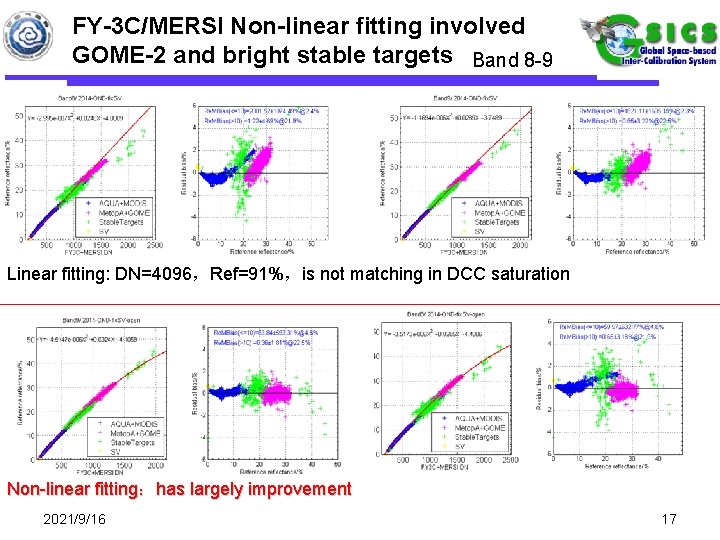
FY-3 C/MERSI Non-linear fitting involved GOME-2 and bright stable targets Band 8 -9 Linear fitting: DN=4096,Ref=91%,is not matching in DCC saturation Non-linear fitting:has largely improvement 2021/9/16 17
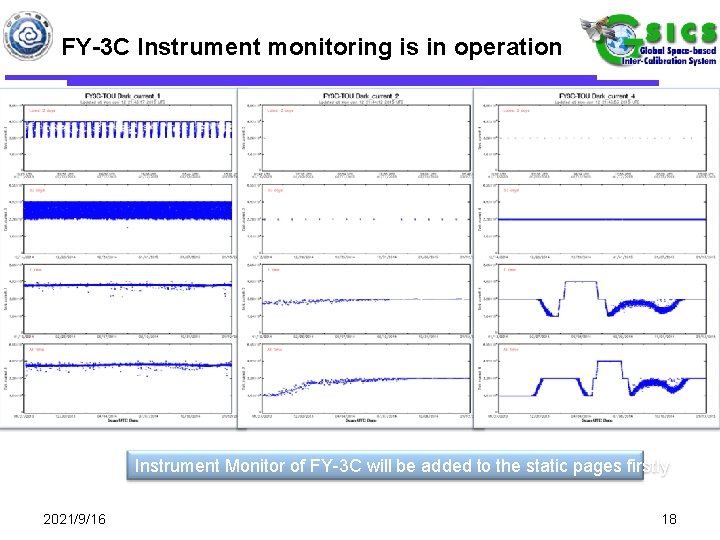
FY-3 C Instrument monitoring is in operation Instrument Monitor of FY-3 C will be added to the static pages firstly 2021/9/16 18
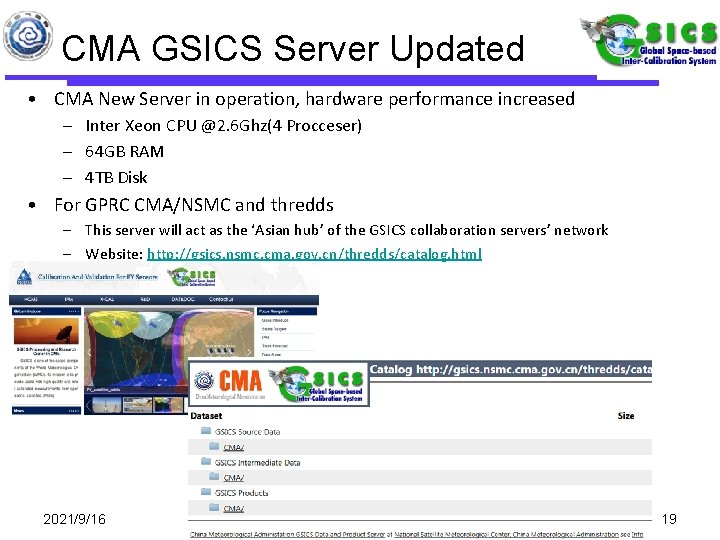
CMA GSICS Server Updated • CMA New Server in operation, hardware performance increased – Inter Xeon CPU @2. 6 Ghz(4 Procceser) – 64 GB RAM – 4 TB Disk • For GPRC CMA/NSMC and thredds – This server will act as the ‘Asian hub’ of the GSICS collaboration servers’ network – Website: http: //gsics. nsmc. cma. gov. cn/thredds/catalog. html 2021/9/16 19
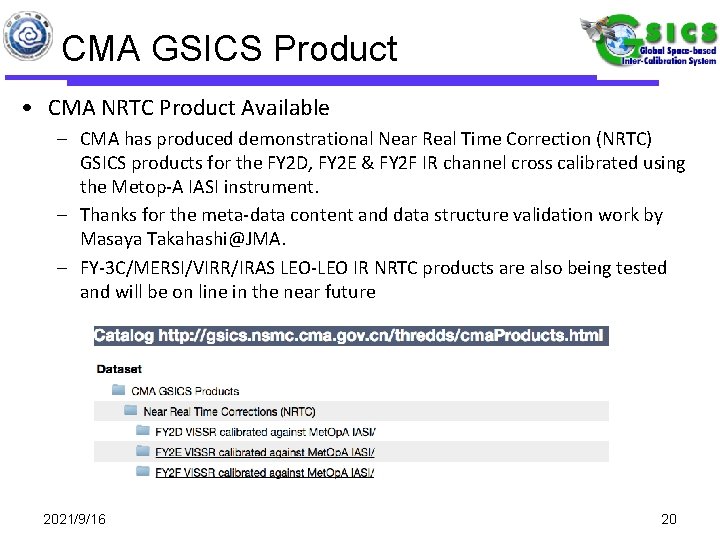
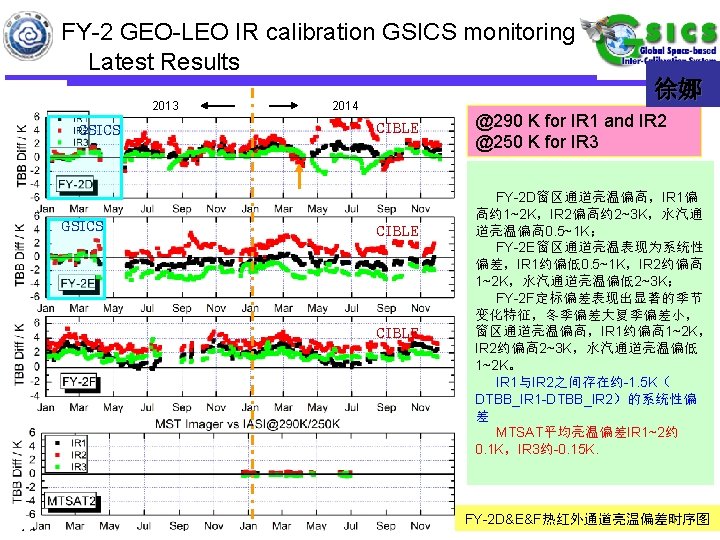
CMA GSICS Product • CMA NRTC Product Available – CMA has produced demonstrational Near Real Time Correction (NRTC) GSICS products for the FY 2 D, FY 2 E & FY 2 F IR channel cross calibrated using the Metop-A IASI instrument. – Thanks for the meta-data content and data structure validation work by Masaya Takahashi@JMA. – FY-3 C/MERSI/VIRR/IRAS LEO-LEO IR NRTC products are also being tested and will be on line in the near future 2021/9/16 20
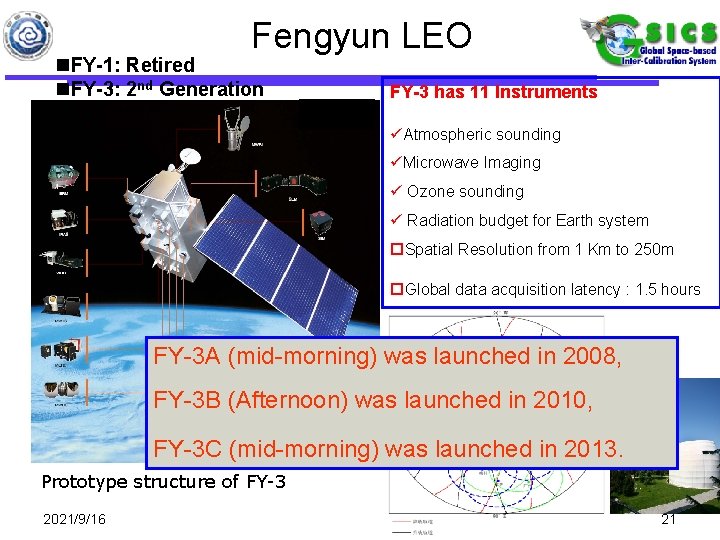
Fengyun LEO n. FY-1: Retired n. FY-3: 2 nd Generation FY-3 has 11 Instruments ok üAtmospheric sounding üMicrowave Imaging ü Ozone sounding ü Radiation budget for Earth system p. Spatial Resolution from 1 Km to 250 m p. Global data acquisition latency : 1. 5 hours FY-3 A (mid-morning) was launched in 2008, FY-3 B (Afternoon) was launched in 2010, FY-3 C (mid-morning) was launched in 2013. Prototype structure of FY-3 2021/9/16 21 21
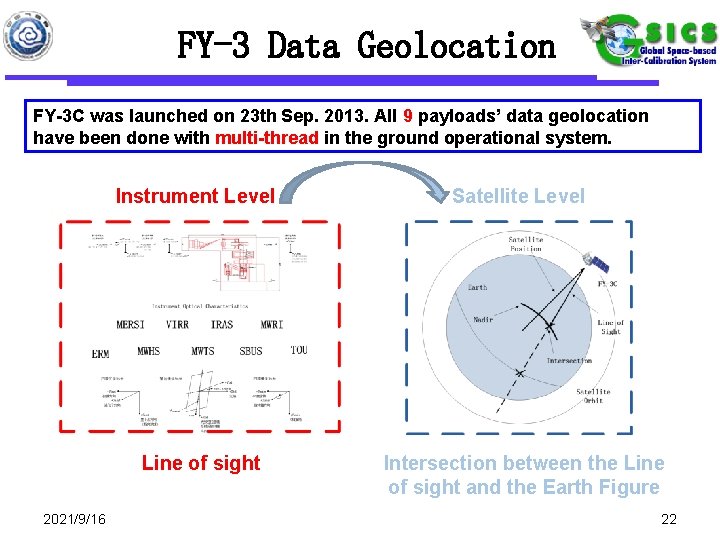
FY-3 Data Geolocation FY-3 C was launched on 23 th Sep. 2013. All 9 payloads’ data geolocation have been done with multi-thread in the ground operational system. 2021/9/16 Instrument Level Satellite Level Line of sight Intersection between the Line of sight and the Earth Figure 22
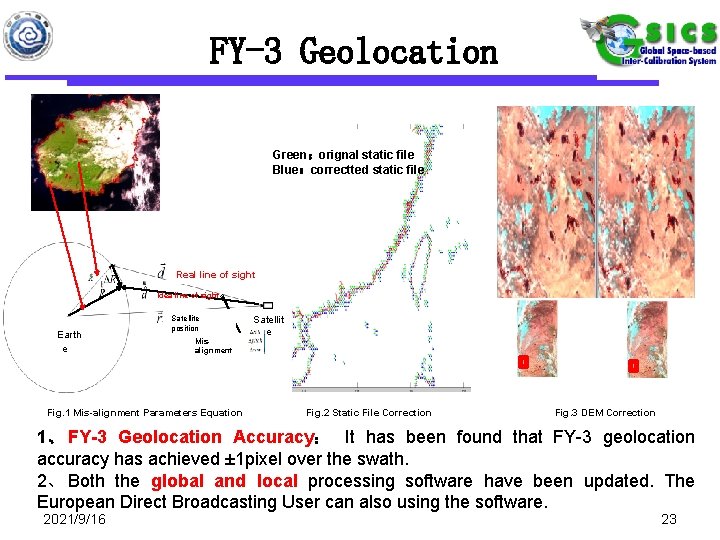
FY-3 Geolocation Green:orignal static file Blue:correctted static file Real line of sight Idea line of sight Earth Satellit e Satellite position Misalignment Fig. 1 Mis-alignment Parameters Equation Satellit e Fig. 2 Static File Correction Fig. 3 DEM Correction 1、 FY-3 Geolocation Accuracy: It has been found that FY-3 geolocation accuracy has achieved ± 1 pixel over the swath. 2、 Both the global and local processing software have been updated. The European Direct Broadcasting User can also using the software. 2021/9/16 23
Thank you for your attention! Lei Yang National Satellite Meteorological Center, China Meteorological Administration yangl@cma. gov. cn 2021/9/16 24
- Slides: 24