
Benefits and Risks of Sterilization ACOG PB 208

Benefits and Risks of Sterilization ACOG PB 208, March 2019 (Replaces Practice Bulletin Number 133, Feb 2013) Greg Epstein, PGY 2 CORE 4/14/2020
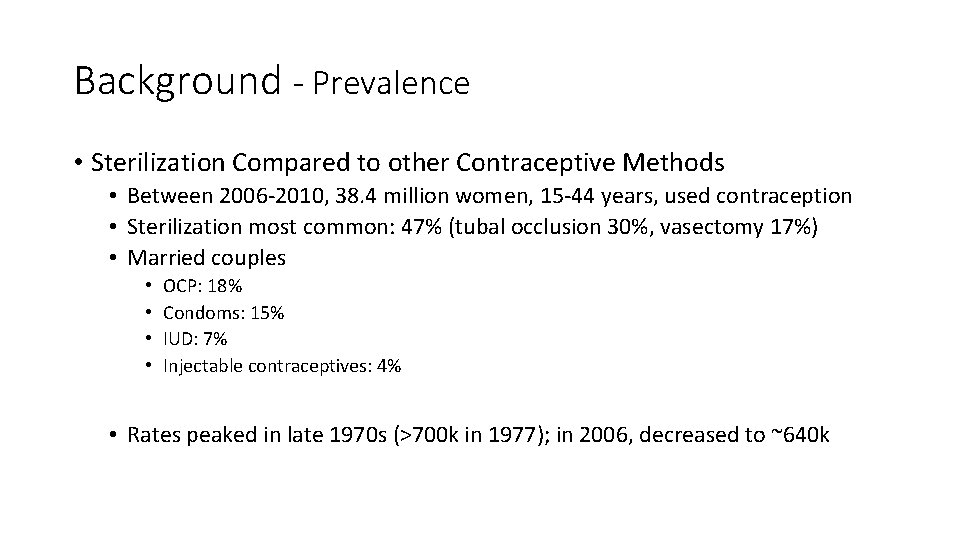
Background - Prevalence • Sterilization Compared to other Contraceptive Methods • Between 2006 -2010, 38. 4 million women, 15 -44 years, used contraception • Sterilization most common: 47% (tubal occlusion 30%, vasectomy 17%) • Married couples • • OCP: 18% Condoms: 15% IUD: 7% Injectable contraceptives: 4% • Rates peaked in late 1970 s (>700 k in 1977); in 2006, decreased to ~640 k
Background – Female Sterilization • Timing • Can be performed anytime • Affected by preference, medical risk assessment, access to service, and insurance coverage • Over 50% of all tubal occlusions are performed in early postpartum period
Background – Female Sterilization - Timing • Postpartum • Performed during cesarean, or after vaginal delivery – should not extend stay • Minilaparotomy after vaginal delivery – performed before significant uterine involution • Anesthesia can vary – usually can be done with same epidural used in labor • Requires counseling: risks, benefits, alternative methods • Obstacles may prevent up to 50% of women from receiving desire/requested sterilization between delivery and hospital discharge • • Young age / concern for regret OR / anesthesia availability Consent process Delivery at hospital with religious affiliation • Risk of unintended pregnancy approaches 50% for women who requested, but did not receive postpartum sterilization.
Background – Female Sterilization • Postpartum • Laws & regulations / insurance coverage may prevent women from receiving desired sterilization • Age limitations • Time / procedural requirements • Coverage may be restricted to pregnancy & immediate postpartum period • Maternal & neonatal complications may necessitate postponing procedure • Providers should realize these obstacles and regulations, and be proactive in planning and counseling, in order to provide the best care for their patients
Background – Female Sterilization • Post-Abortion • Can be safely performed immediately after uncomplicated SAB / TAB • Either by minilap or laparoscopic approach is acceptable • Single anesthetic can be used for abortion and tubal occlusion • Consider state regulations • Some states limit women’s ability to consent to sterilization when seeking an abortion
Background – Female Sterilization • Interval • Tubal occlusion can be performed separate from pregnancy • Check urine pregnancy test before • Does not rule-out luteal phase pregnancy • To reduce the risk of concurrent pregnancy • Perform in follicular phase, or • Use effect method of contraception before procedure
Background – Female Sterilization – approach / technique • Laparoscopy • For interval / post-abortion tubal occlusion • Advantages • Outpatient • Small incision, rapid return to normal activity • Disadvantages • Risk of injury to surrounding organs • May be performed with • Electrocoagulation • Mechanical device • T approach ubal excision
Background – Female Sterilization – approach / technique • Laparoscopy • Electrocoagulation • Bipolar energy >> Monopolar • Reduce the risk of thermal injury to bowel • At least 3 cm of isthmic portion of tube completely coagulated • Mechanical device • Silicone rubber band; spring-loaded clip; titanium clip lined with silicone • Most likely to be effective if fallopian tube is normal • Increased risk of failure / misplacement in cases of adhesions, dilated or thickened tubes
Background – Female Sterilization – approach / technique • Laparoscopy • Tubal excision (Salpingectomy) • No significant risks compared to other tubal occlusive methods • Advantages include • High efficacy • Prevention of future tubal disease • Opportunity to decrease risk of ovarian cancer
Background – Female Sterilization – approach / technique • Minilap • • Reserved for patient with high risk of complication with laparoscopy 2 -3 cm incision infraumbilical (PP) or suprapubic (interval) Appropriate for low-resource settings No difference in major morbidity compared to laparoscopic approach • Techniques • Most common (w/ minilap or cesarean): • Pomeroy, modified Pomeroy, Parkland • Important to excise sufficient section of tube to ensure luminal transection • Send tubal segments to pathology
Background – Female Sterilization – approach / technique • Hysteroscopy • Currently no devices on the market • Essure manufacturer voluntarily discontinued sales in 2018 • Postmarket surveillance study of Essure is ongoing • FDA is monitoring safety of the device
Background – Male Sterilization • Vasectomy • Outpatient, local anesthesia • Safer, more effective, less expensive than abdominal approaches to female sterilization. • Not immediately effective • Use secondary method of birth control until azoospermia confirmed on semen analysis • Most achieved by 3 months; 98 -99% azoospermic by 6 months after vasectomy
Clinical Conditions and Recommendations Who are good candidates for female sterilization? • Women who have completed childbearing. • Important to perform counseling • Technique, efficacy, safety, potential complications, alternatives (LARC) • Major risk is regret: young age, unstable relationship, low parity • No medical conditions are strictly incompatible with sterilization • Safety of surgery should be assessed in context of patient’s medical conditions
Clinical Conditions and Recommendations How safe is laparoscopic sterilization? • Overall complication rate is low; procedure-related deaths very rare • 1 -2 / 100, 000 in US; mostly due to hypoventilation and cardiopulmonary arrest during administration of general anesthesia • Usually associated with underlying medical condition • Major complications are very rare: occur in. 1 -3. 5% of LSC procedures • Overall complications: . 9 -1. 6%: unintended conversion to laparotomy. 9% • Independent predictors of complication include: general anesthesia, previous abdominal or pelvic surgery, obesity, and diabetes
Clinical Conditions and Recommendations How effective is traditional sterilization compared with reversible contraceptve methods • Short-term, user-dependent, reversible contraception (OCPs, injections, barrier) • 1 yr failure rates: overall 12%; OCP, patch, ring 9%; condom 18%, injections 3%, fertility awareness 24% • LARC (IUD / etonorgestrel implant) • 1 yr failure rates: Copper IUD. 8%; Levonorgestrel IUD. 2%; Etonorgestrel. 05% • CREST (large, prospective, multicenter observational study of 10 k women) • 5 yr failure: traditional (1. 3%) vs copper IUD (1. 4%) vs Levo-IUD (. 5 -1. 1%)
Clinical Conditions and Recommendations How does safety of sterilization compare with IUD and implant? • Few medical contraindications exist for IUD or implant • Both at least as effective, with lower morbidity & mortality • Risks with IUD • Pelvic infection in 1 st 20 days: 1% • Expulsion rate in 1 st year: 2 -10% • Perforation: . 1% • Risks with implant • Bruising/pain: 1 -3% • Migration / deep insertion: <1%
Clinical Conditions and Recommendations How does safety of sterilization compare with IUD and implant? (cont) • Risk of ectopic • CREST study: ~30% post-sterilization pregnancies were ectopic • IUD failures: 20% result in ectopic pregnancies • OVERALL: much lower risk of ectopic in patients after sterilization than those not using contraception
Clinical Conditions and Recommendations How to counsel women who have had Essure? • FDA continues to “believe that the benefits of the Essure device outweigh its risks. ” • If not experiencing complications, continue use. • 3 -yr pregnancy rate: . 48% pregnancies. • More common in women who have not undergone 3 -month f/u with HSG or TVUS to confirm proper placement, or do not use back-up contraception during this period.
Clinical Conditions and Recommendations How to counsel women who have had Essure? (cont) • Potential complications include tubal perforation (1 -3%), improper placement (. 5 -3%) and expulsion (. 4 -3%) • Hypersensitivity; small amount of nickel released each day • IF symptoms are potentially device related, and conservative treatment fails, removal is an option. • Results unclear – not all women experience relief of symptoms • Hysteroscopic removal, laparoscopic salpingectomy, and cornuectomy • Hysterectomy not necessary, but may be performed with salpingectomy if indicated
Clinical Conditions and Recommendations Most effective tubal occlusion method for postpartum sterilization? • CREST study: partial salpingectomy is associate with lower failure rates than interval laparoscopic procedures • Removal segment of tube, confirmed by pathology rather than occlusion with device or electrocautery. • Titanium clip w/ or w/o silicone rubber lining, compared to partial salpingectomy (modified Pomeroy) • Decreased efficacy when performed immediately postpartum
Clinical Conditions and Recommendations Does technique for female sterilization affect risk of ectopic pregnancy? • CREST • 10 -yr cumulative probability (. 73%) of ectopic by any method • All methods (except postpartum partial salpingectomy) have increased ectopic risk when performed in women younger < 30. • All methods: risk of ectopic is not diminished with length of time since procedure
Clinical Conditions and Recommendations How do safety and efficacy of tubal occlusion compare with vasectomy? • Vasectomy is much safer than tubal occlusion: less invasive, with local anesthesia, protective against ectopic pregnancy • 1 yr failure rate. 15% < female sterilization • Ectopic risk (per 1000 women-years) • . 005 (vasectomy) <<. 32 (tubal occlusion) << 2. 6 (no contraception) • Major M&M extremely rare; Minor complications. 4 -10% • • No causal relationship with atherosclerosis or immunologic disease No association with testicular or prostate cancer No increased risk of impotence or ability to ejaculate Rare chronic pain from obstructive epididymitis or sperm granuloma
Clinical Conditions and Recommendations Does tubal occlusion cause menstrual abnormalities • Little – no effect on menstrual patterns seen in prospective studies • Accounting for confounding factors (pre-sterilization with hormonal methods) • Conflicting data exists on the effect of hysteroscopic sterilization (Essure) on menstrual patterns
Clinical Conditions and Recommendations Are women who undergo tubal occlusion more likely to have a hysterectomy? • CREST • Pts with tubal occlusion 4 -5 times more likely to undergo hysterectomy over 14 -yr follow-up period, compared to women who’s partners had vasectomy • Independent of age and method of tubal occlusion • Associated with h/o menstrual disorders, and other benign GYN issues.
Clinical Conditions and Recommendations Does tubal occlusion have non-contraceptive benefits? • Reduced incidence of ovarian cancer (RR. 29 -. 69) • Protective effect also seen in women with BRCA 1 and BRCA 2 mutations • Evidence suggests ovarian cancer may originate from fimbriae (STIC) • Complete salpingectomy is becoming increasingly common • Reduce spread of organisms from lower genital tract into peritoneum. • Protective against PID
Clinical Conditions and Recommendations What is the risk of regret after sterilization? • CREST: 12. 7% overall probability @ 14 -yr follow-up • 20. 3% (women <30 yrs at time of sterilization) vs 5. 9% (>30 yrs) • Meta-analysis: • Women <30 yrs at time of sterilization were 3. 5 -8 times more likely to request information about reversal • 8 times more likely to undergo reversal or in vitro fertilization • Similar data for men who underwent vasectomy at young ages • CREST: negative relationship between regret and interval between delivery and sterilization. • No difference in regret associated with interval and post-abortion sterilization • Number of living children not associate with regret / request for reversal
Clinical Conditions and Recommendations How can risk be reduced? • Perform thorough and effective counseling; take into account known risk factors. • Sterilization should not be denied, even in presence of known risk factors • It is critical for health care providers to refrain from inserting their own biases or judgements • Full consideration should be given to reversible methods, especially LARC. • IUDs and etonorgestrel implant are at least as effective as sterilization
Recommendations and Conclusions Level A • Tubal occlusion by laparoscopy is a safe and effective method of permanent contraception • Tubal occlusion does not protect against STIs • Vasectomy is safer, more effective and less expensive than abdominal approach to female sterilization
Recommendations and Conclusions Level A • LSC tubal occlusion is far more effective than short-acting, user-dependent, reversible contraceptive methods (OCPs, injections, barrier methods) • LARC are at least as effective as tubal occlusion; associated with lower M&M • Although pregnancy after sterilization is rare, these pregnancies carry significant ectopic risk • Lower risk for ectopic is seen after sterilization than in non-contraceptive users
Recommendations and Conclusions Level B • Postpartum partial salpingectomy is associate with lower failure rates than interval tubal occlusions done by laparoscopy • Laparoscopic tubal occlusion reduces the incidence of ovarian cancer
Recommendations and Conclusions • Level C • Women should be counseled about the risk of failure, risk of regret, and alternatives (LARC and vasectomy). • In well-informed women, age and parity should not obstacles to sterilization.
- Slides: 32