
BENEFITS 70 Cloud Trend of CIOs will embrace

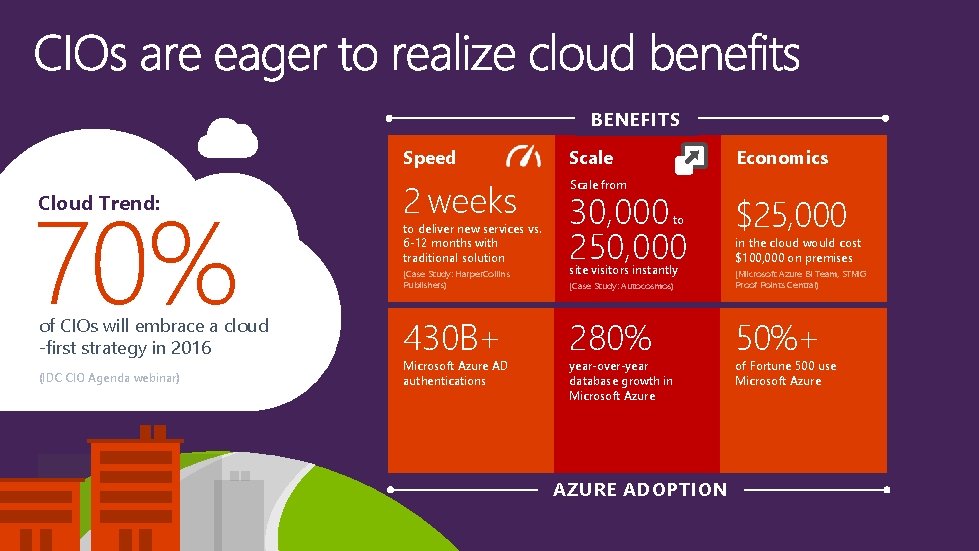
BENEFITS 70% Cloud Trend: of CIOs will embrace a cloud -first strategy in 2016 (IDC CIO Agenda webinar) Speed Scale 2 weeks Scale from to deliver new services vs. 6 -12 months with traditional solution (Case Study: Harper. Collins Publishers) 430 B+ Microsoft Azure AD authentications Economics 30, 000 250, 000 to site visitors instantly $25, 000 in the cloud would cost $100, 000 on premises (Case Study: Autocosmos) (Microsoft Azure BI Team, STMG Proof Points Central) 280% 50%+ year-over-year database growth in Microsoft Azure AZURE ADOPTION of Fortune 500 use Microsoft Azure
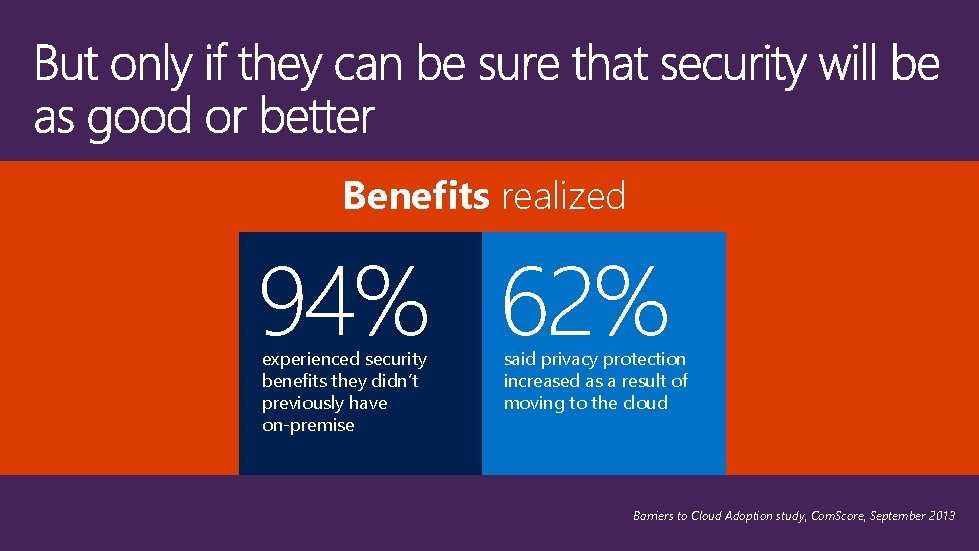
Pre-adoption Benefits realized concern 94% 60% 62% 45% experienced security cited concerns around benefits they as didn’t data security a barrier previously to adoptionhave on-premise said concerned privacythat protection the increased cloud would as aresultinof a moving lack of data to the control cloud Barriers to Cloud Adoption study, Com. Score, September 2013
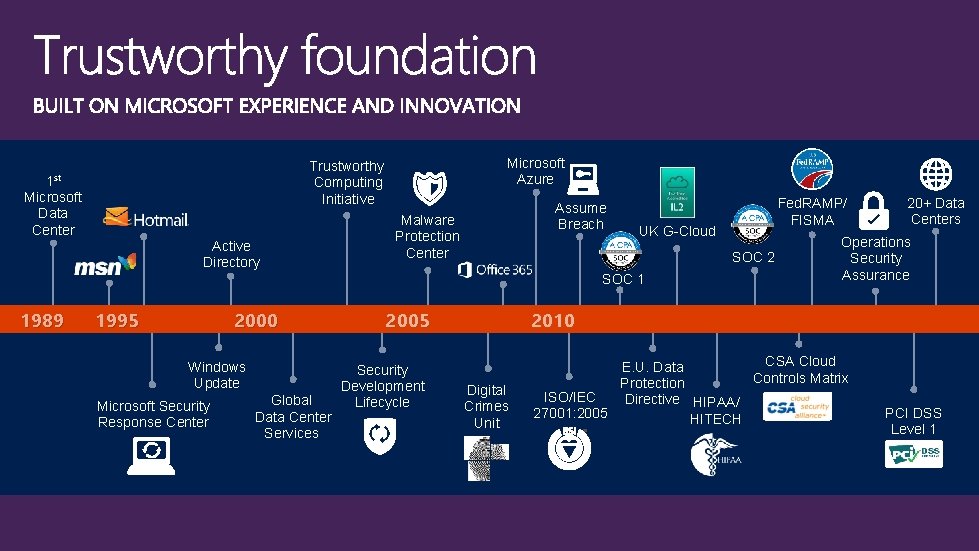
Microsoft Azure Trustworthy Computing Initiative 1 st Microsoft Data Center Active Directory Assume Breach Malware Protection Center UK G-Cloud SOC 2 SOC 1 1989 1995 2000 Windows Update Microsoft Security Response Center Global Data Center Services 2005 Security Development Lifecycle Fed. RAMP/ FISMA 20+ Data Centers Operations Security Assurance 2010 Digital Crimes Unit CSA Cloud E. U. Data Controls Matrix Protection ISO/IEC Directive HIPAA/ 27001: 2005 HITECH PCI DSS Level 1
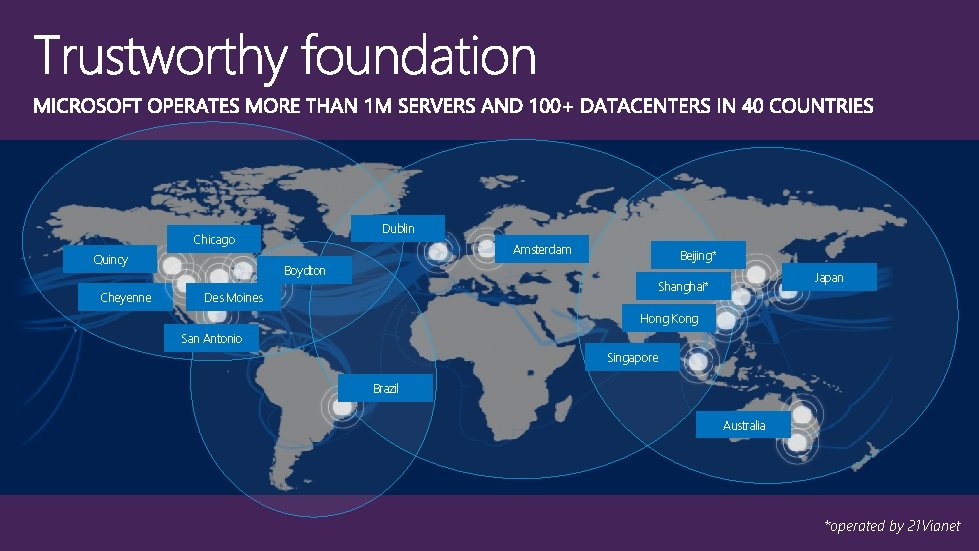
Dublin Chicago Quincy Cheyenne Amsterdam Boydton Beijing* Japan Shanghai* Des Moines Hong Kong San Antonio Singapore Brazil Australia *operated by 21 Vianet
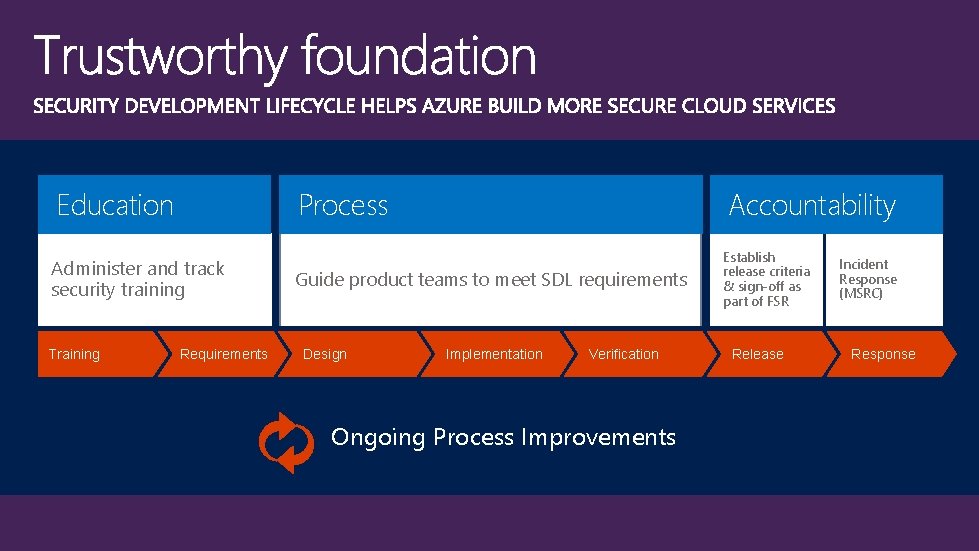
Education Administer and track security training Training Accountability Process Requirements Guide product teams to meet SDL requirements Design Implementation Verification Ongoing Process Improvements Establish release criteria & sign-off as part of FSR Release Incident Response (MSRC) Response
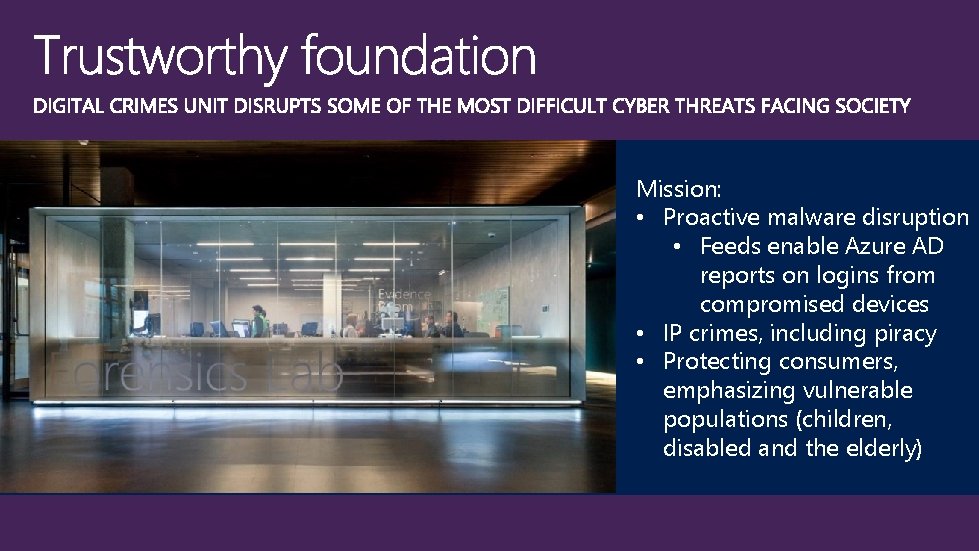
Mission: • Proactive malware disruption • Feeds enable Azure AD reports on logins from compromised devices • IP crimes, including piracy • Protecting consumers, emphasizing vulnerable populations (children, disabled and the elderly)
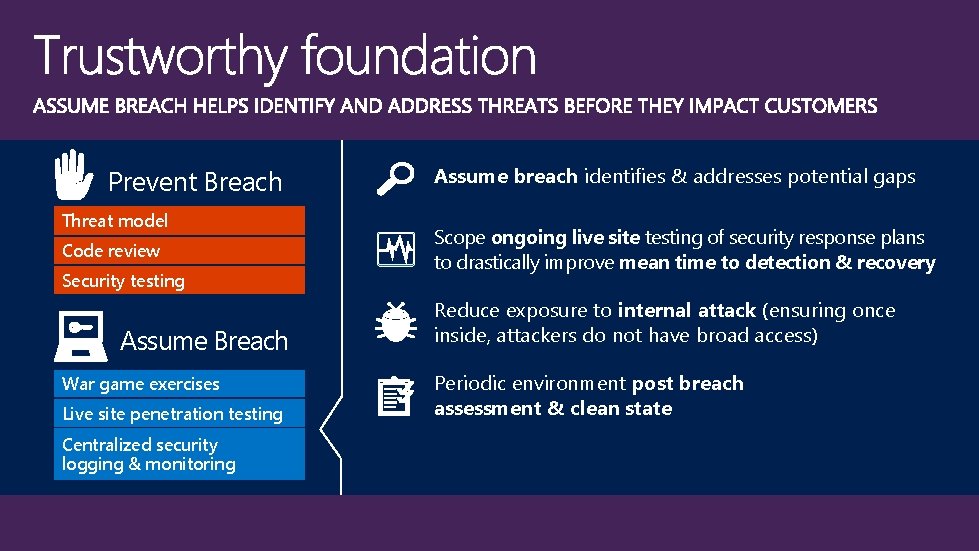
Prevent Breach Threat model Code review Security testing Assume Breach War game exercises Live site penetration testing Centralized security logging & monitoring Assume breach identifies & addresses potential gaps Scope ongoing live site testing of security response plans to drastically improve mean time to detection & recovery Reduce exposure to internal attack (ensuring once inside, attackers do not have broad access) Periodic environment post breach assessment & clean state
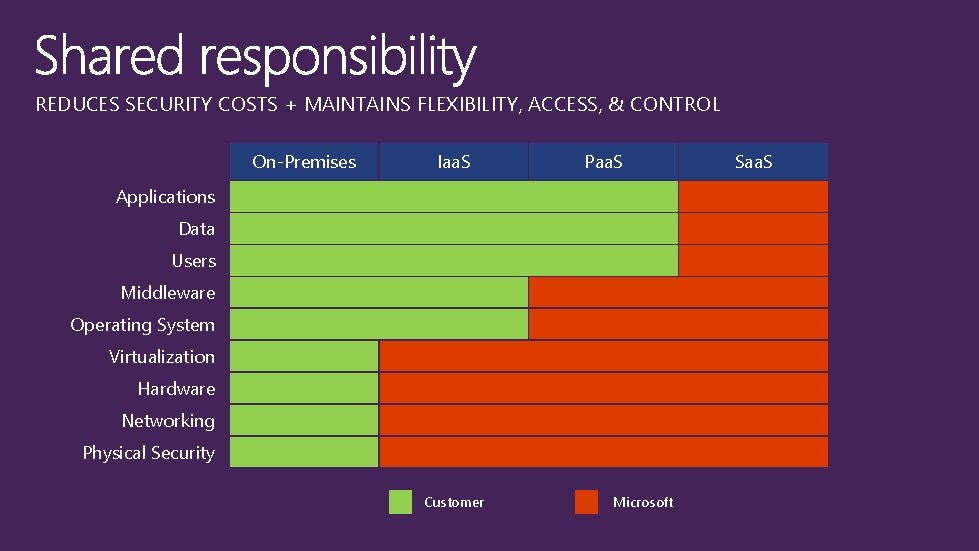
REDUCES SECURITY COSTS + MAINTAINS FLEXIBILITY, ACCESS, & CONTROL On-Premises Iaa. S Paa. S Applications Data Users Middleware Operating System Virtualization Hardware Networking Physical Security Customer Microsoft Saa. S
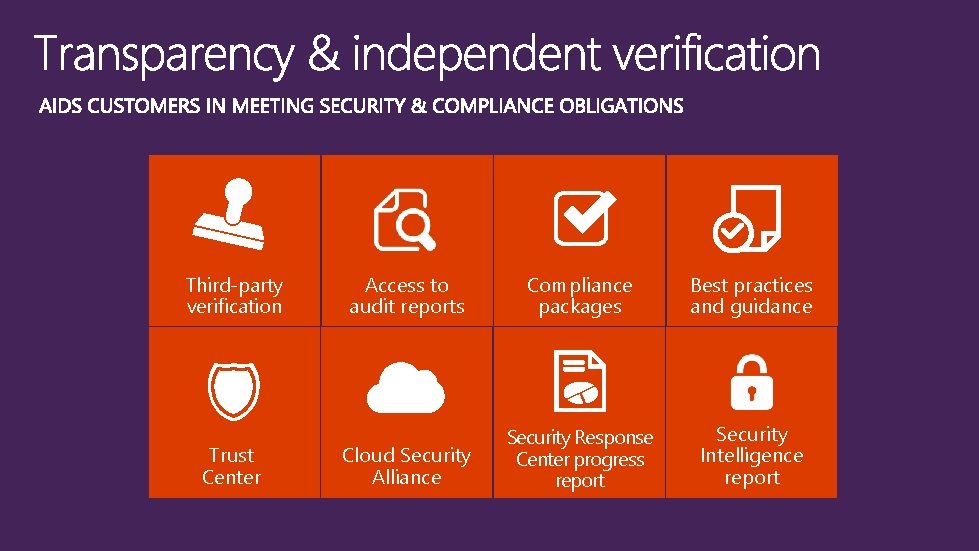
Third-party verification Trust Center Access to audit reports Compliance packages Best practices and guidance Cloud Security Alliance Security Response Center progress report Security Intelligence report
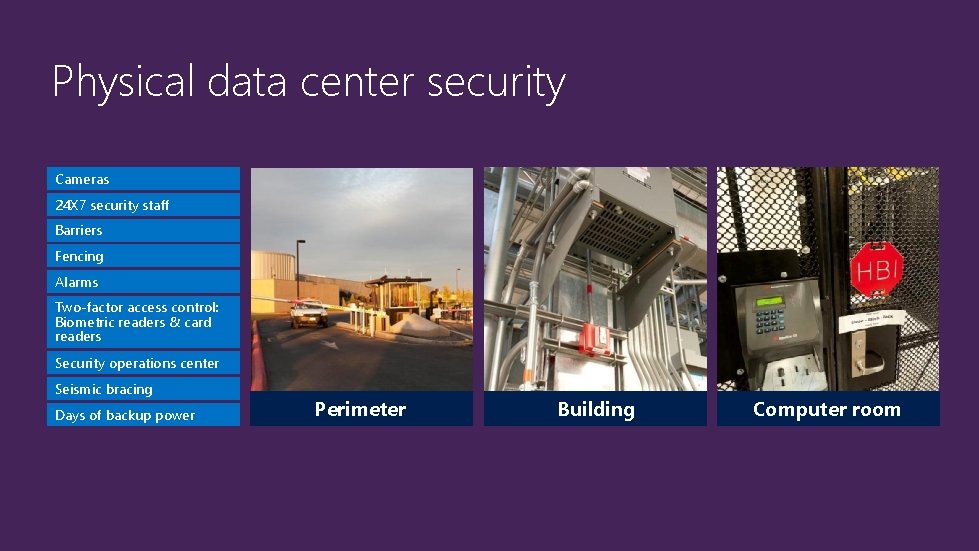
Physical data center security Cameras 24 X 7 security staff Barriers Fencing Alarms Two-factor access control: Biometric readers & card readers Security operations center Seismic bracing Days of backup power Perimeter Building Computer room
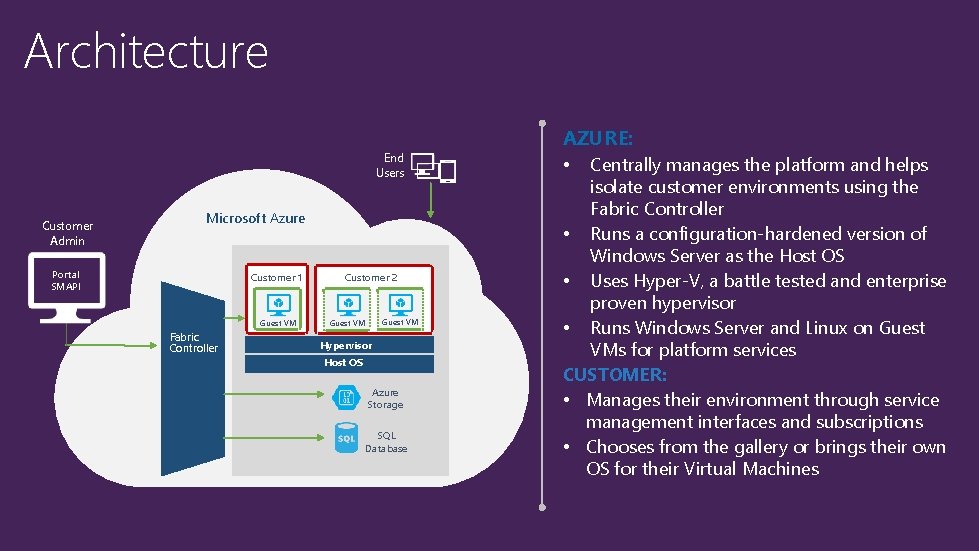
Architecture End Users Customer Admin Microsoft Azure Portal SMAPI Customer 1 Guest VM Fabric Controller Customer 2 Guest VM Hypervisor Host OS Azure Storage SQL Database AZURE: Centrally manages the platform and helps isolate customer environments using the Fabric Controller • Runs a configuration-hardened version of Windows Server as the Host OS • Uses Hyper-V, a battle tested and enterprise proven hypervisor • Runs Windows Server and Linux on Guest VMs for platform services CUSTOMER: • Manages their environment through service management interfaces and subscriptions • Chooses from the gallery or brings their own OS for their Virtual Machines •
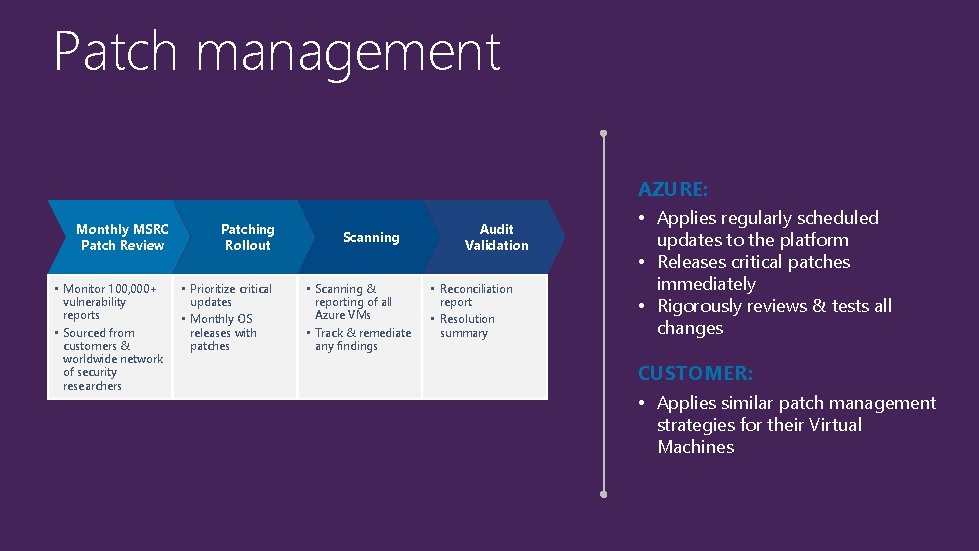
Patch management AZURE: Monthly MSRC Patch Review • Monitor 100, 000+ vulnerability reports • Sourced from customers & worldwide network of security researchers Patching Rollout • Prioritize critical updates • Monthly OS releases with patches Scanning • Scanning & reporting of all Azure VMs • Track & remediate any findings Audit Validation • Reconciliation report • Resolution summary • Applies regularly scheduled updates to the platform • Releases critical patches immediately • Rigorously reviews & tests all changes CUSTOMER: • Applies similar patch management strategies for their Virtual Machines
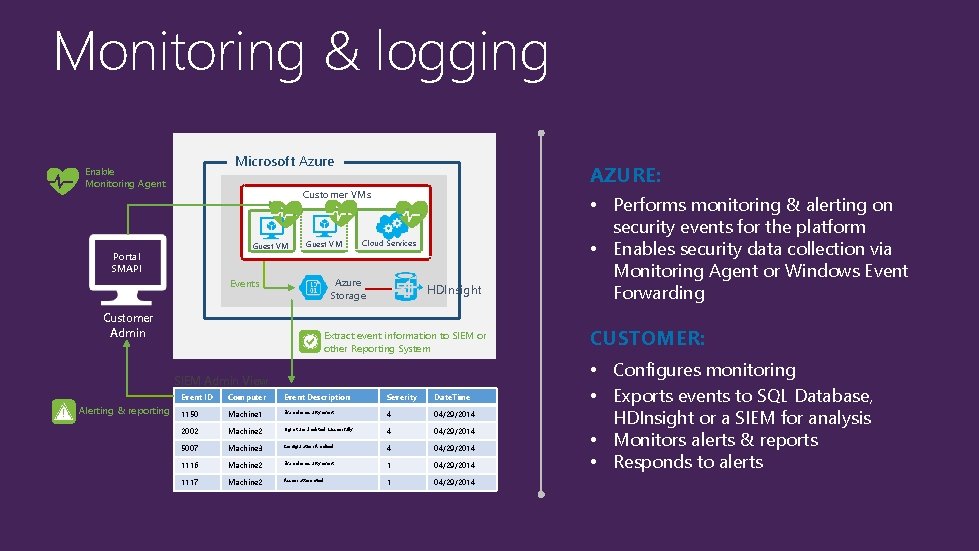
Monitoring & logging Microsoft Azure Enable Monitoring Agent AZURE: Customer VMs Guest VM Portal SMAPI Guest VM Cloud Services Azure Storage Events Customer Admin HDInsight Extract event information to SIEM or other Reporting System SIEM Admin View Alerting & reporting Event ID Computer Event Description Severity Date. Time 1150 Machine 1 Example security event 4 04/29/2014 2002 Machine 2 Signature Updated Successfully 4 04/29/2014 5007 Machine 3 Configuration Applied 4 04/29/2014 1116 Machine 2 Example security event 1 04/29/2014 1117 Machine 2 Access attempted 1 04/29/2014 • Performs monitoring & alerting on security events for the platform • Enables security data collection via Monitoring Agent or Windows Event Forwarding CUSTOMER: • Configures monitoring • Exports events to SQL Database, HDInsight or a SIEM for analysis • Monitors alerts & reports • Responds to alerts
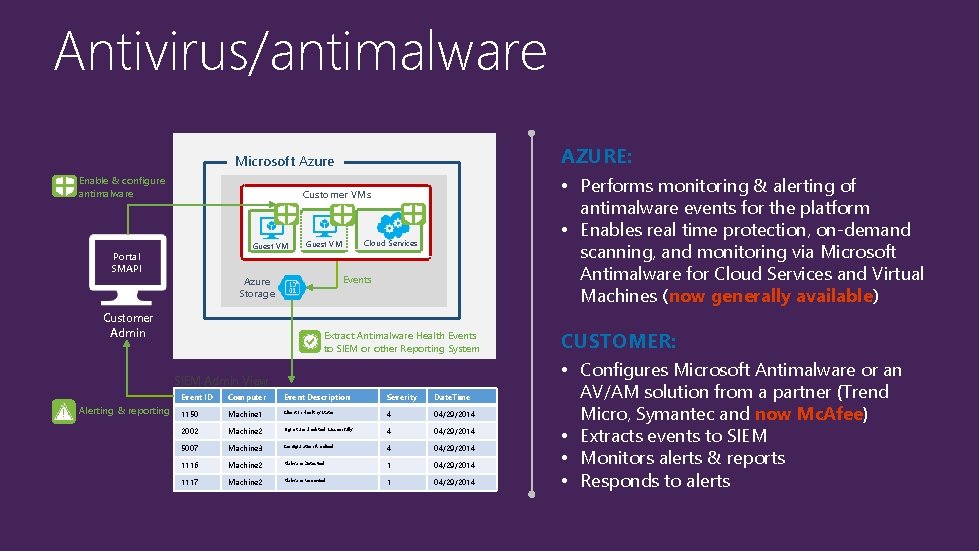
Antivirus/antimalware AZURE: Microsoft Azure Enable & configure antimalware • Performs monitoring & alerting of antimalware events for the platform • Enables real time protection, on-demand scanning, and monitoring via Microsoft Antimalware for Cloud Services and Virtual Machines (now generally available) Customer VMs Guest VM Portal SMAPI Cloud Services Guest VM Events Azure Storage Customer Admin Extract Antimalware Health Events to SIEM or other Reporting System SIEM Admin View Alerting & reporting Event ID Computer Event Description Severity Date. Time 1150 Machine 1 Client in Healthy State 4 04/29/2014 2002 Machine 2 Signature Updated Successfully 4 04/29/2014 5007 Machine 3 Configuration Applied 4 04/29/2014 1116 Machine 2 Malware Detected 1 04/29/2014 1117 Machine 2 Malware Removed 1 04/29/2014 CUSTOMER: • Configures Microsoft Antimalware or an AV/AM solution from a partner (Trend Micro, Symantec and now Mc. Afee) • Extracts events to SIEM • Monitors alerts & reports • Responds to alerts
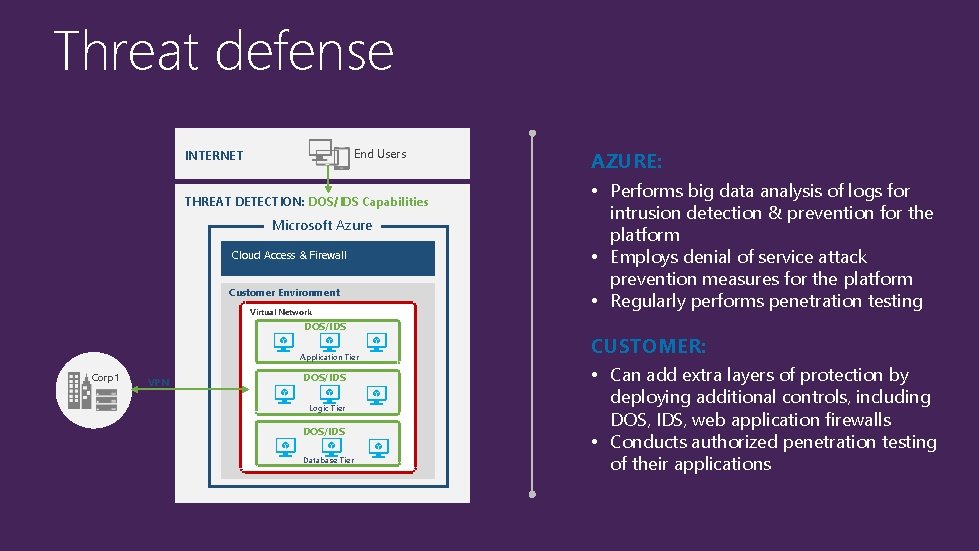
Threat defense End Users INTERNET THREAT DETECTION: DOS/IDS Capabilities Microsoft Azure Cloud Access & Firewall Customer Environment Virtual Network DOS/IDS Application Tier Corp 1 VPN DOS/IDS Logic Tier DOS/IDS Database Tier AZURE: • Performs big data analysis of logs for intrusion detection & prevention for the platform • Employs denial of service attack prevention measures for the platform • Regularly performs penetration testing CUSTOMER: • Can add extra layers of protection by deploying additional controls, including DOS, IDS, web application firewalls • Conducts authorized penetration testing of their applications
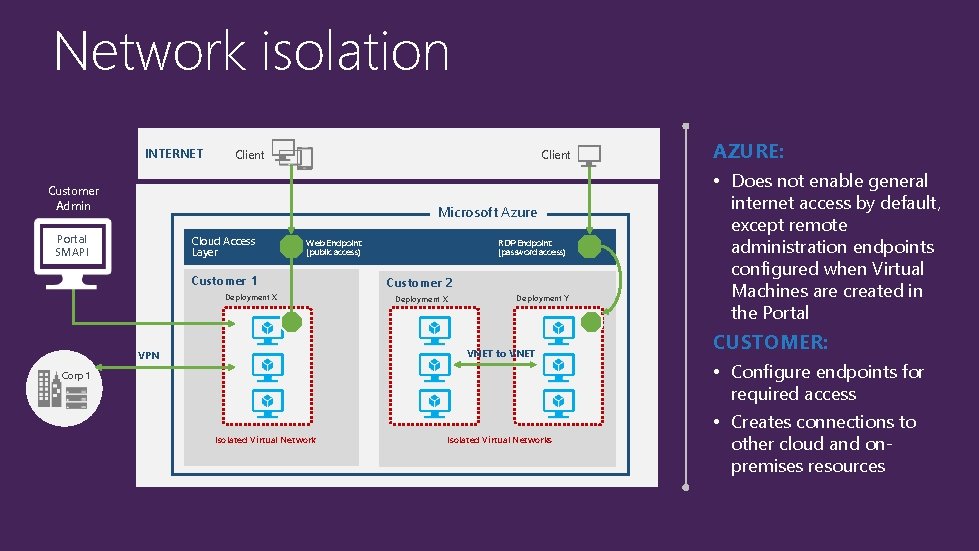
Network isolation INTERNET Client Customer Admin Microsoft Azure Portal SMAPI Smart API Cloud Access Layer Web Endpoint (public access) Customer 1 Deployment X RDP Endpoint (password access) Customer 2 Deployment X Deployment Y VNET to VNET VPN Corp 1 Isolated Virtual Networks AZURE: • Does not enable general internet access by default, except remote administration endpoints configured when Virtual Machines are created in the Portal CUSTOMER: • Configure endpoints for required access • Creates connections to other cloud and onpremises resources
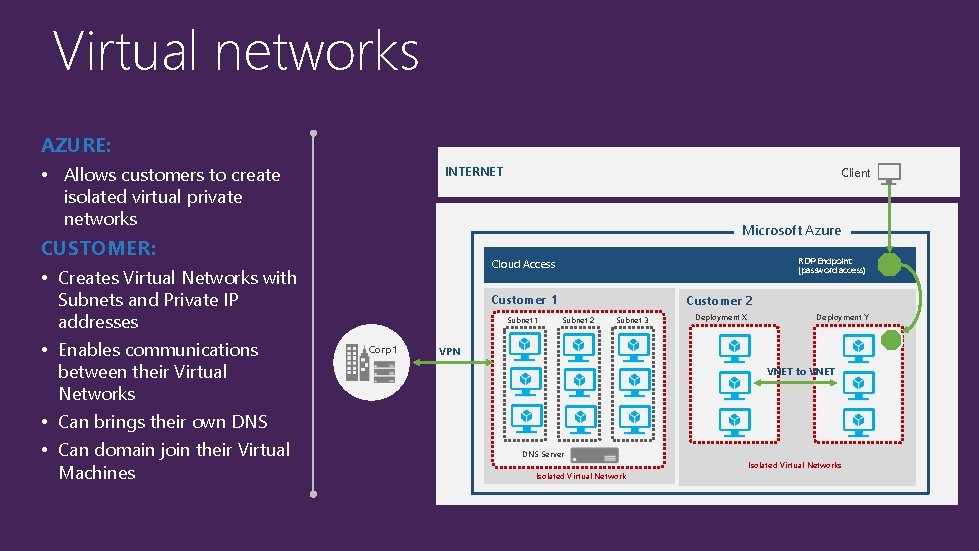
Virtual networks AZURE: • Allows customers to create isolated virtual private networks INTERNET Microsoft Azure CUSTOMER: • Creates Virtual Networks with Subnets and Private IP addresses • Enables communications between their Virtual Networks • Can brings their own DNS • Can domain join their Virtual Machines Client RDP Endpoint (password access) Cloud Access Customer 1 Subnet 1 Corp 1 Customer 2 Subnet 3 Deployment X Deployment Y VPN VNET to VNET DNS Server Isolated Virtual Networks
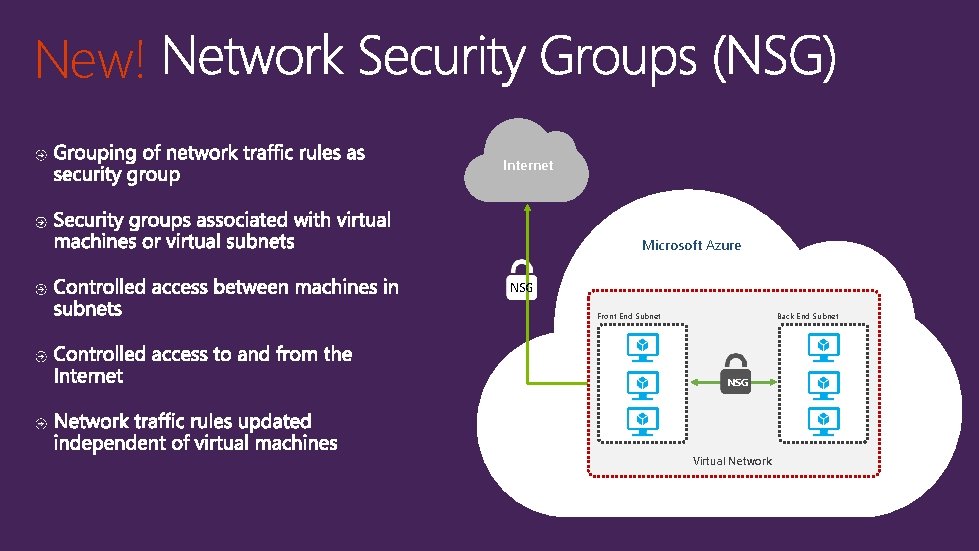
New! Internet Microsoft Azure NSG Back End Subnet Front End Subnet NSG Virtual Network
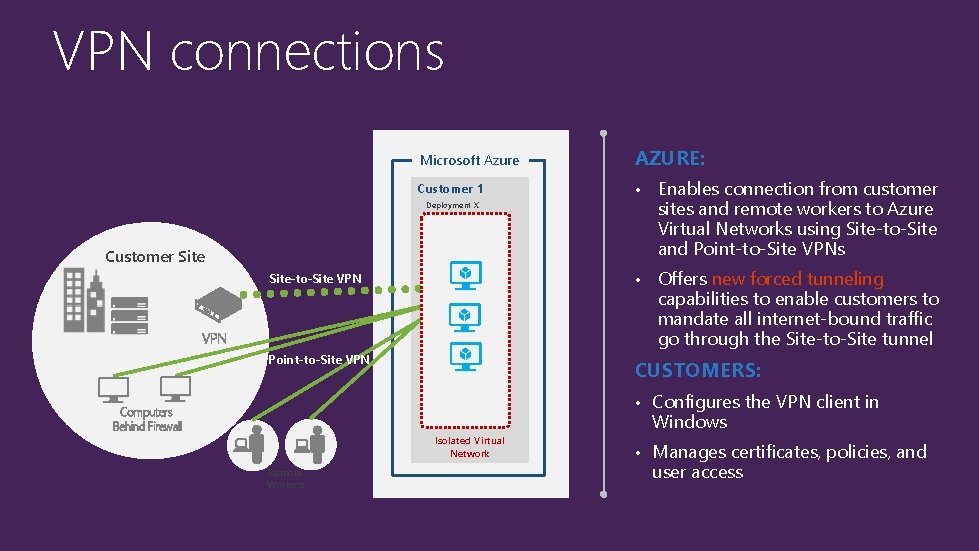
VPN connections Microsoft Azure AZURE: Customer 1 • Enables connection from customer sites and remote workers to Azure Virtual Networks using Site-to-Site and Point-to-Site VPNs Site-to-Site VPN • Offers new forced tunneling capabilities to enable customers to mandate all internet-bound traffic go through the Site-to-Site tunnel Point-to-Site VPN CUSTOMERS: Deployment X Customer Site VPN Computers Behind Firewall Isolated Virtual Network Remote Workers • Configures the VPN client in Windows • Manages certificates, policies, and user access
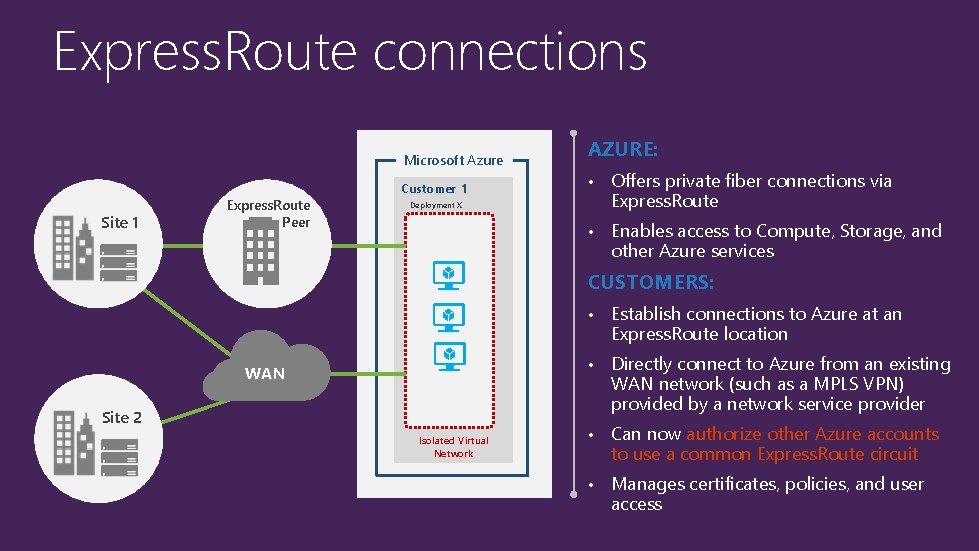
Express. Route connections Microsoft Azure Site 1 Express. Route Peer Customer 1 AZURE: • Offers private fiber connections via Express. Route • Enables access to Compute, Storage, and other Azure services Deployment X CUSTOMERS: WAN Site 2 Isolated Virtual Network • Establish connections to Azure at an Express. Route location • Directly connect to Azure from an existing WAN network (such as a MPLS VPN) provided by a network service provider • Can now authorize other Azure accounts to use a common Express. Route circuit • Manages certificates, policies, and user access
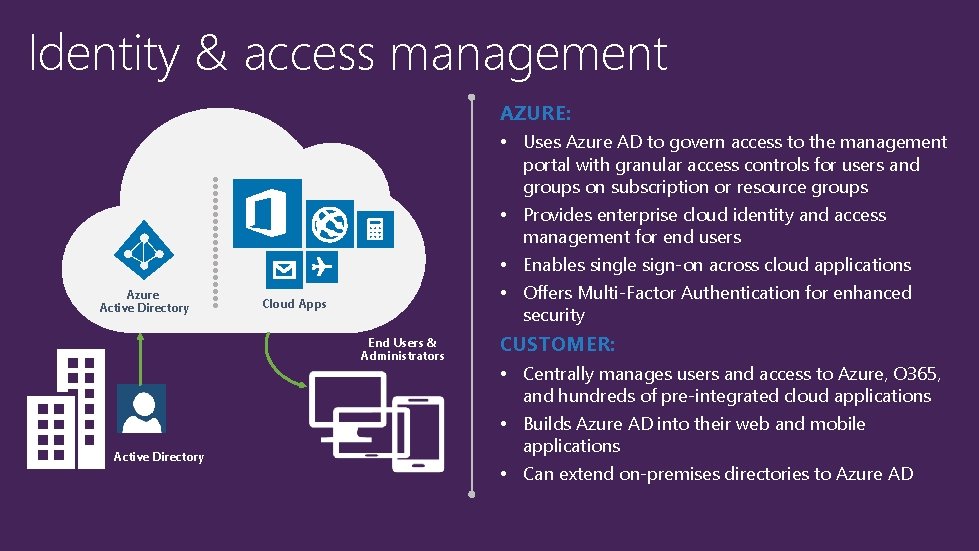
Identity & access management AZURE: Azure Active Directory • Uses Azure AD to govern access to the management portal with granular access controls for users and groups on subscription or resource groups • Provides enterprise cloud identity and access management for end users • Enables single sign-on across cloud applications • Offers Multi-Factor Authentication for enhanced security Cloud Apps End Users & Administrators Active Directory CUSTOMER: • Centrally manages users and access to Azure, O 365, and hundreds of pre-integrated cloud applications • Builds Azure AD into their web and mobile applications • Can extend on-premises directories to Azure AD
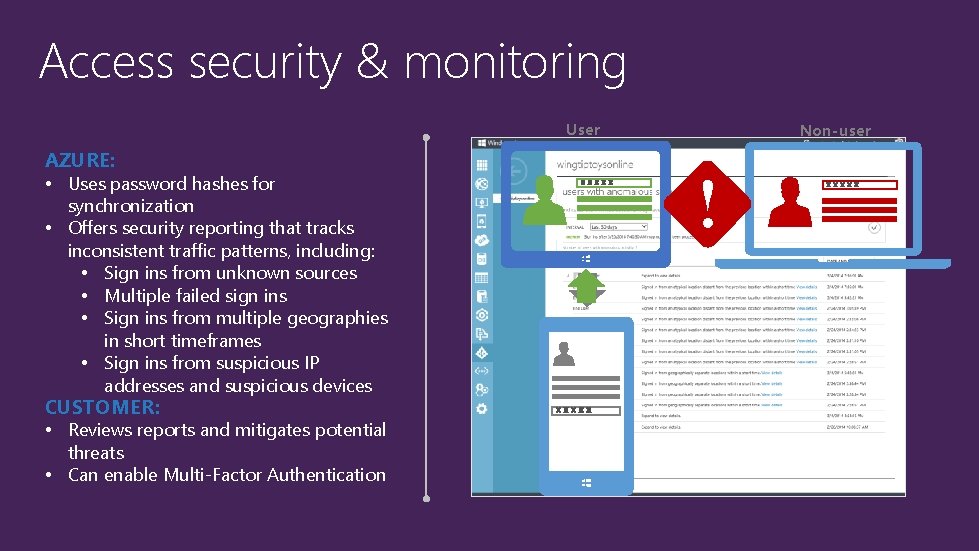
Access security & monitoring User AZURE: • Uses password hashes for synchronization • Offers security reporting that tracks inconsistent traffic patterns, including: • Sign ins from unknown sources • Multiple failed sign ins • Sign ins from multiple geographies in short timeframes • Sign ins from suspicious IP addresses and suspicious devices CUSTOMER: • Reviews reports and mitigates potential threats • Can enable Multi-Factor Authentication Non-user
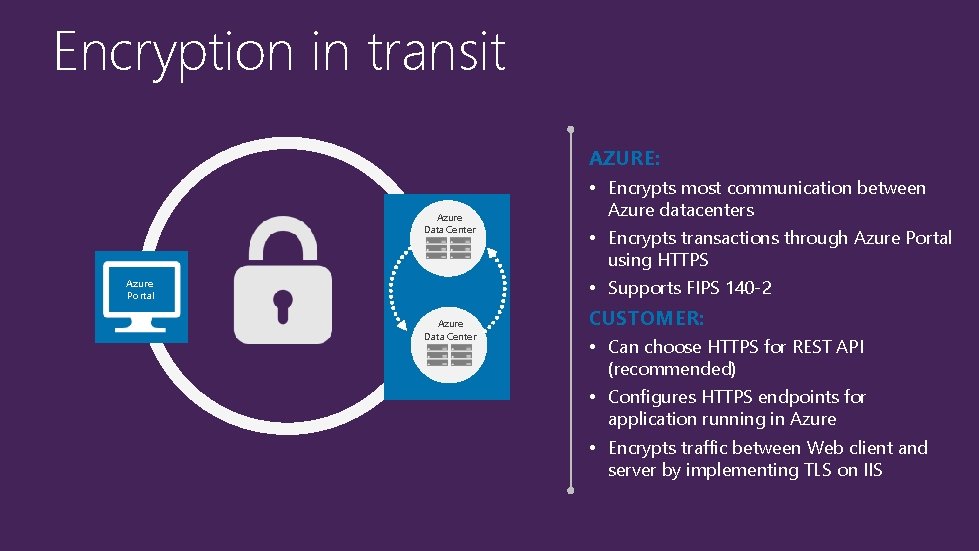
Encryption in transit AZURE: Azure Data Center Azure Portal Azure Data Center • Encrypts most communication between Azure datacenters • Encrypts transactions through Azure Portal using HTTPS • Supports FIPS 140 -2 CUSTOMER: • Can choose HTTPS for REST API (recommended) • Configures HTTPS endpoints for application running in Azure • Encrypts traffic between Web client and server by implementing TLS on IIS
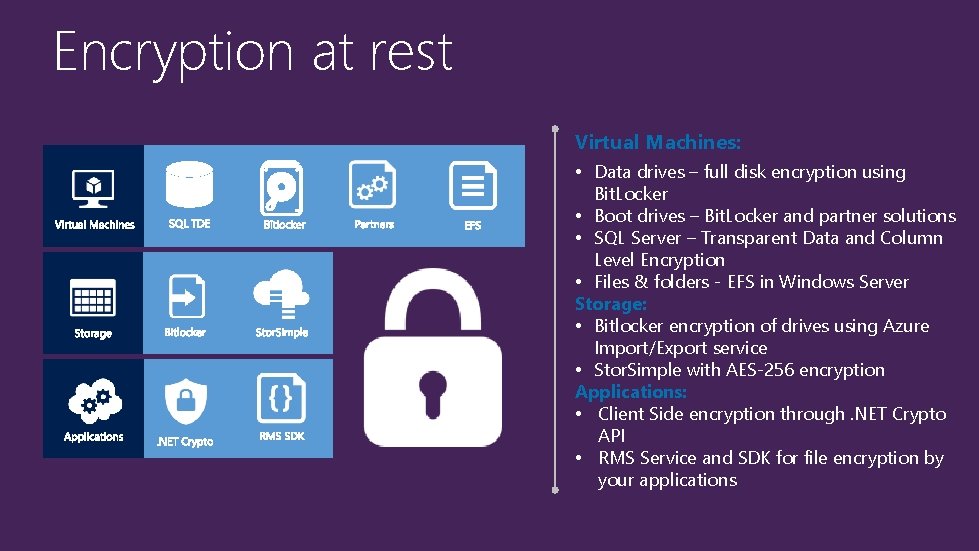
Encryption at rest Virtual Machines: • Data drives – full disk encryption using Bit. Locker • Boot drives – Bit. Locker and partner solutions • SQL Server – Transparent Data and Column Level Encryption • Files & folders - EFS in Windows Server Storage: • Bitlocker encryption of drives using Azure Import/Export service • Stor. Simple with AES-256 encryption Applications: • Client Side encryption through. NET Crypto API • RMS Service and SDK for file encryption by your applications
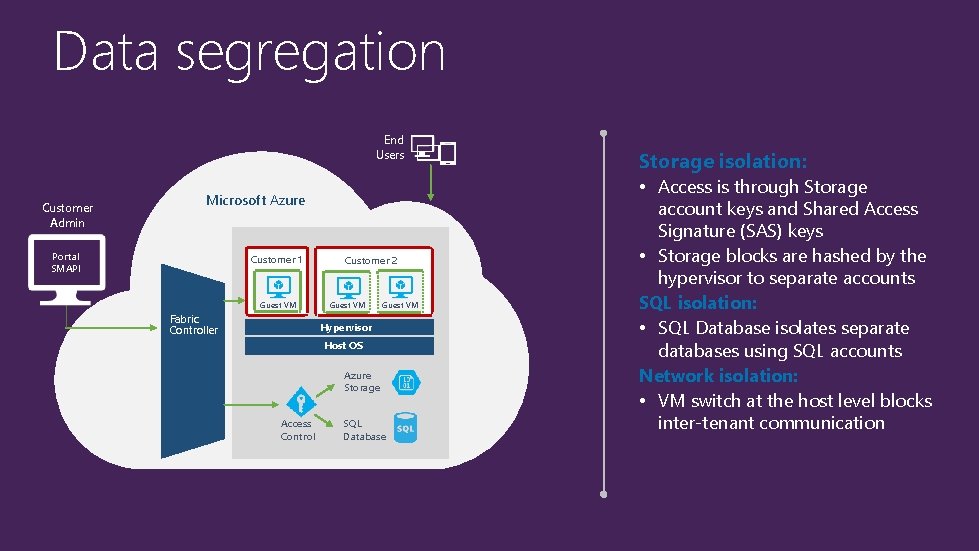
Data segregation End Users Customer Admin Microsoft Azure Portal SMAPI Customer 1 Guest VM Fabric Controller Customer 2 Guest VM Hypervisor Host OS Azure Storage Access Control SQL Database Storage isolation: • Access is through Storage account keys and Shared Access Signature (SAS) keys • Storage blocks are hashed by the hypervisor to separate accounts SQL isolation: • SQL Database isolates separate databases using SQL accounts Network isolation: • VM switch at the host level blocks inter-tenant communication
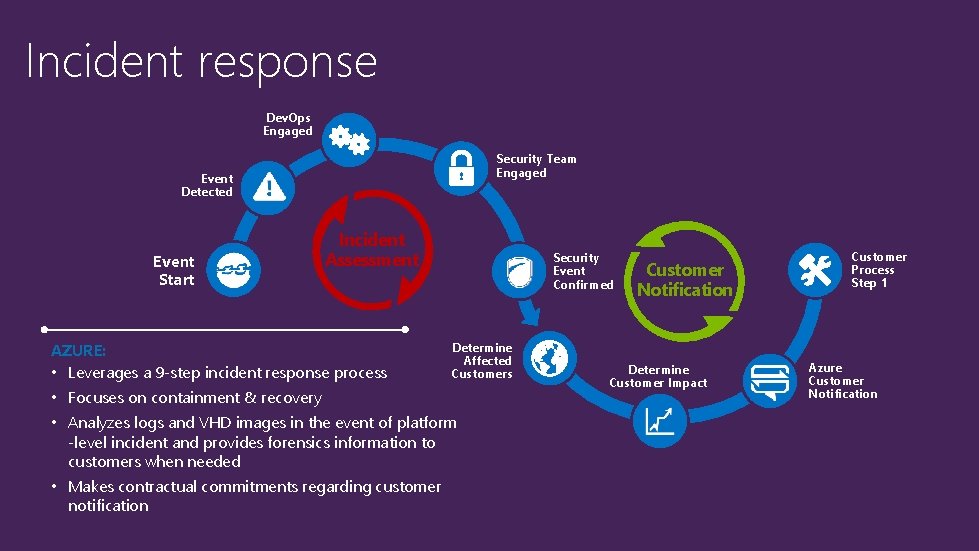
Incident response Dev. Ops Engaged Security Team Engaged Event Detected Event Start Incident Assessment AZURE: • Leverages a 9 -step incident response process Security Event Confirmed Determine Affected Customers • Focuses on containment & recovery • Analyzes logs and VHD images in the event of platform -level incident and provides forensics information to customers when needed • Makes contractual commitments regarding customer notification Customer Notification Determine Customer Impact Customer Process Step 1 Azure Customer Notification
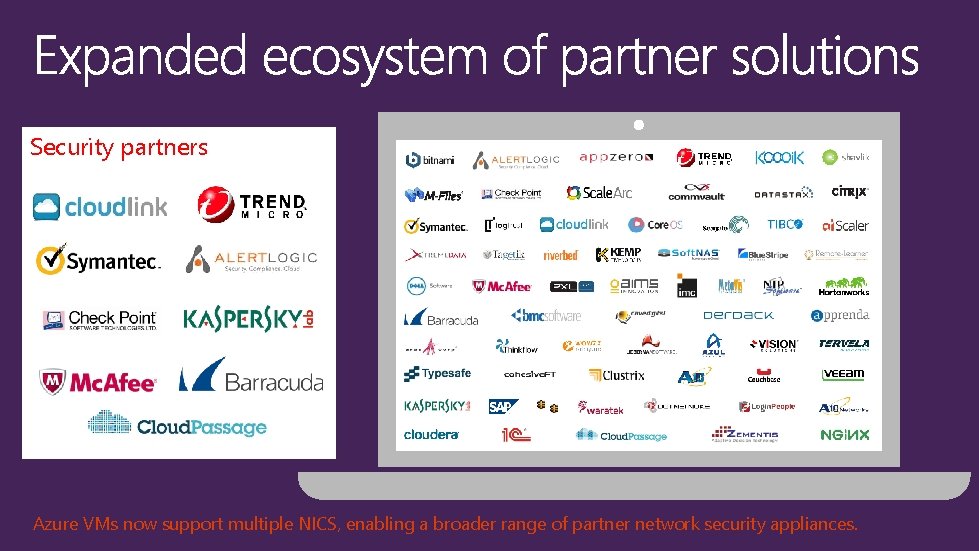
Security partners Azure VMs now support multiple NICS, enabling a broader range of partner network security appliances.
33
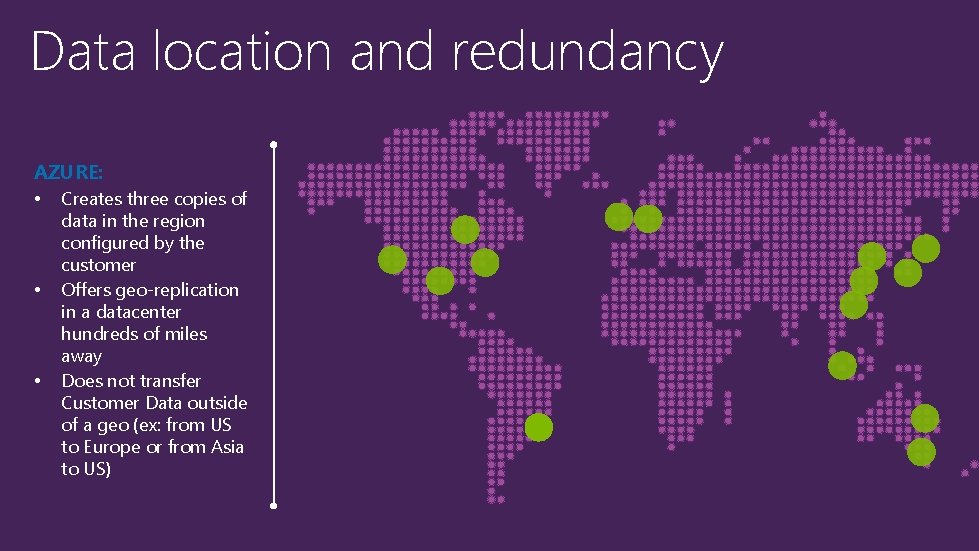
Data location and redundancy AZURE: • • • Creates three copies of data in the region configured by the customer Offers geo-replication in a datacenter hundreds of miles away Does not transfer Customer Data outside of a geo (ex: from US to Europe or from Asia to US)
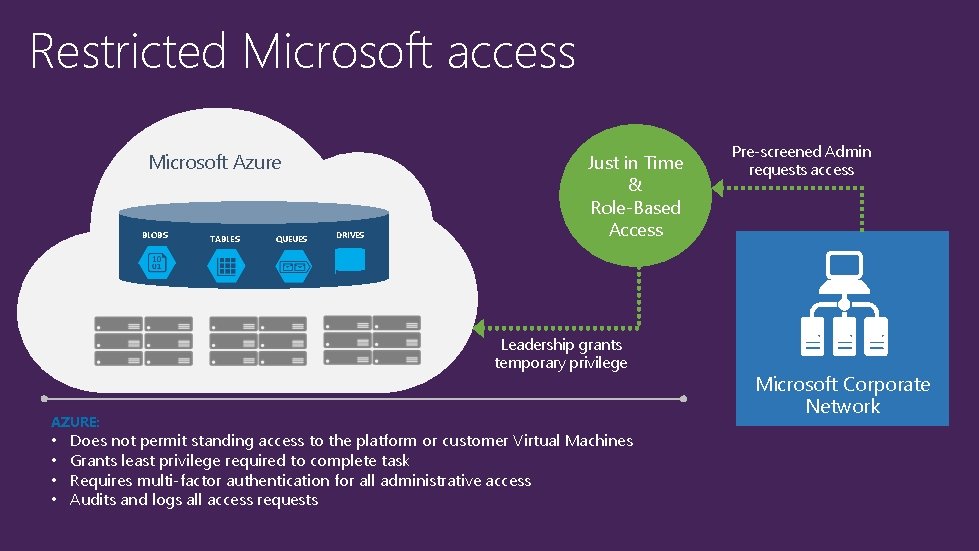
Restricted Microsoft access Microsoft Azure BLOBS TABLES QUEUES DRIVES Just in Time & Role-Based Access Leadership grants temporary privilege AZURE: • • Does not permit standing access to the platform or customer Virtual Machines Grants least privilege required to complete task Requires multi-factor authentication for all administrative access Audits and logs all access requests Pre-screened Admin requests access Microsoft Corporate Network
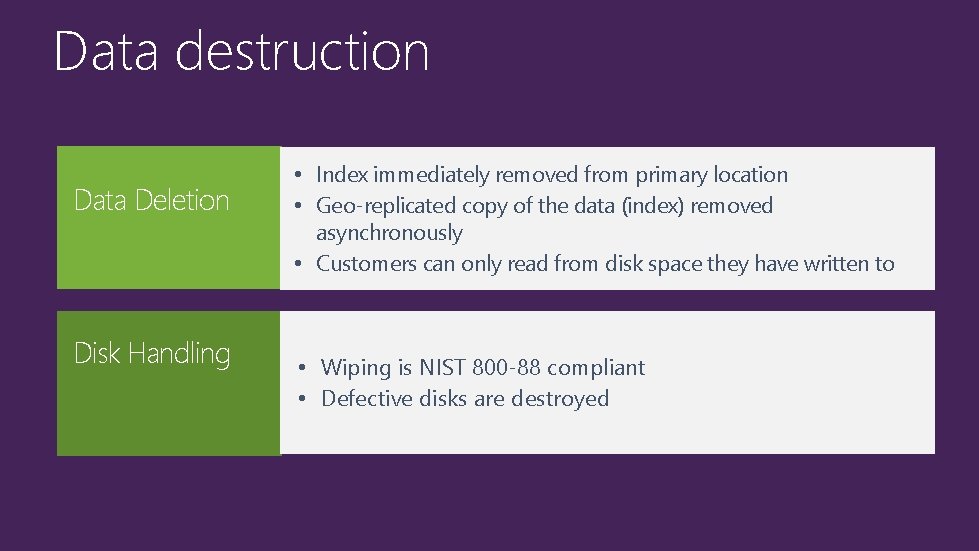
Data destruction Data Deletion Disk Handling • Index immediately removed from primary location • Geo-replicated copy of the data (index) removed asynchronously • Customers can only read from disk space they have written to • Wiping is NIST 800 -88 compliant • Defective disks are destroyed
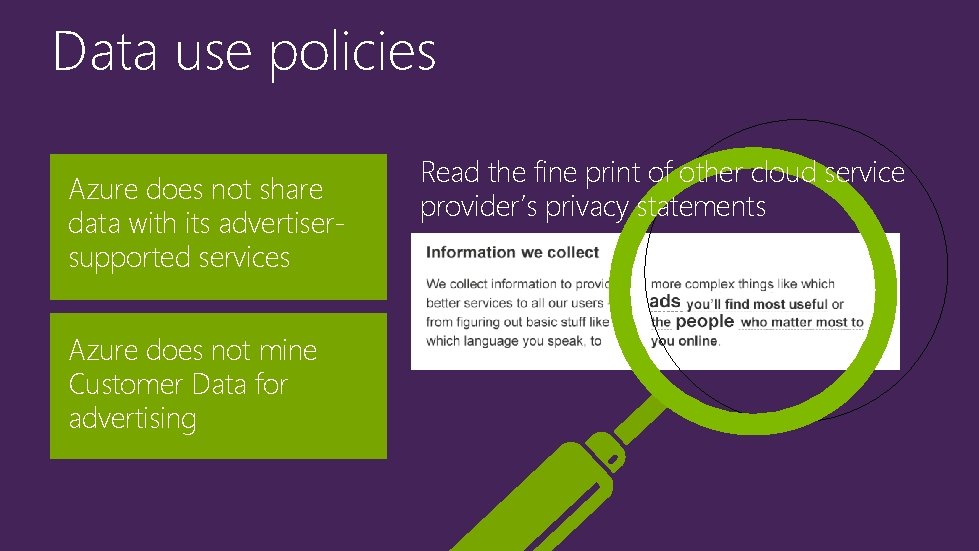
Data use policies Azure does not share data with its advertisersupported services Azure does not mine Customer Data for advertising Read the fine print of other cloud service provider’s privacy statements
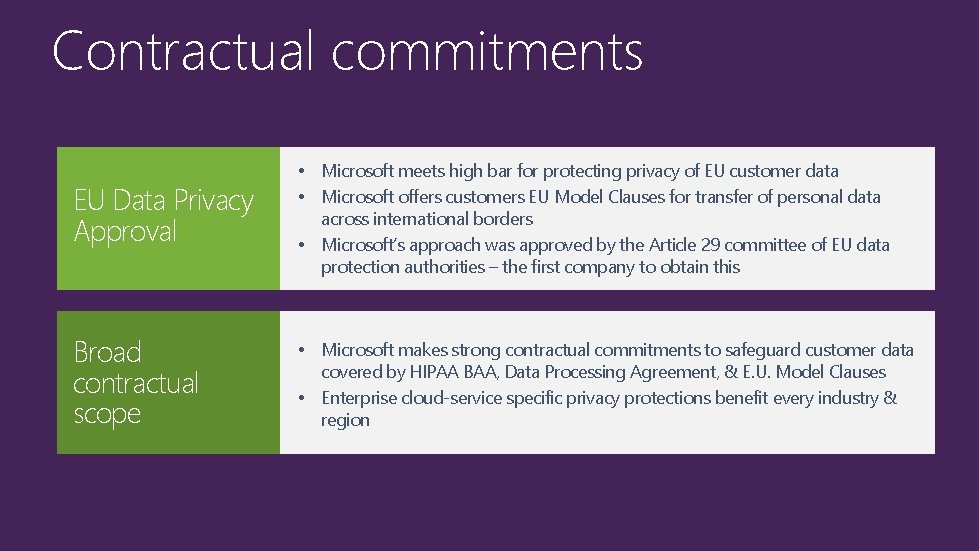
Contractual commitments EU Data Privacy Approval • Microsoft meets high bar for protecting privacy of EU customer data • Microsoft offers customers EU Model Clauses for transfer of personal data across international borders • Microsoft’s approach was approved by the Article 29 committee of EU data protection authorities – the first company to obtain this Broad contractual scope • Microsoft makes strong contractual commitments to safeguard customer data covered by HIPAA BAA, Data Processing Agreement, & E. U. Model Clauses • Enterprise cloud-service specific privacy protections benefit every industry & region
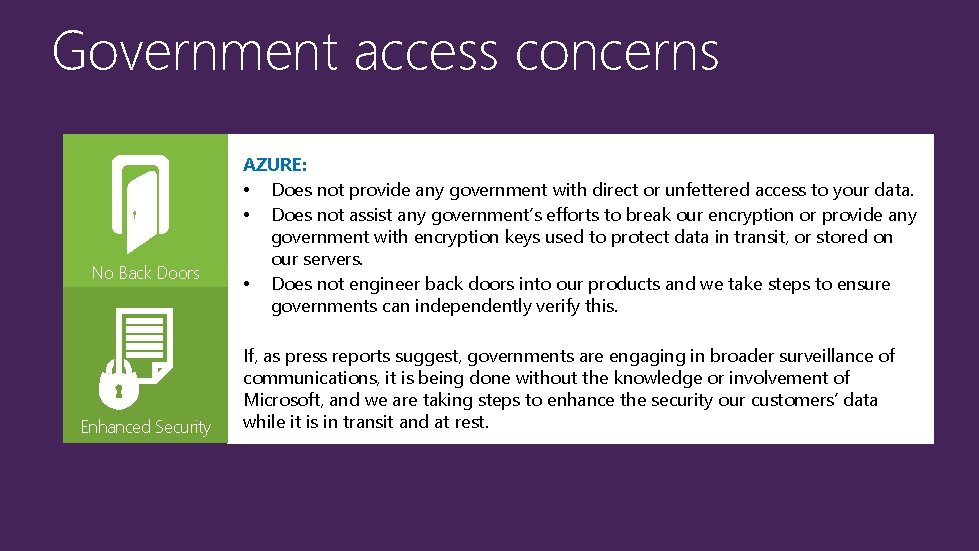
Government access concerns No Back Doors Enhanced Security AZURE: • Does not provide any government with direct or unfettered access to your data. • Does not assist any government’s efforts to break our encryption or provide any government with encryption keys used to protect data in transit, or stored on our servers. • Does not engineer back doors into our products and we take steps to ensure governments can independently verify this. If, as press reports suggest, governments are engaging in broader surveillance of communications, it is being done without the knowledge or involvement of Microsoft, and we are taking steps to enhance the security our customers’ data while it is in transit and at rest.
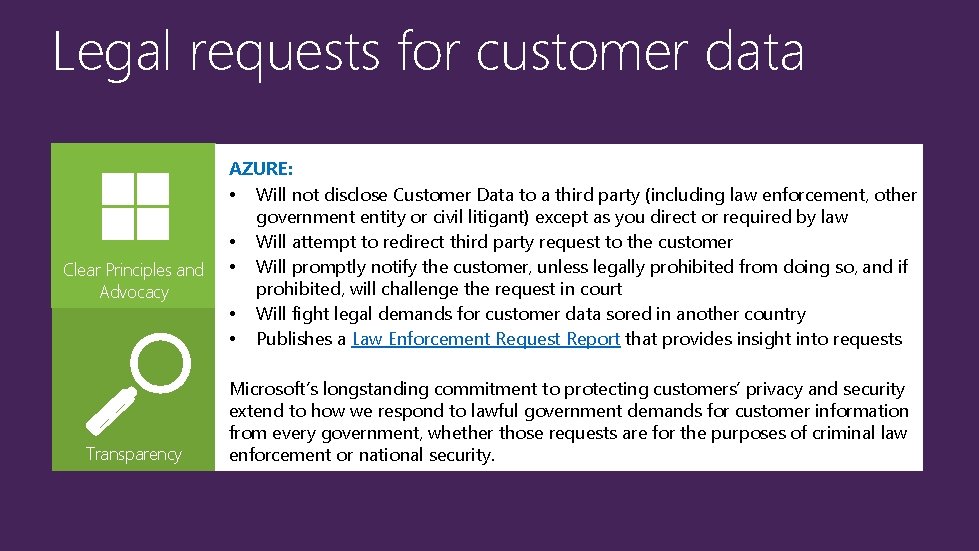
Legal requests for customer data Clear Principles and Advocacy Transparency AZURE: • Will not disclose Customer Data to a third party (including law enforcement, other government entity or civil litigant) except as you direct or required by law • Will attempt to redirect third party request to the customer • Will promptly notify the customer, unless legally prohibited from doing so, and if prohibited, will challenge the request in court • Will fight legal demands for customer data sored in another country • Publishes a Law Enforcement Request Report that provides insight into requests Microsoft’s longstanding commitment to protecting customers’ privacy and security extend to how we respond to lawful government demands for customer information from every government, whether those requests are for the purposes of criminal law enforcement or national security.
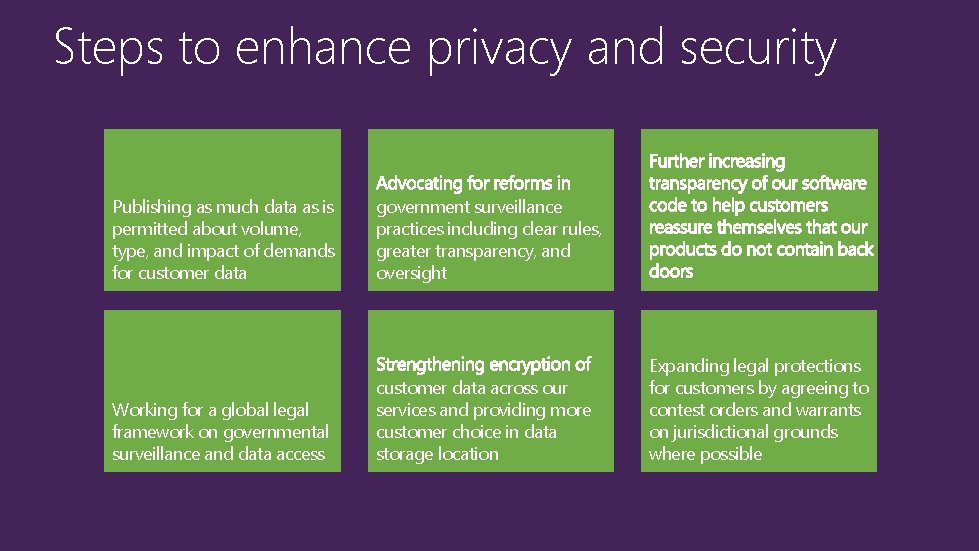
Steps to enhance privacy and security Publishing as much data as is permitted about volume, type, and impact of demands for customer data Working for a global legal framework on governmental surveillance and data access government surveillance practices including clear rules, greater transparency, and oversight customer data across our services and providing more customer choice in data storage location Expanding legal protections for customers by agreeing to contest orders and warrants on jurisdictional grounds where possible
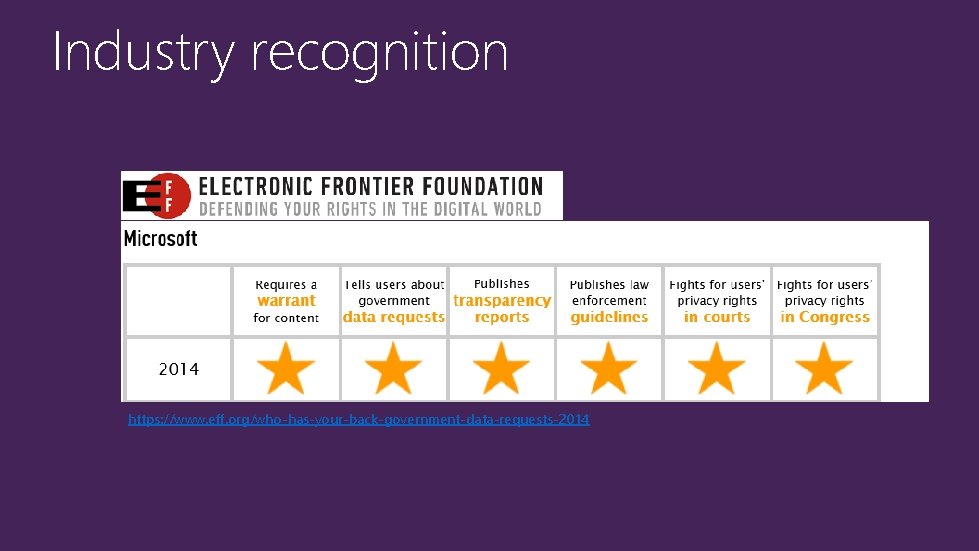
Industry recognition https: //www. eff. org/who-has-your-back-government-data-requests-2014
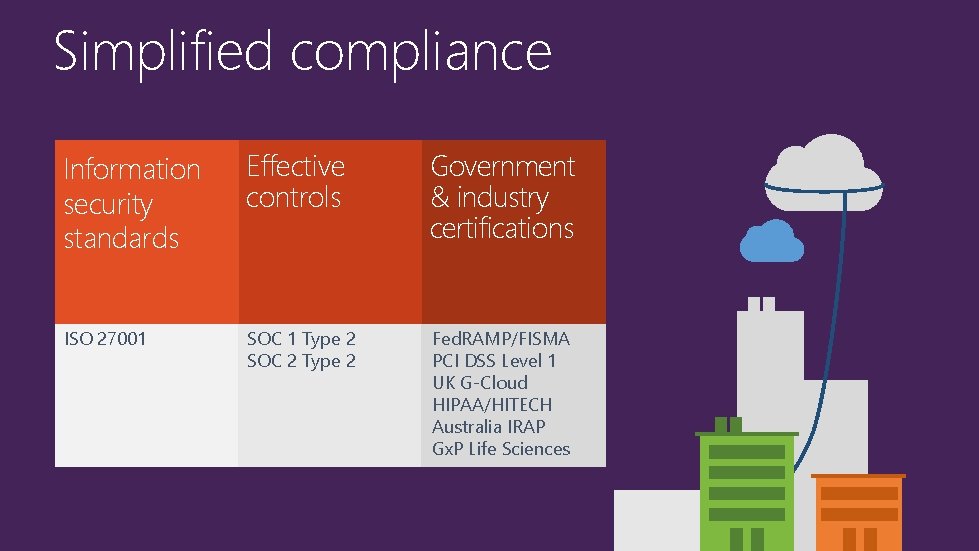
Simplified compliance Information security standards Effective controls Government & industry certifications ISO 27001 SOC 1 Type 2 SOC 2 Type 2 Fed. RAMP/FISMA PCI DSS Level 1 UK G-Cloud HIPAA/HITECH Australia IRAP Gx. P Life Sciences
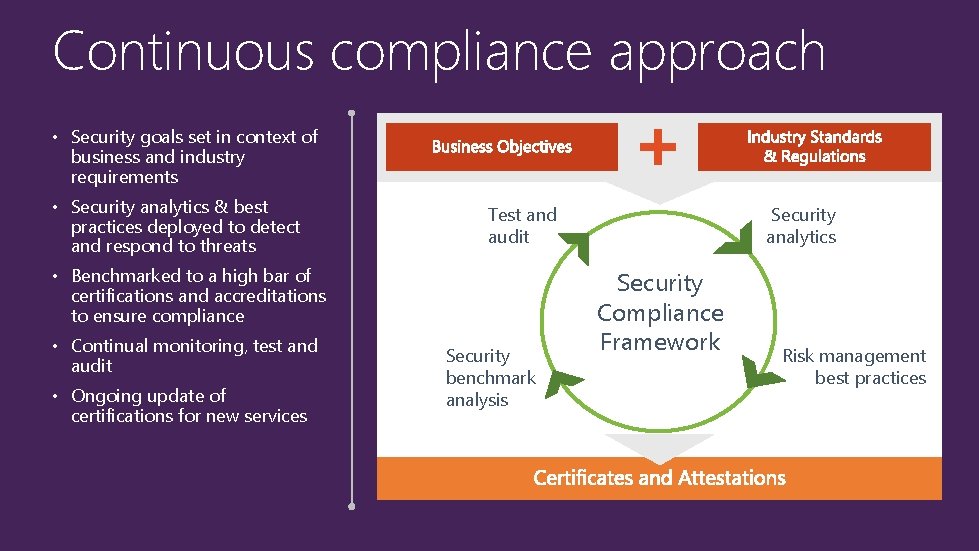
Continuous compliance approach • Security goals set in context of business and industry requirements • Security analytics & best practices deployed to detect and respond to threats Test and audit • Benchmarked to a high bar of certifications and accreditations to ensure compliance • Continual monitoring, test and audit • Ongoing update of certifications for new services Security benchmark analysis Security analytics Security Compliance Framework Risk management best practices
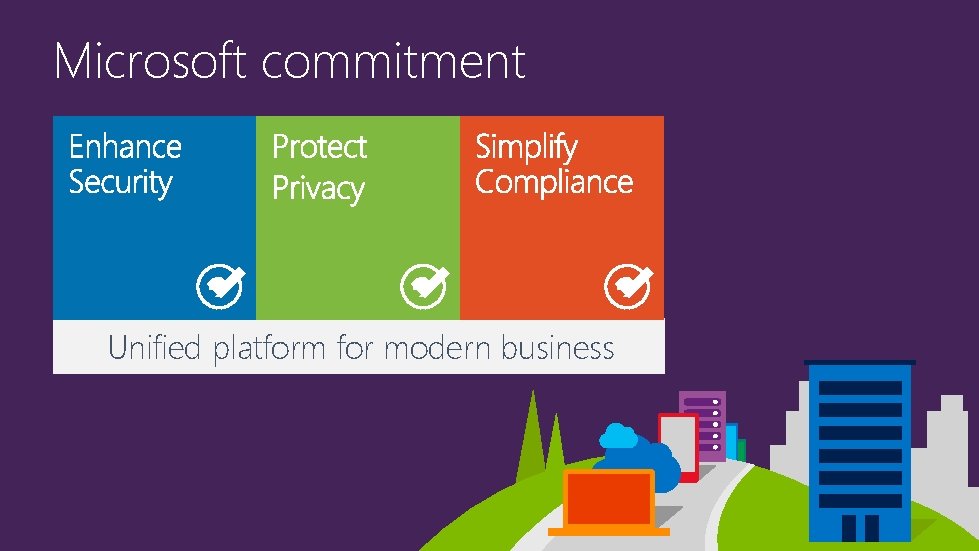
Microsoft commitment Unified platform for modern business
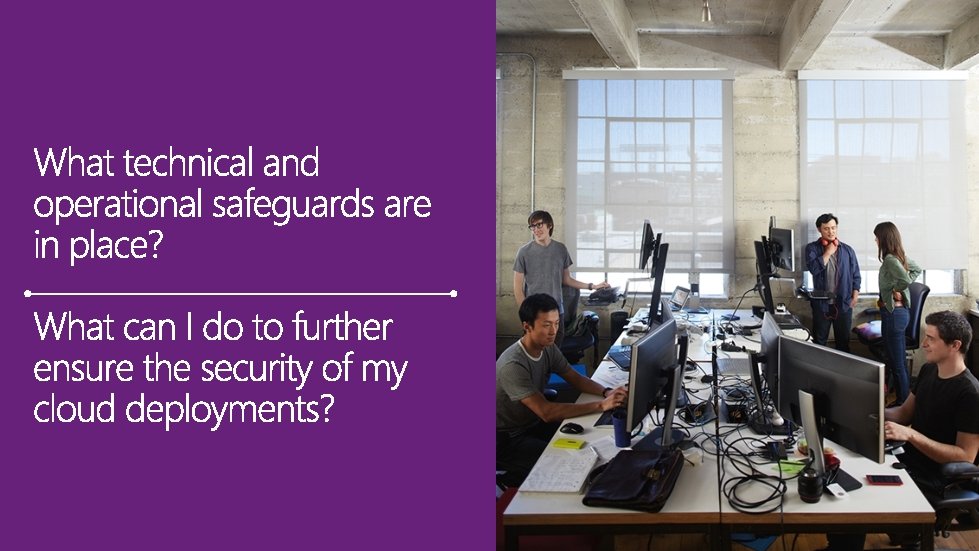
Can the cloud be more secure than on-premises? What technical and operational safeguards are in place? What can I do to further ensure the security of my cloud deployments? Where is my data and who can access it? How do I meet my compliance obligations?
CDP-B 216 | Data Protection in Microsoft Azure CDP-B 305 TWC | A Game of Clouds: Black Belt Security for the Microsoft Cloud CDP-B 227 Introduction to Microsoft Azure Networking Technologies and What's New Attend Ask The Experts Find Me Later at the Azure Booth
http: //www. visualstudio. com http: //blogs. msdn. com/b/developer-tools/ http: //msdn. microsoft. com/vstudio
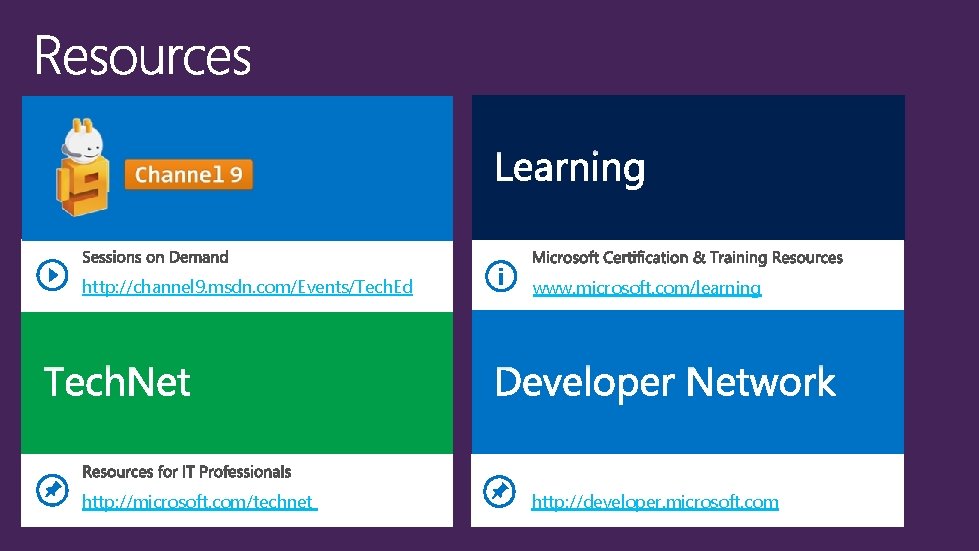
http: //channel 9. msdn. com/Events/Tech. Ed www. microsoft. com/learning http: //microsoft. com/technet http: //developer. microsoft. com
- Slides: 54