
Benefit or Risk What Is Food Irradiation Process
Benefit or Risk?
What Is Food Irradiation? Process of exposing food to controlled levels of ionizing radiation To kill harmful bacteria, pests, or parasites, or to preserve its freshness The process of food irradiation is often called cold pasteurization, because it kills harmful bacteria without heat.
Why Allow Food Products to Be Irradiated? The use of irradiation can: • Decrease the loss of food due to insect infestation, foodborne pathogens, and spoilage. • Decrease consumer concern over foodborne illness. • Help governments respond to the growing international trade in food products.
• • Significant Dates in Food Irradiation History 1895 – First paper published about irradiating food 1920 – Discovery that irradiation could be used to preserve food Early 1950 s – “Atoms for Peace” studies performed 1957 – First commercial use to kill insects and insect eggs in spices in Germany
• 1963 – Approved to eliminate insect infestation for wheat and wheat flour • 1964 – Approved to prevent sprouting in potatoes • 1970 s – NASA uses irradiated food for astronauts • 1983 – Approved for herbs, spices, and seasonings • 1985 – Approved to control trichinella spiralis in pork
• 1986 – Approved to control insects and maturation of fruits and vegetables • 1990 – Approved by FDA to control bacteria in poultry (USDA-1992) • 1997 – Approved by FDA to control pathogens for red meats (USDA-2000) • 2000 – Approved for shell eggs • 2004 - Approved for irradiation of ground beef used in school lunch programs.
How Does Irradiation Work?
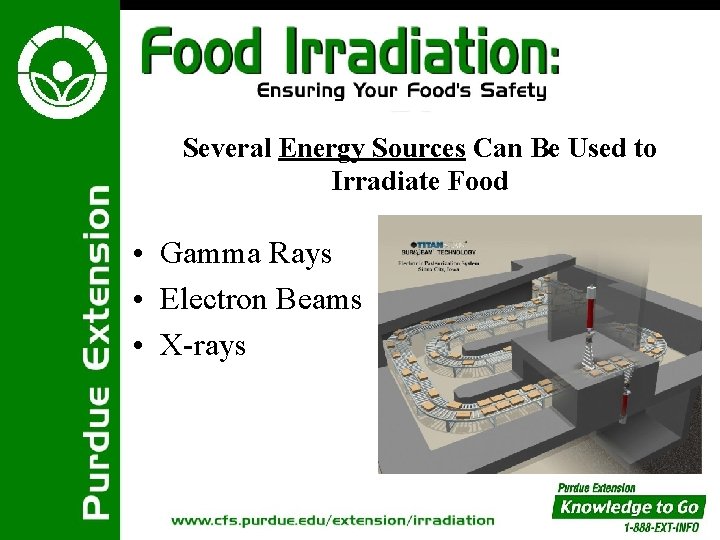
Several Energy Sources Can Be Used to Irradiate Food • Gamma Rays • Electron Beams • X-rays
Technically Speaking… Ionizing radiation is a type of energy similar to radio and television waves, microwaves, and infrared radiation. The nature of the energy is defined by the wavelength of the energy. As the wavelength gets shorter, the energy of the wave increases. As with all types of radiation, when considering possible health effects, you must consider the dose.
Dose and Effect of Radiation • The dose is the amount of radiation used to expose food. • The dose is controlled by the intensity of the radiation and the length of time the food is exposed to the source. • The dose permitted for use in food varies according to the type of food and the desired action. Treatment levels have been approved by FDA as follows:
Dose and Effect of Radiation “Low” doses, < 1 k. Gy ü Control insects in grains and fruits ü Inhibit sprouting in tubers ü Delay the ripening of some fruits/vegetables ü Reduce the problems of parasites in products of animal origin, (e. g. , trichinella spiralis in pork)
Dose and Effects of Radiation “Medium” doses, (1 -10 k. Gy) ü Control Salmonella, Shigella, Campylobacter, Yersinia, Listeria and E. coli in meat, poultry, and fish ü Delay mold growth on strawberries and other fruits
Dose and Effects of Radiation “High” doses, (> than 10 k. Gy) ü Kill microorganisms and insects in spices ü Commercially sterilize foods, destroying all microorganisms of public health concern (i. e. , special diets for people with weakened immune systems)
Minimal Changes Associated with Food Irradiation • • Not all fresh produce is suitable for irradiation. Some treated foods may taste slightly different. Nutritional value of food is virtually unchanged. Some chemical changes occur.
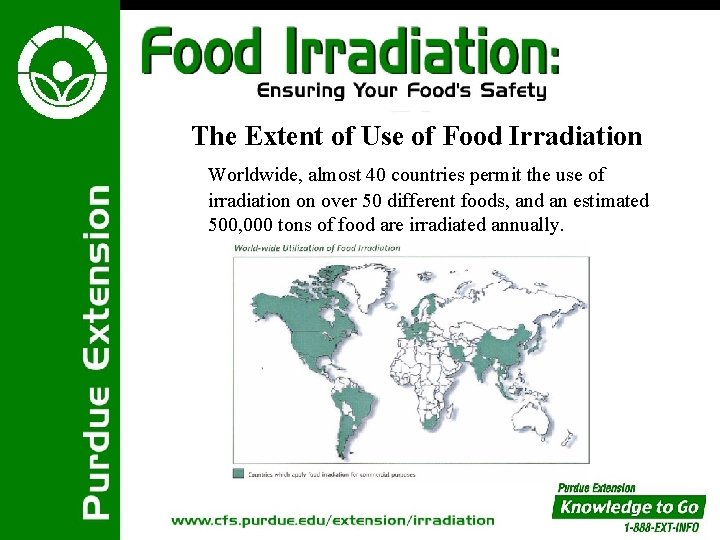
The Extent of Use of Food Irradiation Worldwide, almost 40 countries permit the use of irradiation on over 50 different foods, and an estimated 500, 000 tons of food are irradiated annually.
Regulators of Food Irradiation Ø Food and Drug Administration Ø U. S. Department of Agriculture ü Animal and Plant Health Inspection Service ü Food Safety and Inspection Service Ø Nuclear Regulatory Commission Ø Occupational Safety and Health Administration Ø Department of Transportation
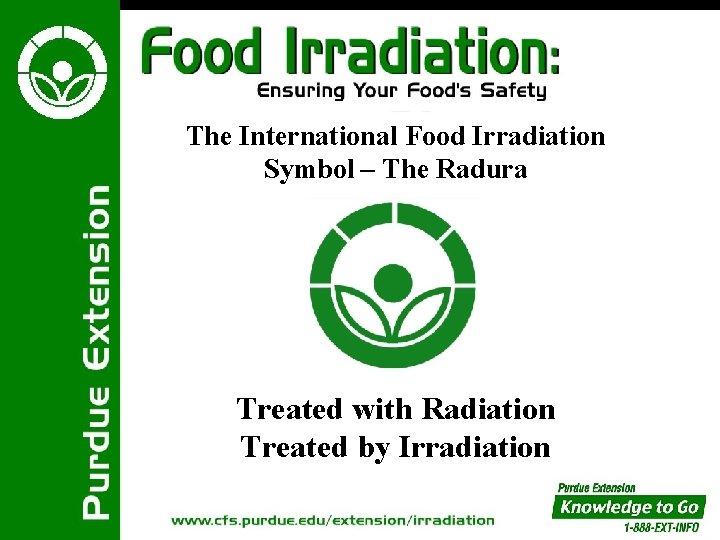
The International Food Irradiation Symbol – The Radura Treated with Radiation Treated by Irradiation
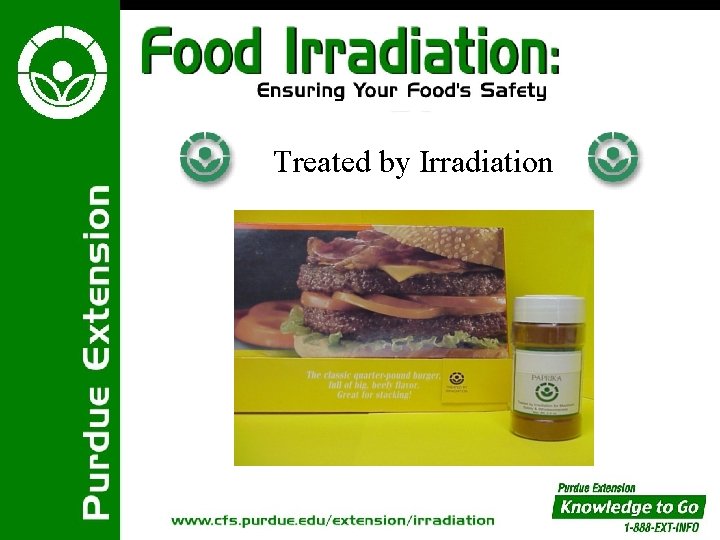
Treated by Irradiation
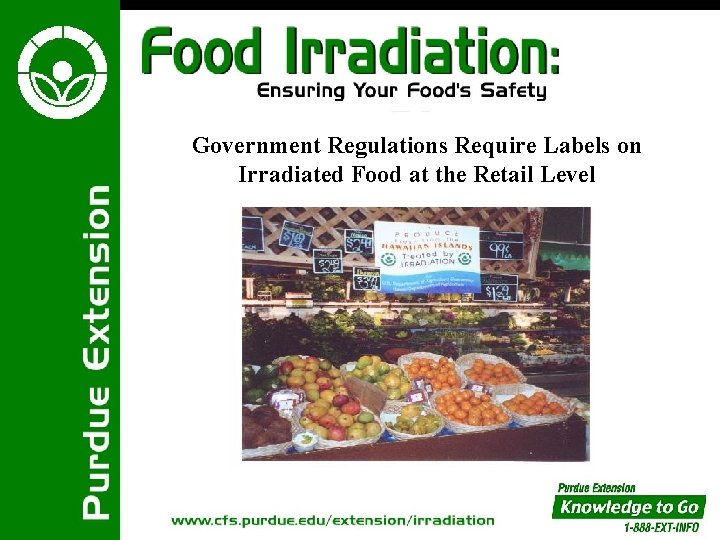
Government Regulations Require Labels on Irradiated Food at the Retail Level
Organizations that Endorse Food Irradiation World Health Organization American Medical Association Institute of Food Technologists American Council on Science and Health Food and Agriculture Organization American Dietetic Association
Acceptance of Irradiated Foods Consumer Attitudes Are Changing While many consumers are unfamiliar with food irradiation, consumer research shows that, as more and more factual information is provided, the public increasingly views irradiation in a more positive light.
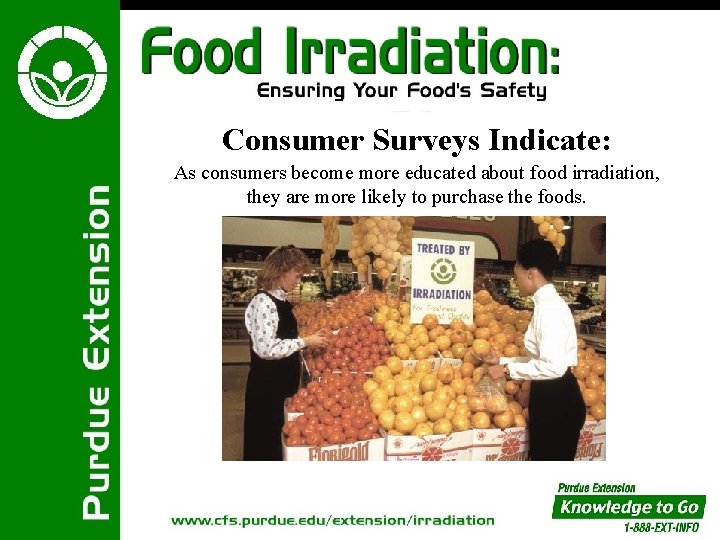
Consumer Surveys Indicate: As consumers become more educated about food irradiation, they are more likely to purchase the foods.
Will Irradiated Food Be More Expensive?
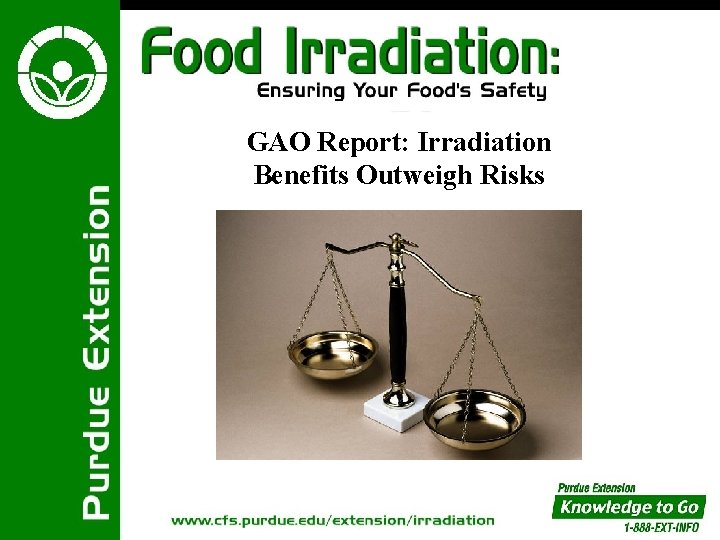
GAO Report: Irradiation Benefits Outweigh Risks
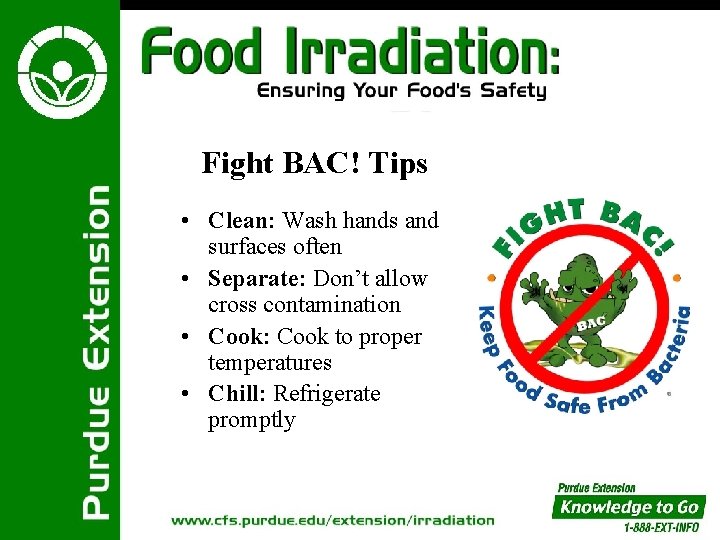
Fight BAC! Tips • Clean: Wash hands and surfaces often • Separate: Don’t allow cross contamination • Cook: Cook to proper temperatures • Chill: Refrigerate promptly
In Conclusion: Consumers are gaining knowledge about the benefits of food irradiation and its potential to reduce the risk of foodborne disease, but the process is not a replacement for proper food handling practices. Irradiation, like other prevention methods, is but one method used to prevent foodborne illness.
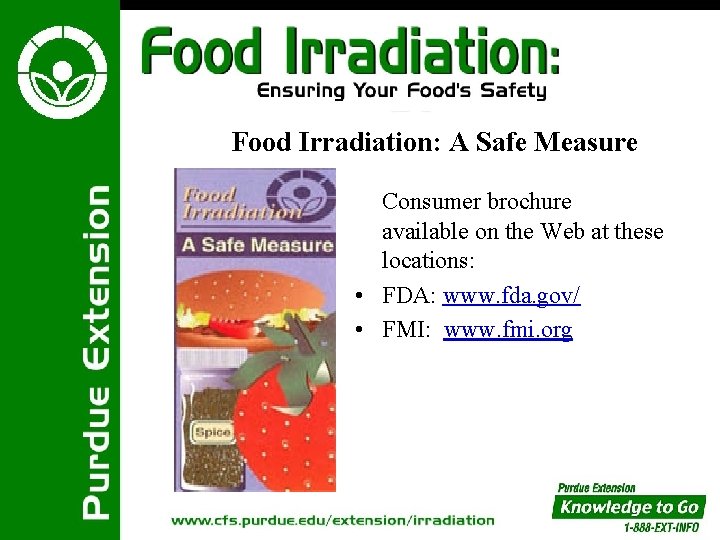
Food Irradiation: A Safe Measure Consumer brochure available on the Web at these locations: • FDA: www. fda. gov/ • FMI: www. fmi. org
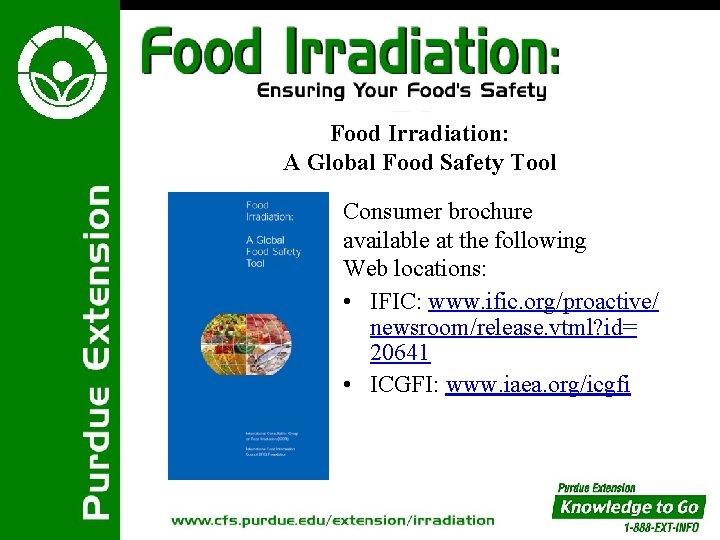
Food Irradiation: A Global Food Safety Tool Consumer brochure available at the following Web locations: • IFIC: www. ific. org/proactive/ newsroom/release. vtml? id= 20641 • ICGFI: www. iaea. org/icgfi
- Slides: 29