
Benefit Cost Analysis Typically used for public projects
Benefit Cost Analysis • Typically used for public projects • The goal is to determine if benefits exceed costs: Benefit / Cost Ratio > 1 • The goal is NOT to maximize B/C Ratio. • Interest rates used are typically lower than those used by businesses. • Typically 4% - 8% (6. 5% is typical) • OMB requires 10% (except water proj. ) 1
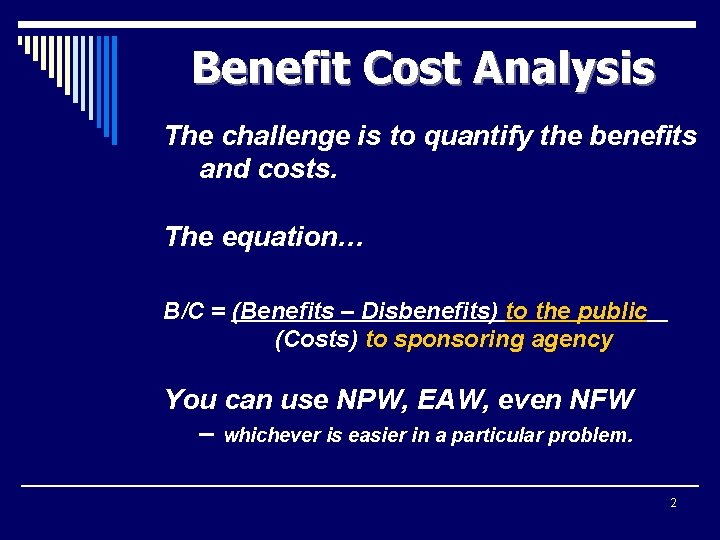
Benefit Cost Analysis The challenge is to quantify the benefits and costs. The equation… B/C = (Benefits – Disbenefits) to the public (Costs) to sponsoring agency You can use NPW, EAW, even NFW – whichever is easier in a particular problem. 2
Benefit Cost Analysis Steps: 1. Define the planning horizon. 2. Specify the Discount Rate (MARR) to be used. 3. Develop the cost and benefit-disbenefit profiles in monetary terms. 4. Compare the benefits to costs using a specified measure of worth, such as annual equivalent or present worth. 5. If the B/C ratio is: >1 project is justified =1 barely justified – political <1 not justified 6. Repeat steps 3 – 5 for alternative viewpoints 3
Example A city library is to be expanded to include meeting rooms, more electronic volumes, computer facilities, and electronic check-in and check-out. The cost of the expansion will be $700, 000 and the new equipment will cost another $175, 000. Maintenance and renewal of the new addition and equipment will run approximately $100, 000/year. The library is projected to be in operation for 20 years, with a residual value of 40% of first cost for the physical facilities. There is no salvage value for the equipment. Discount is 8%. An estimated 150, 000 people will visit the library each year. How much additional benefit person, per year, must the library visitors perceive in order to justify the expansion? 4
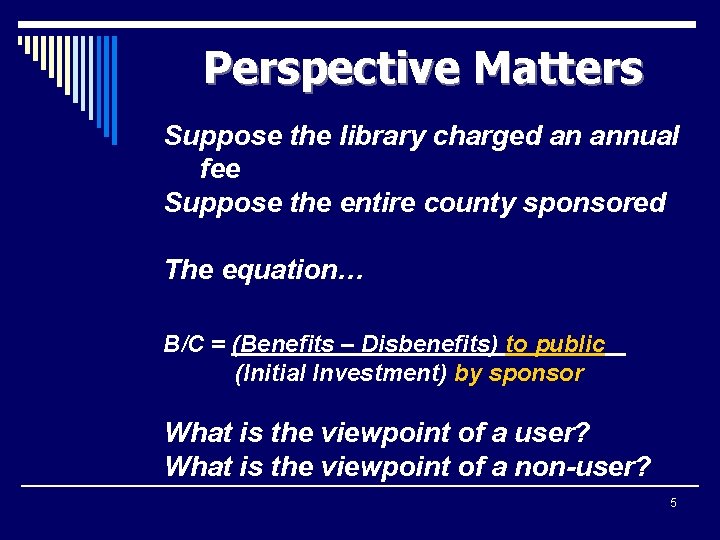
Perspective Matters Suppose the library charged an annual fee Suppose the entire county sponsored The equation… B/C = (Benefits – Disbenefits) to public (Initial Investment) by sponsor What is the viewpoint of a user? What is the viewpoint of a non-user? 5
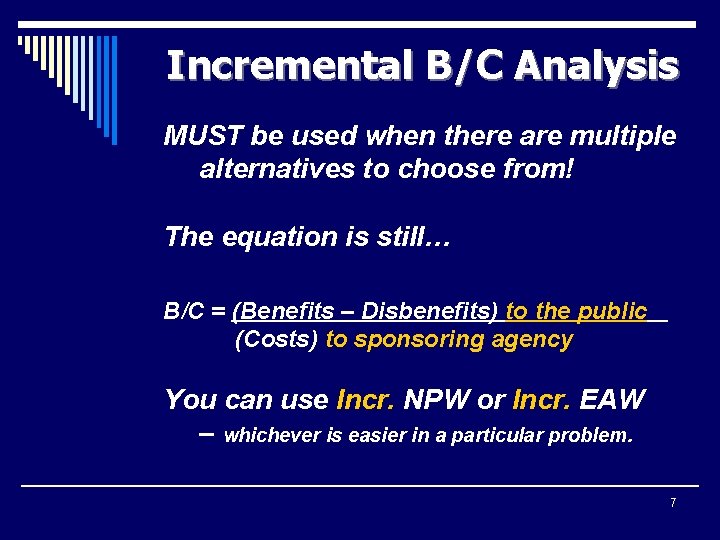
Incremental B/C Analysis MUST be used when there are multiple alternatives to choose from! The equation is still… B/C = (Benefits – Disbenefits) to the public (Costs) to sponsoring agency You can use Incr. NPW or Incr. EAW – whichever is easier in a particular problem. 7
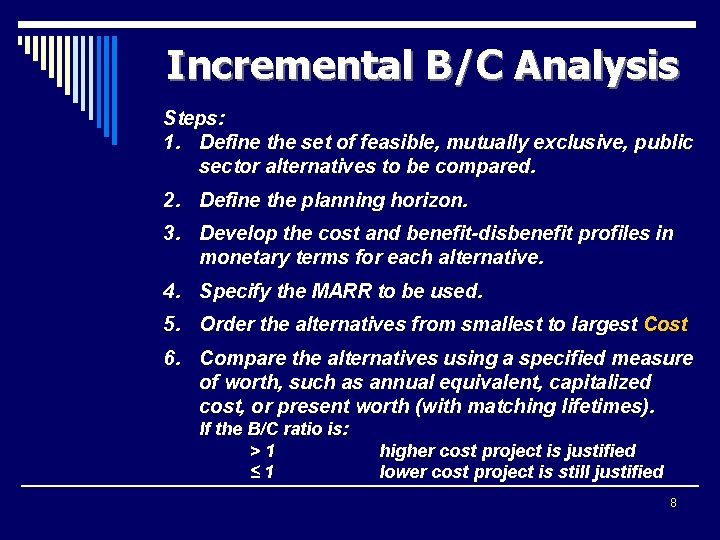
Incremental B/C Analysis Steps: 1. Define the set of feasible, mutually exclusive, public sector alternatives to be compared. 2. Define the planning horizon. 3. Develop the cost and benefit-disbenefit profiles in monetary terms for each alternative. 4. Specify the MARR to be used. 5. Order the alternatives from smallest to largest Cost 6. Compare the alternatives using a specified measure of worth, such as annual equivalent, capitalized cost, or present worth (with matching lifetimes). If the B/C ratio is: >1 ≤ 1 higher cost project is justified lower cost project is still justified 8
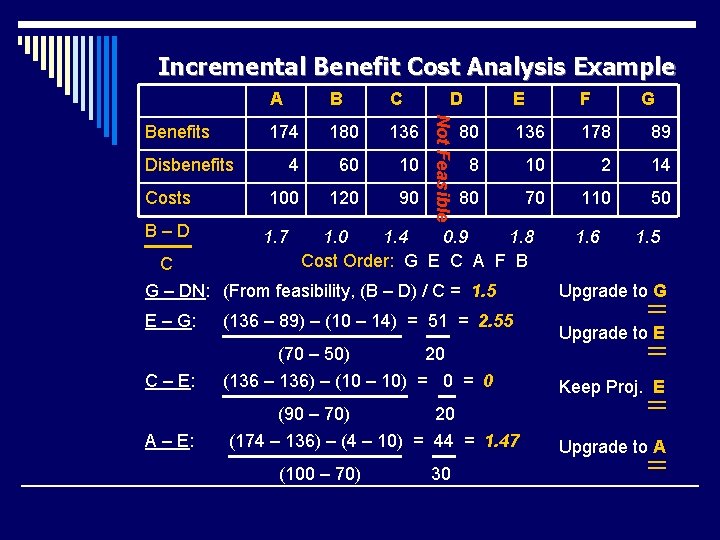
Incremental Benefit Cost Analysis Example B C 174 180 136 4 60 10 Costs 100 120 90 B–D 1. 7 Benefits Disbenefits C D Not Feasible A E F 80 136 178 89 8 10 2 14 80 70 110 50 1. 4 0. 9 1. 8 Cost Order: G E C A F B G – DN: (From feasibility, (B – D) / C = 1. 5 E – G: (136 – 89) – (10 – 14) = 51 = 2. 55 (70 – 50) C – E: A – E: Upgrade to G Upgrade to E Keep Proj. E 20 (174 – 136) – (4 – 10) = 44 = 1. 47 (100 – 70) 1. 5 20 (136 – 136) – (10 – 10) = 0 (90 – 70) 1. 6 G 30 Upgrade to A
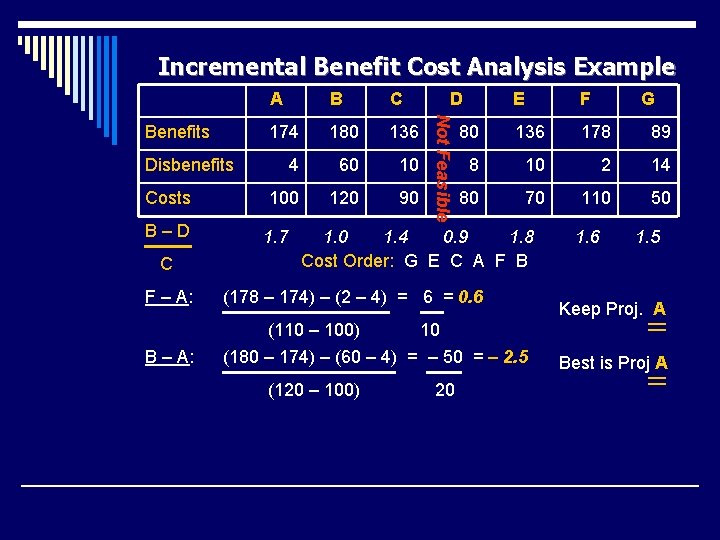
Incremental Benefit Cost Analysis Example B C 174 180 136 4 60 10 Costs 100 120 90 B–D 1. 7 Benefits Disbenefits C F – A: E F 80 136 178 89 8 10 2 14 80 70 110 50 1. 4 0. 9 1. 8 Cost Order: G E C A F B (178 – 174) – (2 – 4) = 6 = 0. 6 (110 – 100) B – A: D Not Feasible A 1. 5 Keep Proj. A 10 (180 – 174) – (60 – 4) = – 50 = – 2. 5 (120 – 100) 1. 6 G 20 Best is Proj A
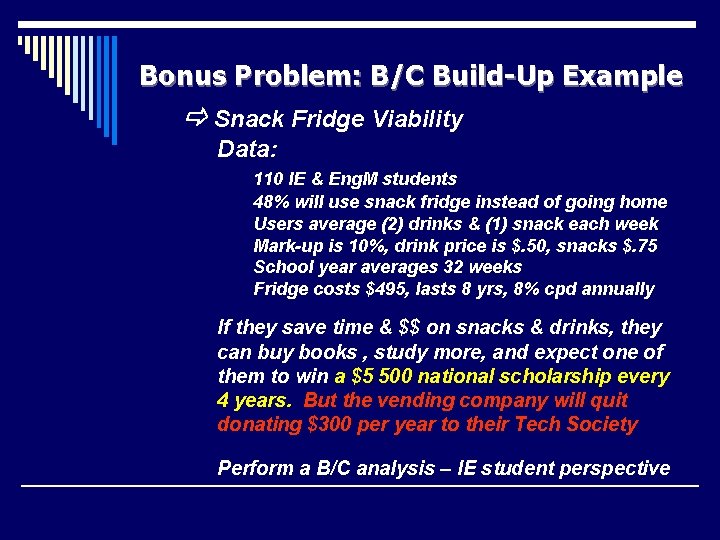
Bonus Problem: B/C Build-Up Example Snack Fridge Viability Data: 110 IE & Eng. M students 48% will use snack fridge instead of going home Users average (2) drinks & (1) snack each week Mark-up is 10%, drink price is $. 50, snacks $. 75 School year averages 32 weeks Fridge costs $495, lasts 8 yrs, 8% cpd annually If they save time & $$ on snacks & drinks, they can buy books , study more, and expect one of them to win a $5 500 national scholarship every 4 years. But the vending company will quit donating $300 per year to their Tech Society Perform a B/C analysis – IE student perspective
- Slides: 10