
Benedict Tests for Sugars Sucrose Glucose Starch What
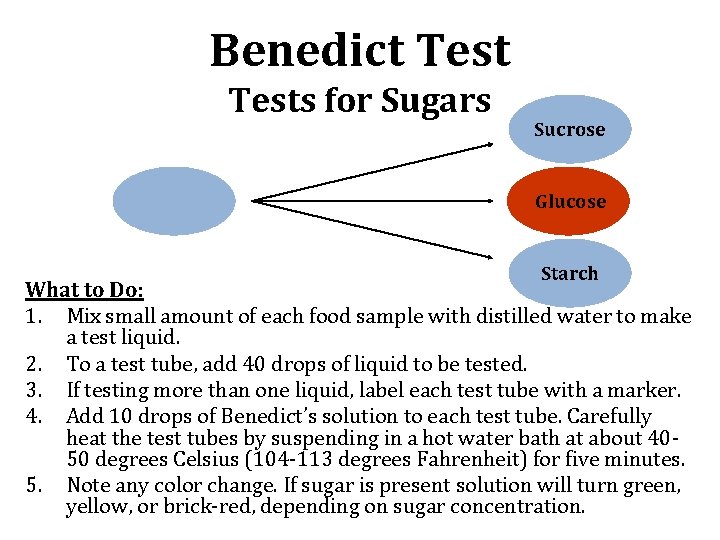
Benedict Tests for Sugars Sucrose Glucose Starch What to Do: 1. Mix small amount of each food sample with distilled water to make a test liquid. 2. To a test tube, add 40 drops of liquid to be tested. 3. If testing more than one liquid, label each test tube with a marker. 4. Add 10 drops of Benedict’s solution to each test tube. Carefully heat the test tubes by suspending in a hot water bath at about 4050 degrees Celsius (104 -113 degrees Fahrenheit) for five minutes. 5. Note any color change. If sugar is present solution will turn green, yellow, or brick-red, depending on sugar concentration.
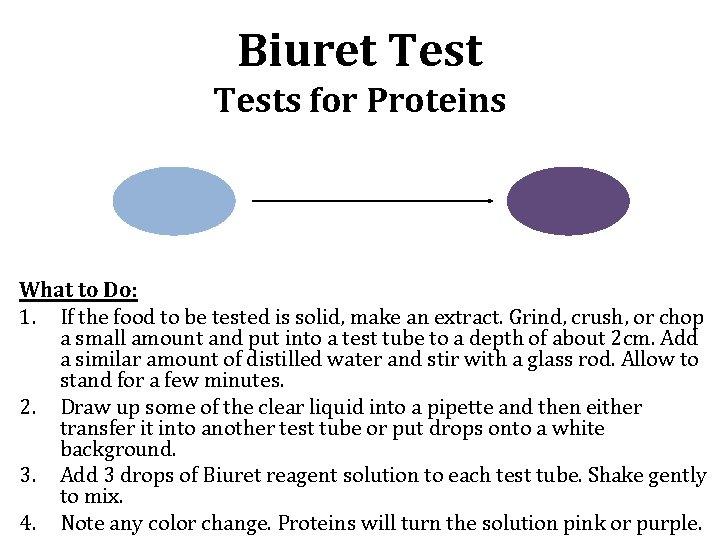
Biuret Tests for Proteins What to Do: 1. If the food to be tested is solid, make an extract. Grind, crush, or chop a small amount and put into a test tube to a depth of about 2 cm. Add a similar amount of distilled water and stir with a glass rod. Allow to stand for a few minutes. 2. Draw up some of the clear liquid into a pipette and then either transfer it into another test tube or put drops onto a white background. 3. Add 3 drops of Biuret reagent solution to each test tube. Shake gently to mix. 4. Note any color change. Proteins will turn the solution pink or purple.
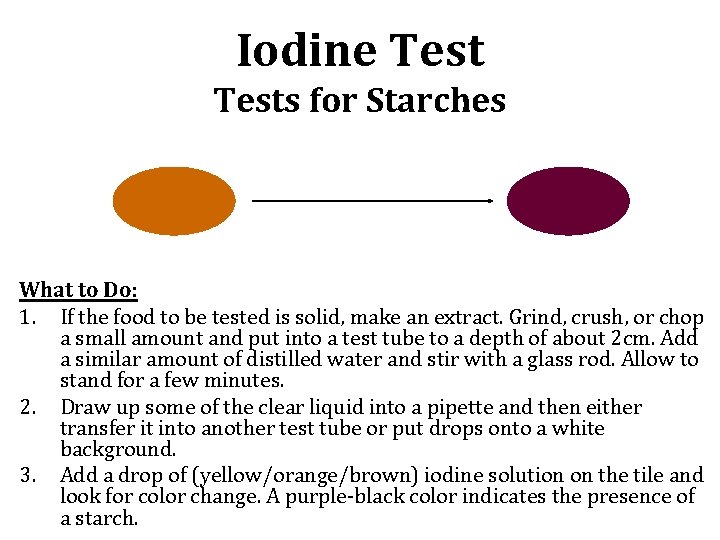
Iodine Tests for Starches What to Do: 1. If the food to be tested is solid, make an extract. Grind, crush, or chop a small amount and put into a test tube to a depth of about 2 cm. Add a similar amount of distilled water and stir with a glass rod. Allow to stand for a few minutes. 2. Draw up some of the clear liquid into a pipette and then either transfer it into another test tube or put drops onto a white background. 3. Add a drop of (yellow/orange/brown) iodine solution on the tile and look for color change. A purple-black color indicates the presence of a starch.
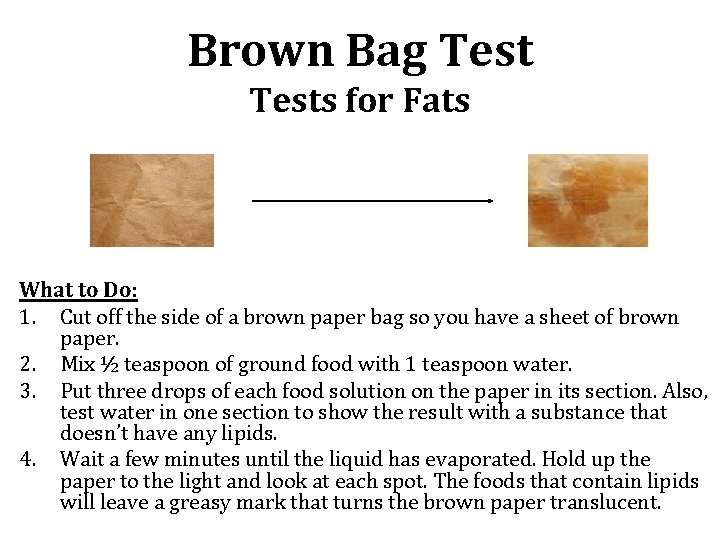
Brown Bag Tests for Fats What to Do: 1. Cut off the side of a brown paper bag so you have a sheet of brown paper. 2. Mix ½ teaspoon of ground food with 1 teaspoon water. 3. Put three drops of each food solution on the paper in its section. Also, test water in one section to show the result with a substance that doesn’t have any lipids. 4. Wait a few minutes until the liquid has evaporated. Hold up the paper to the light and look at each spot. The foods that contain lipids will leave a greasy mark that turns the brown paper translucent.
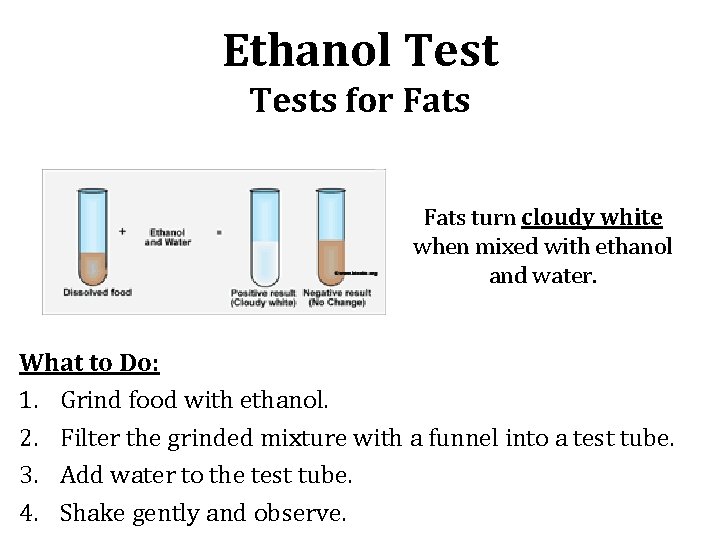
Ethanol Tests for Fats turn cloudy white when mixed with ethanol and water. What to Do: 1. Grind food with ethanol. 2. Filter the grinded mixture with a funnel into a test tube. 3. Add water to the test tube. 4. Shake gently and observe.
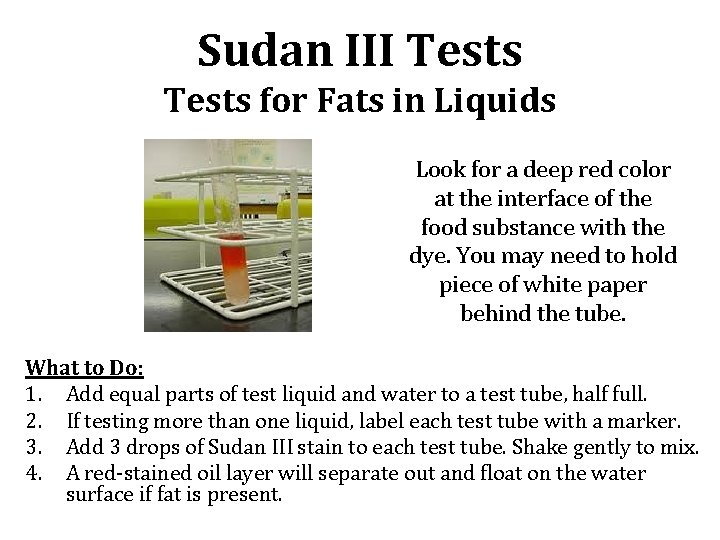
Sudan III Tests for Fats in Liquids Look for a deep red color at the interface of the food substance with the dye. You may need to hold piece of white paper behind the tube. What to Do: 1. Add equal parts of test liquid and water to a test tube, half full. 2. If testing more than one liquid, label each test tube with a marker. 3. Add 3 drops of Sudan III stain to each test tube. Shake gently to mix. 4. A red-stained oil layer will separate out and float on the water surface if fat is present.
- Slides: 6