
Benchmarking Resource Usage for Spectrum Sensing on Commodity

Benchmarking Resource Usage for Spectrum Sensing on Commodity Mobile Devices Ayon Chakraborty, Udit Gupta and Samir R. Das WINGS Lab ACM Hot. Wireless 2016
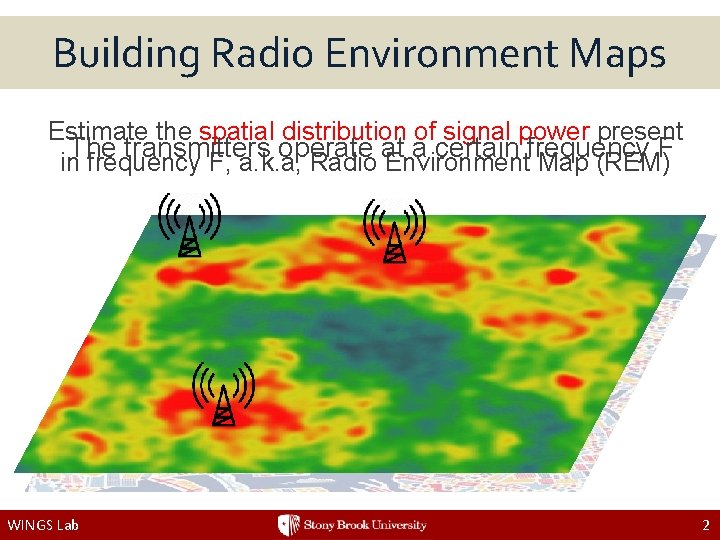
Building Radio Environment Maps Estimate the spatial distribution of signal power present The transmitters operate at a certain frequency F, a. k. a, Radio Environment Map (REM) WINGS Lab 2
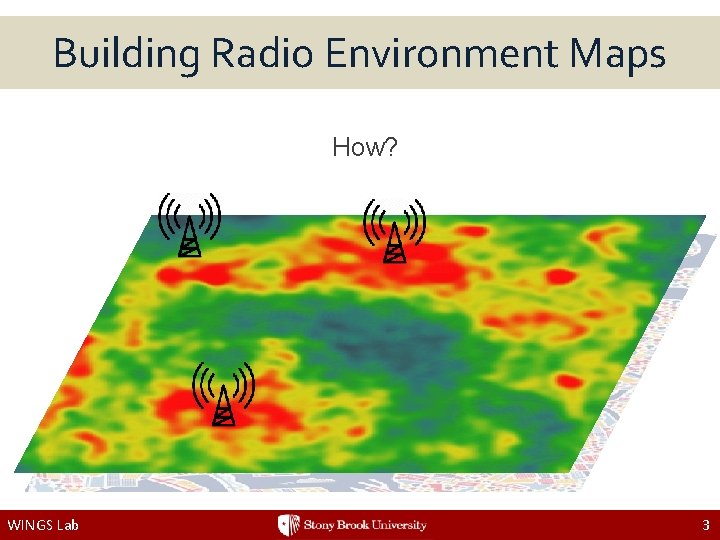
Building Radio Environment Maps How? WINGS Lab 3
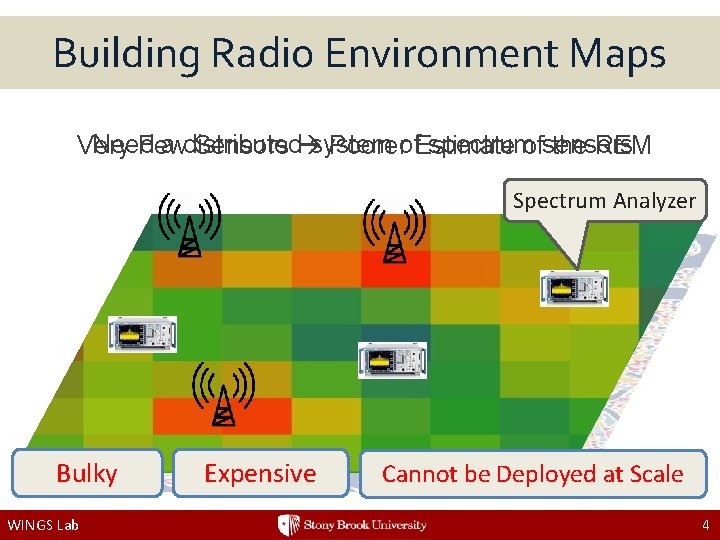
Building Radio Environment Maps Need a distributed spectrumofsensors Very Few Sensors system Poorerof. Estimate the REM Spectrum Analyzer Bulky WINGS Lab Expensive Cannot be Deployed at Scale 4
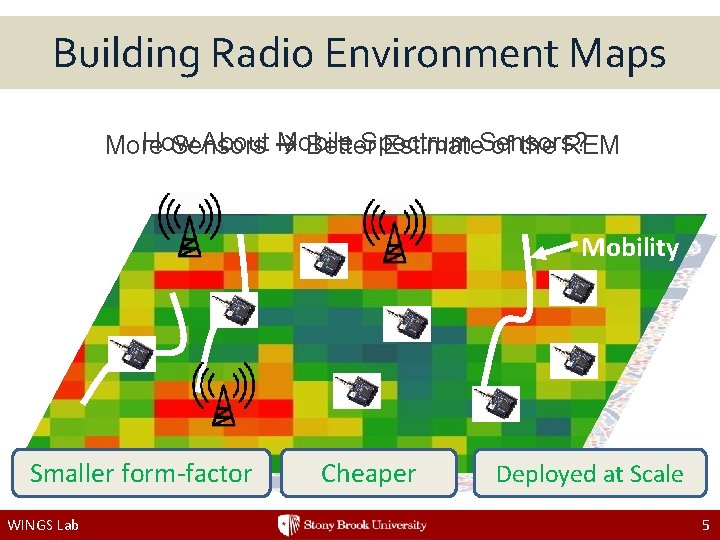
Building Radio Environment Maps How About Mobile Spectrum More Sensors Better Estimate. Sensors? of the REM Mobility Smaller form-factor WINGS Lab Cheaper Deployed at Scale 5
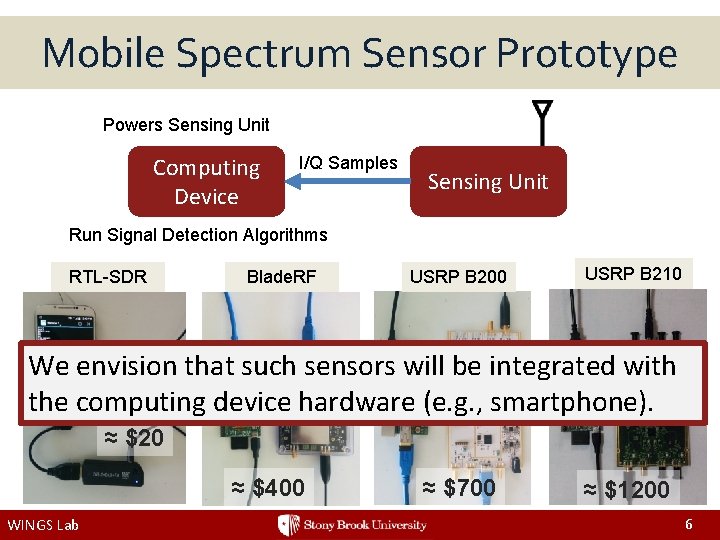
Mobile Spectrum Sensor Prototype Powers Sensing Unit Computing Device I/Q Samples Sensing Unit Run Signal Detection Algorithms RTL-SDR Blade. RF USRP B 200 USRP B 210 Phone We envision that such sensors will be integrated with RPi the computing device hardware (e. g. , smartphone). RPi ≈ $20 ≈ $400 WINGS Lab ≈ $700 ≈ $1200 6
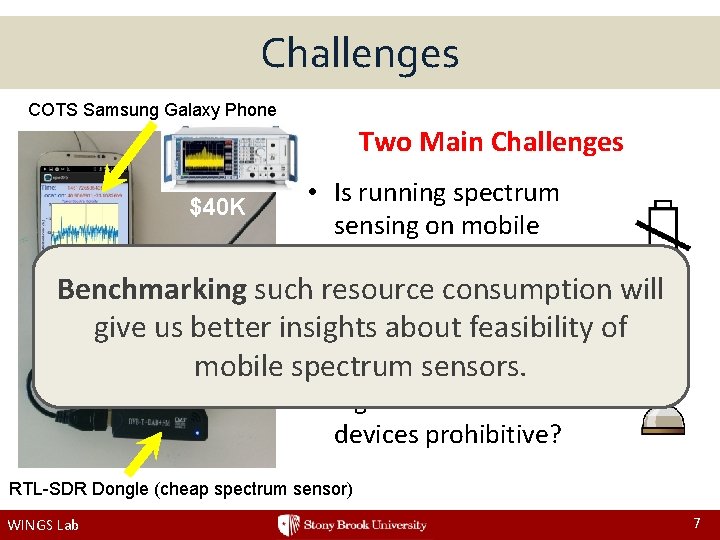
Challenges COTS Samsung Galaxy Phone Two Main Challenges • Is running spectrum sensing on mobile devices energy efficient? Benchmarking such • resource consumption will Is the computational give us better insights about feasibility of latency incurred in runningsensors. signal detection mobile spectrum ≈ $20 algorithms on mobile devices prohibitive? $40 K RTL-SDR Dongle (cheap spectrum sensor) WINGS Lab 7
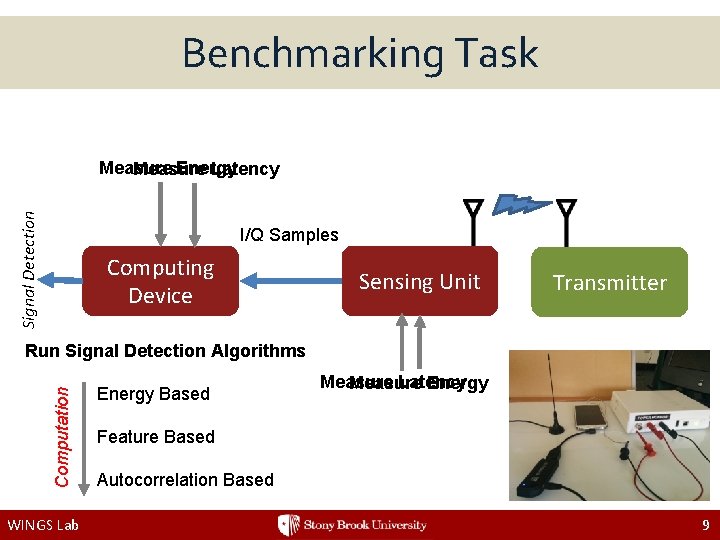
Benchmarking Task Signal Detection Measure Energy Measure Latency I/Q Samples Computing Device Sensing Unit Transmitter Computation Run Signal Detection Algorithms WINGS Lab Energy Based Measure Latency Measure Energy Feature Based Autocorrelation Based 9
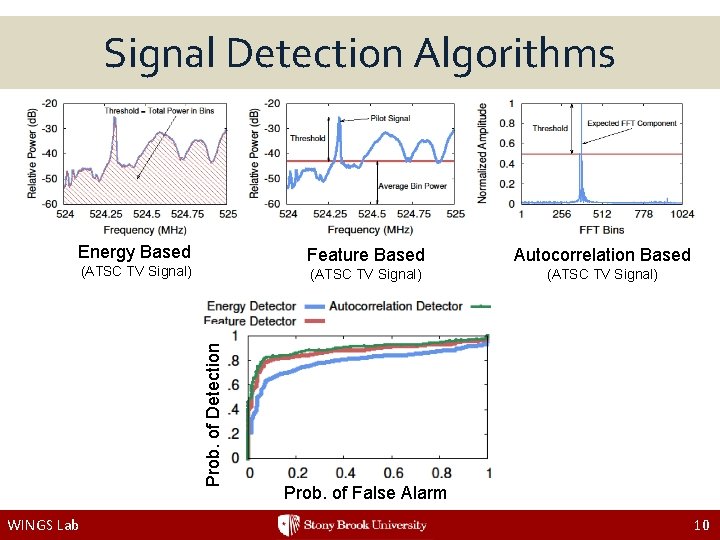
Signal Detection Algorithms Energy Based Prob. of Detection (ATSC TV Signal) WINGS Lab Feature Based Autocorrelation Based (ATSC TV Signal) Prob. of False Alarm 10
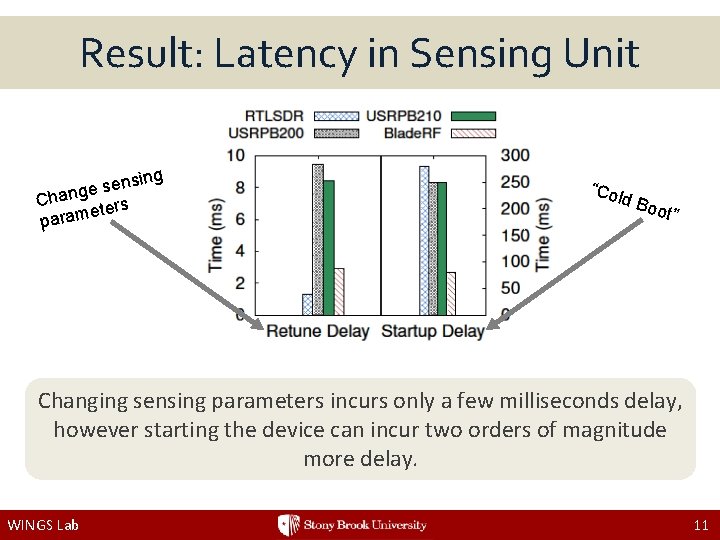
Result: Latency in Sensing Unit sing n e s e Chang ters e param “Col d Bo ot” Changing sensing parameters incurs only a few milliseconds delay, however starting the device can incur two orders of magnitude more delay. WINGS Lab 11
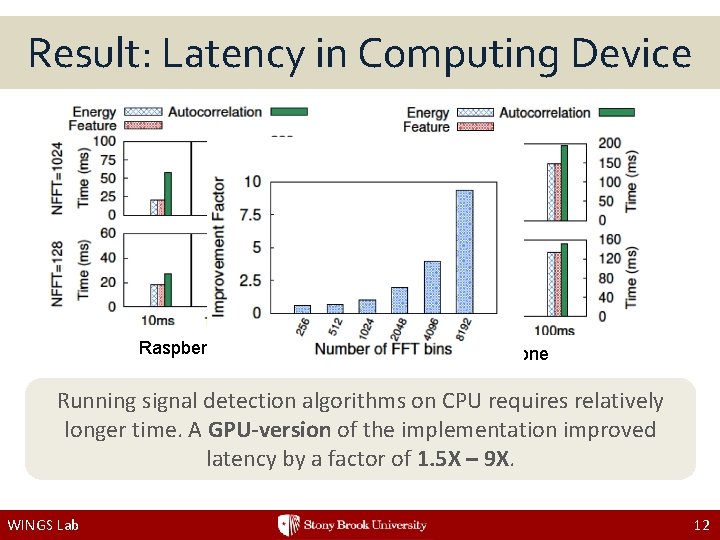
Result: Latency in Computing Device Raspberry Pi Phone Running signal detection algorithms on CPU requires relatively longer time. A GPU-version of the implementation improved latency by a factor of 1. 5 X – 9 X. WINGS Lab 12
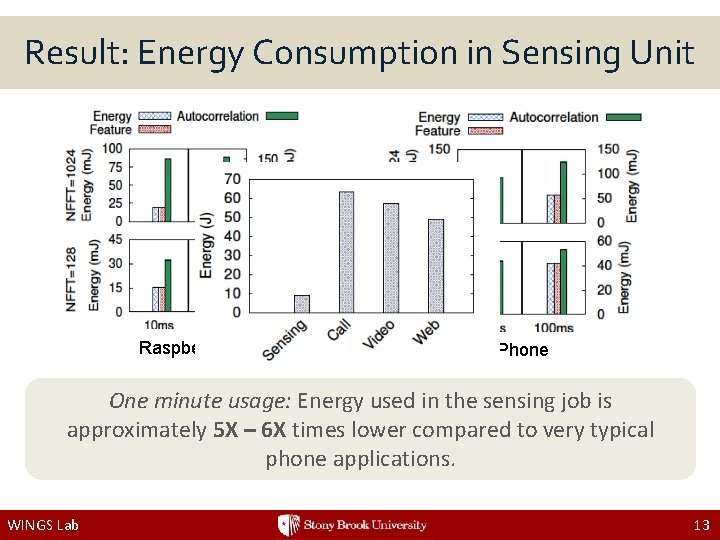
Result: Energy Consumption in Sensing Unit Raspberry Pi Phone One minute usage: Energy used in the sensing job is approximately 5 X – 6 X times lower compared to very typical phone applications. WINGS Lab 13
Takeaways • Mobile spectrum sensing enables crowdsourcing spectrum measurements resulting in more granular estimate of spectrum maps. • Benchmarking results on our prototype platforms with optimization (GPU) show feasibility of such sensors. • Energy consumption on our prototype platform is modest. 5 X – 6 X lesser than typical smartphone apps. WINGS Lab 14
Thanks! Questions? WINGS Lab 15
- Slides: 14