
Benchmarking for Improved Water Utility Performance Benchmarking Water
Benchmarking for Improved Water Utility Performance

Benchmarking Water Services m. blokland@unesco-ihe. org
Contributing Partners UNESCO-IHE USP of Brazil CEPT University of India NWSC of Uganda Vewin/CDC of the Netherlands

Topic 3: Benchmarking in the Water and Sanitation Sector

Application of benchmarking in the water sector: • In water and wastewater utilities: • Instruments are well established • Practiced by a minority of utilities • In river basin organisations: • Instruments are being established • Practiced mostly on a pilot basis

Application ‘Performance assessment’ (or ‘metric benchmarking’) • performance measurement: e. g. ‘% of population served’ or ‘labour productivity’ • performance comparison: comparison over time, with another water provider, with a guideline/standard ‘Performance improvement (or ‘process benchmarking’) • performance improvement deals with discovering the differences in the underlying policies, processes and methods being used: e. g. on leakage detection in an effort to reduce Non Revenue Water • processes can be compared between water utilities but also between a water utility and an organisation in another sector: e. g. an energy provider on billing and revenue collection
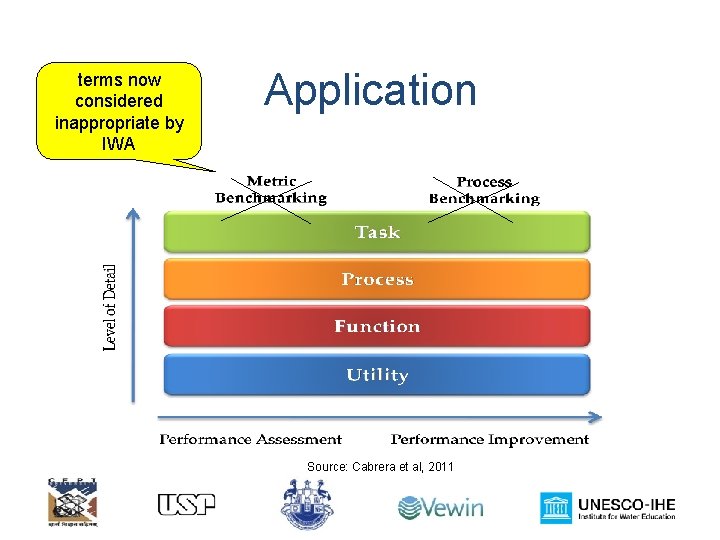
terms now considered inappropriate by IWA Application Source: Cabrera et al, 2011
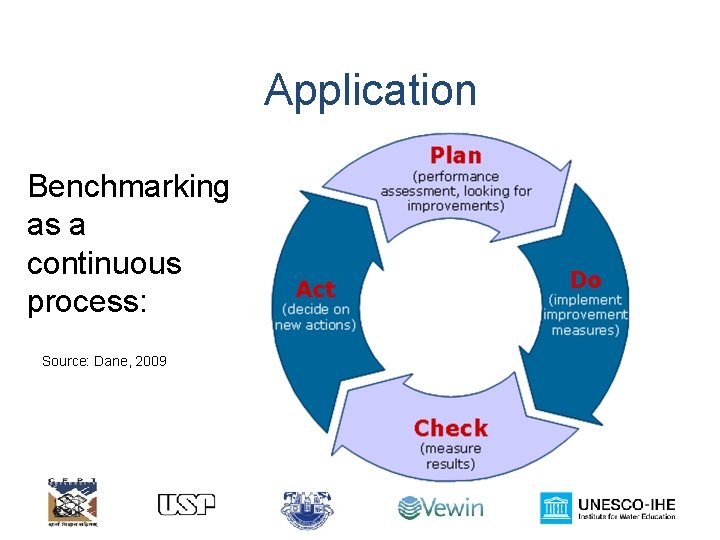
Application Benchmarking as a continuous process: Source: Dane, 2009
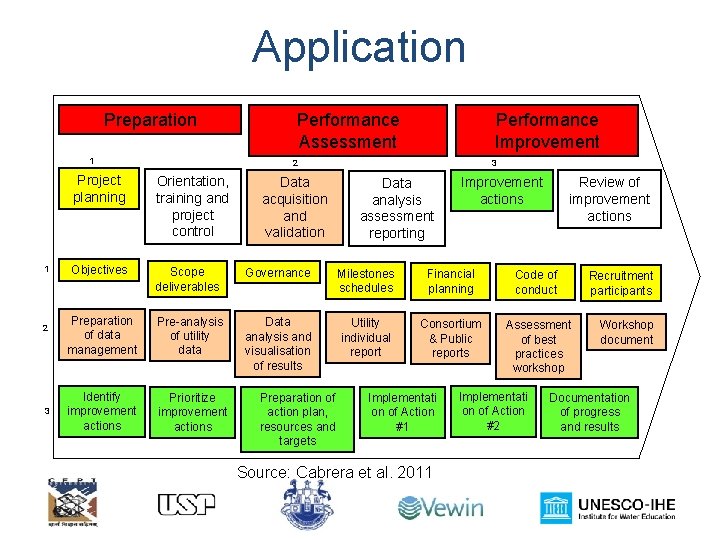
Application Preparation 1 1 2 3 Performance Assessment Performance Improvement 3 2 Project planning Orientation, training and project control Objectives Scope deliverables Governance Milestones schedules Financial planning Code of conduct Preparation of data management Pre-analysis of utility data Data analysis and visualisation of results Utility individual report Consortium & Public reports Assessment of best practices workshop Identify improvement actions Prioritize improvement actions Data acquisition and validation Preparation of action plan, resources and targets Data analysis assessment reporting Implementati on of Action #1 Source: Cabrera et al. 2011 Improvement actions Implementati on of Action #2 Review of improvement actions Recruitment participants Workshop document Documentation of progress and results

Application International Water Association • Difficulties when comparing performance (surface water vs. groundwater, topography, availability of water resources, per capita GNP, cost of resources, etc. ) within the same country, but probably more so when comparing across countries or even continents • Example: A utility operating in a relatively flat, industrialized country such as the Netherlands, with access to an abundance of water resources, with a high average per capita income and low urbanization rates has less challenges to address than a utility operating in waterscarce and mountainous areas of Mexico, with a much lower per capita income • This means that when we compare performance, we must be aware of contextual differences between utilities. IWA has introduced contextual indicators to help explain differences in performance Source: Alegre et al, 2006

Application Performance Assessment Indicator Population served Water supply connections No of Employees Unaccounted for water (UFW) Working Ratio Staff per 1000 connections Service coverage – water supply Average domestic tariff (US$/m 3) 2002 538, 600 131, 136 762 32% 0. 62 5. 66 85% 0. 18 Is this utility well performing?

Application Performance assessment: comparison over time KPI 2000 2001 2002 Population served 460, 900 480, 000 538, 600 Water supply connections 94, 724 112, 427 131, 136 No of Employees 713 730 762 Unaccounted for water 24% 28% 32% Working Ratio 0. 82 0. 67 0. 62 Staff per 1000 connections 7. 20 6. 49 5. 66 Service coverage – water supply 75% 80% 85% Average domestic tariff (US$/m 3) 0. 30 0. 45 The same utility…. is it performing well now?
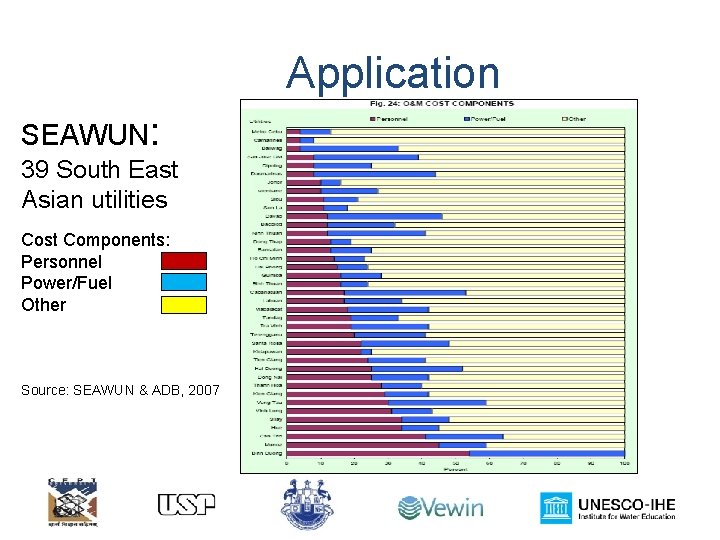
Application SEAWUN: 39 South East Asian utilities Cost Components: Personnel Power/Fuel Other Source: SEAWUN & ADB, 2007

Application Vewin: 10 Dutch water supply companies % of customer calls answered within 20 seconds Performance of worst performers improved significantly Source: VEWIN, 2007, 2010

Application Performance comparison across countries Source: NUS, 2006

Application Performance comparison across countries Source: Eureau, 2008
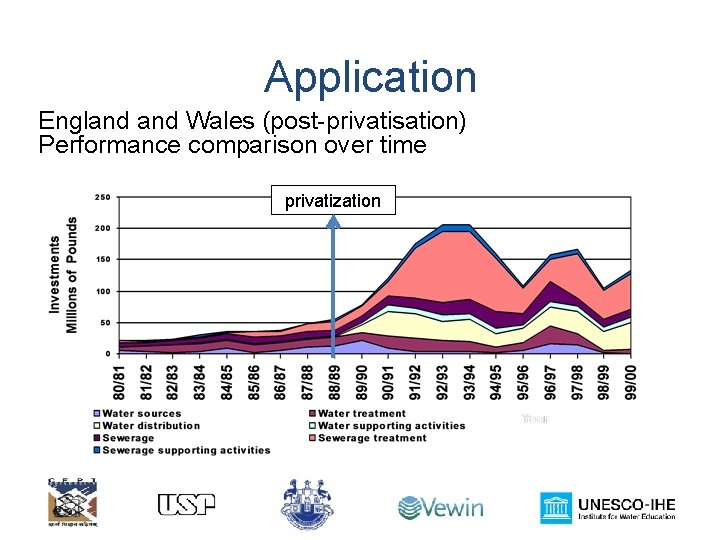
Application England Wales (post-privatisation) Performance comparison over time privatization
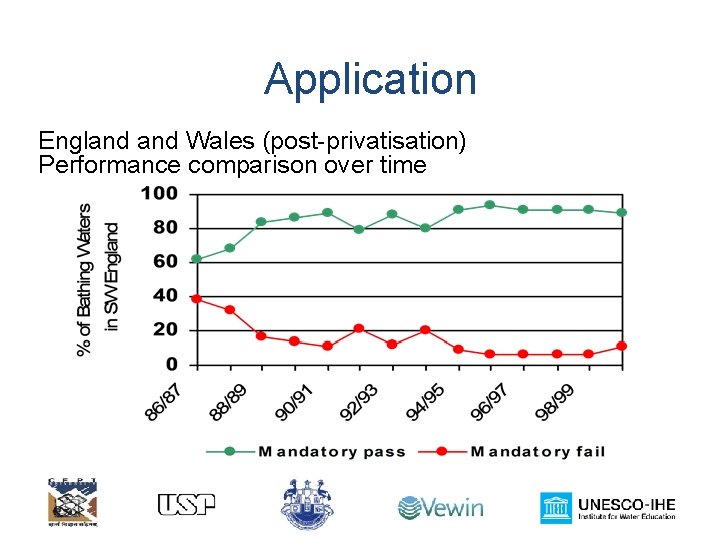
Application England Wales (post-privatisation) Performance comparison over time
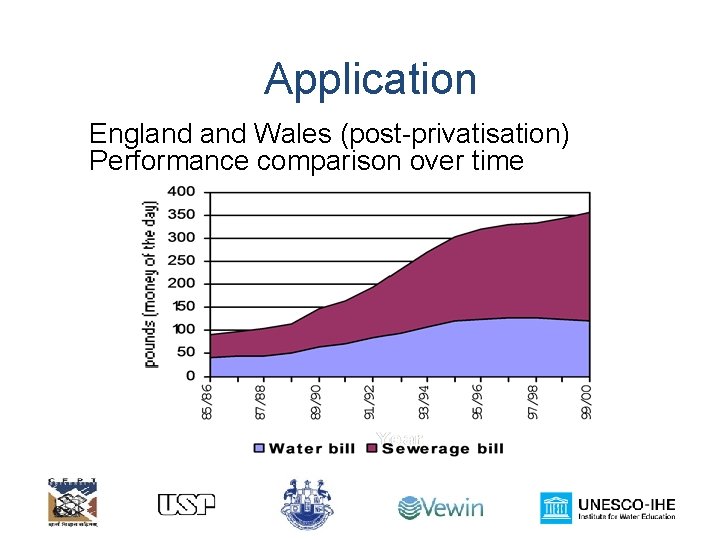
Application England Wales (post-privatisation) Performance comparison over time
- Slides: 19