
Benchmark Chart Research For the Cradle of Civilization
Benchmark Chart Research For the Cradle of Civilization Unit Respectfully submitted by C. Stephen Ingraham cs. I 13
The Law of Synergy The product of a group is greater than any individual of that group. 1) Each member of the group individually works on their own study guide chart. 2) Then each member shares what they have researched. 3) Then each member adds any information they may have overlooked to their study cs. I 13 guide charts.
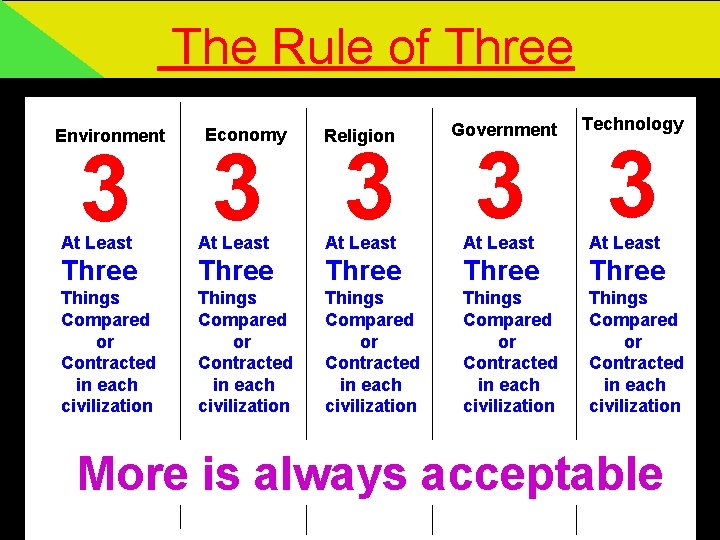
The Rule of Three Environment Economy Religion Government Technology 3 3 3 At Least At Least Three Three Things Compared or Contracted in each civilization Things Compared or Contracted in each civilization More is always acceptable cs. I 13
Ancient Environments 1) All ancient civilizations developed in river valleys, because water was needed to drink, cook, wash, irrigate the crops, and for transportation. 2) The rivers would flood their banks (usually during the spring time) and provide fertile silt. 3) The physical features one would see occur naturally (they are not made by humans). Examples are: deserts, mountains, valleys, plains, plateaus, basins, bays, gulfs, seas, and oceans.
Ancient Economies 1) All ancient people began the exchange of goods through trading one item for something else. This is called barter. 2) Later coins were used to buy items. This is called money economy. 3) Each Civilization could produce different items to export (send out) so they could import (bring in) the items they needed. 1) 4) For a list of exports (surplus items) and 2) imports (needed items) check this out: 3) Mesopotamia p. 64 “Changing Economy” 4) Egypt pp. 111 -2 “Early People of Nubia” 5) China pp. 169 -170 “Trade on the Silk Road” 6) India pp. 190 -1 “The Golden Age of India”
Imports of Ancient India Imports from Mesopotamia were Arabian horses, dried fru precious stones. Imports from China were silk and porcelain, wines, dry fru precious stones, corals, perfumes, and velvets

Ancient Religions 1) All ancient civilizations developed religion to explain the unknown events of nature. 2) They created gods who had the power to make natural events happen. 3) If they worship many gods this is called Polytheism. However, if they worship only one supreme god this is called Monotheism. (Some ancient civilization at various time were both).

CHINESE GODS Ao Ch'in Dragon God responsible for the Southern Ocean Ao Kuang Dragon God responsible for the Eastern Ocean Ao Jun Dragon God responsible for the Western Ocean Ao Shun Dragon God responsible for the Northern Ocean Ch'ang-o (aka Heng-o) Goddess of the Moon and wife of Shen I “The Archer” God of the Sun & Ch’ango-o Husban Chih-Nii (aka Chih Nu) Goddess of crafts & clouds. Rules Over: Handcrafts, rain. Pa Description: Goddess of droughts. Rules Over: Droughts. The Chinese also believed that their ancestors were wise guides For the living and they could be contacted using oracle (dragon) bones.
Ancient Governments 1) All ancient people needed laws to organized and someone in charge. 2) Originally the wises individual lead during times of peace and the strongest ruled during times of war. 3) When one person has the authority to rule in war time and in peace this type of government is called a monarchy. 4) The earliest civilizations developed into monarchies, but the title or what they called the leader might be different.
Ancient Technologies 1) All ancient civilizations developed their own style of writing system. How they wrote it, the number of symbols or pictures they used, what they wrote it on, and what it looked like was very different. 2) The need to solve problems and to make life easier lead to each civilization developing many new inventions and different innovations. 3) Check these out in the textbook: Mesopotamia pp. 61 -2 “New Inventions” & p. 66 “Innovations” 1) Egypt pp. 95 -6 “Source of Innovation” 2) & pp. 98 -100 “The Early Period” 3) China pp. 168 -9 “A Golden Age” 4) India pp. 190 -1 “The Golden Age of India”
- Slides: 10