
Bench to Bedside Current Challenges in TBI Research
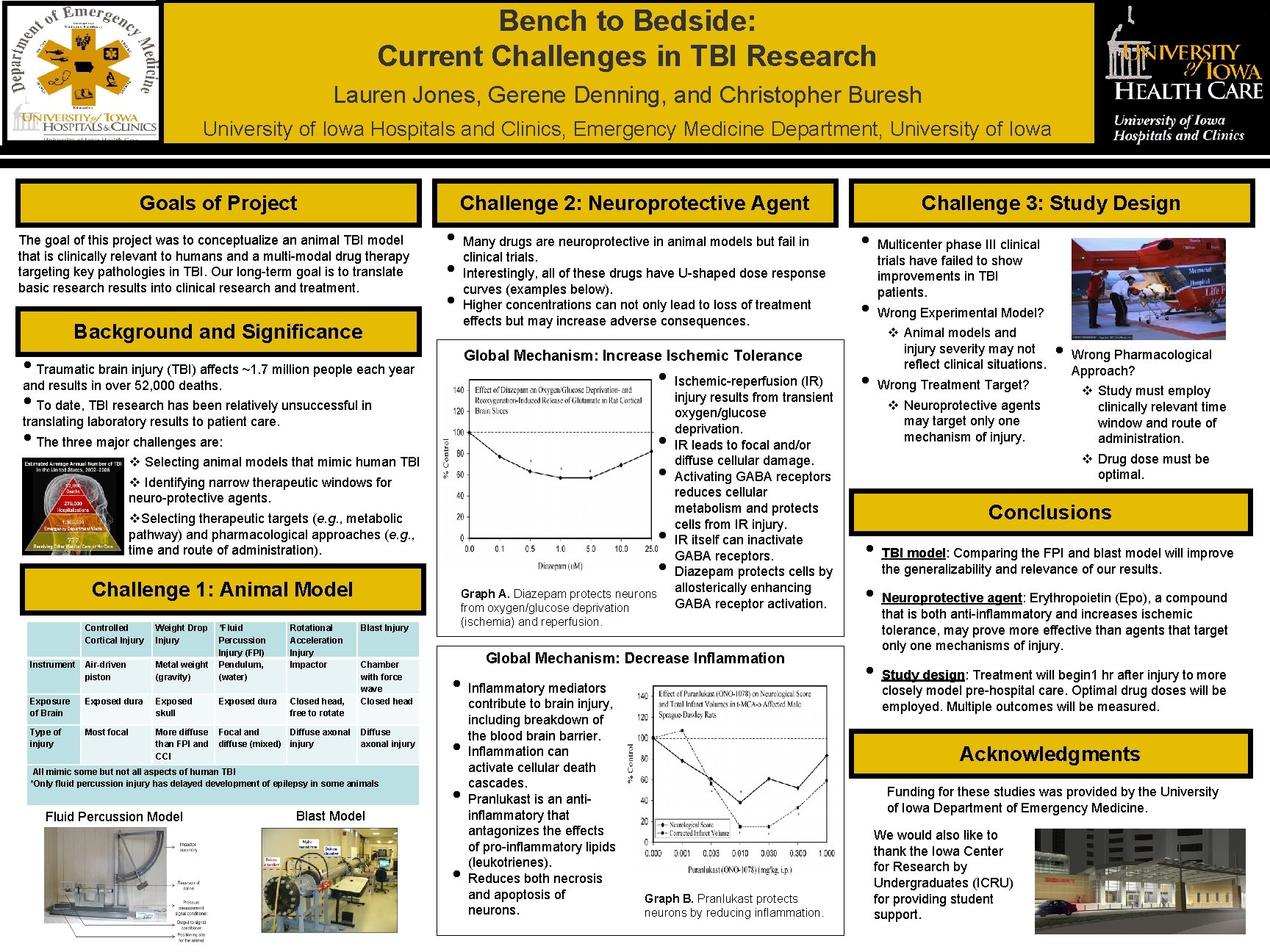
Bench to Bedside: Current Challenges in TBI Research Put Picture here Lauren Jones, Gerene Denning, and Christopher Buresh University of Iowa Hospitals and Clinics, Emergency Medicine Department, University of Iowa Goals of Project Challenge 2: Neuroprotective Agent The goal of this project was to conceptualize an animal TBI model that is clinically relevant to humans and a multi-modal drug therapy targeting key pathologies in TBI. Our long-term goal is to translate basic research results into clinical research and treatment. • Many drugs are neuroprotective in animal models but fail in clinical trials. • Interestingly, all of these drugs have U-shaped dose response curves (examples below). • Higher concentrations can not only lead to loss of treatment effects but may increase adverse consequences. Background and Significance • Ischemic-reperfusion (IR) • • v Selecting animal models that mimic human TBI v Identifying narrow therapeutic windows for neuro-protective agents. v. Selecting therapeutic targets (e. g. , metabolic pathway) and pharmacological approaches (e. g. , time and route of administration). Controlled Cortical Injury Weight Drop Injury *Fluid Percussion Injury (FPI) Pendulum, (water) Rotational Acceleration Injury Impactor Instrument Air-driven piston Metal weight (gravity) Exposure of Brain Exposed dura Exposed skull Exposed dura Closed head, free to rotate Type of injury Most focal More diffuse than FPI and CCI Focal and diffuse (mixed) Diffuse axonal injury Blast Injury Chamber with force wave Closed head Diffuse axonal injury All mimic some but not all aspects of human TBI *Only fluid percussion injury has delayed development of epilepsy in some animals Fluid Percussion Model Blast Model • Multicenter phase III clinical trials have failed to show improvements in TBI patients. • Wrong Experimental Model? Global Mechanism: Increase Ischemic Tolerance • Traumatic brain injury (TBI) affects ~1. 7 million people each year and results in over 52, 000 deaths. • To date, TBI research has been relatively unsuccessful in translating laboratory results to patient care. • The three major challenges are: Challenge 1: Animal Model Challenge 3: Study Design • • Graph A. Diazepam protects neurons from oxygen/glucose deprivation (ischemia) and reperfusion. injury results from transient oxygen/glucose deprivation. IR leads to focal and/or diffuse cellular damage. Activating GABA receptors reduces cellular metabolism and protects cells from IR injury. IR itself can inactivate GABA receptors. Diazepam protects cells by allosterically enhancing GABA receptor activation. Global Mechanism: Decrease Inflammation • Inflammatory mediators • • • contribute to brain injury, including breakdown of the blood brain barrier. Inflammation can activate cellular death cascades. Pranlukast is an antiinflammatory that antagonizes the effects of pro-inflammatory lipids (leukotrienes). Reduces both necrosis and apoptosis of neurons. • v Animal models and injury severity may not reflect clinical situations. Wrong Treatment Target? v Neuroprotective agents may target only one mechanism of injury. • Wrong Pharmacological Approach? v Study must employ clinically relevant time window and route of administration. v Drug dose must be optimal. Conclusions • TBI model: Comparing the FPI and blast model will improve the generalizability and relevance of our results. • Neuroprotective agent: Erythropoietin (Epo), a compound that is both anti-inflammatory and increases ischemic tolerance, may prove more effective than agents that target only one mechanisms of injury. • Study design: Treatment will begin 1 hr after injury to more closely model pre-hospital care. Optimal drug doses will be employed. Multiple outcomes will be measured. Acknowledgments Funding for these studies was provided by the University of Iowa Department of Emergency Medicine. Graph B. Pranlukast protects neurons by reducing inflammation. We would also like to thank the Iowa Center for Research by Undergraduates (ICRU) for providing student support.
- Slides: 1