
Ben Marsden Information Security Director Smith College A
Ben Marsden, Information Security Director, Smith College A Pragmatic Information Security Program for Small Institutions EDUCause Security Professionals Conference, April 2013
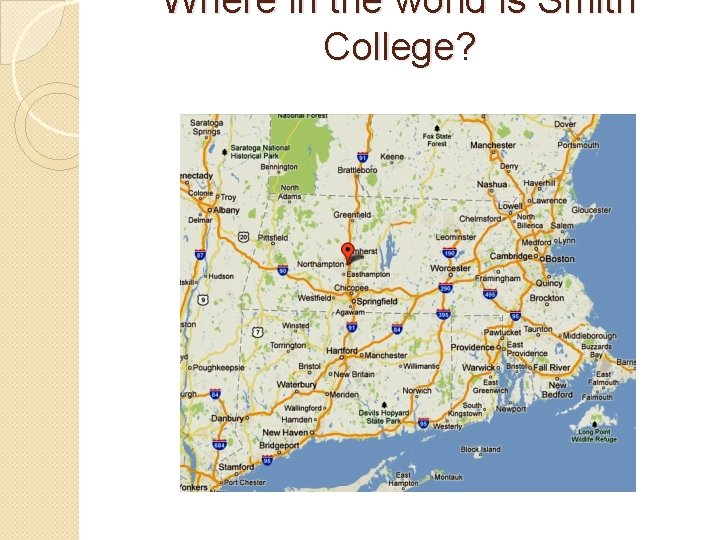
Where in the world is Smith College?
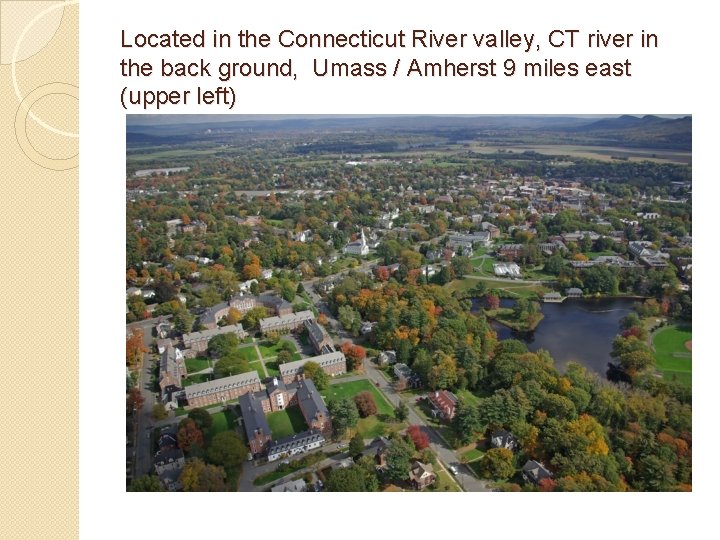
Located in the Connecticut River valley, CT river in the back ground, Umass / Amherst 9 miles east (upper left)
Smith College quick stats: �Undergrad residential women’s college ◦ ~2700 students, 513 faculty, 841 staff ◦ ~4000 community members ◦ One of the “Seven Sisters” �~120 buildings, geographically contiguous �“new” (15 months? ) VP of IT �updated ITS Strategic Plan
me… �At Umass / Amherst about forever: ◦ Umass / Amherst : BS, MS geology ◦ Ugrad –> staff �VMS & unix sysadmin �Assistant director, Engineering Computer Svcs �Moved to Smith College : ◦ 1999 : Director, SNS ◦ 2012 : Director, Information Security
WISP – the early years �Original WISP adopted in 2010 �MA data breach law compliance �When all you have is a hammer, everything looks like ….
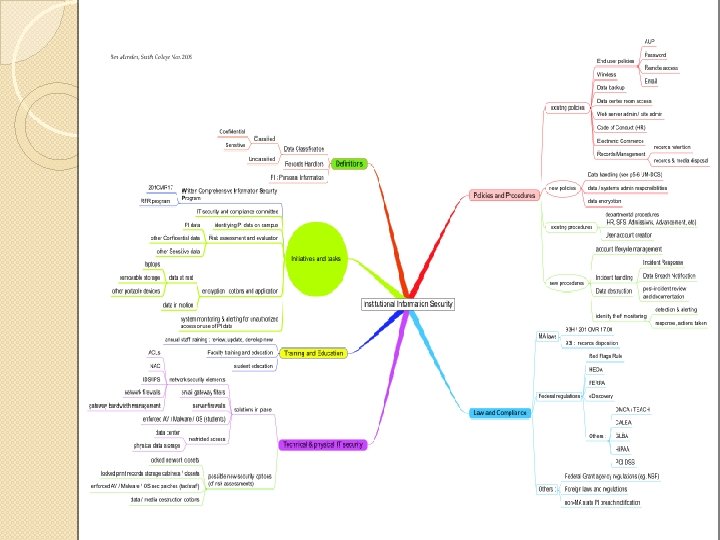
An Info Security Program… �New position = new security program �But, a security program is NOT … ◦ an overview of the current security profile �Help! What should a “real” security program look like? ◦ Attend a bunch of sessions… like this one… !
Other sessions I’ve attended in the past…. {imagine picture of jigsaw puzzle with missing pieces here} � Don’t fit me : institution size, available resources � Strategically incomplete, not comprehensive in breadth � Focus on technical controls, not on strategic models � Don’t lay out a helpful path for implementation � So… …. back to baseline fundamentals… ◦ what is an Information Security Program? Why have one?
Info Sec overarching Program Goals : I hold these truths to be self evident… �General Info Sec goals : promote CIA ◦ Confidentiality, Integrity, Availability �Institutional Info Sec goals : protect IIP ◦ Information, Infrastructure, and our Peeps �Reduce the overall risk profile of the institution �* Keep Info Sec Simple ◦ Not simple = not done (or at least not sustainable)
An Info Sec Program is … (conceptually) �It is the manifestation of the Institution's Security Profile design goals �Or, the framework through which governance directives (strategic) are transmitted to management for actions (tactical)
An Info Sec Program is … (actually) � It articulates complementary control domains that meld a variety of security control initiatives so as to most effectively enhance the overall security comportment of the institution. ◦ -- Ben the Pedantic �It defines information security control domains to most effectively select, implement and manage security control initiatives. � It’s an umbrella against the constant downpour of threats
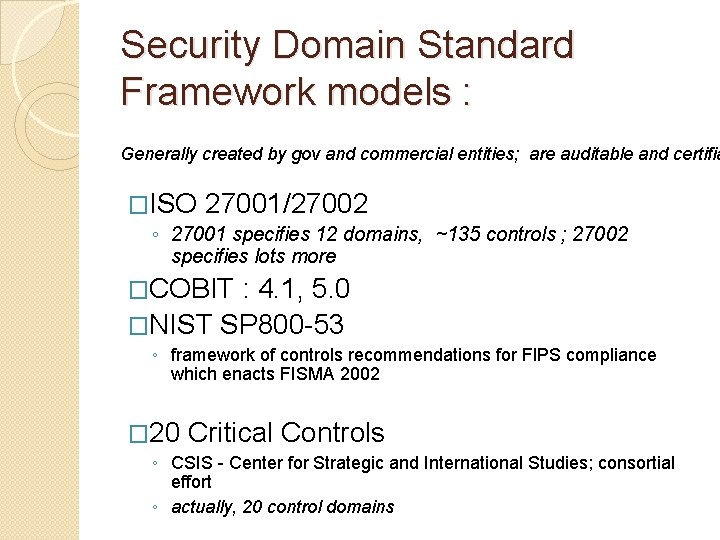
Security Domain Standard Framework models : Generally created by gov and commercial entities; are auditable and certifia �ISO 27001/27002 ◦ 27001 specifies 12 domains, ~135 controls ; 27002 specifies lots more �COBIT : 4. 1, 5. 0 �NIST SP 800 -53 ◦ framework of controls recommendations for FIPS compliance which enacts FISMA 2002 � 20 Critical Controls ◦ CSIS - Center for Strategic and International Studies; consortial effort ◦ actually, 20 control domains
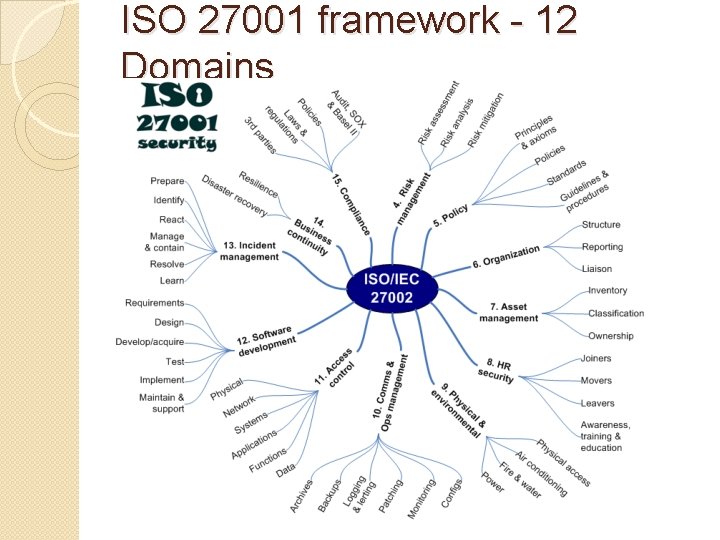
ISO 27001 framework - 12 Domains
ISO 2700 n in education: � "[The Educause Information Security Guide] fundamental organization is based upon the ISO/IEC 27002: 2005 standard, Information technology - Security techniques - Code of practice for information security management. […] the Guide is organized into topics which parallel the major clauses of ISO 27002. ” � Umass / Amherst has based their Security Program on ISO 2700 n
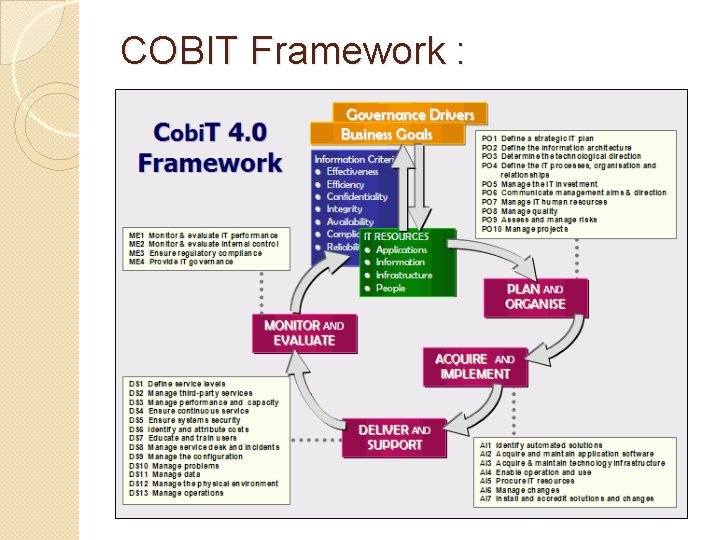
COBIT Framework :
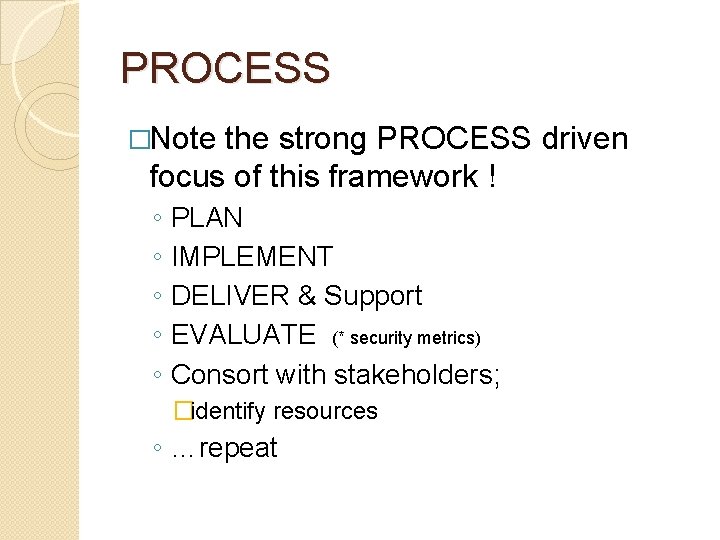
PROCESS �Note the strong PROCESS driven focus of this framework ! ◦ ◦ ◦ PLAN IMPLEMENT DELIVER & Support EVALUATE (* security metrics) Consort with stakeholders; �identify resources ◦ …repeat
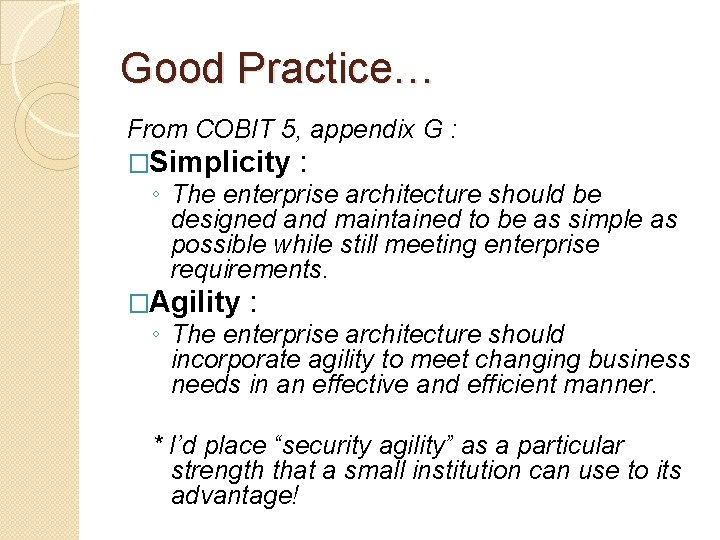
Good Practice… From COBIT 5, appendix G : �Simplicity : ◦ The enterprise architecture should be designed and maintained to be as simple as possible while still meeting enterprise requirements. �Agility : ◦ The enterprise architecture should incorporate agility to meet changing business needs in an effective and efficient manner. * I’d place “security agility” as a particular strength that a small institution can use to its advantage!
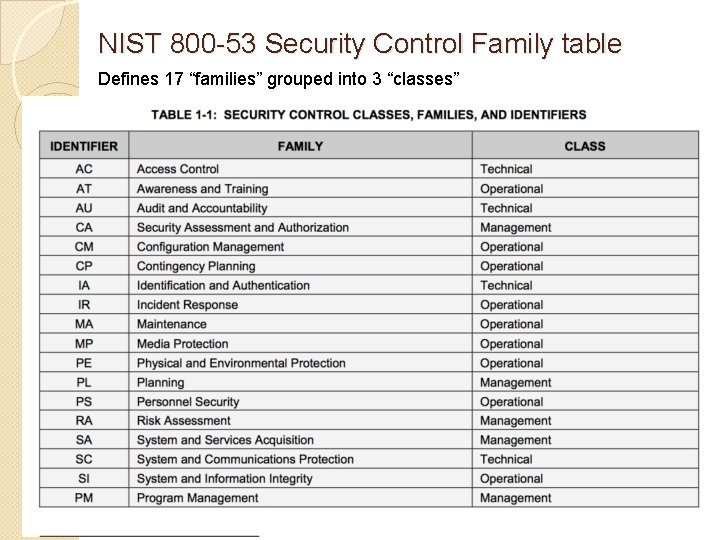
NIST 800 -53 Security Control Family table Defines 17 “families” grouped into 3 “classes”
SIIS “classes” � Strategic - ◦ high level, conceptual, longer view (lectures in the class room) � Tactical - ◦ low level, hands-on, shorter view (field work, boots on the ground) �(“You don’t learn geology in the classroom, you learn it through the soles of you boots. ”)
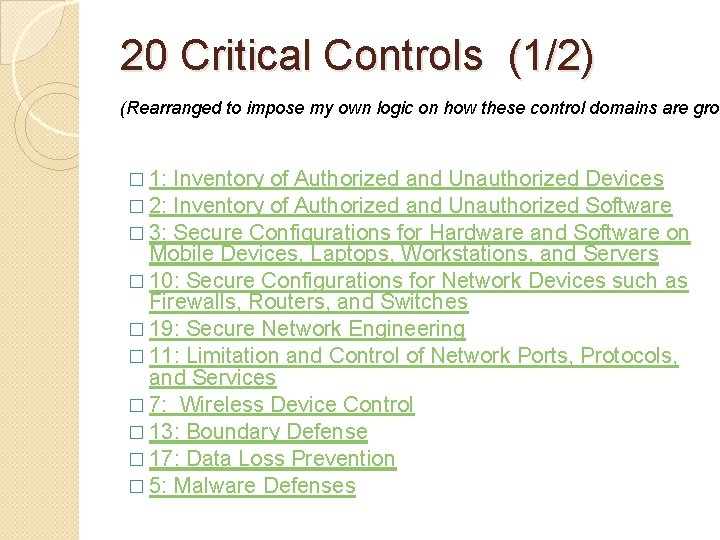
20 Critical Controls (1/2) (Rearranged to impose my own logic on how these control domains are grou � 1: � 2: � 3: Inventory of Authorized and Unauthorized Devices Inventory of Authorized and Unauthorized Software Secure Configurations for Hardware and Software on Mobile Devices, Laptops, Workstations, and Servers � 10: Secure Configurations for Network Devices such as Firewalls, Routers, and Switches � 19: Secure Network Engineering � 11: Limitation and Control of Network Ports, Protocols, and Services � 7: Wireless Device Control � 13: Boundary Defense � 17: Data Loss Prevention � 5: Malware Defenses
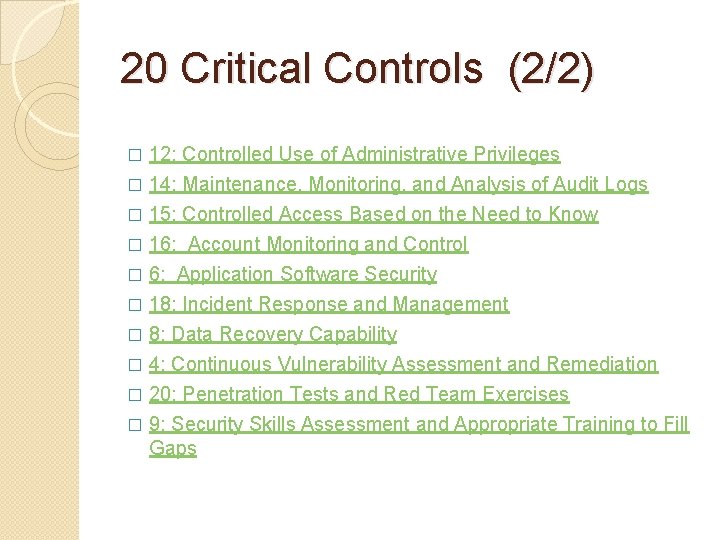
20 Critical Controls (2/2) 12: Controlled Use of Administrative Privileges � 14: Maintenance, Monitoring, and Analysis of Audit Logs � 15: Controlled Access Based on the Need to Know � 16: Account Monitoring and Control � 6: Application Software Security � 18: Incident Response and Management � 8: Data Recovery Capability � 4: Continuous Vulnerability Assessment and Remediation � 20: Penetration Tests and Red Team Exercises � 9: Security Skills Assessment and Appropriate Training to Fill Gaps �
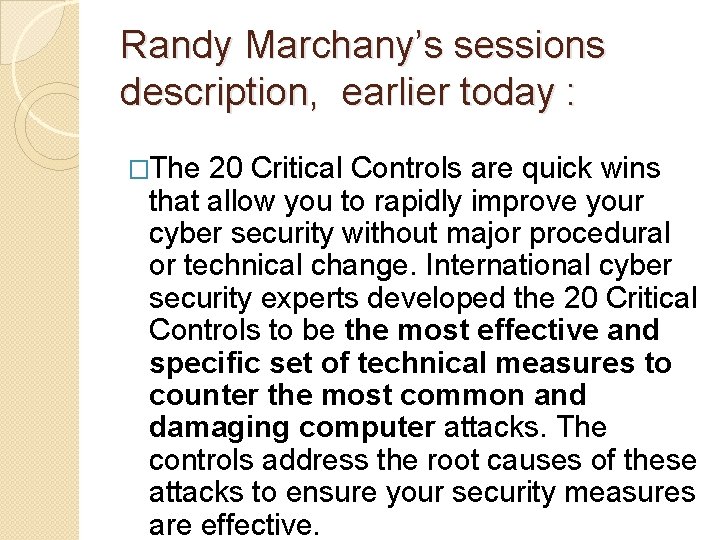
Randy Marchany’s sessions description, earlier today : �The 20 Critical Controls are quick wins that allow you to rapidly improve your cyber security without major procedural or technical change. International cyber security experts developed the 20 Critical Controls to be the most effective and specific set of technical measures to counter the most common and damaging computer attacks. The controls address the root causes of these attacks to ensure your security measures are effective.
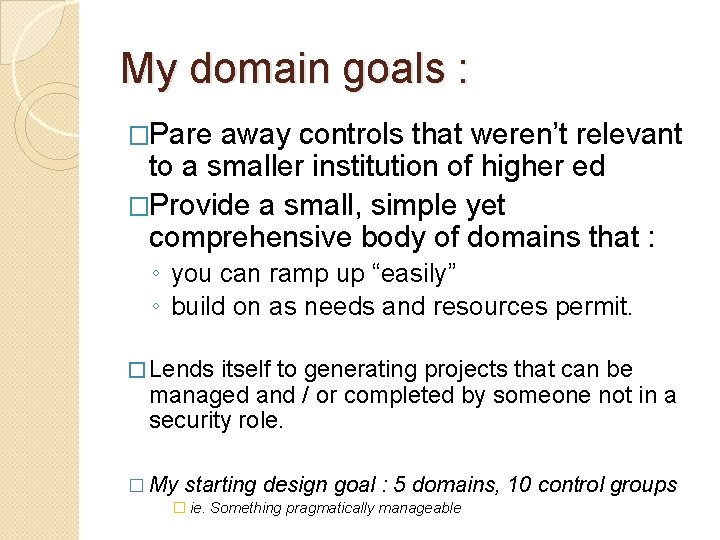
My domain goals : �Pare away controls that weren’t relevant to a smaller institution of higher ed �Provide a small, simple yet comprehensive body of domains that : ◦ you can ramp up “easily” ◦ build on as needs and resources permit. � Lends itself to generating projects that can be managed and / or completed by someone not in a security role. � My starting design goal : 5 domains, 10 control groups � ie. Something pragmatically manageable
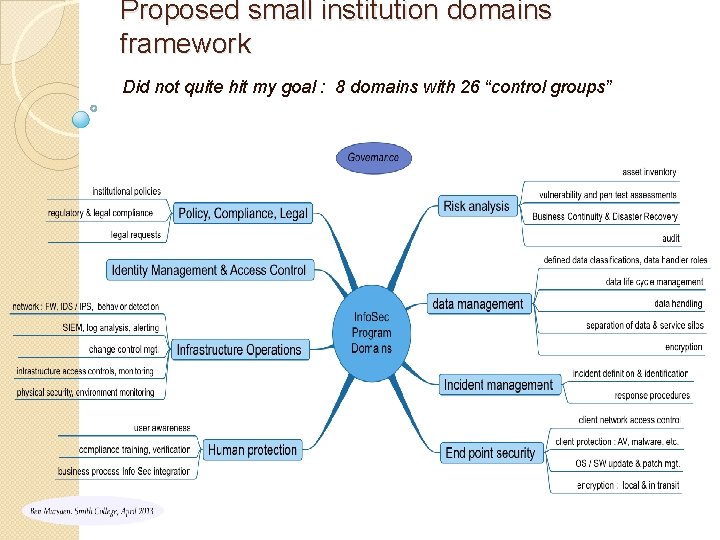
Proposed small institution domains framework Did not quite hit my goal : 8 domains with 26 “control groups”
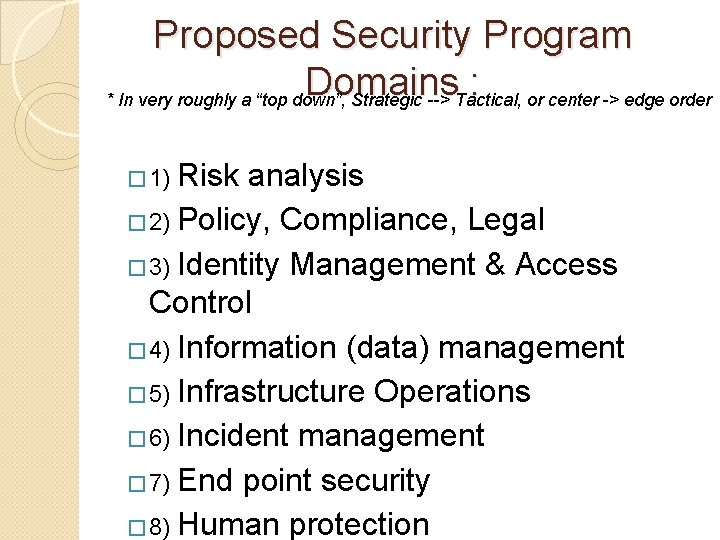
Proposed Security Program Domains : * In very roughly a “top down”, Strategic --> Tactical, or center -> edge order Risk analysis � 2) Policy, Compliance, Legal � 3) Identity Management & Access Control � 4) Information (data) management � 5) Infrastructure Operations � 6) Incident management � 7) End point security � 8) Human protection � 1)
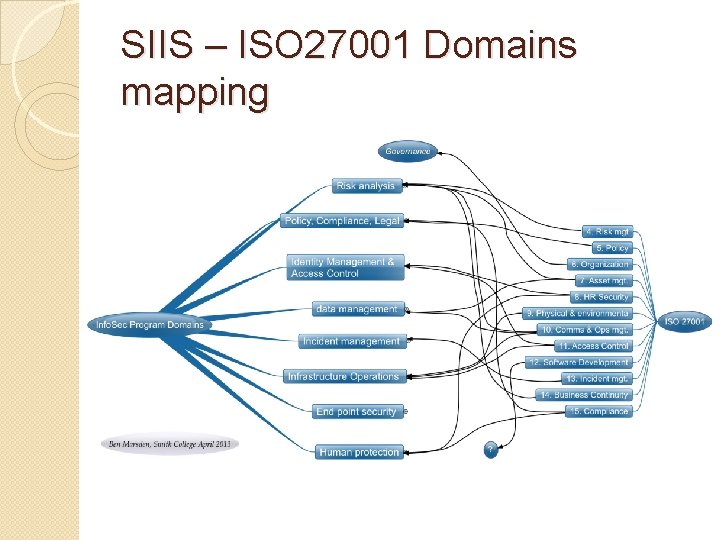
SIIS – ISO 27001 Domains mapping
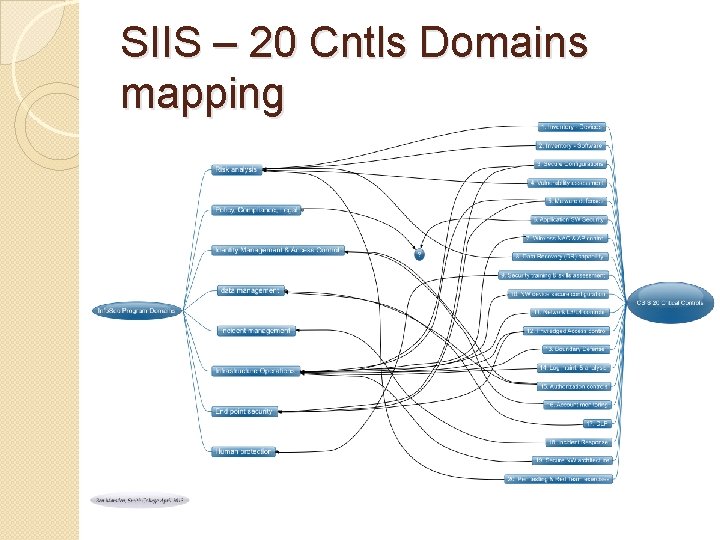
SIIS – 20 Cntls Domains mapping
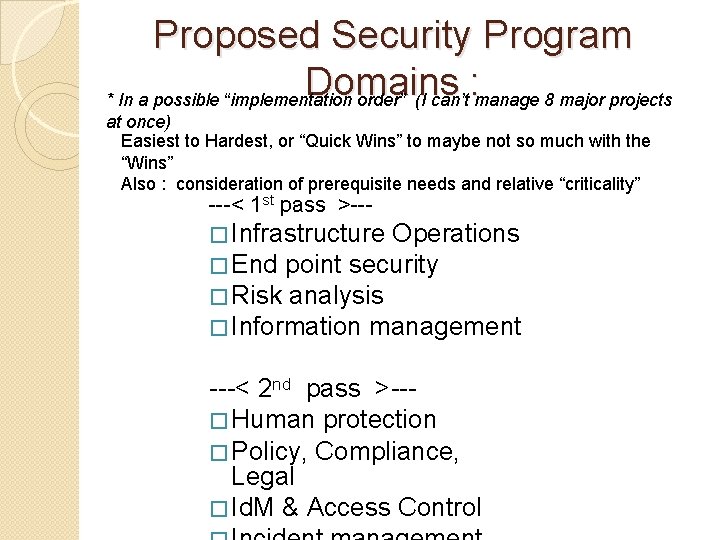
Proposed Security Program Domains : * In a possible “implementation order” (I can’t manage 8 major projects at once) Easiest to Hardest, or “Quick Wins” to maybe not so much with the “Wins” Also : consideration of prerequisite needs and relative “criticality” ---< 1 st pass >--� Infrastructure Operations � End point security � Risk analysis � Information management ---< 2 nd pass >--� Human protection � Policy, Compliance, Legal � Id. M & Access Control
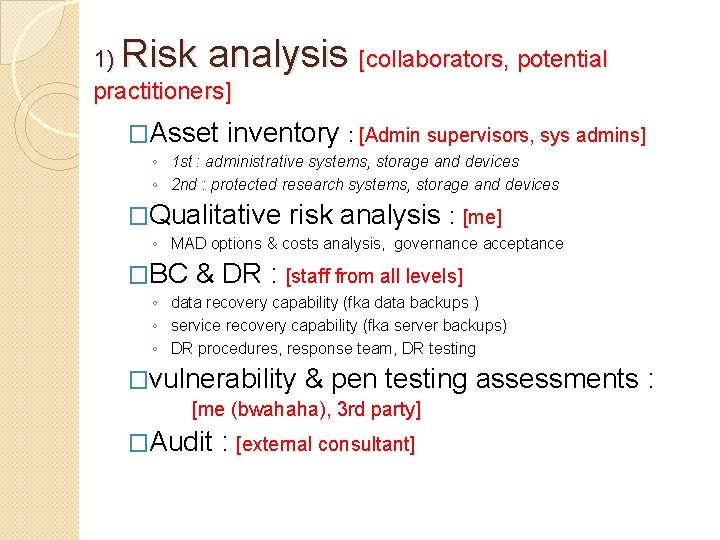
Risk analysis [collaborators, potential 1) practitioners] �Asset inventory : [Admin supervisors, sys admins] ◦ 1 st : administrative systems, storage and devices ◦ 2 nd : protected research systems, storage and devices �Qualitative risk analysis : [me] ◦ MAD options & costs analysis, governance acceptance �BC & DR : [staff from all levels] ◦ data recovery capability (fka data backups ) ◦ service recovery capability (fka server backups) ◦ DR procedures, response team, DR testing �vulnerability & pen testing assessments : [me (bwahaha), 3 rd party] �Audit : [external consultant]
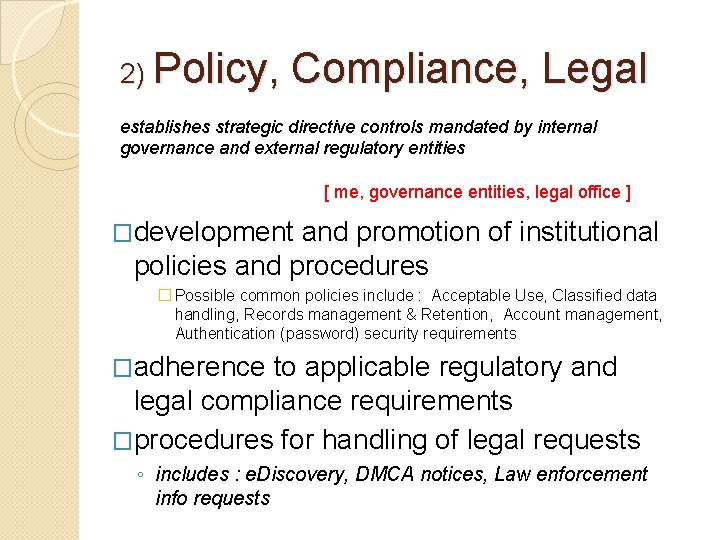
2) Policy, Compliance, Legal establishes strategic directive controls mandated by internal governance and external regulatory entities [ me, governance entities, legal office ] �development and promotion of institutional policies and procedures � Possible common policies include : Acceptable Use, Classified data handling, Records management & Retention, Account management, Authentication (password) security requirements �adherence to applicable regulatory and legal compliance requirements �procedures for handling of legal requests ◦ includes : e. Discovery, DMCA notices, Law enforcement info requests
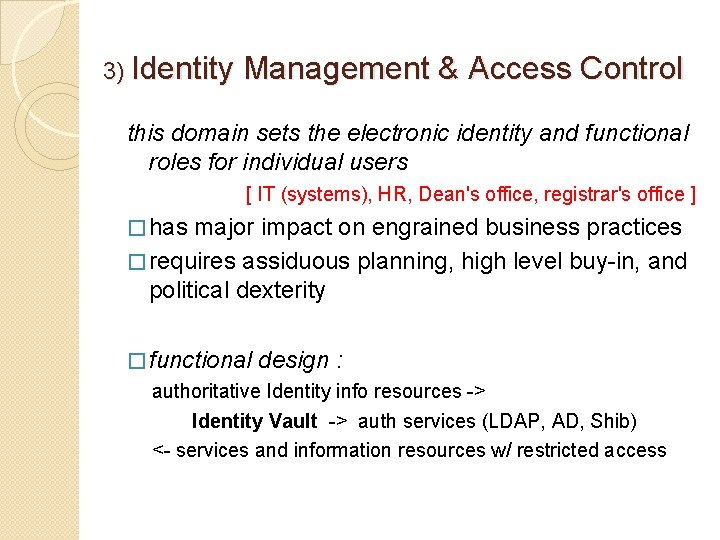
3) Identity Management & Access Control this domain sets the electronic identity and functional roles for individual users [ IT (systems), HR, Dean's office, registrar's office ] � has major impact on engrained business practices � requires assiduous planning, high level buy-in, and political dexterity � functional design : authoritative Identity info resources -> Identity Vault -> auth services (LDAP, AD, Shib) <- services and information resources w/ restricted access
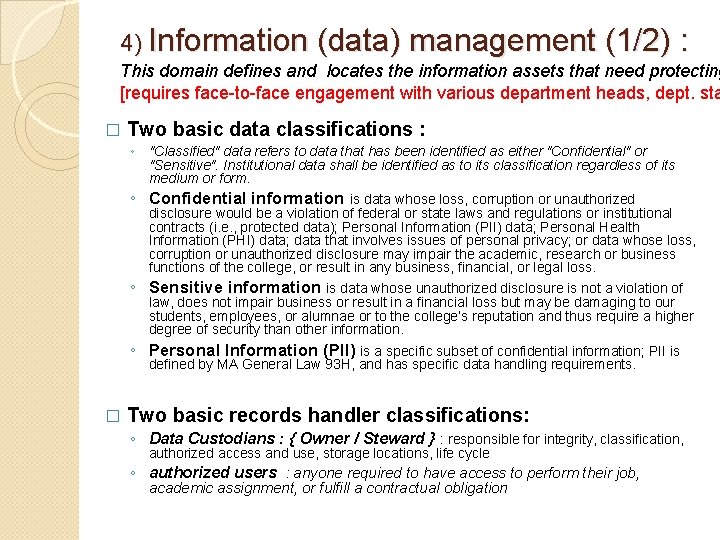
4) Information (data) management (1/2) : This domain defines and locates the information assets that need protecting [requires face-to-face engagement with various department heads, dept. sta � Two basic data classifications : ◦ "Classified" data refers to data that has been identified as either "Confidential" or "Sensitive". Institutional data shall be identified as to its classification regardless of its medium or form. ◦ Confidential information is data whose loss, corruption or unauthorized disclosure would be a violation of federal or state laws and regulations or institutional contracts (i. e. , protected data); Personal Information (PII) data; Personal Health Information (PHI) data; data that involves issues of personal privacy; or data whose loss, corruption or unauthorized disclosure may impair the academic, research or business functions of the college, or result in any business, financial, or legal loss. ◦ Sensitive information is data whose unauthorized disclosure is not a violation of law, does not impair business or result in a financial loss but may be damaging to our students, employees, or alumnae or to the college’s reputation and thus require a higher degree of security than other information. ◦ Personal Information (PII) is a specific subset of confidential information; PII is defined by MA General Law 93 H, and has specific data handling requirements. � Two basic records handler classifications: ◦ Data Custodians : { Owner / Steward } : responsible for integrity, classification, authorized access and use, storage locations, life cycle ◦ authorized users : anyone required to have access to perform their job, academic assignment, or fulfill a contractual obligation
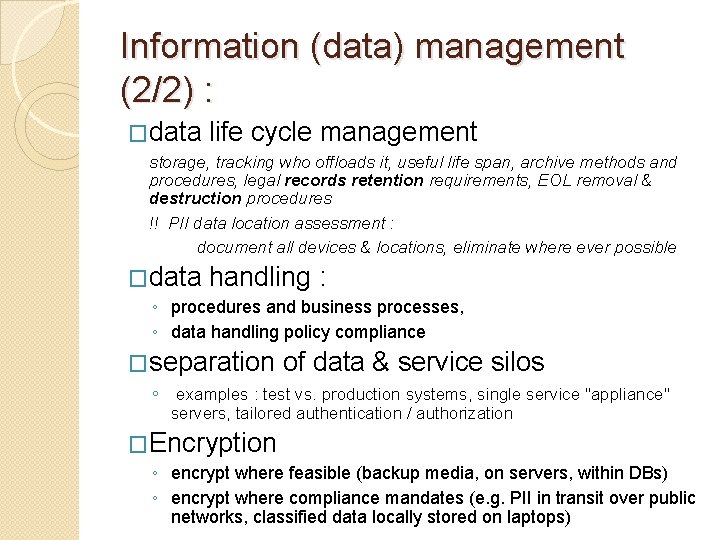
Information (data) management (2/2) : �data life cycle management storage, tracking who offloads it, useful life span, archive methods and procedures, legal records retention requirements, EOL removal & destruction procedures !! PII data location assessment : document all devices & locations, eliminate where ever possible �data handling : ◦ procedures and business processes, ◦ data handling policy compliance �separation of data & service silos ◦ examples : test vs. production systems, single service "appliance" servers, tailored authentication / authorization �Encryption ◦ encrypt where feasible (backup media, on servers, within DBs) ◦ encrypt where compliance mandates (e. g. PII in transit over public networks, classified data locally stored on laptops)
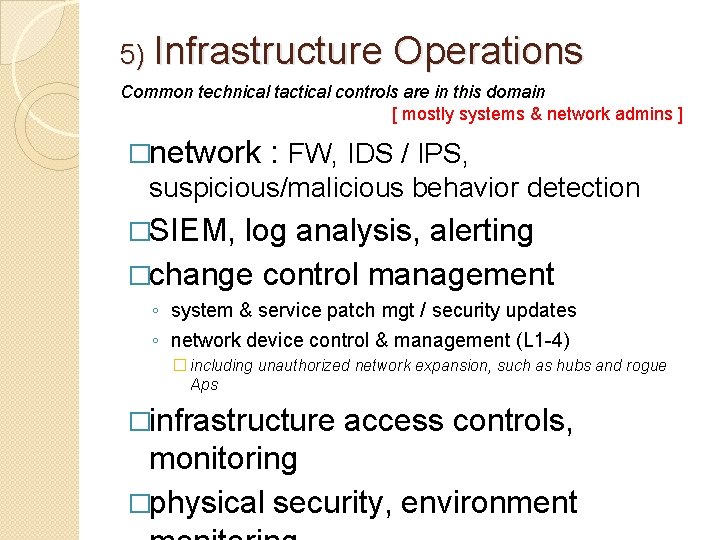
5) Infrastructure Operations Common technical tactical controls are in this domain [ mostly systems & network admins ] �network : FW, IDS / IPS, suspicious/malicious behavior detection �SIEM, log analysis, alerting �change control management ◦ system & service patch mgt / security updates ◦ network device control & management (L 1 -4) � including unauthorized network expansion, such as hubs and rogue Aps �infrastructure access controls, monitoring �physical security, environment
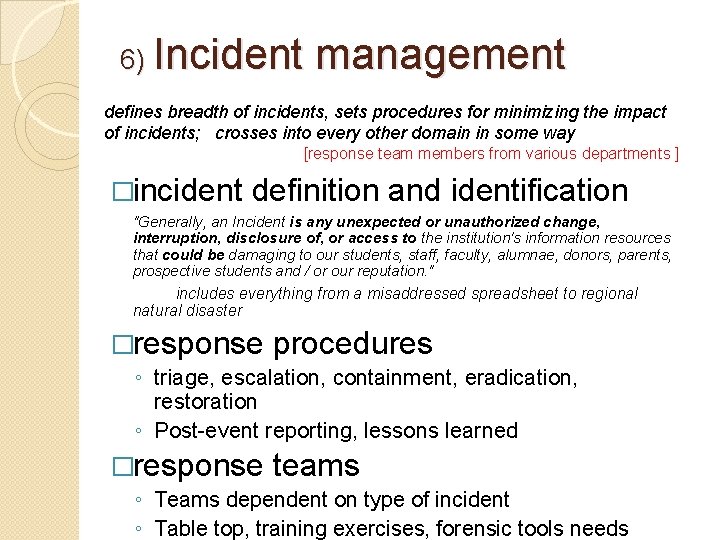
6) Incident management defines breadth of incidents, sets procedures for minimizing the impact of incidents; crosses into every other domain in some way [response team members from various departments ] �incident definition and identification "Generally, an Incident is any unexpected or unauthorized change, interruption, disclosure of, or access to the institution's information resources that could be damaging to our students, staff, faculty, alumnae, donors, parents, prospective students and / or our reputation. " includes everything from a misaddressed spreadsheet to regional natural disaster �response procedures ◦ triage, escalation, containment, eradication, restoration ◦ Post-event reporting, lessons learned �response teams ◦ Teams dependent on type of incident ◦ Table top, training exercises, forensic tools needs
7) End point security this domain address all aspects of network edge device security [ user support, client technical services, departmental IT support staff ] �client network access control �client protection : ◦ AV, malware, host-based FW, app whitelisting, etc. �OS and SW update & patch management �encryption : both local and in transit �* stricter controls for classified data
8) Human protection This domain addresses all aspects of keeping users safe, promoting safe use of information resources, and proselytizing Info Security awareness. [ User support, student affairs, College Relations office, HR ] � user awareness : ◦ communicating IS awareness at the user layer ◦ identity protection, security threat awareness, personal info care, managing privacy, preventing misuse, personal security compromise response, client management best practices � policy compliance training & verification � business process Info Sec integration : ◦ communicating IS awareness at the business process layer ◦ opening lines of communication to promote security best practices ◦ integration into project management � NB: the human is invariably the weakest link in
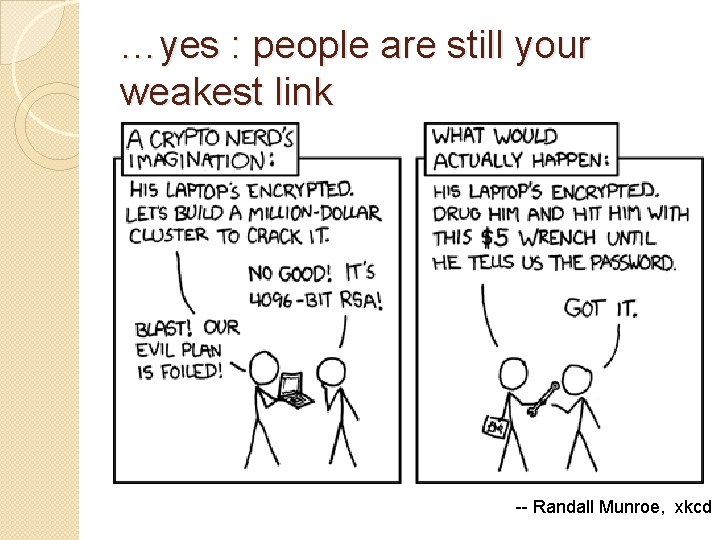
…yes : people are still your weakest link -- Randall Munroe, xkcd
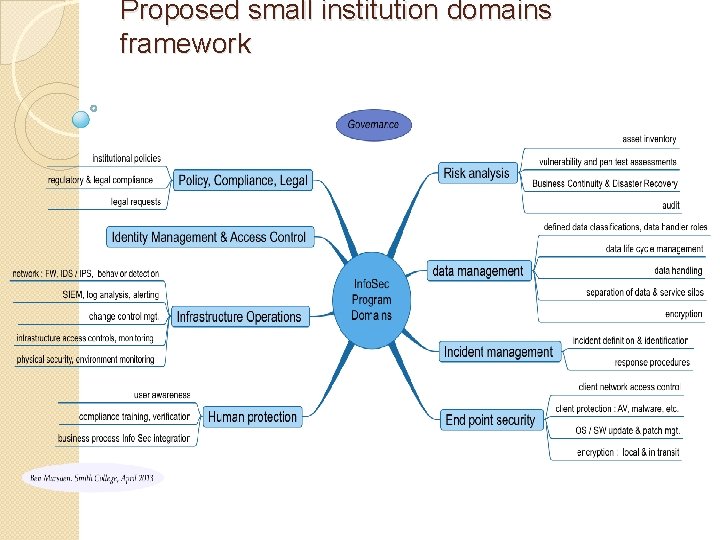
Proposed small institution domains framework
A look at Governance: �what is it, and what is its role in the Info Security program? �Conceptually, it is making sure that the right questions get asked in the right forum �vets sec program initiatives to confirm they are in line with the mission of the institution and the direction of senior leadership �It might be a committee, but for agility, best to also have a designated point of authority ◦ (or a heirarchy)
Where does governance come into play? �Security program content & priorities �Risk ◦ confirming qualitative risk analysis ◦ MAD (max allowable downtime) risk / cost acceptance ◦ DR options : governance accepts the risks, and controls the purse strings �Policy �Audit
Governance and Incident Response : When a potential incident occurs, local staff must have the authority to take actions “above their pay grade” to effectively respond. - has to be formally conveyed, local responder must be able to act without fear of reprimand From The Checklist Manifesto : “…in the face of an extraordinarily complex problem, power needs to be pushed out of the center as far as possible. ” (on Katrina response, Walmart CEO Lee Scott) “ ‘A lot of you are going to have to make decisions above your level. Make the best decision that you can with the information that’s available to you at the time, and, above all, do the right thing. ’”
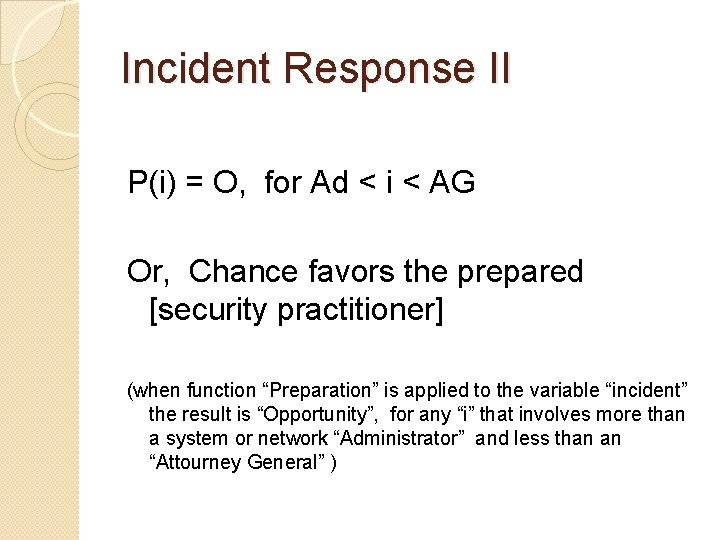
Incident Response II P(i) = O, for Ad < i < AG Or, Chance favors the prepared [security practitioner] (when function “Preparation” is applied to the variable “incident” the result is “Opportunity”, for any “i” that involves more than a system or network “Administrator” and less than an “Attourney General” )
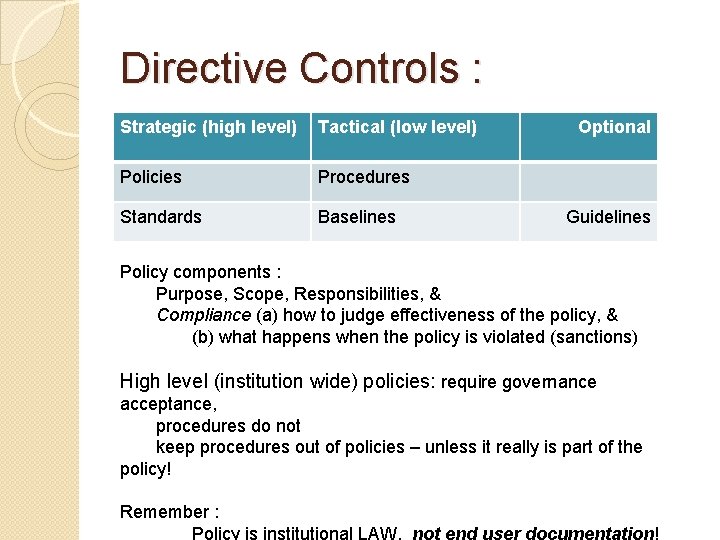
Directive Controls : Strategic (high level) Tactical (low level) Policies Procedures Standards Baselines Optional Guidelines Policy components : Purpose, Scope, Responsibilities, & Compliance (a) how to judge effectiveness of the policy, & (b) what happens when the policy is violated (sanctions) High level (institution wide) policies: require governance acceptance, procedures do not keep procedures out of policies – unless it really is part of the policy! Remember : Policy is institutional LAW, not end user documentation!
Next Steps … �assign select controls to subdomains ◦ start with controls you already have in place ◦ add controls you'd like to implement that fill gaps in your domain profile �Translate targeted controls into initiatives or projects ◦ tap a staff member to take ownership of a subdomain ◦ usurp a staff member to lead a project based on initiatives
Next next steps…. “quick wins” �Look at what you already have in place that fits the program, ◦ identify who's already managing some of these controls ◦ quick "self audit" on these areas for small deficiencies to address �Look for controls that : ◦ don't require lengthy formalized governance vetting, ◦ don't cost big $$, ◦ don't disrupt established business processes … but tweaking business processes != disrupting them, ! Staff generally want to "do the right thing" if
Random additional thoughts: Be The Face of Security : �visit / survey key departments & staff members �find out : what info, where info, who owns data, who classifies data, who uses data, business processes, account and authorization management, etc. (if at least to get them thinking about these things themselves) �Inform : key current security issues, regulatory compliance requirements, policies, incident response procedures, etc. �ask : what concerns do they have?
More (platitudinous) thoughts… �“Just say…” anything but “no” ◦ (errr, except when it’s a policy violation) �Just thinking… ◦ when security isn't in anyone's job description, it *can* be part of everyone's job; BUT if there *is* someone with "security" as a substantial part of their job description, does that relieve others from taking ownership of IT Sec concerns ("Not my problem")? �Fear the threat more than the regulation ◦ Don't tailor your security program design to meet the needs of a compliance directive, or audit comment response
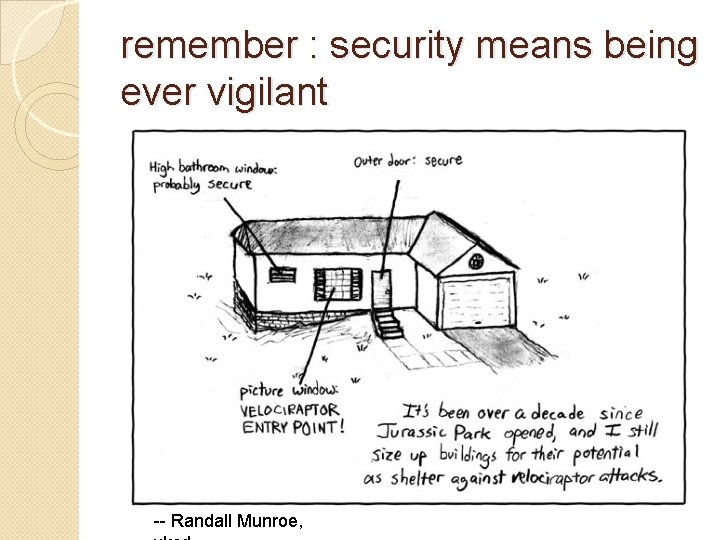
remember : security means being ever vigilant -- Randall Munroe,
Contact info : �My . sig ===================== Ben Marsden : Information Security Director, CISSP/GISP ITS, Stoddard Hall, Smith College, Northampton, MA 01063 bmarsden@smith. edu (413) 585 -4479 --------------------------------
- Slides: 51