
BEM Closedown evaluation and legacies A Lim Sei
BEM – Close-down, evaluation and legacies (A) Lim Sei Kee @ c. K
Discussion Qs �Now that you have learnt the concepts of business event management: what may be the last step of running an event? �What is important when it comes to closing down an event? What do you (event organizer) have to do after the event is over?
Introduction �The close down of an event should be approached the same way as it is set up: �Most accidents don’t happen on the way up, but on the way down. (golden rule in mountain climbing world)
After the event is over: �Close-down �Evaluation �Divestment & legacies
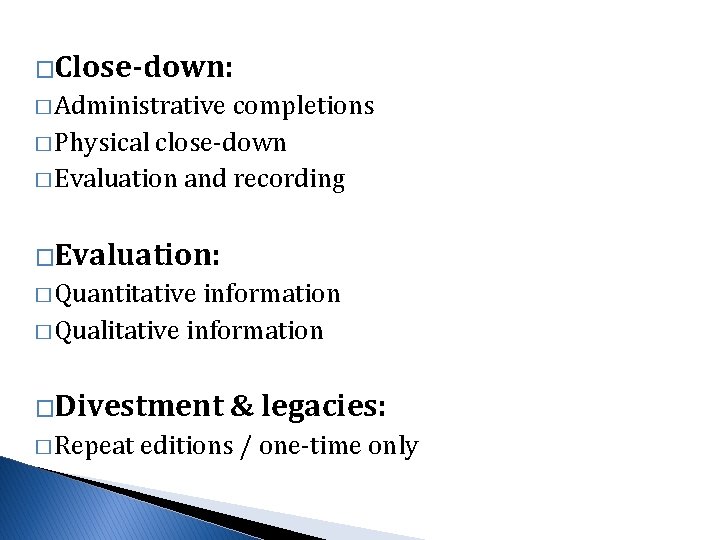
�Close-down: � Administrative completions � Physical close-down � Evaluation and recording �Evaluation: � Quantitative information � Qualitative information �Divestment � Repeat & legacies: editions / one-time only
Close-down �Administrative tasks: completion of the accounts, payment of final bills to contractors, and final marketing activities such as closure press releases. �Preparation of final accounts will tell how the event went financially, and where an event has run in the public domain.
�Evaluation: Co-ordinators should be around to speak to visitors and VIPs on departure to obtain verbal feedback and pick up comments. �Personal contact: It is essential to thank all those involved, in particular key staff. It is both good manners and a courtesy.
�Big clear up: this should be approached in much the same way as the set-up. �General rule: clear-up operations moves from small items to large ones. �Items of stock to be re-used, such as catering stock, linen, consumables and small equipment should be returned to a central storage place prior to collection.
�Be sufficiently prepared for the clear-up operation: consider not only the tasks, but also the number of people and equipment you will need to do the job. �Careful storekeeping and the ability to redeploy equipment, resources and other materials may save a great deal of money and possibly effort next time.
Evaluation �It is important to evaluate an event. �The evaluation should use all the various source of information available. �Q: What are the differences between quantitative information and qualitative information?
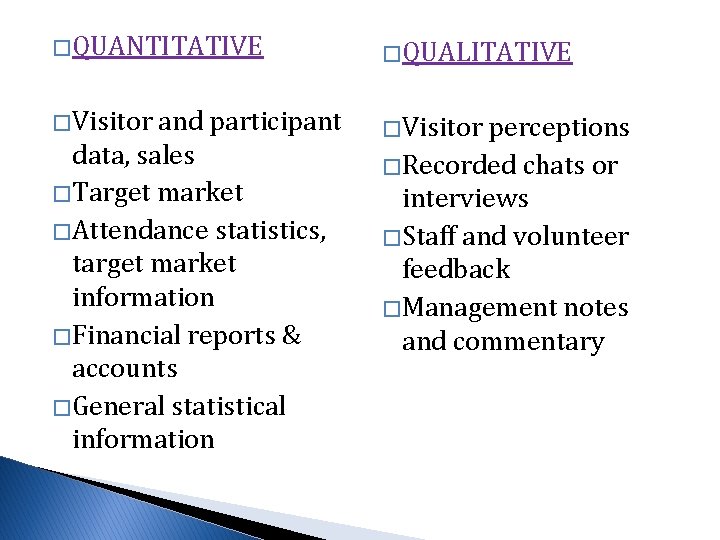
� QUANTITATIVE � QUALITATIVE � Visitor and participant data, sales � Target market � Attendance statistics, target market information � Financial reports & accounts � General statistical information perceptions � Recorded chats or interviews � Staff and volunteer feedback � Management notes and commentary
�Purpose of evaluation: learn how an event went and to be able to improve on it for the future. � 1. Activities that went well but could be strengthened further � 2. Activities that went well in such a way that they are best left untouched � 3. Activities that went badly and need sorting out.
Two key evaluation issues: �Did the event meet its objectives? �What can be improved for the next edition, if there is one?
�Evaluation is especially important when there is future editions. �The identification and solving of problems can only be carried out properly if there is enough information to ascertain the real cause of a problem.
�In general, knowing what is best or worst about an event will help to increase satisfaction levels and reduce dissatisfaction. �In any list of problems, the ones that cause the most difficulty should be dealt with first.
�Visitors’ impressions of an event are influenced by two sets of judgments: aspects that satisfy them, and aspects that dissatisfy them. �Satisfiers: ambience, excitement, social involvement, relations, together with some service elements. �Dissatisfiers: physical and basic service features: parking, toilets, availability of information, queues.
Conclusion �It is important to recognize the limitations of what can be achieved in evaluating events. �We are never going to achieve complete and total satisfaction.
Event finishes: what to do next? �A Handover and site restoration �B Removal of structures �C Removal of utilities �D Cleaning and waste disposal �E Bump-out equipment and furniture �F Clear down small items �G Cleaning begins
For next week, �Events leave a legacy. �This may be in personal memories or friendly social contacts made at the event, or it may even be items / merchandise. �It may be transient or long-lasting. �Either way, some thought should be given the setting of objectives at the beginning, to the legacy.
Important Dates � 8 th NOVEMBER 2014: Last official lecture for Business Event Management � 15 th NOVEMBER / 22 nd NOVEMBER 2014: Final Presentation � 29 th NOVEMBER 2014: Report in for last attendance taking upon submission of all tasks.
- Slides: 20