
Below is the equation for the Pythagorean theorem


Below is the equation for the Pythagorean theorem. Over the next few pages, you will use this equation to answer some questions. a 2 + b 2 = c 2 c a b
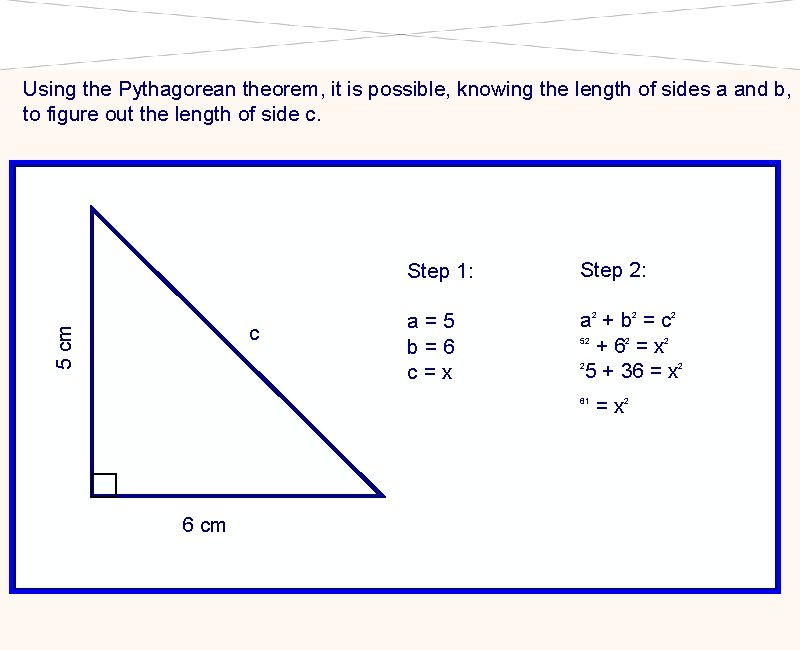
Using the Pythagorean theorem, it is possible, knowing the length of sides a and b, to figure out the length of side c. 5 cm c Step 1: Step 2: a=5 b=6 c=x a 2 + b 2 = c 2 52 + 62 = x 2 2 5 + 36 = x 2 61 6 cm = x 2
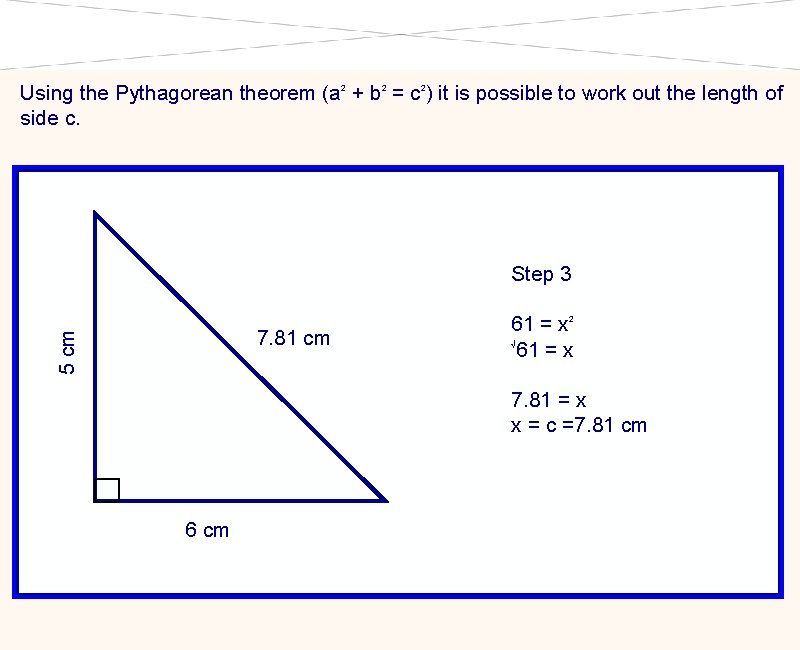
Using the Pythagorean theorem (a 2 + b 2 = c 2) it is possible to work out the length of side c. Step 3 5 cm 7. 81 cm 61 = x 2 √ 61 = x 7. 81 = x x = c =7. 81 cm 6 cm
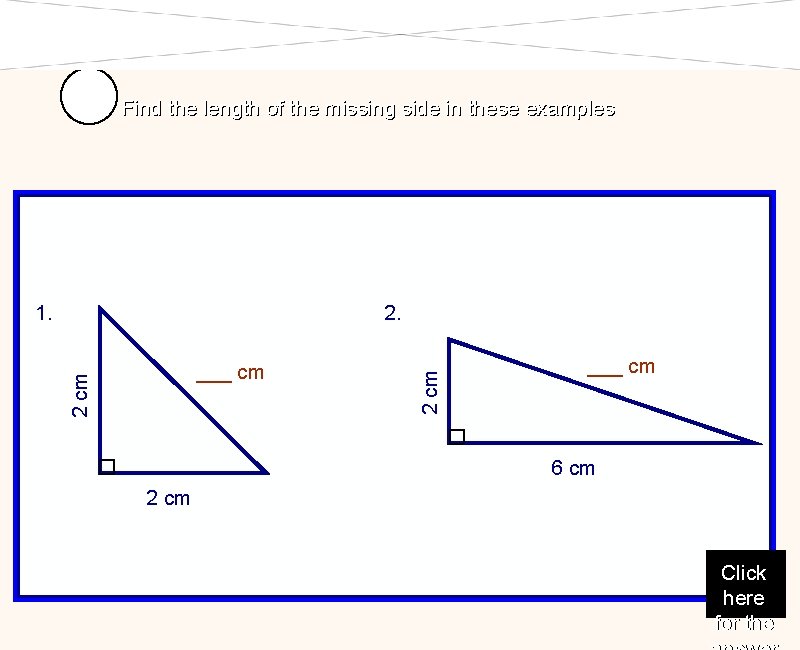
Find the length of the missing side in these examples 2. 2 cm ___ cm 2 cm 1. ___ cm 6 cm 2 cm Click here for the
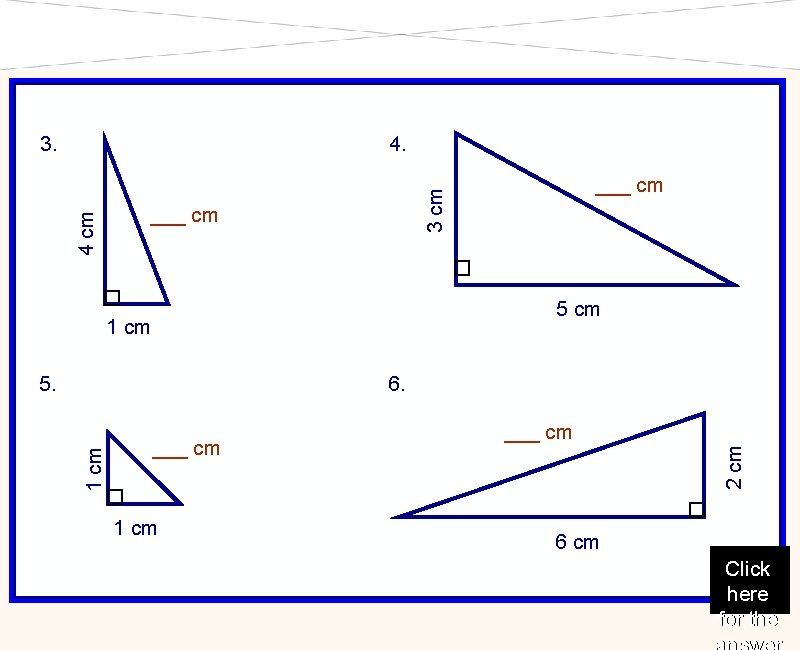
4. ___ cm 3 cm 4 cm 3. ___ cm 5 cm 1 cm 6. ___ cm 1 cm ___ cm 2 cm 1 cm 5. 6 cm Click here for the
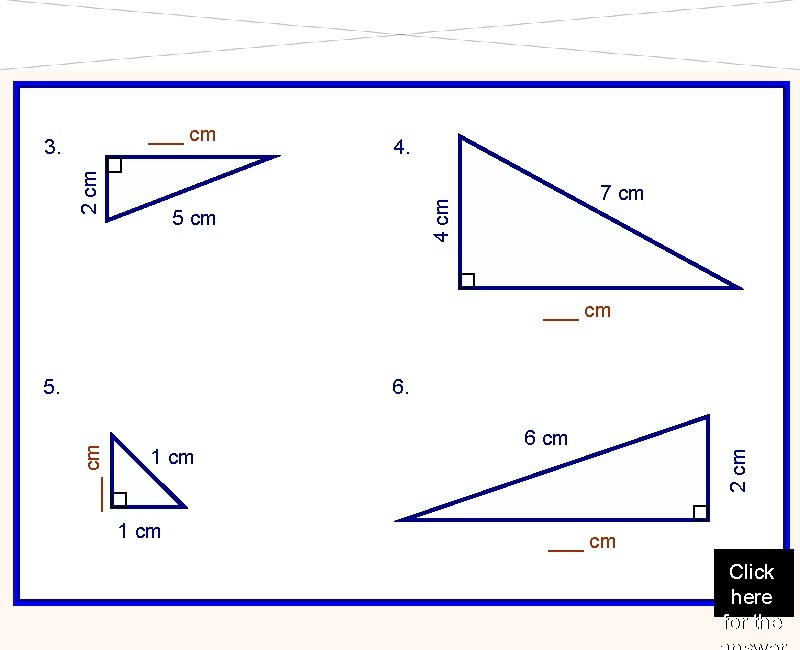
2 cm 4. 7 cm 4 cm ___ cm 3. 5 cm ___ cm 1 cm 6 cm 2 cm 6. ___ cm 5. ___ cm Click here for the
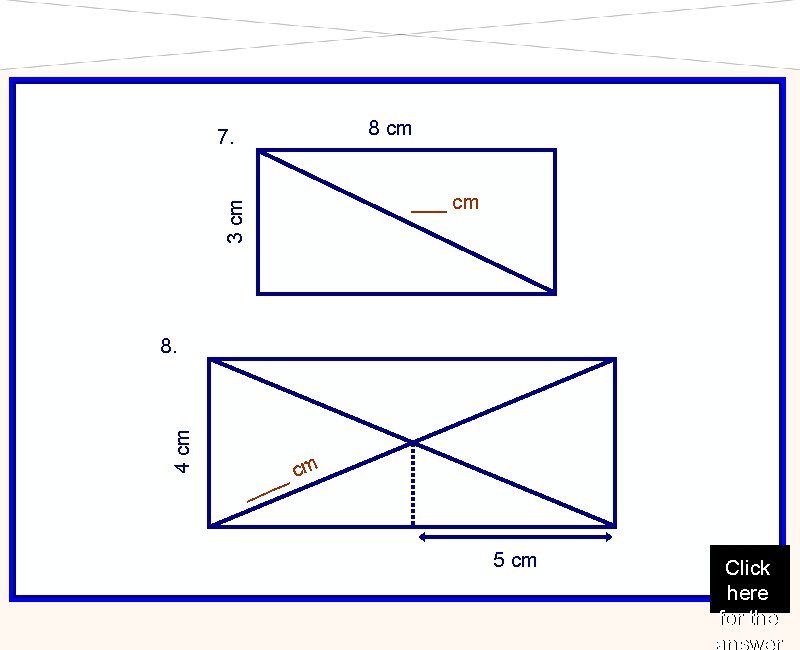
8 cm 7. 3 cm ___ cm 4 cm 8. c _ _ _ m _ 5 cm Click here for the
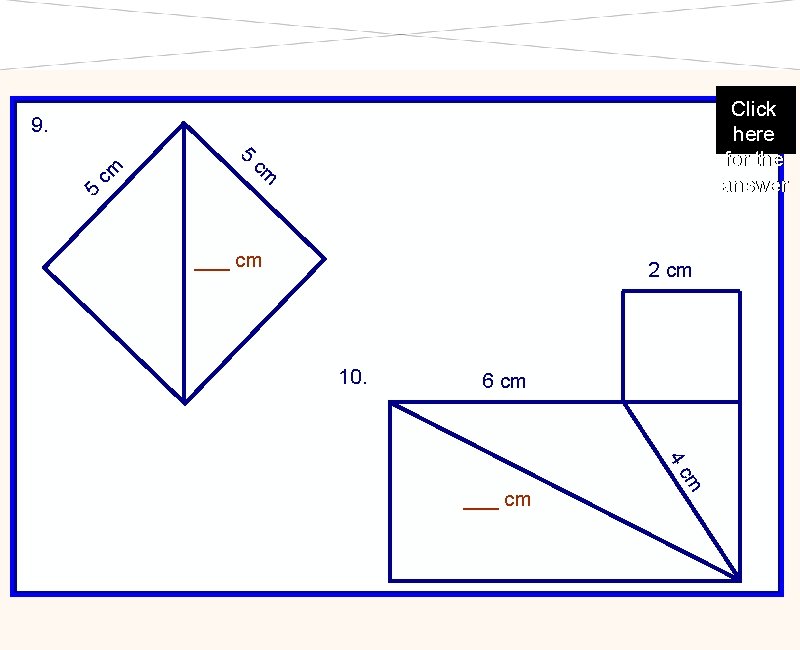
Click here for the answer 9. cm 5 ___ cm 2 cm 10. 6 cm m 4 c ___ cm

The following pages are answers to the tasks in the lesson activity.
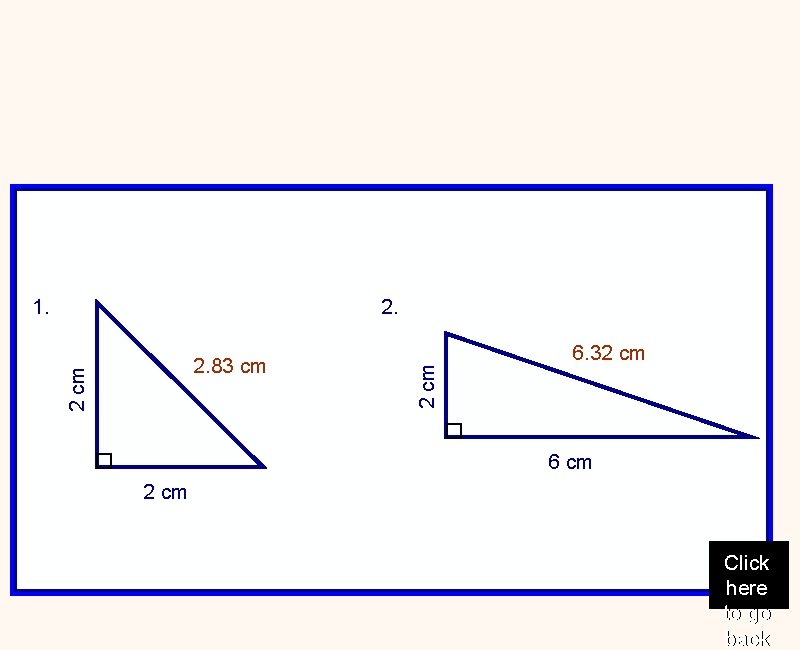
2. 2 cm 2. 83 cm 2 cm 1. 6. 32 cm 6 cm 2 cm Click here to go back
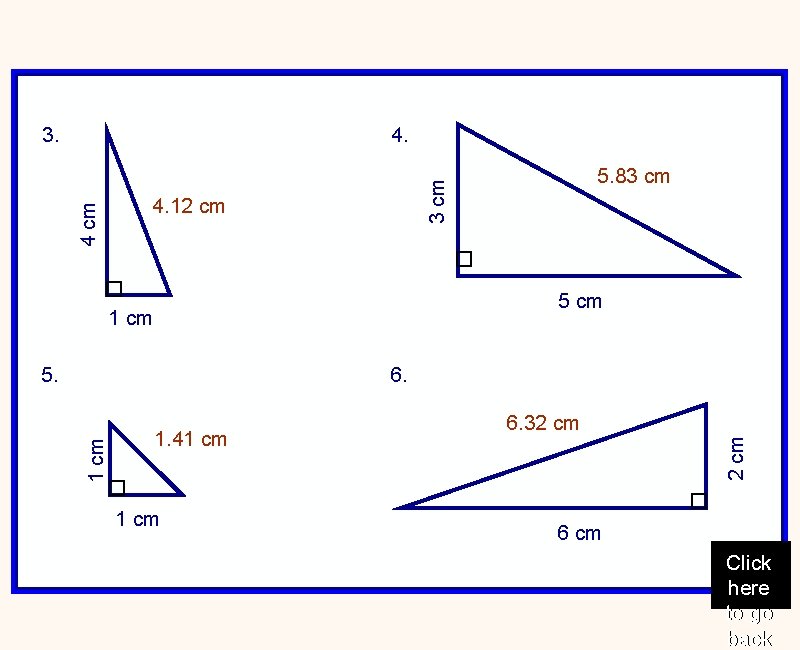
4. 5. 83 cm 4 cm 3. 4. 12 cm 5 cm 1 cm 6. 1. 41 cm 6. 32 cm 1 cm 5. 6 cm Click here to go back
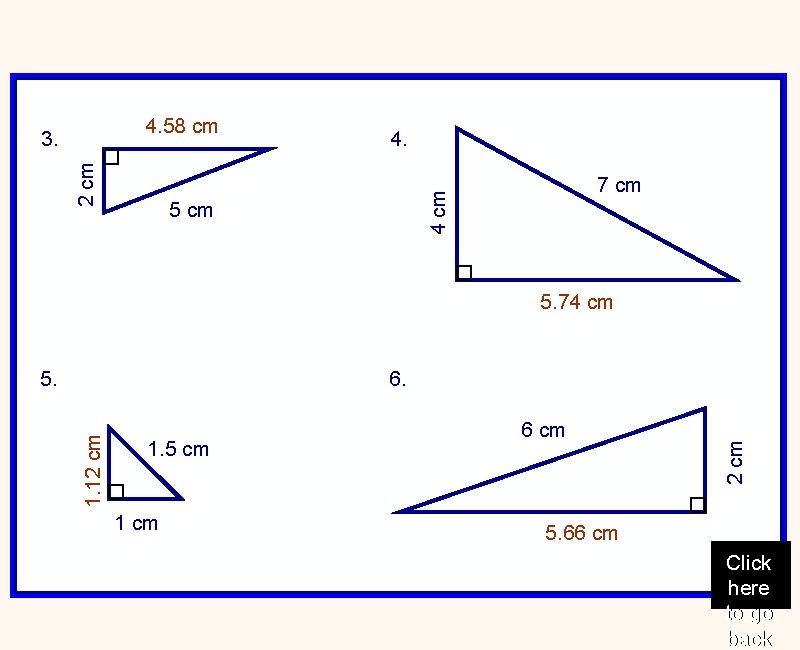
2 cm 4. 7 cm 4. 58 cm 3. 5 cm 5. 74 cm 1. 5 cm 1 cm 6 cm 2 cm 6. 1. 12 cm 5. 66 cm Click here to go back
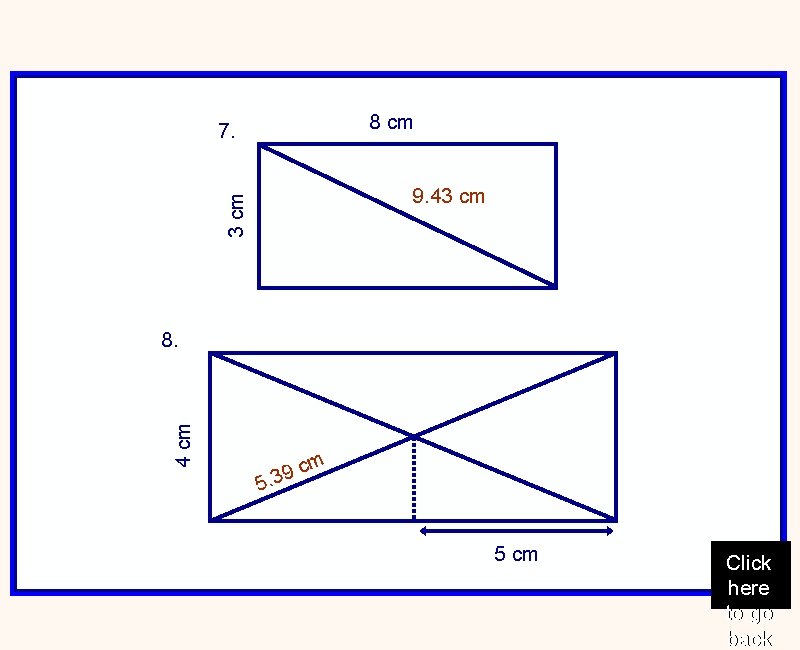
8 cm 7. 3 cm 9. 43 cm 4 cm 8. m 5 c. 39 5 cm Click here to go back
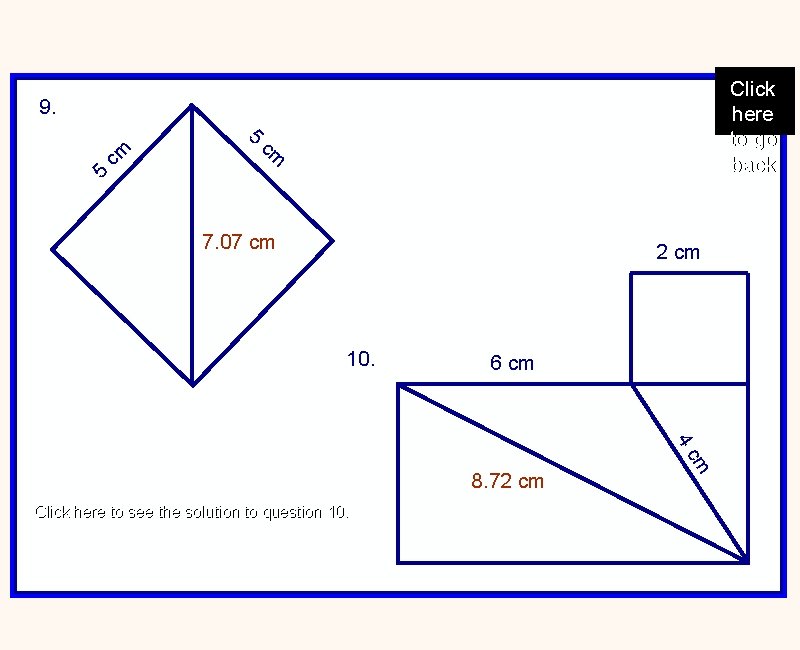
Click here to go back 9. cm 5 7. 07 cm 2 cm 10. 6 cm 4 c Click here to see the solution to question 10. m 8. 72 cm
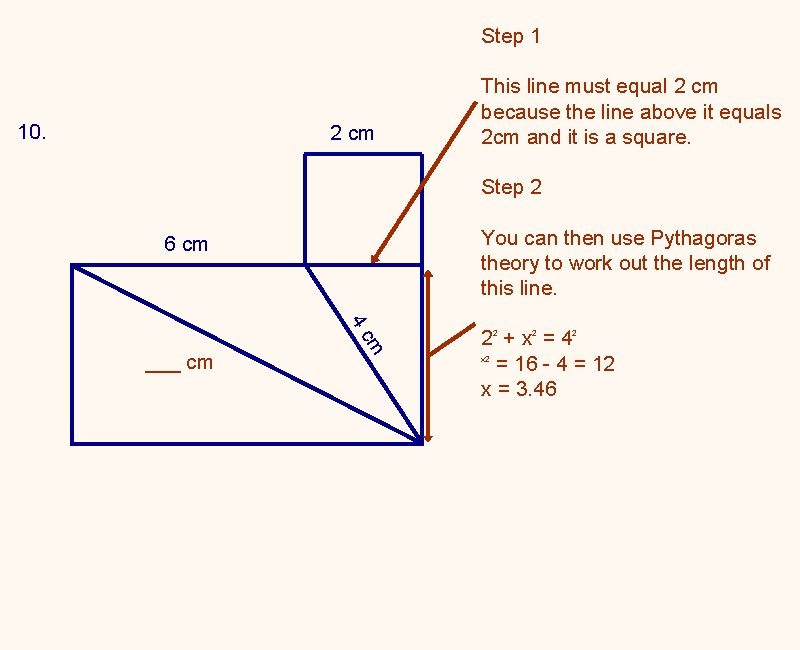
Step 1 10. 2 cm This line must equal 2 cm because the line above it equals 2 cm and it is a square. Step 2 You can then use Pythagoras theory to work out the length of this line. 6 cm m 4 c ___ cm 22 + x 2 = 4 2 x 2 = 16 - 4 = 12 x = 3. 46
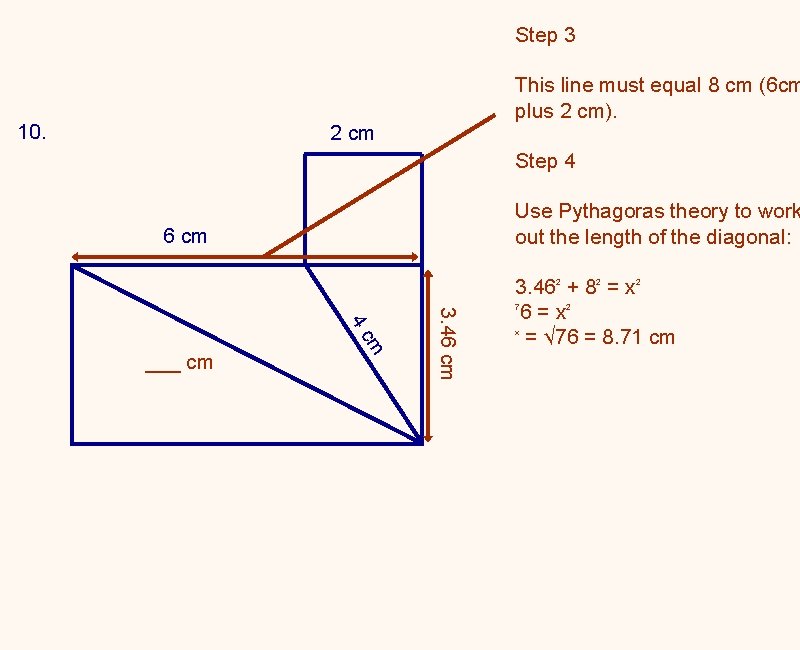
Step 3 10. This line must equal 8 cm (6 cm plus 2 cm). 2 cm Step 4 Use Pythagoras theory to work out the length of the diagonal: 6 cm 3. 46 cm m 4 c ___ cm 3. 462 + 82 = x 2 7 6 = x 2 x = √ 76 = 8. 71 cm
- Slides: 17