
BELLWORK New Study Island due Tuesday Cones The
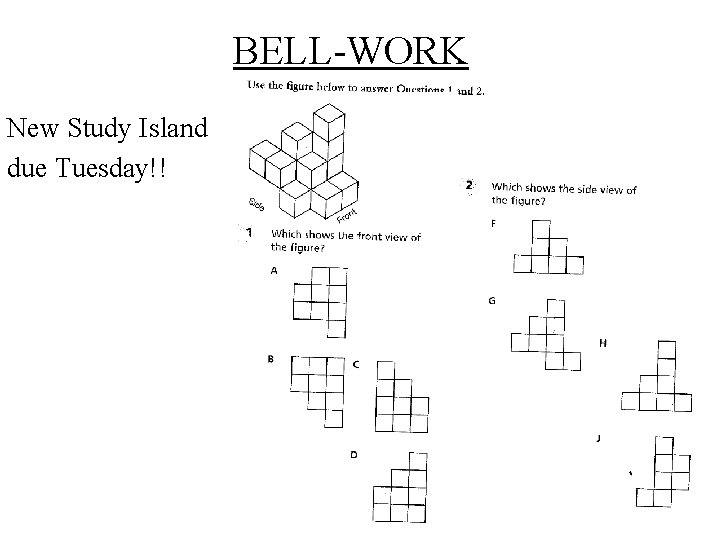
BELL-WORK New Study Island due Tuesday!!
Cones The lateral area of a cone is half the product of the circumference of the base and the slant height. L. A. = ½ × 2Πr × l, or L. A. = Πrl The surface area of a cone is the sum of the lateral area and the area of the base. S. A. = L. A. + B S. A = Πrl + Πr 2 TB pg 841 Guided Practice 4 TB pg 842 Guided Practice 5 A-B
Spheres A sphere is the set of all points in space equidistant from a given point called the center. A radius, r, is a segment that has one endpoint at the center and the other endpoint on the sphere. A diameter is a segment passing through the center with endpoints on the sphere.
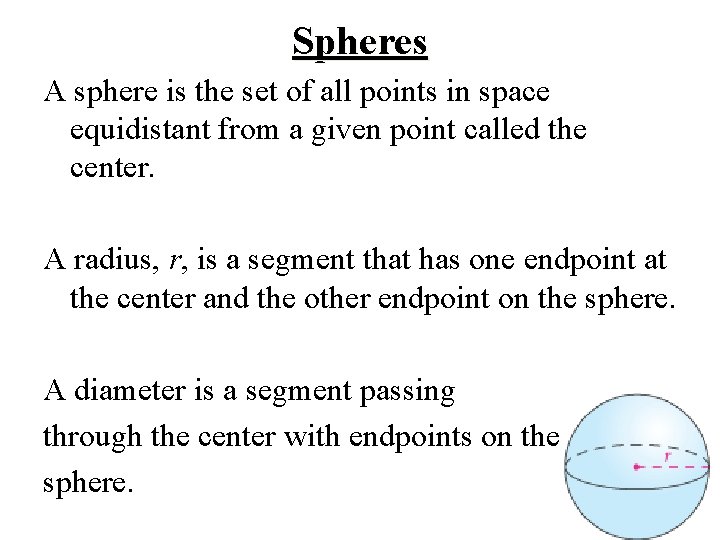
Spheres A sphere is the set of all points in space equidistant from a given point called the center. A radius, r, is a segment that has one endpoint at the center and the other endpoint on the sphere. A diameter is a segment passing through the center with endpoints on the sphere.
Spheres When a plane and a sphere intersect in more than one point, the intersection is… a circle.
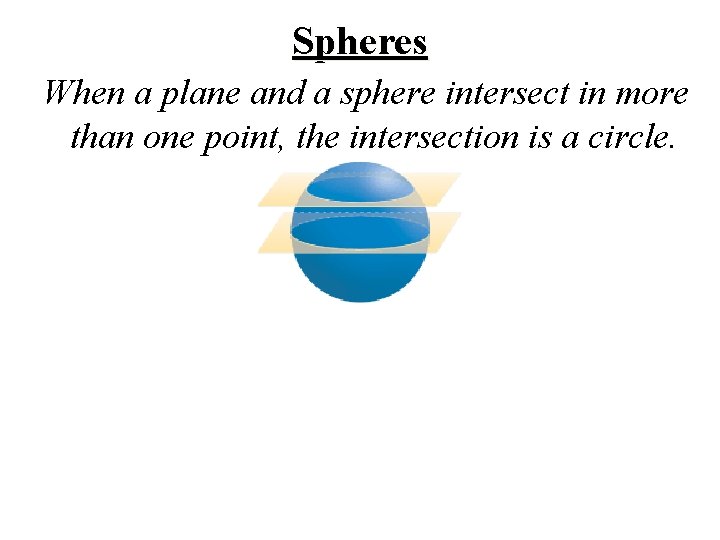
Spheres When a plane and a sphere intersect in more than one point, the intersection is a circle.
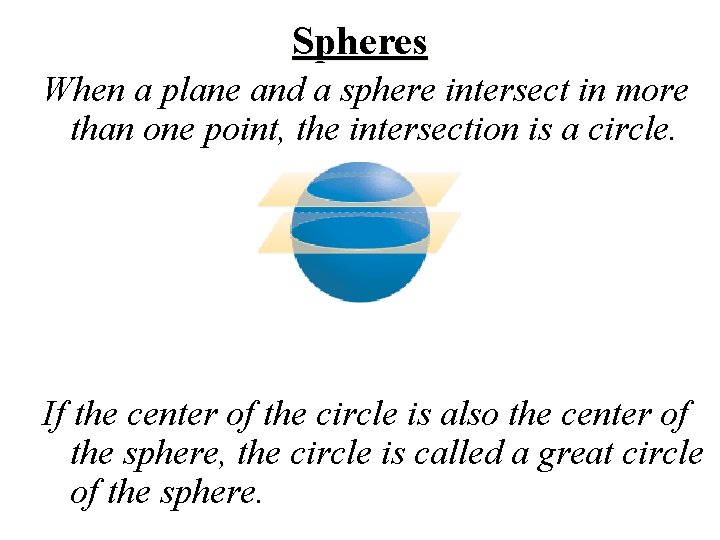
Spheres When a plane and a sphere intersect in more than one point, the intersection is a circle. If the center of the circle is also the center of the sphere, the circle is called a great circle of the sphere.
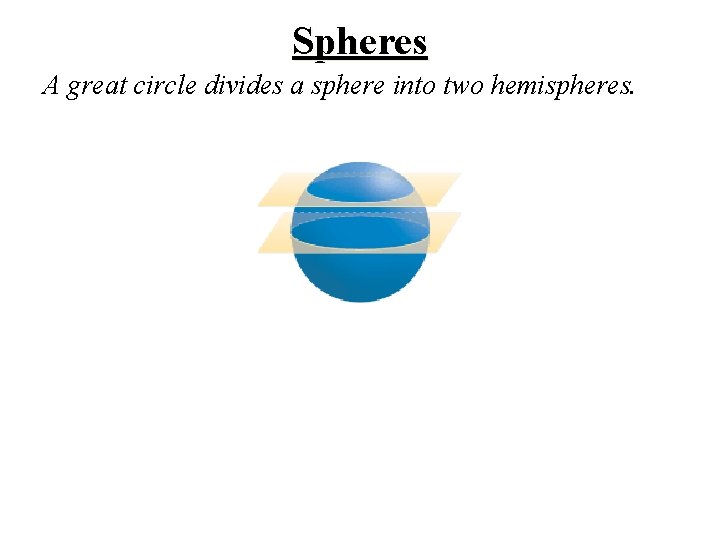
Spheres A great circle divides a sphere into two hemispheres.
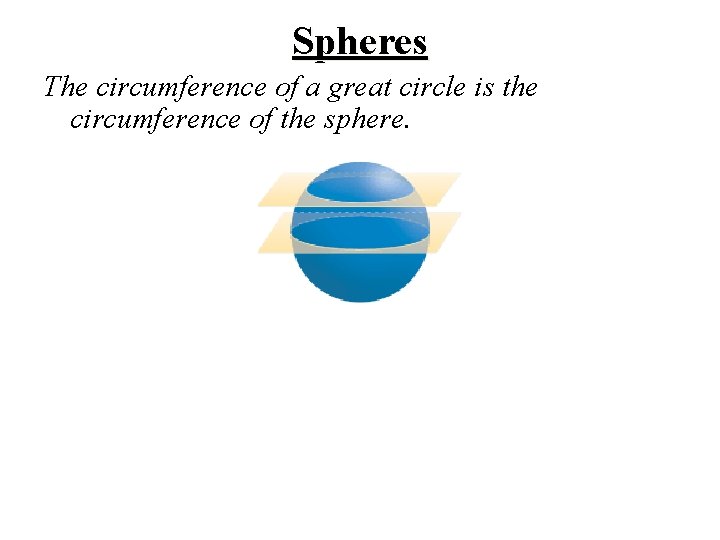
Spheres The circumference of a great circle is the circumference of the sphere.
Spheres Surface Area of a Sphere The surface area of a sphere is four times the product of Π and the square of the radius of the sphere. S. A. = 4πr 2 (Proof on page 864)
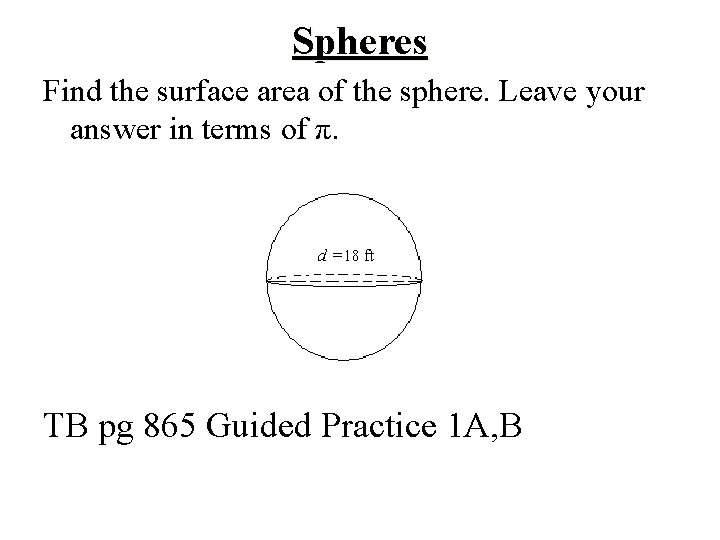
Spheres Find the surface area of the sphere. Leave your answer in terms of π. TB pg 865 Guided Practice 1 A, B
Spheres The circumference of a rubber ball is 13 cm. Approximate its surface area to the nearest whole number.
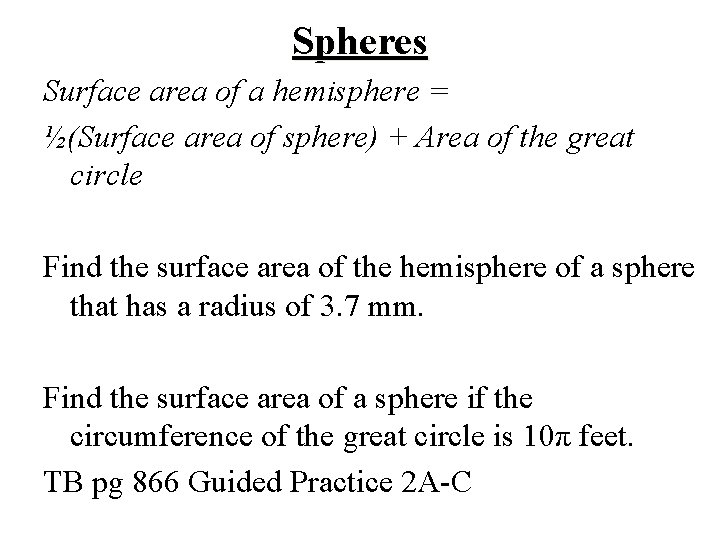
Spheres Surface area of a hemisphere = ½(Surface area of sphere) + Area of the great circle Find the surface area of the hemisphere of a sphere that has a radius of 3. 7 mm. Find the surface area of a sphere if the circumference of the great circle is 10π feet. TB pg 866 Guided Practice 2 A-C
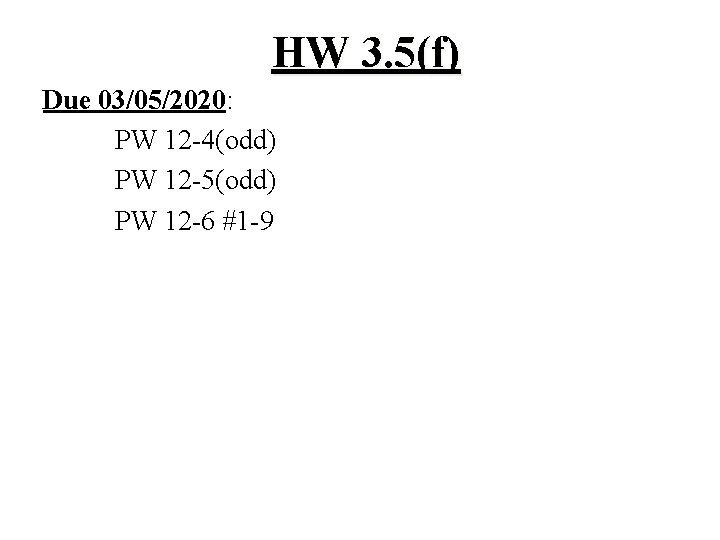
HW 3. 5(f) Due 03/05/2020: PW 12 -4(odd) PW 12 -5(odd) PW 12 -6 #1 -9
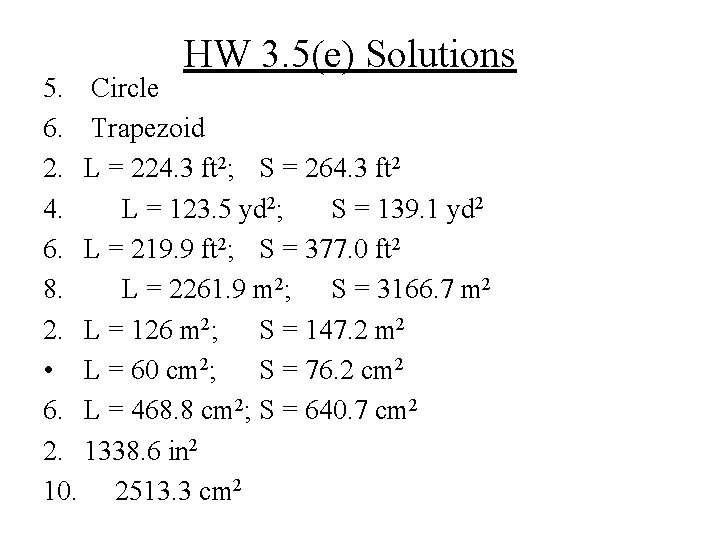
HW 3. 5(e) Solutions 5. Circle 6. Trapezoid 2. L = 224. 3 ft 2; S = 264. 3 ft 2 4. L = 123. 5 yd 2; S = 139. 1 yd 2 6. L = 219. 9 ft 2; S = 377. 0 ft 2 8. L = 2261. 9 m 2; S = 3166. 7 m 2 2. L = 126 m 2; S = 147. 2 m 2 • L = 60 cm 2; S = 76. 2 cm 2 6. L = 468. 8 cm 2; S = 640. 7 cm 2 2. 1338. 6 in 2 10. 2513. 3 cm 2
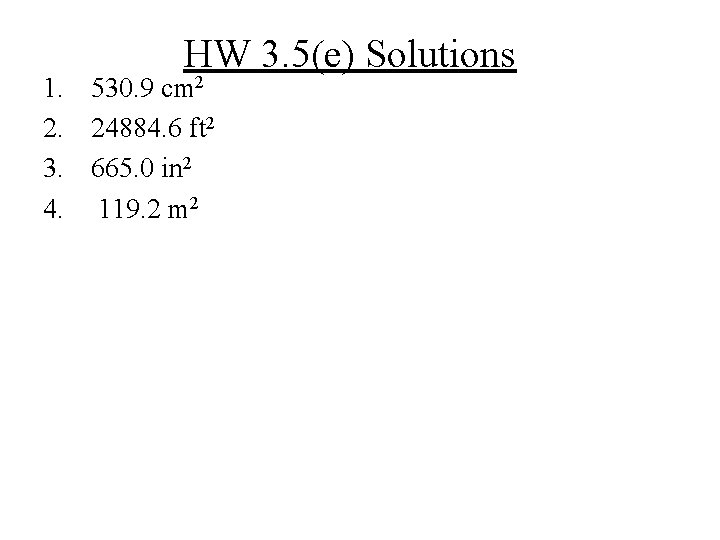
HW 3. 5(e) Solutions 1. 530. 9 cm 2 2. 24884. 6 ft 2 3. 665. 0 in 2 4. 119. 2 m 2
Guiding question: How is volume calculated?
Volume Standard: G-GMD. A. 1 Explain volume formulas and use them to solve problems. By the end of lesson: Calculate the surface area and volume of 3 -D figures Get done early? HW
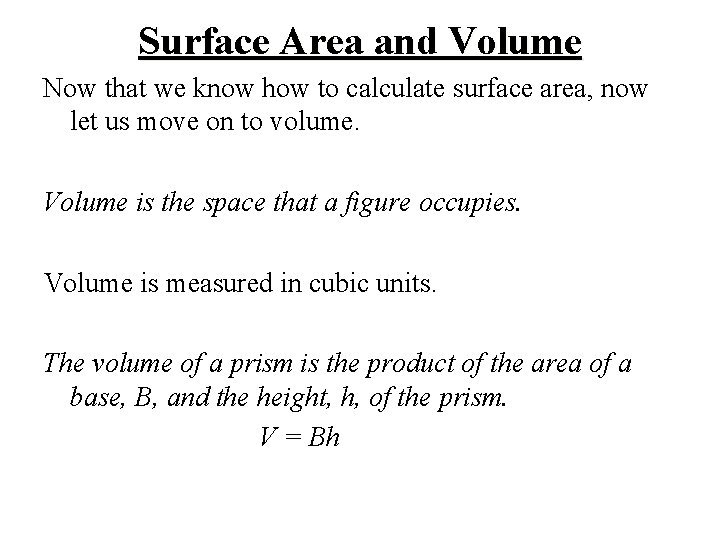
Surface Area and Volume Now that we know how to calculate surface area, now let us move on to volume. Volume is the space that a figure occupies. Volume is measured in cubic units. The volume of a prism is the product of the area of a base, B, and the height, h, of the prism. V = Bh
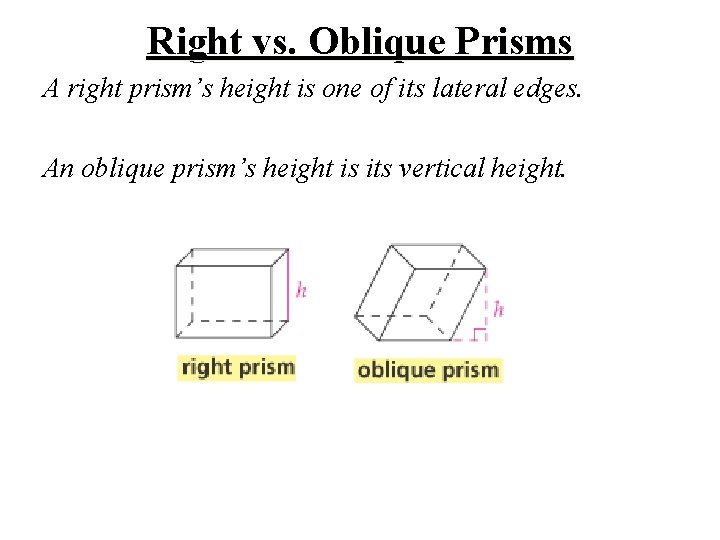
Right vs. Oblique Prisms A right prism’s height is one of its lateral edges. An oblique prism’s height is its vertical height.
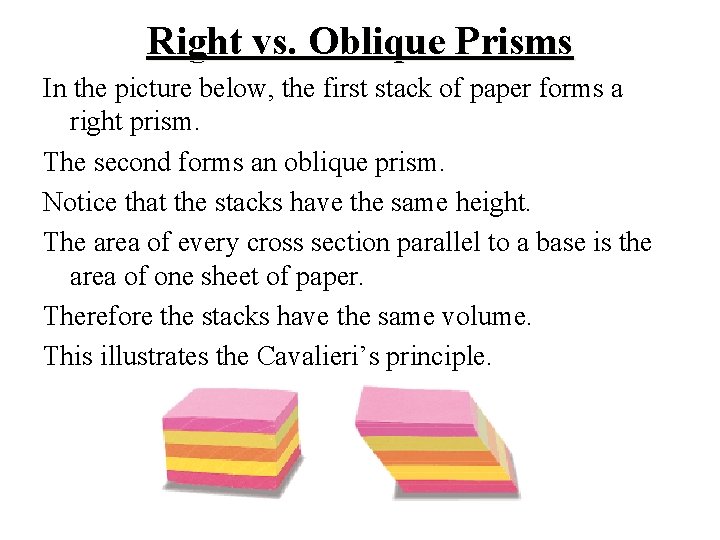
Right vs. Oblique Prisms In the picture below, the first stack of paper forms a right prism. The second forms an oblique prism. Notice that the stacks have the same height. The area of every cross section parallel to a base is the area of one sheet of paper. Therefore the stacks have the same volume. This illustrates the Cavalieri’s principle.
Volume of a Prism Cavalieri’s Principle: If two space figures have the same height and the same cross-sectional area at every level, then they have the same volume.
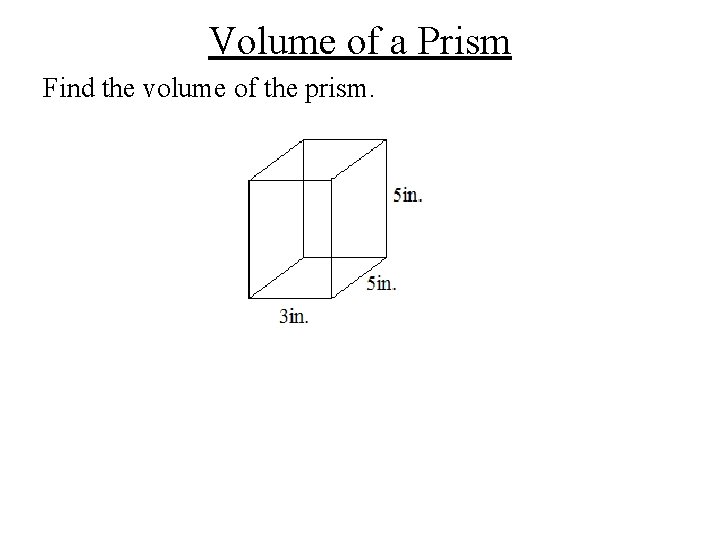
Volume of a Prism Find the volume of the prism.
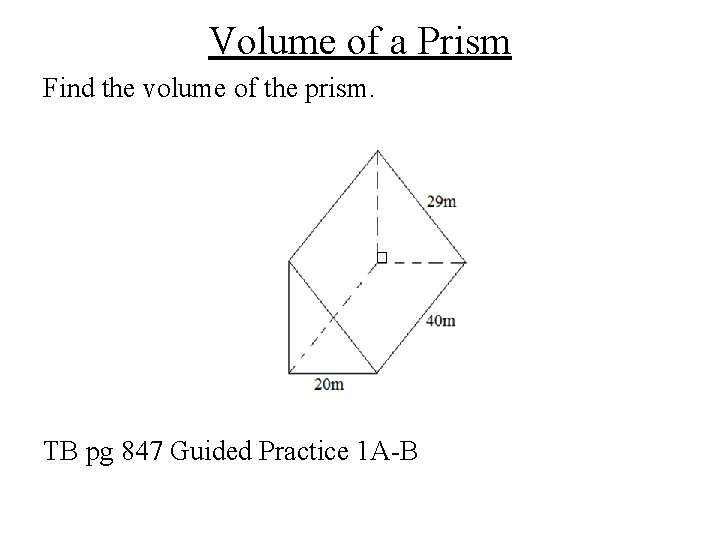
Volume of a Prism Find the volume of the prism. TB pg 847 Guided Practice 1 A-B
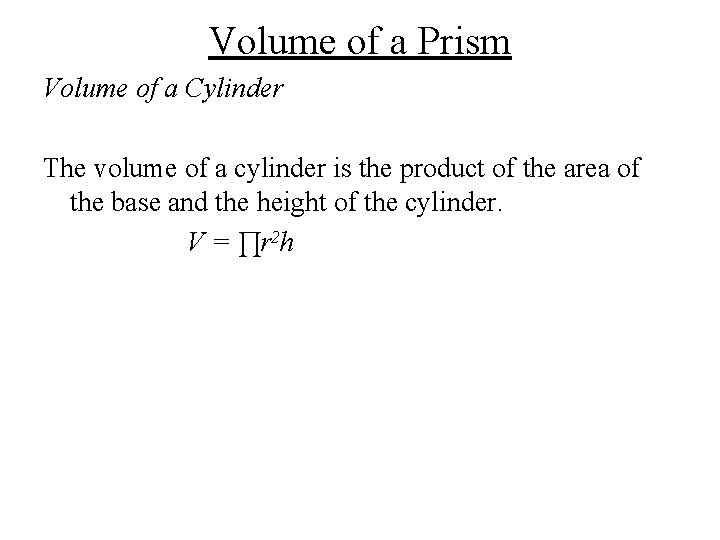
Volume of a Prism Volume of a Cylinder The volume of a cylinder is the product of the area of the base and the height of the cylinder. V = ∏r 2 h
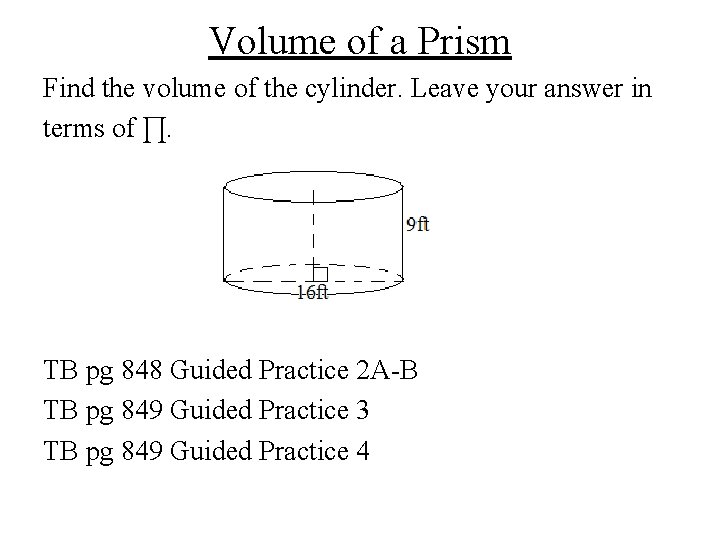
Volume of a Prism Find the volume of the cylinder. Leave your answer in terms of ∏. TB pg 848 Guided Practice 2 A-B TB pg 849 Guided Practice 3 TB pg 849 Guided Practice 4
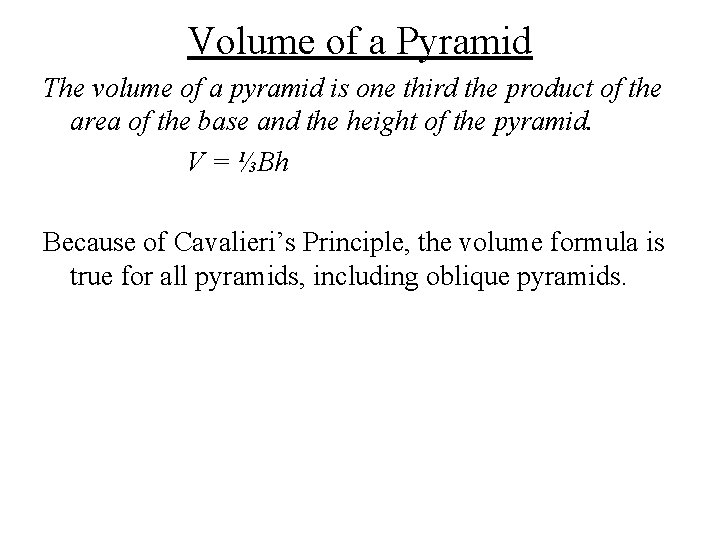
Volume of a Pyramid The volume of a pyramid is one third the product of the area of the base and the height of the pyramid. V = ⅓Bh Because of Cavalieri’s Principle, the volume formula is true for all pyramids, including oblique pyramids.
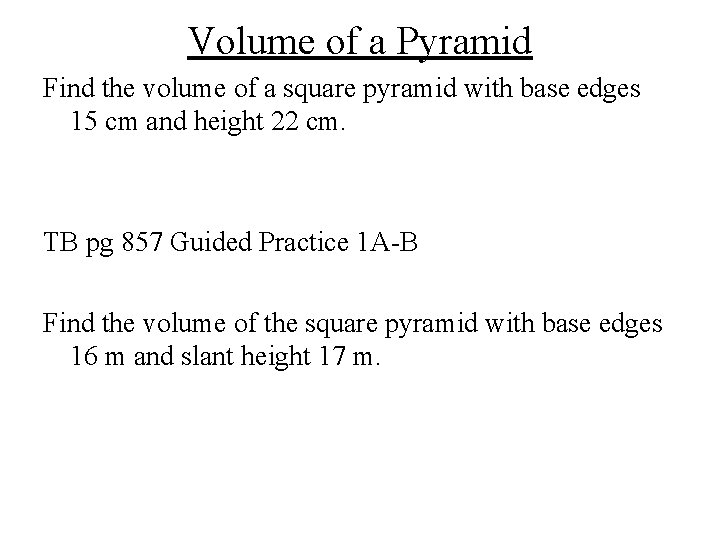
Volume of a Pyramid Find the volume of a square pyramid with base edges 15 cm and height 22 cm. TB pg 857 Guided Practice 1 A-B Find the volume of the square pyramid with base edges 16 m and slant height 17 m.
Volume of a Pyramid Volume of a Cone The volume of a cone is one third the product of the area of the base and the height of the cone. V = ⅓∏r 2 h
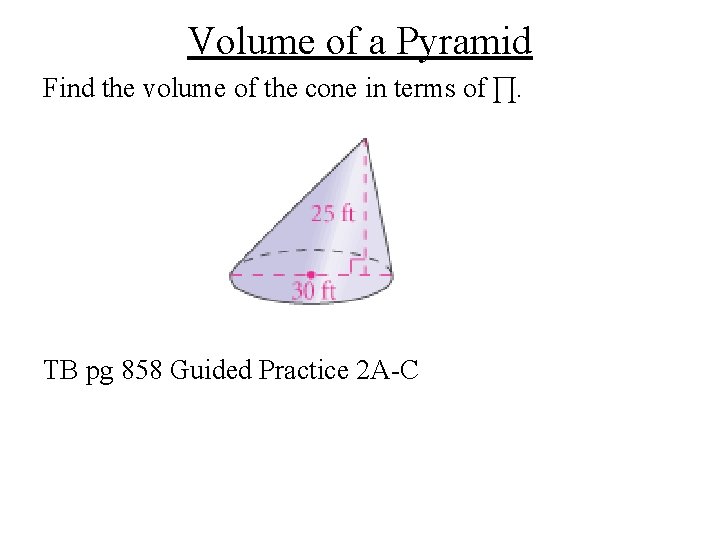
Volume of a Pyramid Find the volume of the cone in terms of ∏. TB pg 858 Guided Practice 2 A-C
Spheres Volume of a Sphere The volume of a sphere is four thirds the product of Π and the cube of the radius of the sphere. V = 4πr 3 3 (proof on page 866)
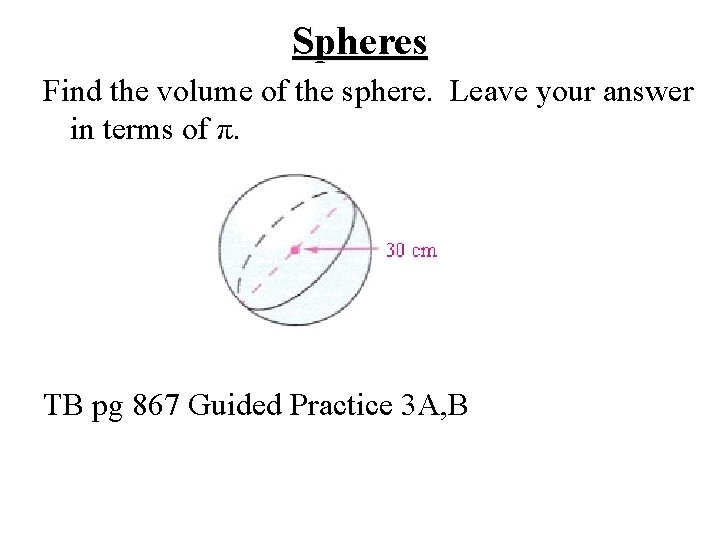
Spheres Find the volume of the sphere. Leave your answer in terms of π. TB pg 867 Guided Practice 3 A, B
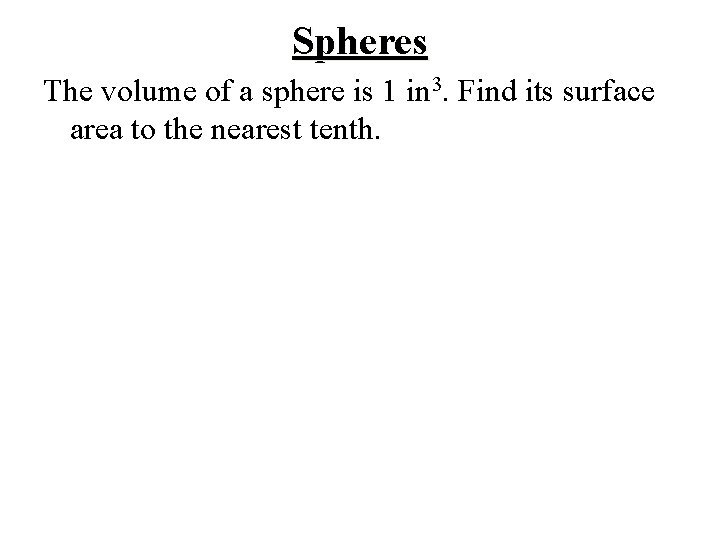
Spheres The volume of a sphere is 1 in 3. Find its surface area to the nearest tenth.
Who wants to answer the Guiding question? How is volume calculated?
- Slides: 34