
Bellwork n How was the universe created Do
Bellwork n How was the universe created? Do you think there are other lifeforms in our universe? Share any other background knowledge or questions you might have about “space”.
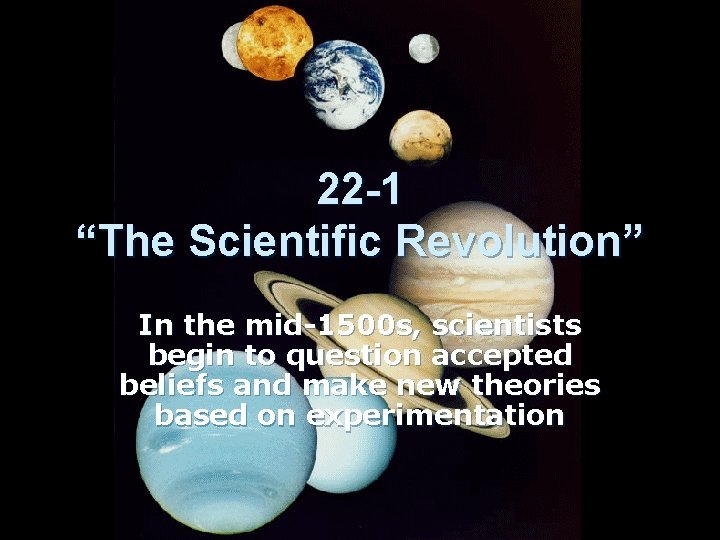
22 -1 “The Scientific Revolution” In the mid-1500 s, scientists begin to question accepted beliefs and make new theories based on experimentation
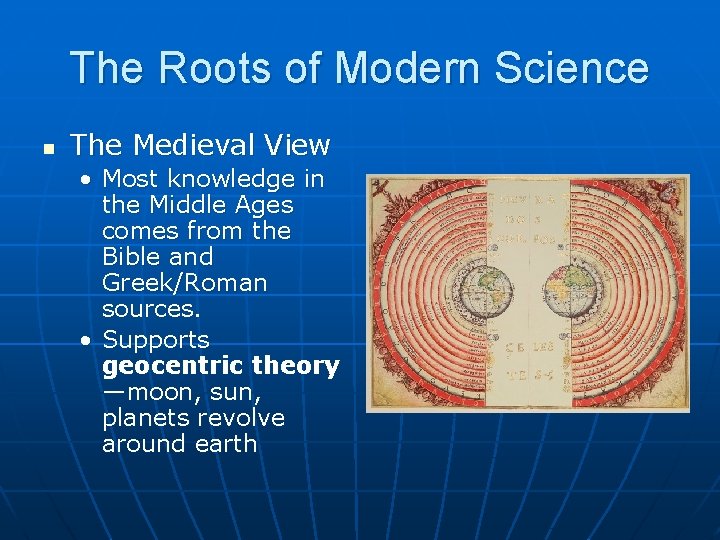
The Roots of Modern Science n The Medieval View • Most knowledge in the Middle Ages comes from the Bible and Greek/Roman sources. • Supports geocentric theory —moon, sun, planets revolve around earth
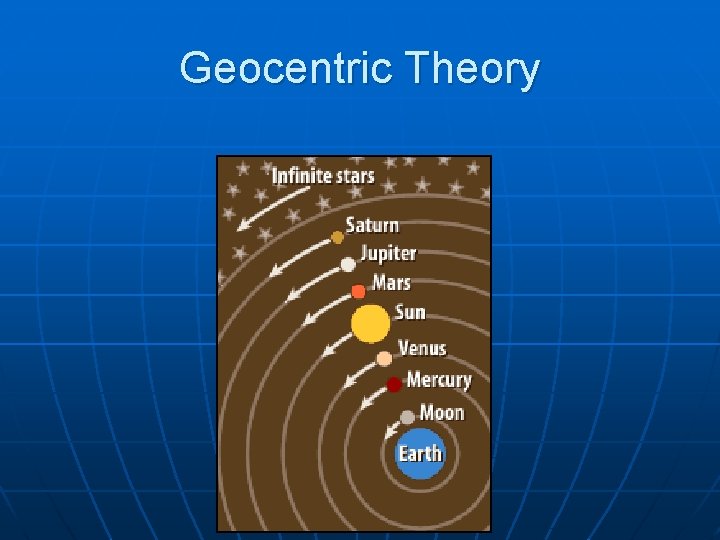
Geocentric Theory
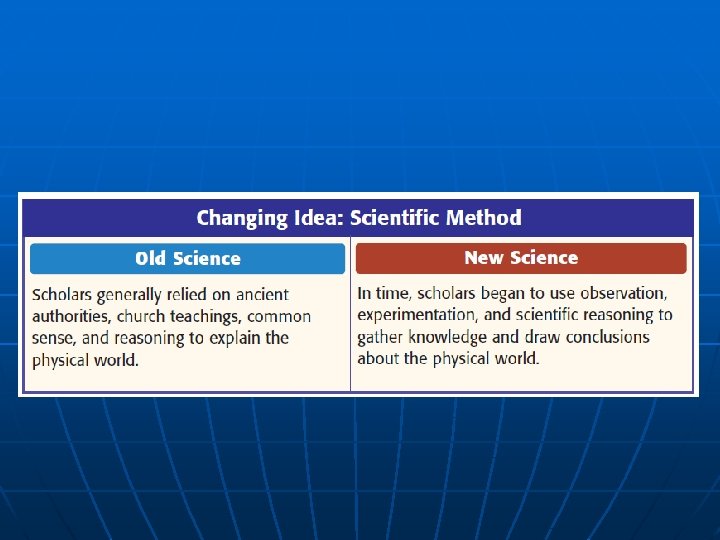
The Roots of Modern Science n A New Way of Thinking • Renaissance prompts new ways of thinking (1300 -1600) • Scientific Revolution—new way of viewing the natural world—based on observation and inquiry • New discoveries, overseas exploration open up thinking • Scholars make new developments in astronomy and mathematics.
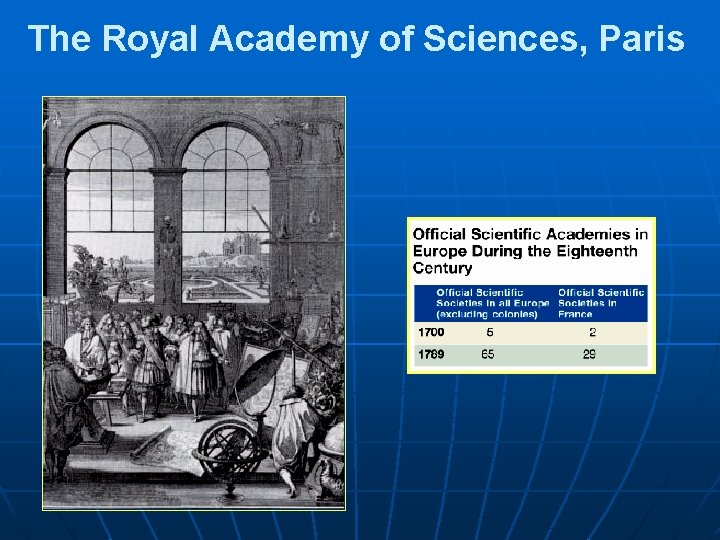
The Royal Academy of Sciences, Paris
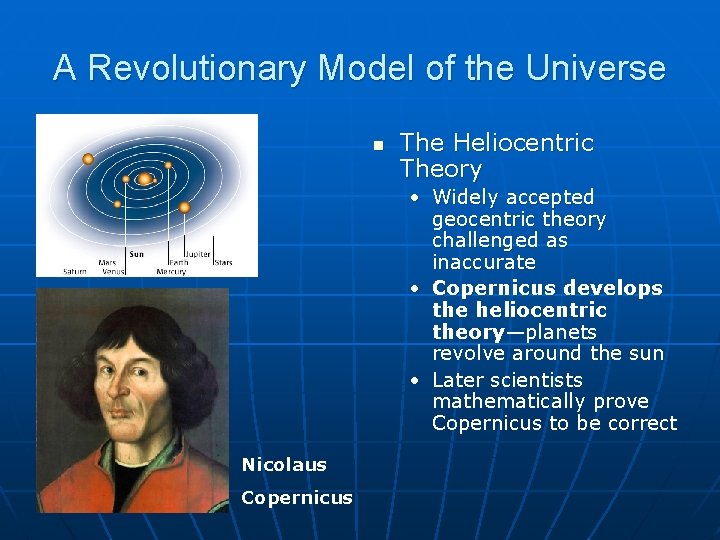
A Revolutionary Model of the Universe n The Heliocentric Theory • Widely accepted geocentric theory challenged as inaccurate • Copernicus develops the heliocentric theory—planets revolve around the sun • Later scientists mathematically prove Copernicus to be correct Nicolaus Copernicus
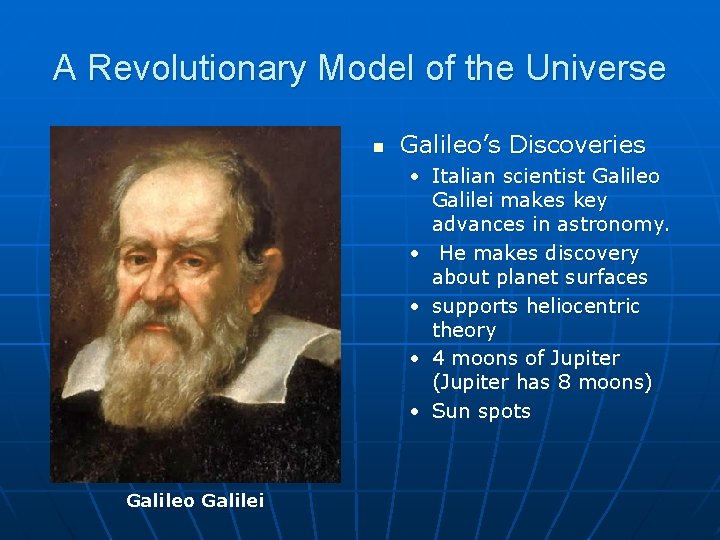
A Revolutionary Model of the Universe n Galileo’s Discoveries • Italian scientist Galileo Galilei makes key advances in astronomy. • He makes discovery about planet surfaces • supports heliocentric theory • 4 moons of Jupiter (Jupiter has 8 moons) • Sun spots Galileo Galilei
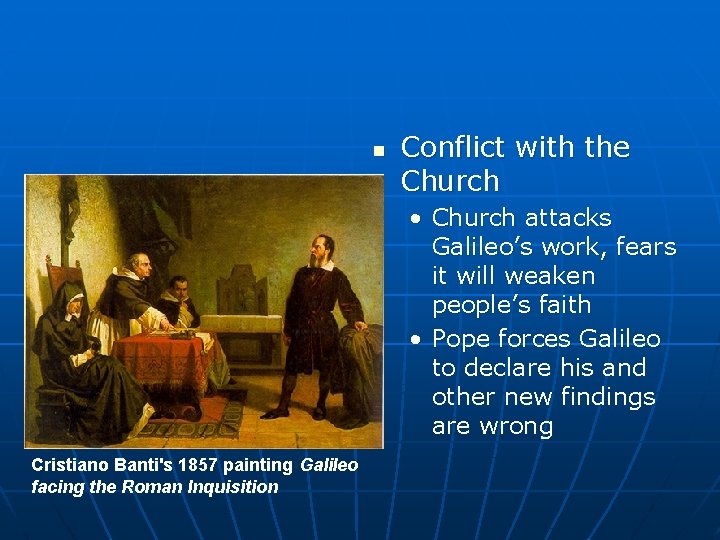
n Conflict with the Church • Church attacks Galileo’s work, fears it will weaken people’s faith • Pope forces Galileo to declare his and other new findings are wrong Cristiano Banti's 1857 painting Galileo facing the Roman Inquisition
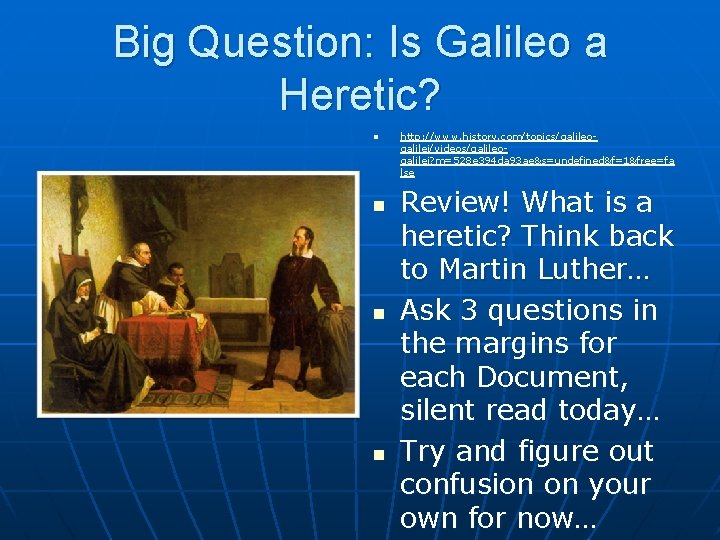
Big Question: Is Galileo a Heretic? n n http: //www. history. com/topics/galileogalilei/videos/galileogalilei? m=528 e 394 da 93 ae&s=undefined&f=1&free=fa lse Review! What is a heretic? Think back to Martin Luther… Ask 3 questions in the margins for each Document, silent read today… Try and figure out confusion on your own for now…
The Scientific Method n A Logical Approach • Revolution in thinking leads to development of scientific method—a series of steps forming and testing scientific theories n Bacon and Descartes • Thinkers Bacon and Descartes help to create scientific method • Bacon urges scientists to experiment before drawing conclusions • Descartes advocates using logic and math to reason out basic truths
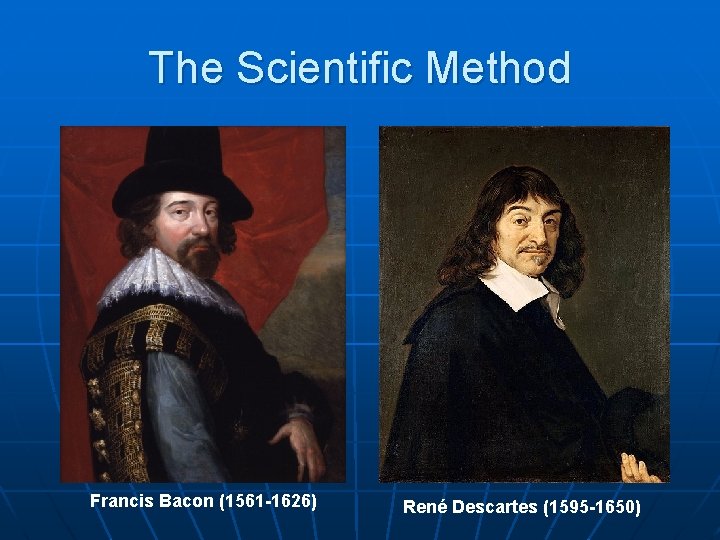
The Scientific Method Francis Bacon (1561 -1626) René Descartes (1595 -1650)
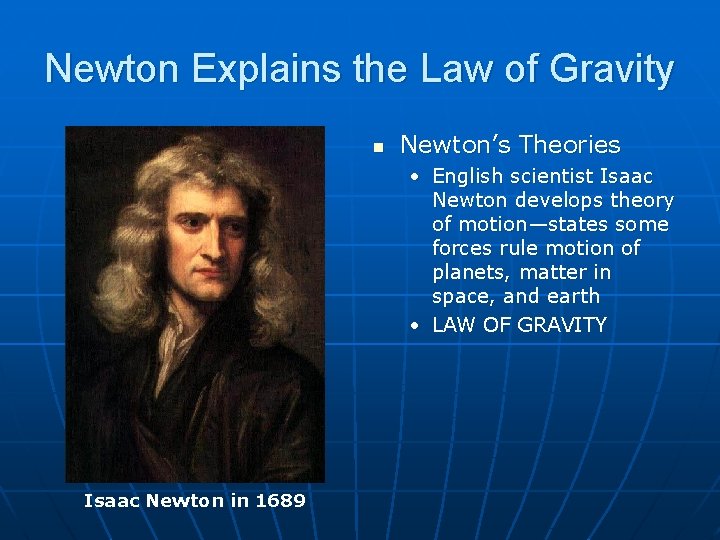
Newton Explains the Law of Gravity n Newton’s Theories • English scientist Isaac Newton develops theory of motion—states some forces rule motion of planets, matter in space, and earth • LAW OF GRAVITY Isaac Newton in 1689
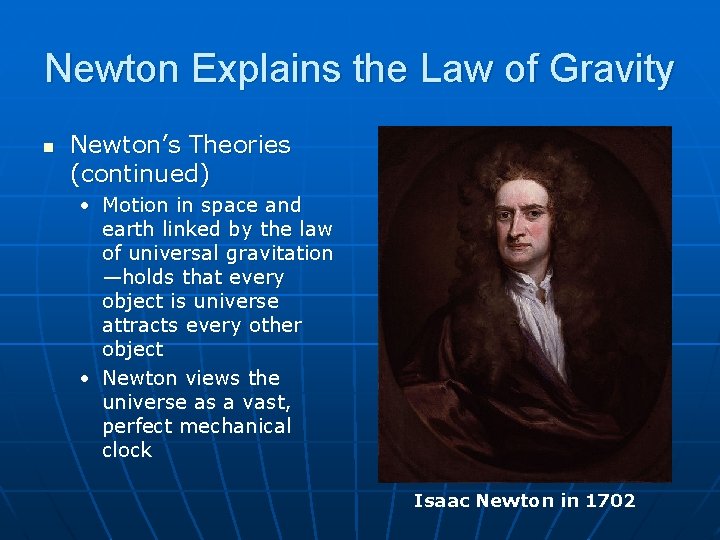
Newton Explains the Law of Gravity n Newton’s Theories (continued) • Motion in space and earth linked by the law of universal gravitation —holds that every object is universe attracts every other object • Newton views the universe as a vast, perfect mechanical clock Isaac Newton in 1702
Reading Directions: Galileo DBQ Bell work: Finish your 6 questions! n Big Question: Is Galileo a heretic? n
Round 1 n n n Share your 6 questions with your table partner from either Doc A/b As a team, select 1 question (out of 12) and try your best to answer it. Don’t use your phone. Try and make that educated guess about the author’s words/intent. Share out…
Guided Reading Questions A/B n n n As a team complete your (1) copy of Guided Questions for Doc A and B. Close read and use those strategies to work through confusion If you are finished early raise your hand let me know…
Galileo DBQ Continued… n Troubles with Document B? • Lets read together and find out • Have your guided reading questions for Doc B out n n Final individual assignment “Judgement of Galileo”. Evaluate the claims of Galileo and the catholic church Start Cosmos Video!!
- Slides: 19