
Bellwork 118 IFC The genetics behind the Punnett
Bellwork 11/8 IFC: The genetics behind the Punnett square model has been debated thoroughly by scientists. Pete learns to use Punnett squares to predict the outcome of a cross-breeding experiment. Why does he think that he can use the scientific knowledge behind this model to predict the outcomes of his experiment? A. Models are always accurate. B. Reginald C. Punnett was a scientist. C. The square is made from four smaller squares. D. Punnett squares have been confirmed by the scientific community. 1.
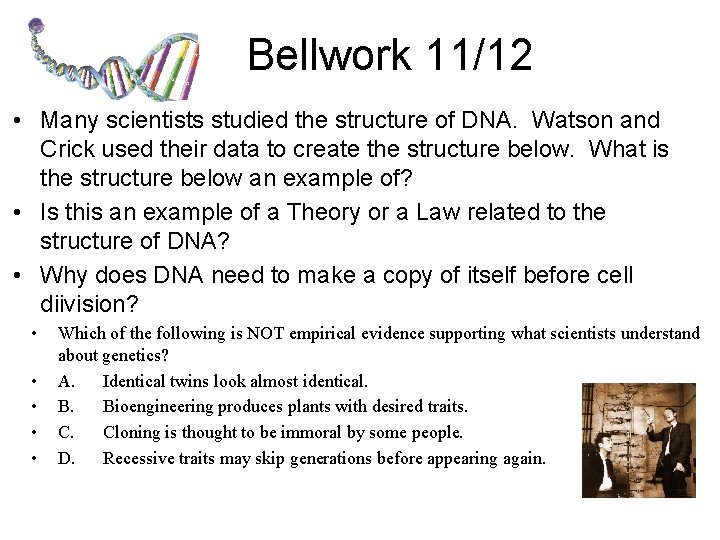
Bellwork 11/12 • Many scientists studied the structure of DNA. Watson and Crick used their data to create the structure below. What is the structure below an example of? • Is this an example of a Theory or a Law related to the structure of DNA? • Why does DNA need to make a copy of itself before cell diivision? • • • Which of the following is NOT empirical evidence supporting what scientists understand about genetics? A. Identical twins look almost identical. B. Bioengineering produces plants with desired traits. C. Cloning is thought to be immoral by some people. D. Recessive traits may skip generations before appearing again.
DNA Structure and Function EQ: what is DNA?
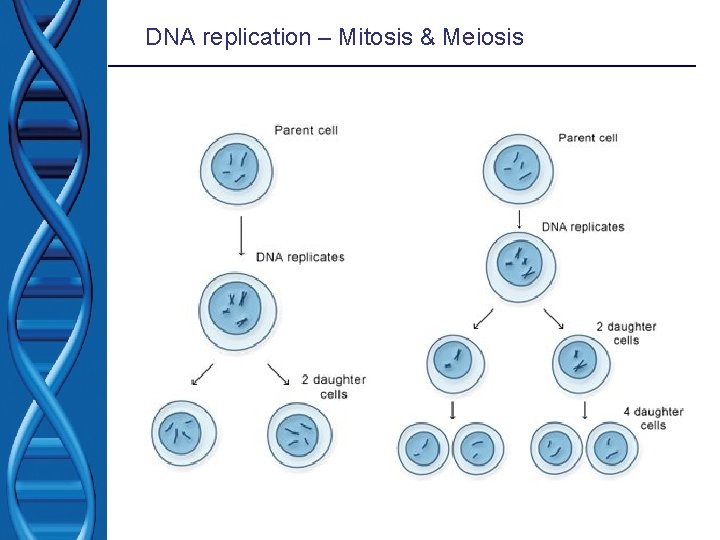
DNA replication – Mitosis & Meiosis
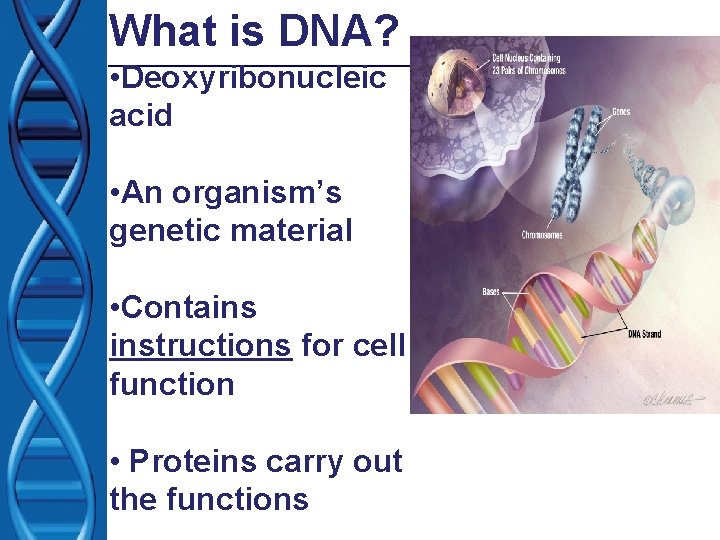
What is DNA? • Deoxyribonucleic acid • An organism’s genetic material • Contains instructions for cell function • Proteins carry out the functions
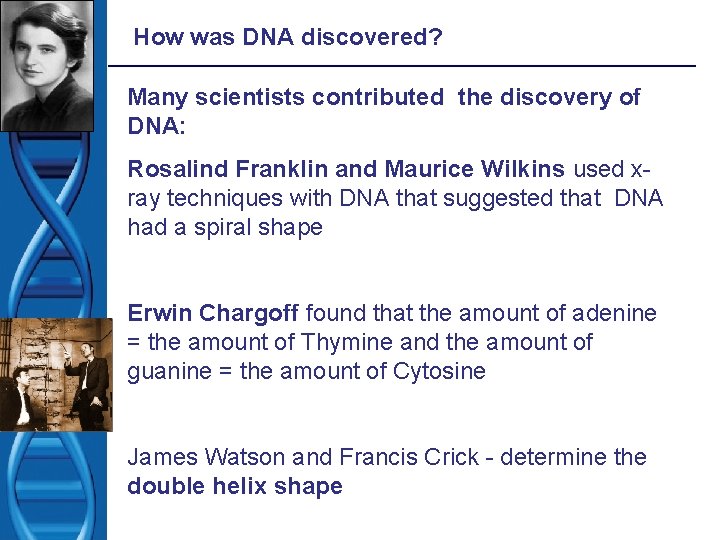
How was DNA discovered? Many scientists contributed the discovery of DNA: Rosalind Franklin and Maurice Wilkins used xray techniques with DNA that suggested that DNA had a spiral shape Erwin Chargoff found that the amount of adenine = the amount of Thymine and the amount of guanine = the amount of Cytosine James Watson and Francis Crick - determine the double helix shape
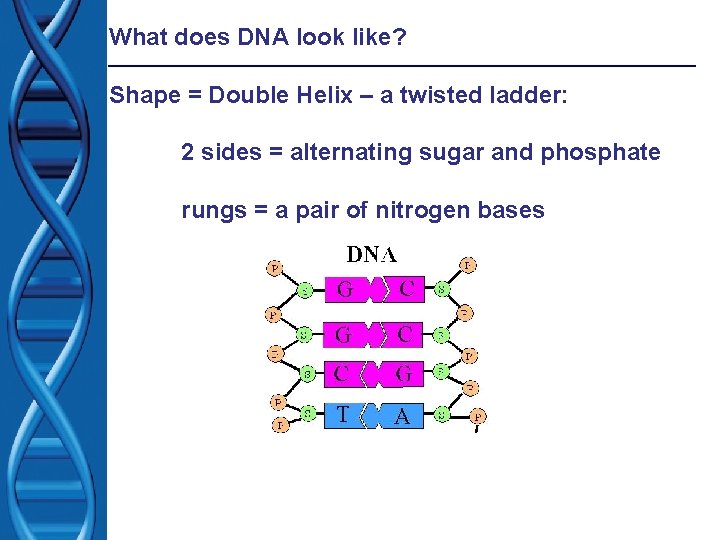
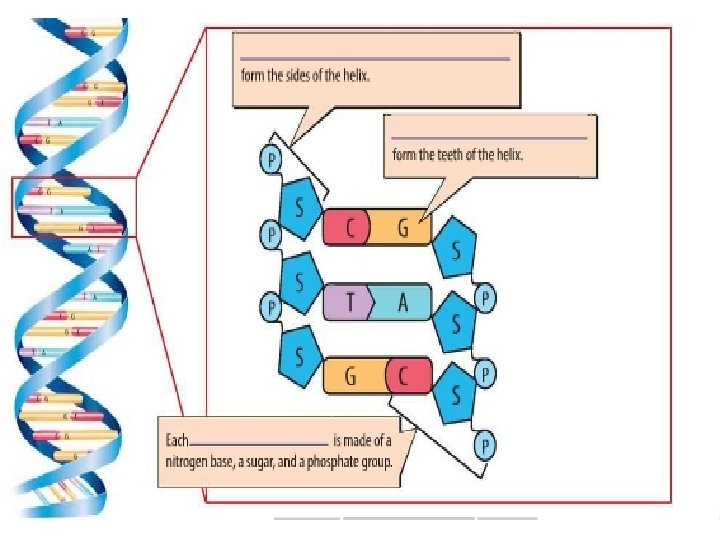
What does DNA look like? Shape = Double Helix – a twisted ladder: 2 sides = alternating sugar and phosphate rungs = a pair of nitrogen bases
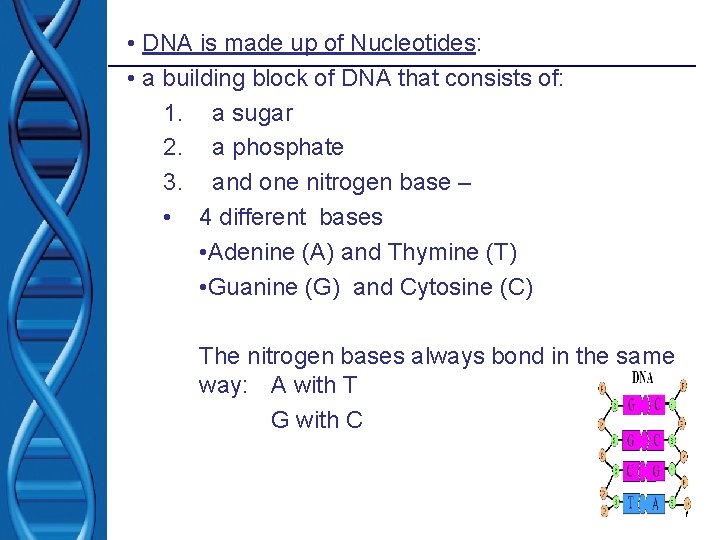
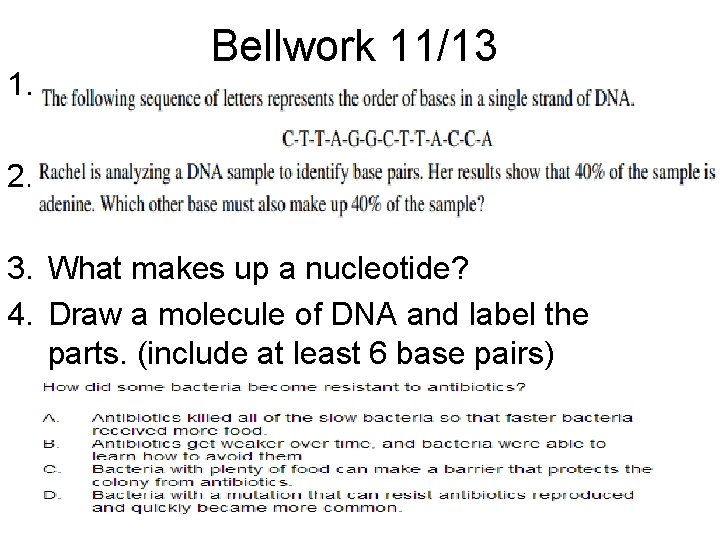
• DNA is made up of Nucleotides: • a building block of DNA that consists of: 1. a sugar 2. a phosphate 3. and one nitrogen base – • 4 different bases • Adenine (A) and Thymine (T) • Guanine (G) and Cytosine (C) The nitrogen bases always bond in the same way: A with T G with C
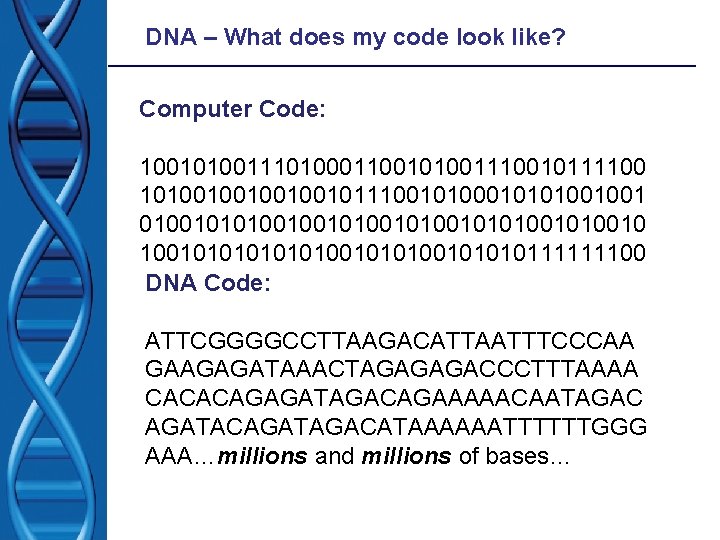
DNA – What does my code look like? Computer Code: 10010100111010001100101001110010111100 1010010010111001010100100101010010100101001010100101010111111100 DNA Code: ATTCGGGGCCTTAAGACATTAATTTCCCAA GAAGAGATAAACTAGAGAGACCCTTTAAAA CACACAGAGATAGACAGAAAAACAATAGAC AGATACAGATAGACATAAAAAATTTTTTGGG AAA…millions and millions of bases…
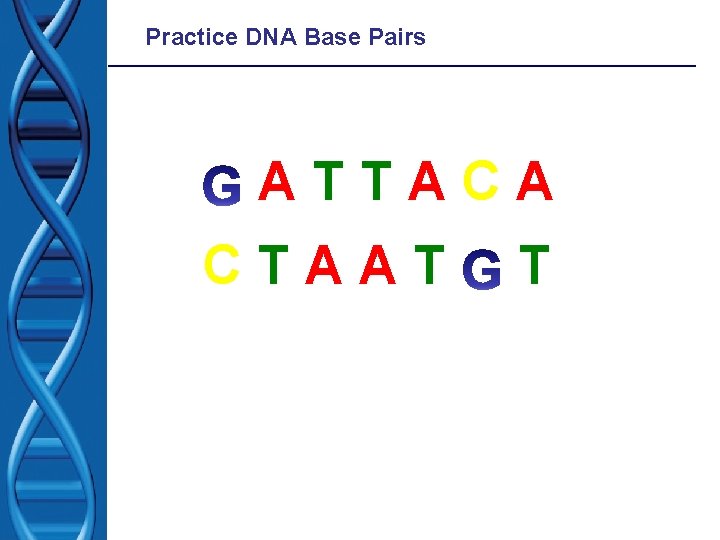
Practice DNA Base Pairs ATTACA CTAAT T
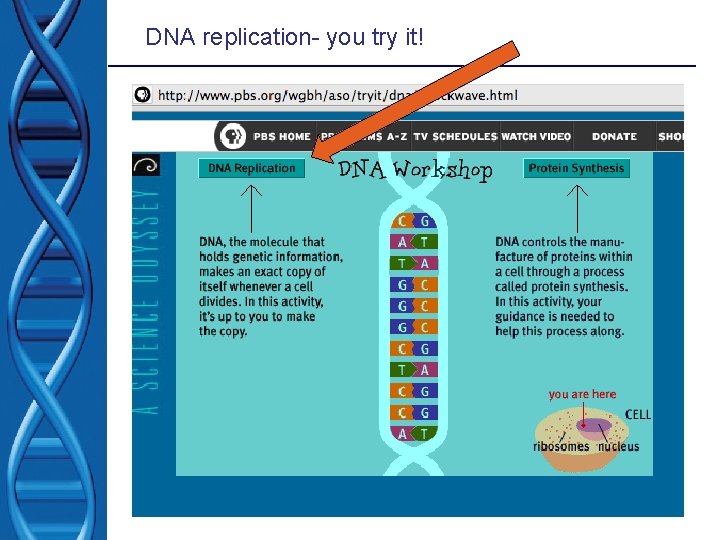
Build a DNA molecule – you try it!
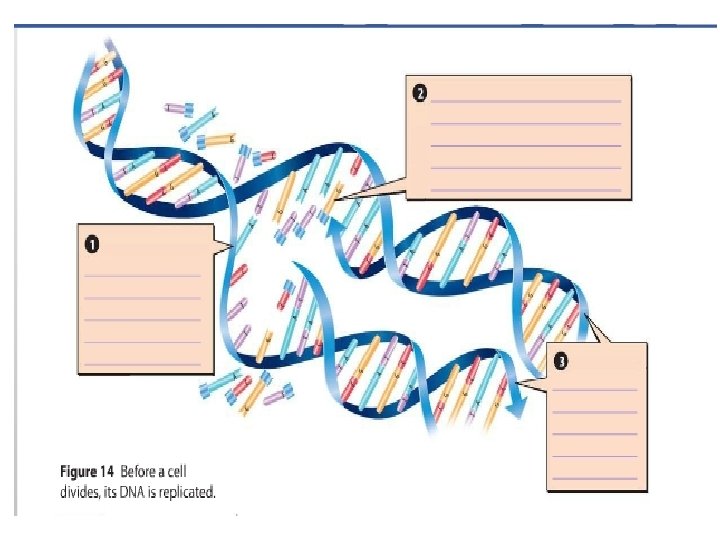
How are copies of DNA made? • DNA replication – process by which the cell makes copies of DNA molecules
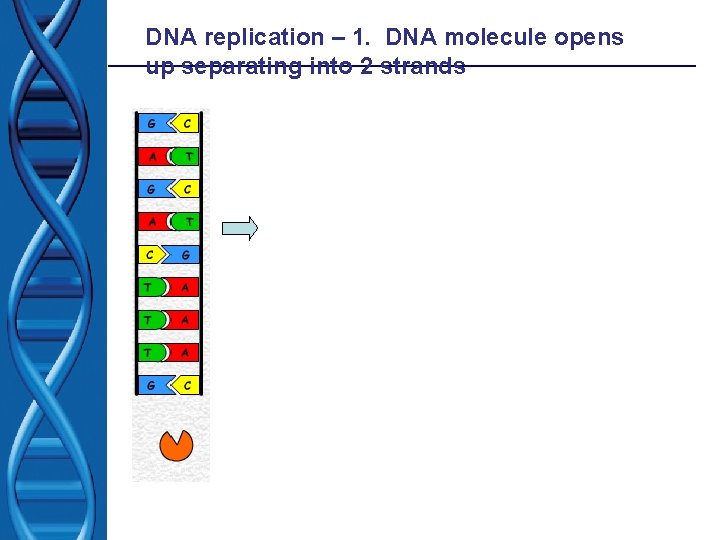
DNA replication – 1. DNA molecule opens up separating into 2 strands
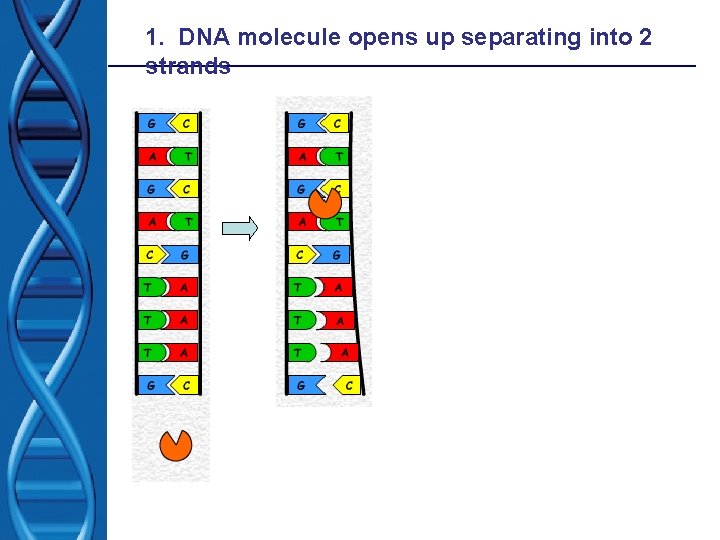
1. DNA molecule opens up separating into 2 strands
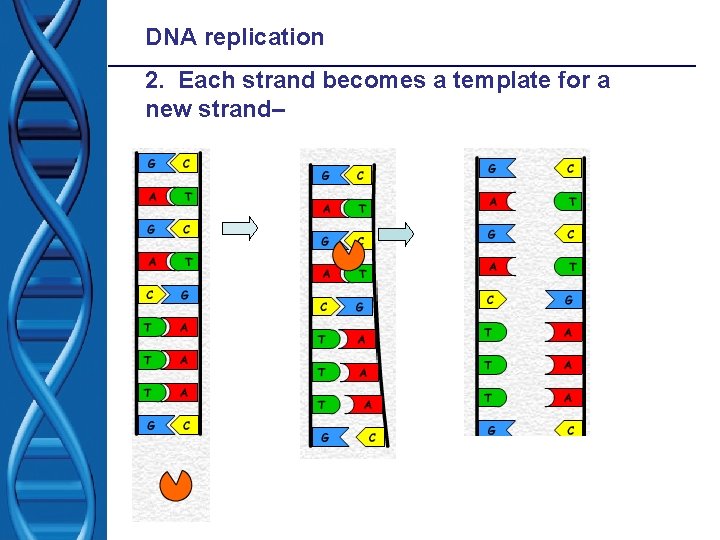
DNA replication 2. Each strand becomes a template for a new strand–
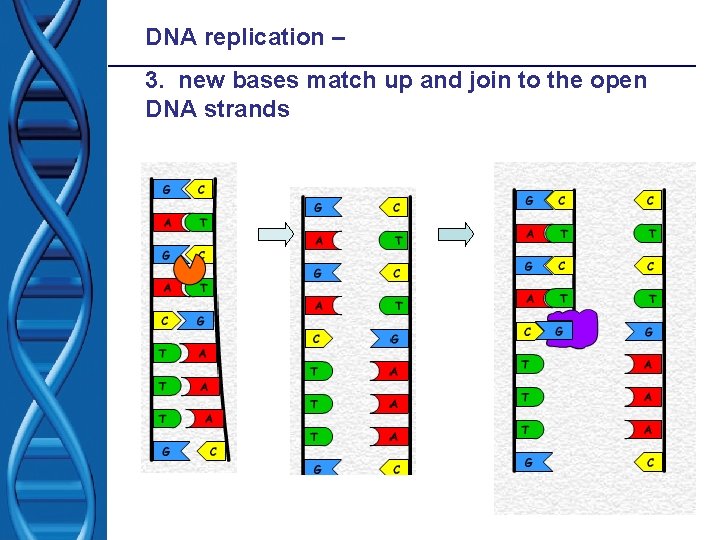
DNA replication – 3. new bases match up and join to the open DNA strands
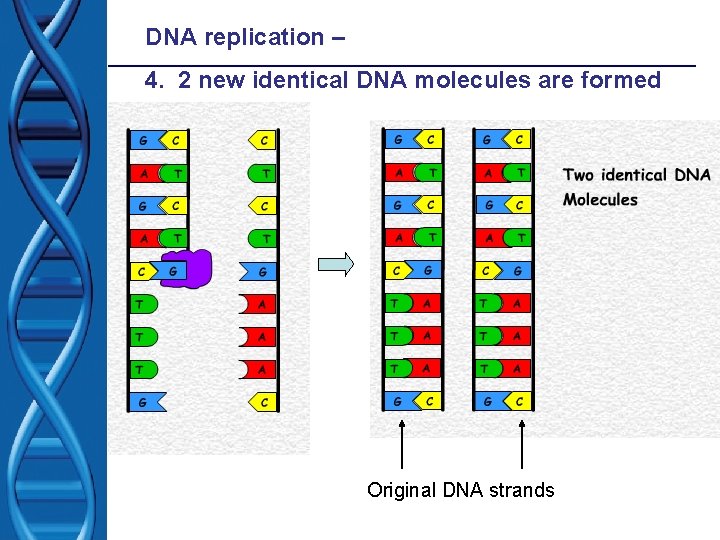
DNA replication – 4. 2 new identical DNA molecules are formed Original DNA strands
DNA replication- you try it!
1. Bellwork 11/13 2. 3. What makes up a nucleotide? 4. Draw a molecule of DNA and label the parts. (include at least 6 base pairs)
What are mutations? Changes in type, number or order of bases on a strand of DNA
What causes mutations? • Errors during DNA replication • Errors during meiosis • Mutagens - physical or chemical agents that cause mutations
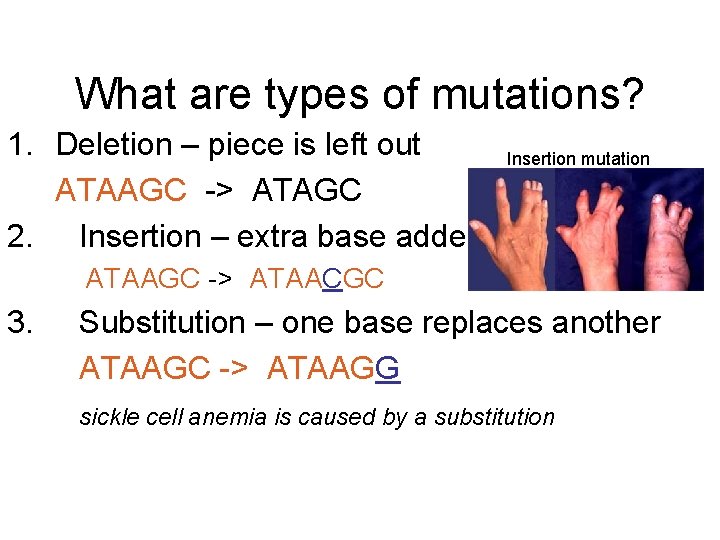
What are types of mutations? 1. Deletion – piece is left out ATAAGC -> ATAGC 2. Insertion – extra base added Insertion mutation ATAAGC -> ATAACGC 3. Substitution – one base replaces another ATAAGC -> ATAAGG sickle cell anemia is caused by a substitution
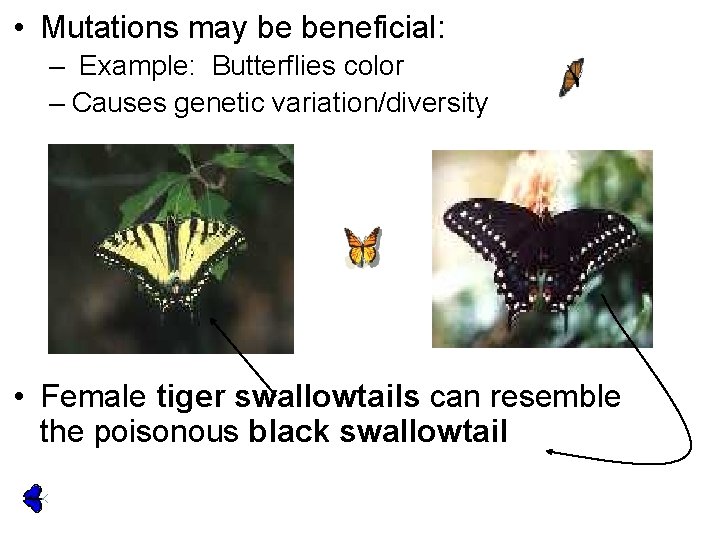
• Mutations may be beneficial: – Example: Butterflies color – Causes genetic variation/diversity • Female tiger swallowtails can resemble the poisonous black swallowtail
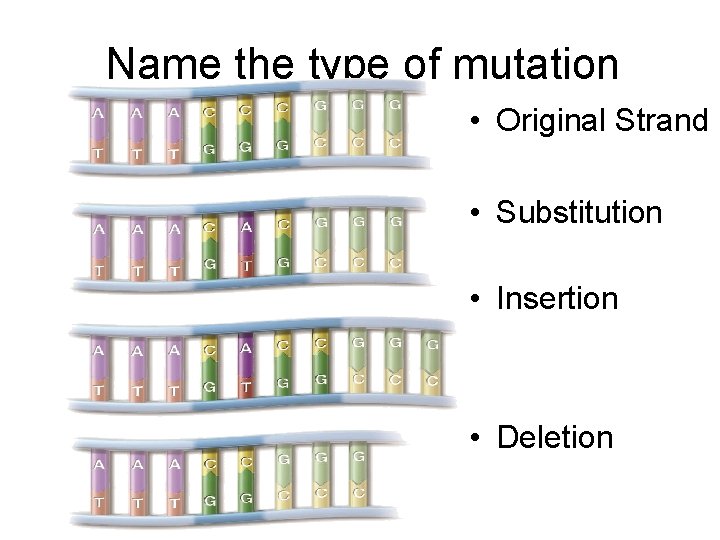
Name the type of mutation • Original Strand • Substitution • Insertion • Deletion
DNA Video • http: //www. thefoxisblack. com/2013/03/2 1/dna-is-amazing-and-so-is-this-video/

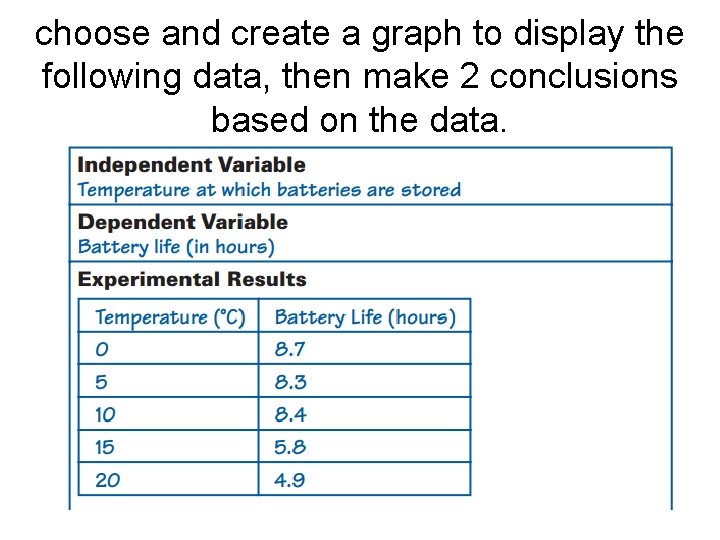
choose and create a graph to display the following data, then make 2 conclusions based on the data.
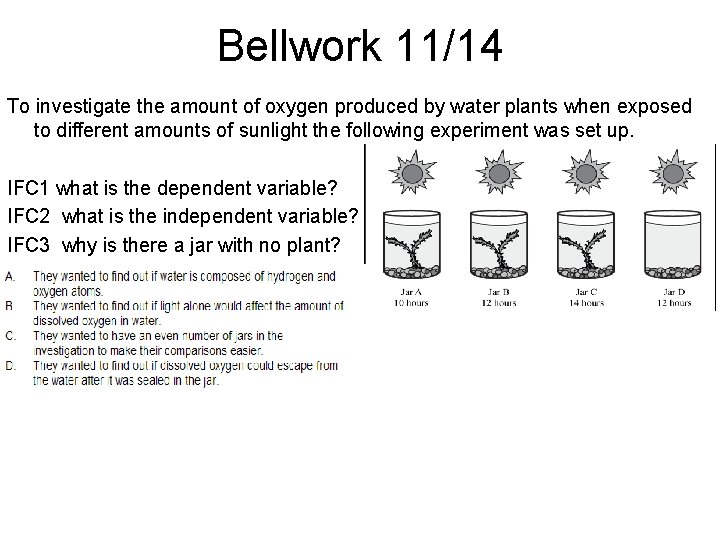
Bellwork 11/14 To investigate the amount of oxygen produced by water plants when exposed to different amounts of sunlight the following experiment was set up. IFC 1 what is the dependent variable? IFC 2 what is the independent variable? IFC 3 why is there a jar with no plant?
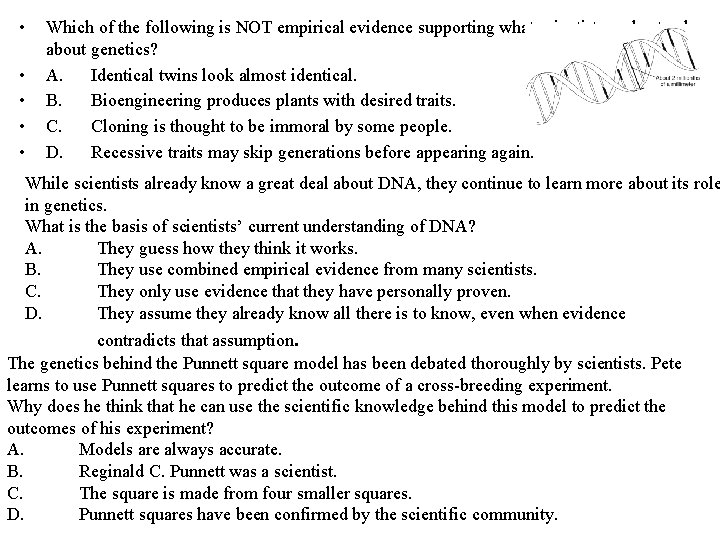
• • • Which of the following is NOT empirical evidence supporting what scientists understand about genetics? A. Identical twins look almost identical. B. Bioengineering produces plants with desired traits. C. Cloning is thought to be immoral by some people. D. Recessive traits may skip generations before appearing again. While scientists already know a great deal about DNA, they continue to learn more about its role in genetics. What is the basis of scientists’ current understanding of DNA? A. They guess how they think it works. B. They use combined empirical evidence from many scientists. C. They only use evidence that they have personally proven. D. They assume they already know all there is to know, even when evidence contradicts that assumption. The genetics behind the Punnett square model has been debated thoroughly by scientists. Pete learns to use Punnett squares to predict the outcome of a cross-breeding experiment. Why does he think that he can use the scientific knowledge behind this model to predict the outcomes of his experiment? A. Models are always accurate. B. Reginald C. Punnett was a scientist. C. The square is made from four smaller squares. D. Punnett squares have been confirmed by the scientific community.
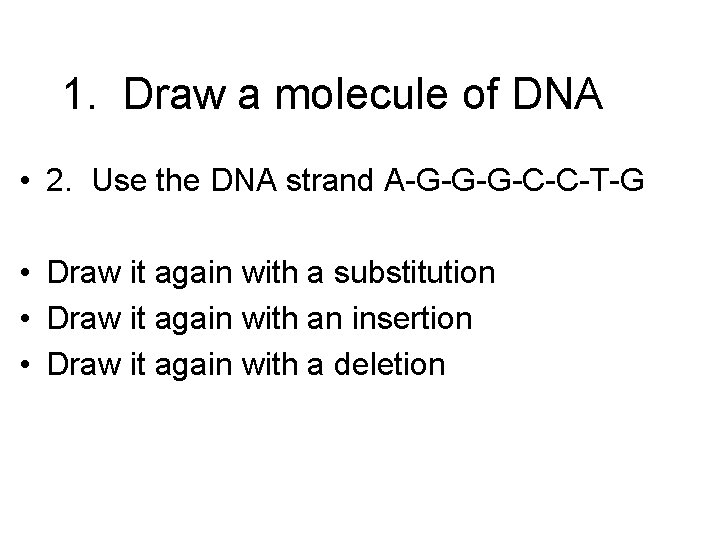
1. Draw a molecule of DNA • 2. Use the DNA strand A-G-G-G-C-C-T-G • Draw it again with a substitution • Draw it again with an insertion • Draw it again with a deletion
- Slides: 33