
Bellringer Describe the end behavior Find any local
Bell-ringer �Describe the end behavior. Find any local maxima/minima to the nearest tenth. 1). P(x) = x 4 – 3 x 3 + 3 x + 3 rises on the left and on the right local min (-. 5, 1. 9), (2. 1, 1. 0); local max (. 7, 4. 3) 2). P(x) = –x 3 + 4 x – 2 rises on the left and falls on the right local min (-1. 2, -5. 7), local max (1. 2, 1. 1)
Sketch the graph �Once we know the end behavior and local max/min pick an x-value to the left and right of each local maxima and minima, write down table and graph points. 1). P(x) = x 4 – 3 x 3 + 3 x + 3 rises on the left and on the right local min (-. 5, 1. 9), (2. 1, 1. 0); local max (. 7, 4. 3)
7. 3 Products & Factors of Polynomials I Objectives: 1). Multiple and factor polynomials. 2). Use the factor theorem to solve problems
Review of Exponent Rules �Recall: When multiplying variables you must add the exponents.
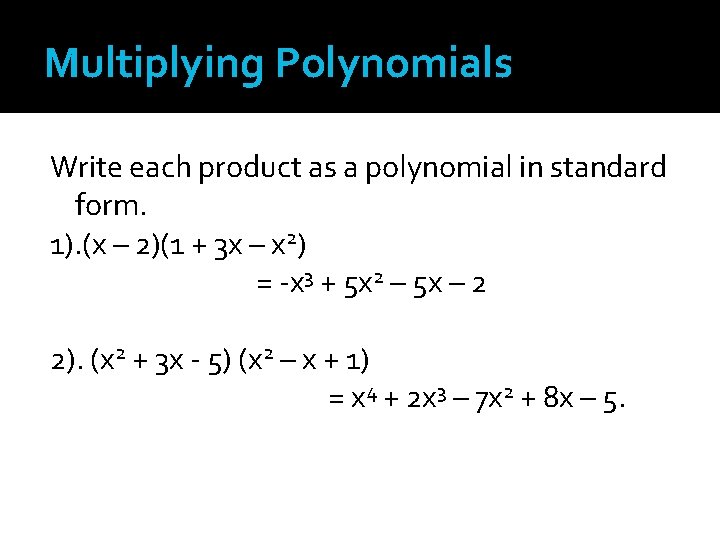
Multiplying Polynomials Write each product as a polynomial in standard form. 1). (x – 2)(1 + 3 x – x 2) = -x 3 + 5 x 2 – 5 x – 2 2). (x 2 + 3 x - 5) (x 2 – x + 1) = x 4 + 2 x 3 – 7 x 2 + 8 x – 5.
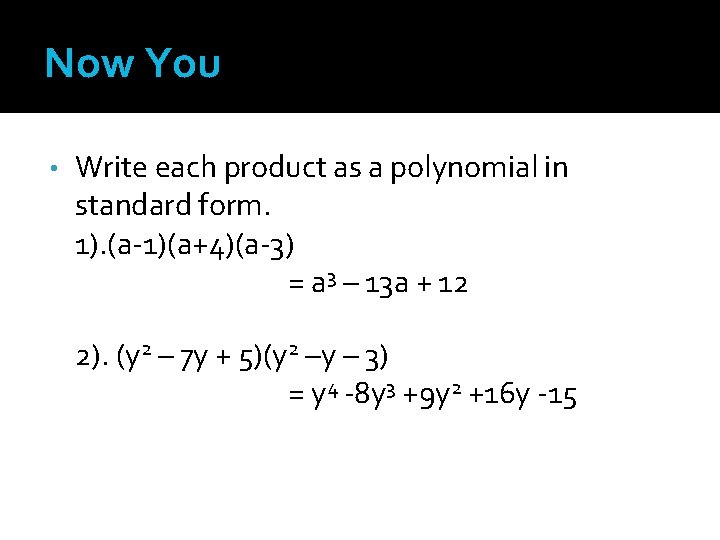
Now You • Write each product as a polynomial in standard form. 1). (a-1)(a+4)(a-3) = a 3 – 13 a + 12 2). (y 2 – 7 y + 5)(y 2 –y – 3) = y 4 -8 y 3 +9 y 2 +16 y -15
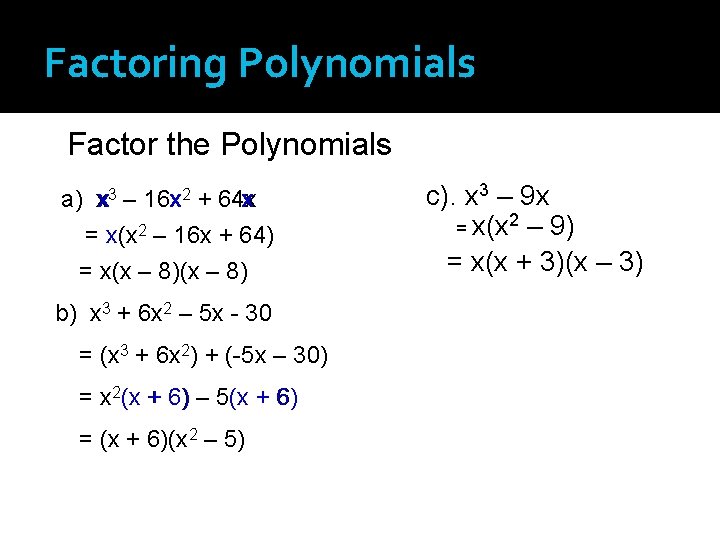
Factoring Polynomials Factor the Polynomials a) xx 3 – 16 x x 2 + 64 x x = x(x 2 – 16 x + 64) = x(x – 8) b) x 3 + 6 x 2 – 5 x - 30 = (x 3 + 6 x 2) + (-5 x – 30) = x 2(x + 6) – 5(x (x + 6) = (x + 6)(x 2 – 5) c). x 3 – 9 x = x(x 2 – 9) = x(x + 3)(x – 3)
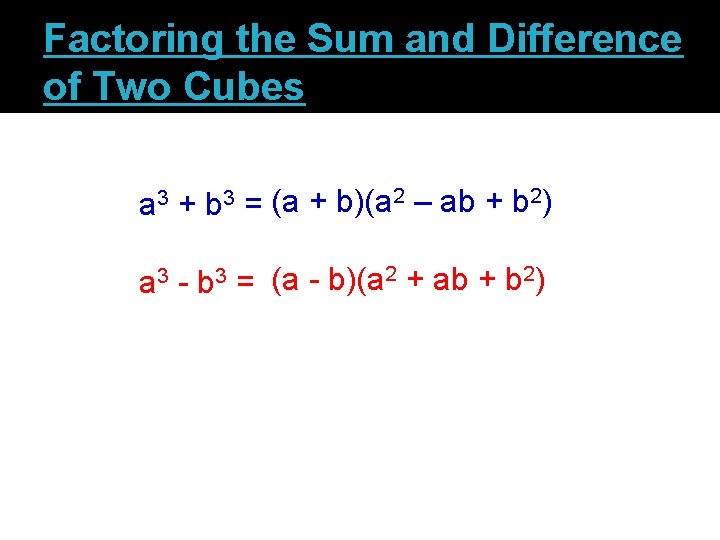
Factoring the Sum and Difference of Two Cubes a 3 + b 3 = (a + b)(a 2 – ab + b 2) a 3 - b 3 = (a - b)(a 2 + ab + b 2)
Sums and Differences of Cubes �Cool Math Example
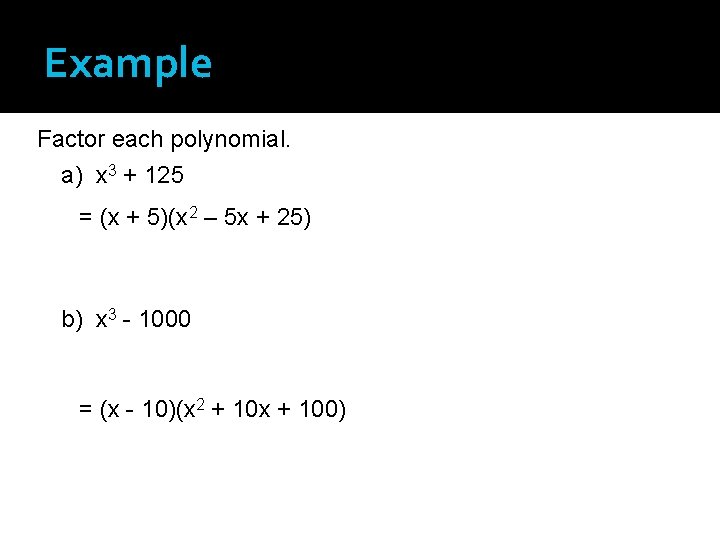
Example Factor each polynomial. a) x 3 + 125 = (x + 5)(x 2 – 5 x + 25) b) x 3 - 1000 = (x - 10)(x 2 + 10 x + 100)
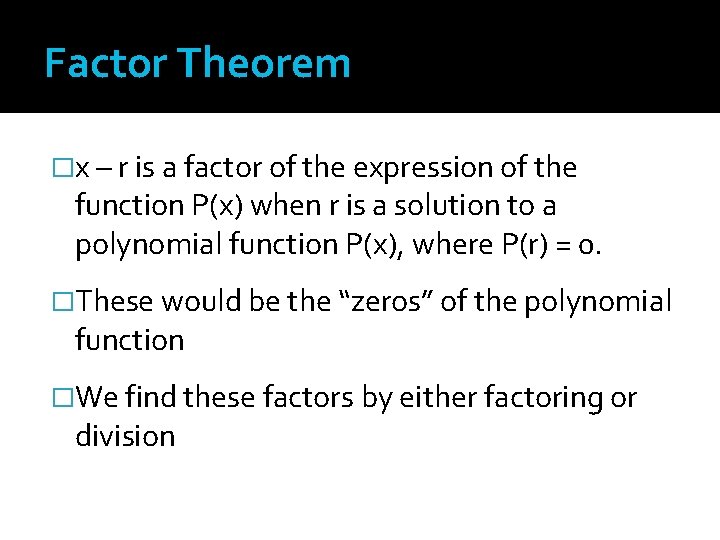
Factor Theorem �x – r is a factor of the expression of the function P(x) when r is a solution to a polynomial function P(x), where P(r) = 0. �These would be the “zeros” of the polynomial function �We find these factors by either factoring or division
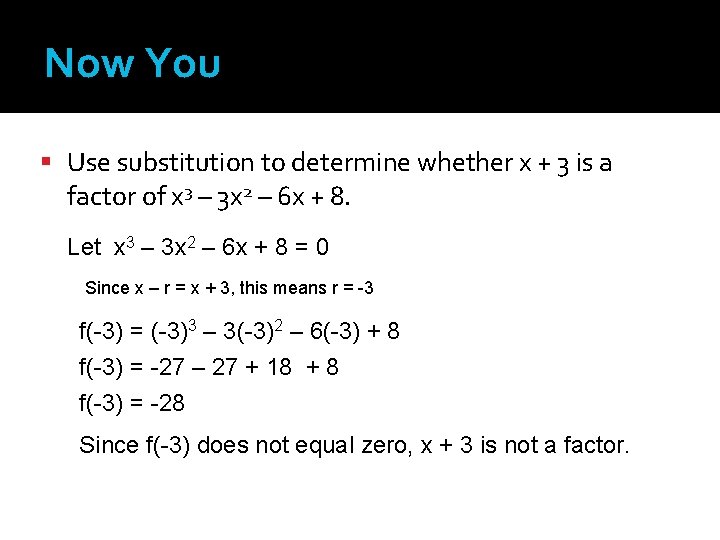
Now You Use substitution to determine whether x + 3 is a factor of x 3 – 3 x 2 – 6 x + 8. Let x 3 – 3 x 2 – 6 x + 8 = 0 Since x – r = x + 3, this means r = -3 f(-3) = (-3)3 – 3(-3)2 – 6(-3) + 8 f(-3) = -27 – 27 + 18 + 8 f(-3) = -28 Since f(-3) does not equal zero, x + 3 is not a factor.
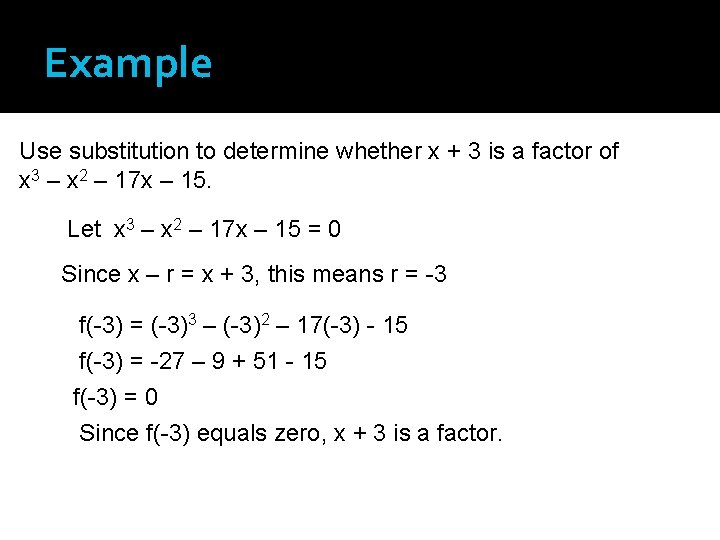
Example Use substitution to determine whether x + 3 is a factor of x 3 – x 2 – 17 x – 15. Let x 3 – x 2 – 17 x – 15 = 0 Since x – r = x + 3, this means r = -3 f(-3) = (-3)3 – (-3)2 – 17(-3) - 15 f(-3) = -27 – 9 + 51 - 15 f(-3) = 0 Since f(-3) equals zero, x + 3 is a factor.
Homework �page 445 -446 #15 -69 by 3’s.

White board practice �Grab 1 white board, 1 eraser, 1 marker. �I will show you a problem, solve it and then show me your answer.
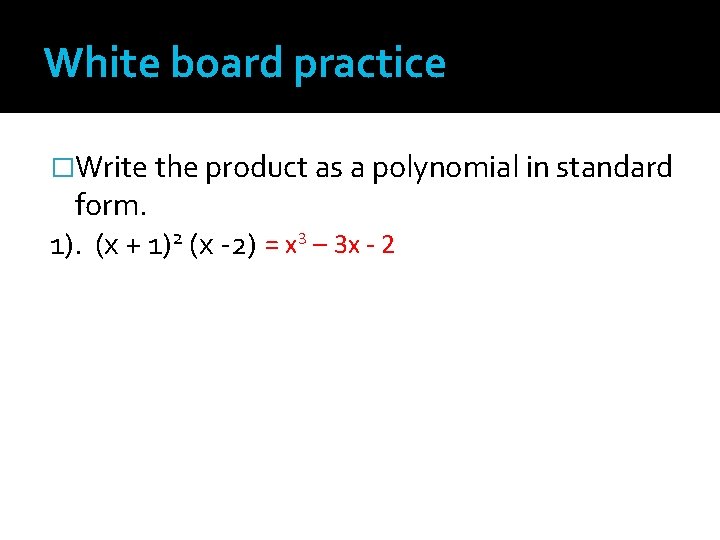
White board practice �Write the product as a polynomial in standard form. 1). (x + 1)2 (x -2) = x 3 – 3 x - 2
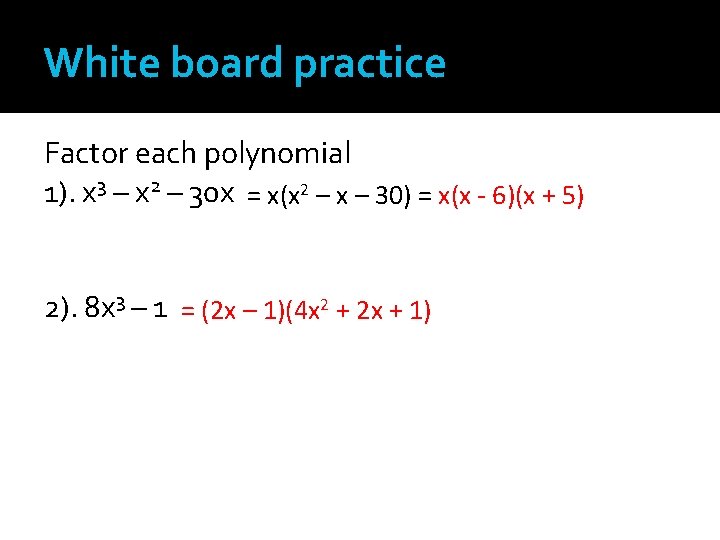
White board practice Factor each polynomial 1). x 3 – x 2 – 30 x = x(x 2 – x – 30) = x(x - 6)(x + 5) 2). 8 x 3 – 1 = (2 x – 1)(4 x 2 + 2 x + 1)
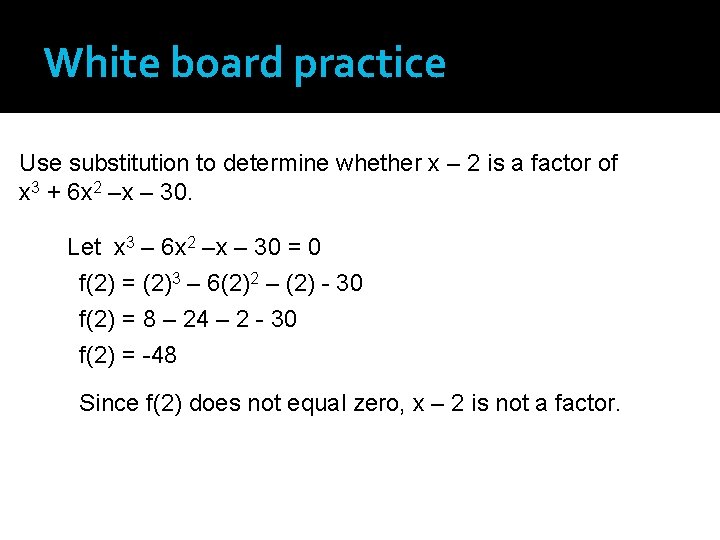
White board practice Use substitution to determine whether x – 2 is a factor of x 3 + 6 x 2 –x – 30. Let x 3 – 6 x 2 –x – 30 = 0 f(2) = (2)3 – 6(2)2 – (2) - 30 f(2) = 8 – 24 – 2 - 30 f(2) = -48 Since f(2) does not equal zero, x – 2 is not a factor.
- Slides: 18