
Bellringer 15 l Make a list of items

Bellringer # 15 l Make a list of items that you put on your calendar. l What items appear in a regular pattern or periodic?
Chapter 5 The Periodic Table Chapter Overview How elements in the periodic table were arranged historically and how they are arranged now. l Valence electrons, ionization, and periodicity. l The organization of the periodic table into periods and groups. l Classification of the elements as metals and non metals and provides examples and properties of each type of element. l
Section 1 Organizing the Elements Focus You will study the organization of the periodic table, how Mendeleev first arranged the elements in order of increasing atomic mass and observe periodic trends and their properties. l You will also learn how the modern periodic table is arranged by atomic number and demonstrate periodic law. l
Ch. 5 S. 1 Key Ideas l How did Mendeleev arrange the elements in his periodic table? l How are elements arranged in the modern periodic table? l Vocab l Periodic law l Period l Group
Organizing the Elements l Scientists in the 1860 s knew some of the chemical and physical properties of more than 60 elements. l There was no system for organizing the elements. l In order to find a way to organize the elements, scientists studied the elements and the properties of the elements.
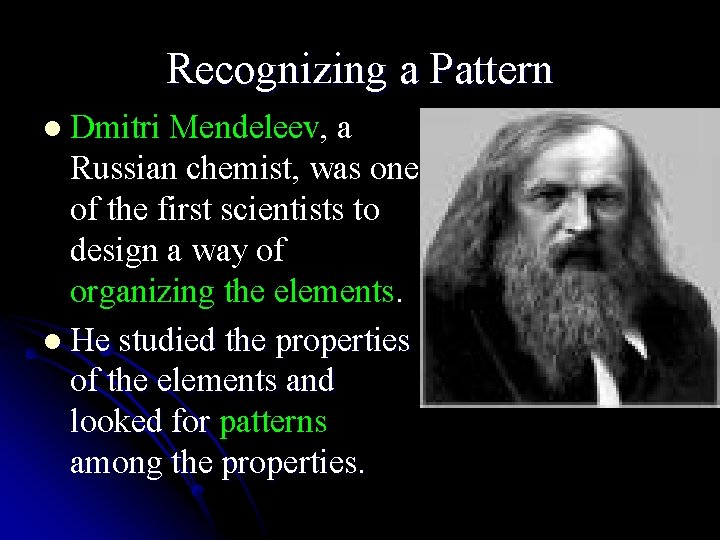
Recognizing a Pattern l Dmitri Mendeleev, a Russian chemist, was one of the first scientists to design a way of organizing the elements. l He studied the properties of the elements and looked for patterns among the properties.
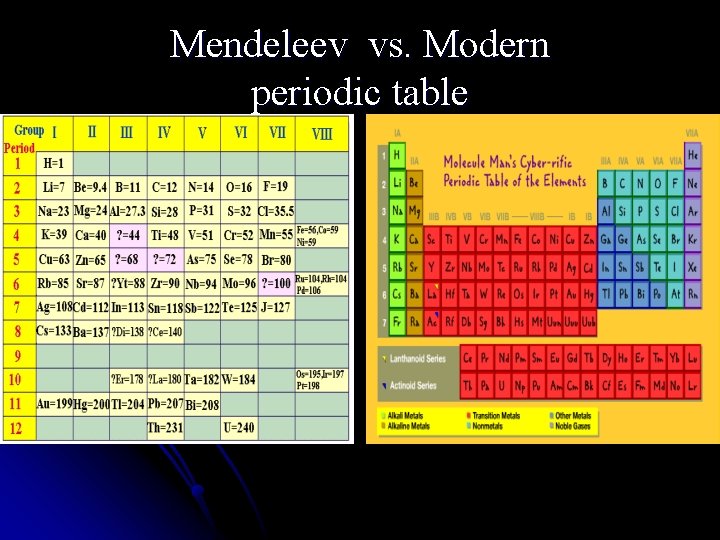
Recognizing a Pattern In 1869, Mendeleev published the first periodic table of the elements. l He arranged the elements in rows by increasing atomic mass. l How did he organize the elements? l He started a new row each time the chemical properties of the elements repeated. l So, for any column, all of the elements in that column had similar properties.
Mendeleev was able to predict new elements When Mendeleev arranged the elements in a list, he left gaps in the list. l When he made the list into a table he left the gaps in the table. l He put question marks in these gaps. l The question marks indicate places where there was no known element whose properties fit the pattern. l He predicted that new elements would be discovered. l
Mendeleev was able to predict new elements For example, Mendeleev left a space for an element after silicon. He predicted that this element would be a gray metal that has a high melting point. l In 1886, the element germanium was discovered. l The properties of geranium are very similar to those predicted by Mendeleev. l Two other examples are: gallium and scandium l
l Mendeleev was not the only person to develop a periodic table but, he was the first person to use the table to make predictions. l Mendeleev is often considered to be the father of the periodic table. l The element mendelevium was names in his honor.
A few elements did not fit the pattern l Some of the elements did not fit his pattern. l He had to reverse the positions of the elements tellurium and iodine. l They now belonged in a column with similar elements. l But they were no longer in order of increasing atomic mass.
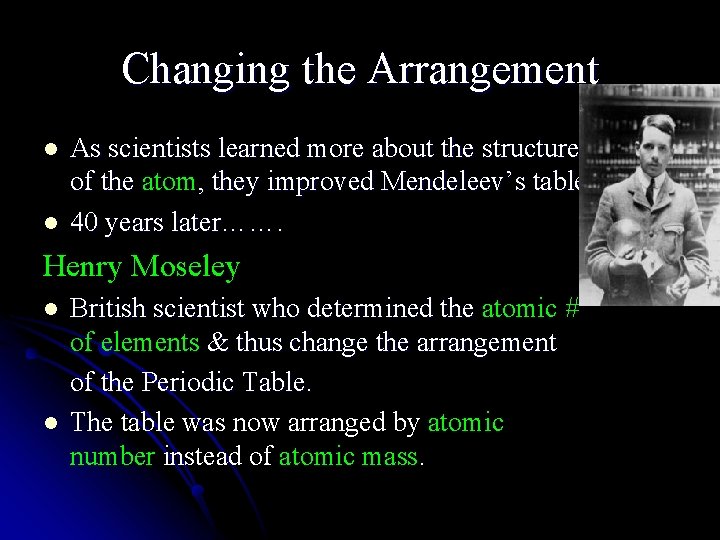
Changing the Arrangement l l As scientists learned more about the structure of the atom, they improved Mendeleev’s table. 40 years later……. Henry Moseley l l British scientist who determined the atomic # of elements & thus change the arrangement of the Periodic Table. The table was now arranged by atomic number instead of atomic mass.
Changing the Arrangement l Today’s periodic table includes more than 100 l The Periodic Law l The modern periodic table organizes elements by atomic number. l When the elements are arranged in this way, elements that have similar properties appear at regular intervals. elements.
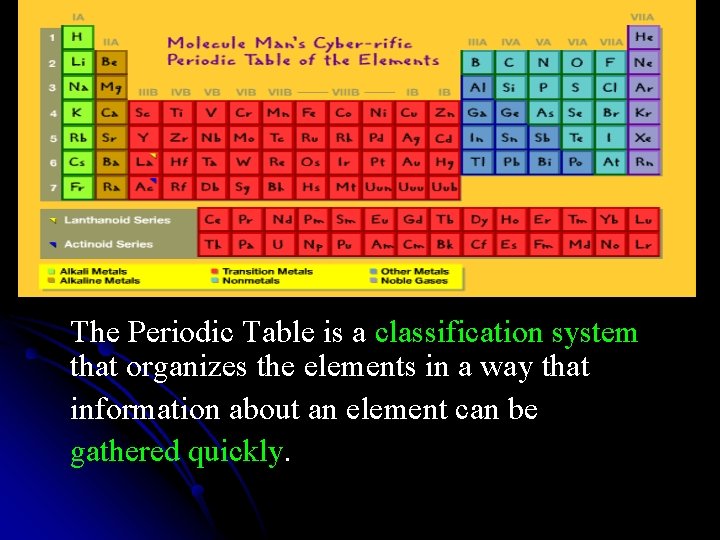
The Periodic Table is a classification system that organizes the elements in a way that information about an element can be gathered quickly.
The Periodic Table of Elements is a scientific tool. l Your job is to interpret the information. l The periodic table tells you: l l The element symbol l Atomic number l The element name l The average atomic mass l Group number l Period number l And whether the element is a metal or a nonmetal
Elements’ Diverse Histories Elements have connections to different cultures. l Carbon, sulfur, tin, gold and silver were named and used by many ancient civilizations. l Platinum was first introduced to Europe from the Americas. l Vanadium was discovered in Mexico and was named after a Scandinavian goddess. l Polonium was named after Poland to honor the birthplace of one of its discoverers, Marie Curie. l
Elements become less metallic across each period l Each row of the periodic table is a period. l The periodic table has seven periods. l As you move from left to right across the period, properties such as reactivity and conductivity change, and elements become less metallic.
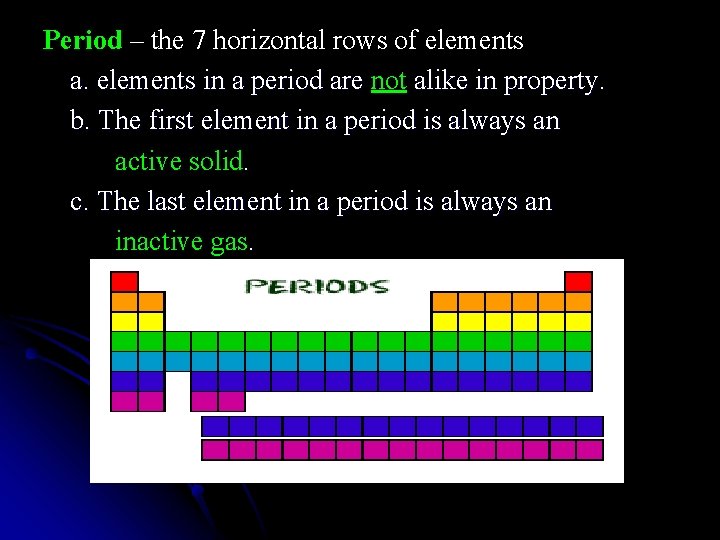
Period – the 7 horizontal rows of elements a. elements in a period are not alike in property. b. The first element in a period is always an active solid. c. The last element in a period is always an inactive gas.
Elements in a group have similar properties l Each column of the periodic table is a group. l All of the elements in a group have similar chemical properties. l Ex: helium and neon (Group 18) are both unreactive elements. l Under normal conditions, these elements do not join with atoms of other elements to form compounds.
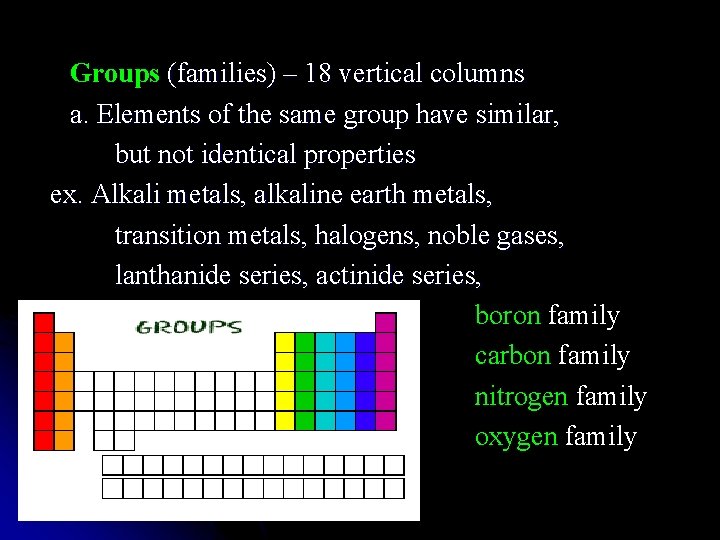
Groups (families) – 18 vertical columns a. Elements of the same group have similar, but not identical properties ex. Alkali metals, alkaline earth metals, transition metals, halogens, noble gases, lanthanide series, actinide series, boron family carbon family nitrogen family oxygen family
Mendeleev vs. Modern periodic table
Homework l Organizing the elements worksheet and the chapter 5 vocab. l You can find the vocab on page 169

Bellringer # 16 l Identify the following on the periodic table: A. The chemical symbol for mercury B. The period and group for gold C. The atomic mass of iron D. The atomic number of neon E. The element represented by Cu
Ch. 5 S. 2 Exploring the Periodic Table Focus l You will learn about the process of ionization and how valence electrons account for the periodic properties of elements. l The section concludes with a brief description of how elements are classified as metals, semiconductors, and nonmetals according to their properties and where, in general, these categories can be found on the periodic table.
Ch. 5 S. 2 Key Ideas l l Why do elements within a group of the periodic table have similar chemical properties? What happens to an atom that gains or loses an electron? What are three main categories of elements? Vocab l Ion l Metal l Nonmetal l Semiconductor
Exploring the Periodic Table l Why is neon an unreactive element? l Why is sodium so reactive that it reacts violently with moisture and oxygen in the air? l These chemical properties are related to the number of electrons in each element.
The Role of Electrons l Atomic Number- is the number of protons in an atom. l When the number of protons equals the number of neutrons, it is a neutral atom. l The periodic trends in the periodic table are the result of electron arrangement.
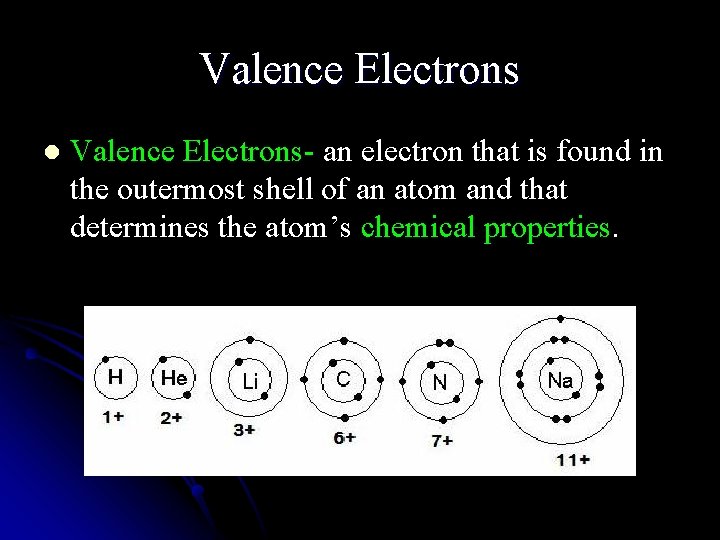
Valence Electrons l Valence Electrons- an electron that is found in the outermost shell of an atom and that determines the atom’s chemical properties.
Valence electrons account for similar properties l The number of valence electrons determines many of the chemical properties of an element. l l Ex: Lithium and Sodium have one valence electron, so they have similar properties. In general, elements in a group have chemical and physical properties in common because they have the same number of valence electrons.
But the elements in a group are not exactly alike. l They differ: l In numbers of protons in their nuclei l In numbers of electrons in their filled energy levels l Look at Figure 1 on page 151 l What is the difference in the location of the electrons?
An element’s location in the periodic table is related to electron arrangement l You can find out how the electrons are arranged in the atoms of an element if you know where the element is located in the periodic table. l Ex: Hydrogen and Helium are in the first period. Hydrogen has one electron in its first energy level while Helium has two.
Energy Levels l The number of energy levels that are filled in an atom depends on the number of electrons. l Energy Level 1 - can hold 2 electrons l Energy Level 2 - can hold 8 electrons l Energy Level 3 - can hold 18 electrons l Energy Level 4 - can hold 32 electrons
Orbitals l There are four types of orbitals. ls lp ld lf l Look in your book at Figure 3, 4 on page 130 l The s orbital is shaped like a sphere. l The p orbital is shaped like a dumbell l The d and f orbitals are very complex l Look in your book at figure 2 on page 152
Ion Formation l Atoms whose outer s and p orbitals are not filled may undergo a process called ionization. l That means that atoms may gain or loose valance electrons to fill their outer orbitals. l If an atom gains or loses electrons, it no longer has an equal number of electrons and protons. l Because the charges do not cancel completely, the atom has a net electric charge.
Group 1 elements form positive ions l Lithium is a group 1 element l It is very reactive in air, water, and especially in acid. l The structure of Lithium explains its reactivity.
• Look at Figure 3 on page 153 • Lithium has three electrons. • Two of the electrons are in the first energy level. • The second energy level only has one electron. • Since this electron can be removed so easily it makes the Lithium very reactive. • Removing this electron forms a positive ion, or cation.
Group 17 elements form negative ions Like lithium, fluorine is very reactive. l Each fluorine atom has nine electrons. l Fluorine has two electrons in the first energy level and seven in the second. l A fluorine atom needs only one more electron to have a filled outermost energy level. l An atom of fluorine easily gains the electron to form a negative ion or anion. l
Group 17 elements form negative ions l Because an ion of fluorine has a filled outer energy level, the ion is more stable and less reactive than a fluorine atom. l Other Group 17 elements have seven electrons and behave just like fluorine.
Ions have charge l The gain of an electron means the gain of a negative charge, producing a negatively charged ion. l The loss of an electron means the loss of a negative charge, which leaves a positively charged ion. l Only electrons can be added or removed to change the charge.
How are elements classified l The elements in the 18 groups in the periodic table are classified into three main groups. l These categories are based on general properties that the elements in the categories have in common. l All elements are either metals, nonmetals, or semiconductors.
Metals l Metal- an element that is shiny and that conducts heat and electricity well. l Most l Some elements are metals. examples are gold, platinum, copper, and lead.
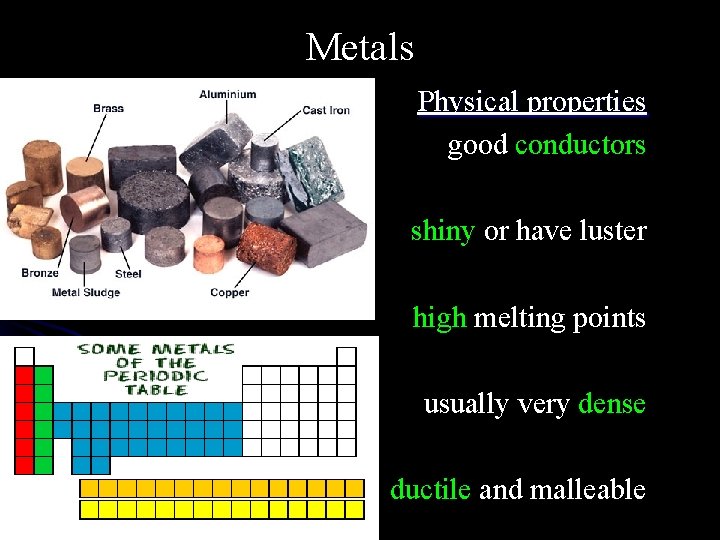
Metals Physical properties good conductors shiny or have luster high melting points usually very dense ductile and malleable
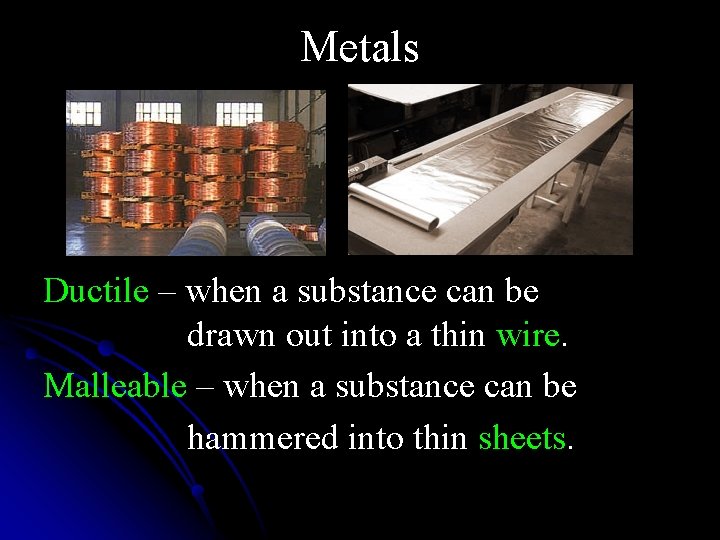
Metals Ductile – when a substance can be drawn out into a thin wire. Malleable – when a substance can be hammered into thin sheets.
Metals Chemical Properties * depend upon the electron arrangement in the outer most energy level. Valence electrons – electrons in the outermost energy level. metals have 1, 2, 3, or 4 valence electrons l metals tend to lose valence electrons l will corrode (rusting, tarnishing) l
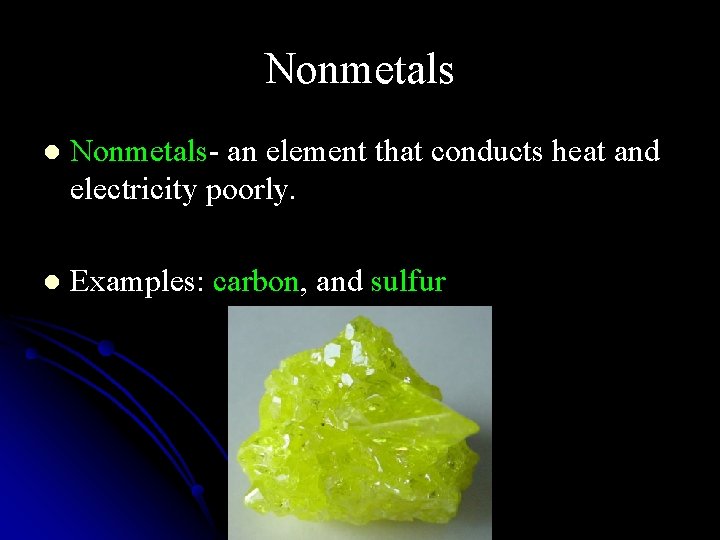
Nonmetals l Nonmetals- an element that conducts heat and electricity poorly. l Examples: carbon, and sulfur
Nonmetals Physical Properties no luster and dull in appearance. do not conduct heat & electricity very well. brittle and break easily not malleable or ductile have low densities & melting points
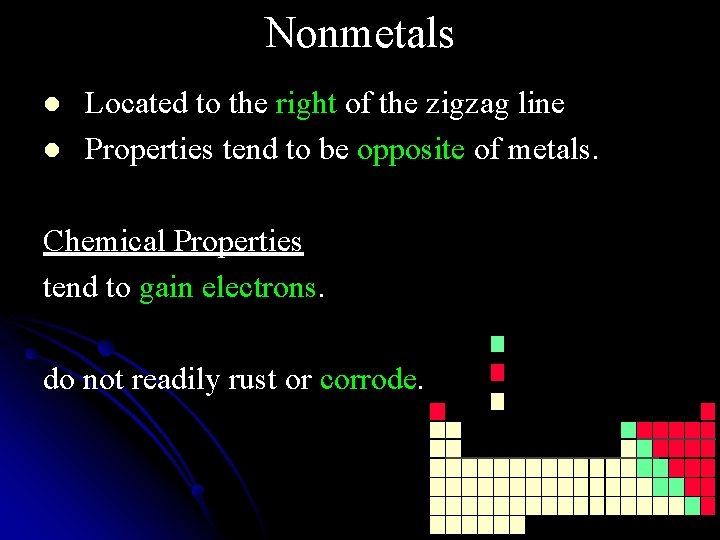
Nonmetals l l Located to the right of the zigzag line Properties tend to be opposite of metals. Chemical Properties tend to gain electrons. do not readily rust or corrode.
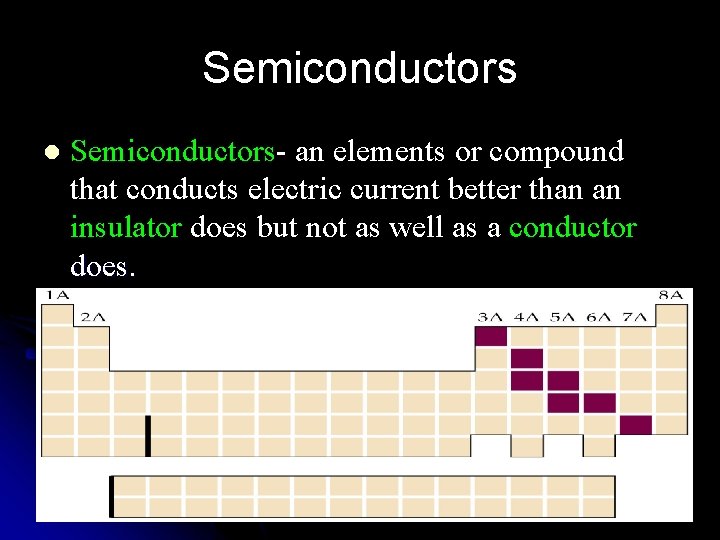
Semiconductors l Semiconductors- an elements or compound that conducts electric current better than an insulator does but not as well as a conductor does.
Semiconductors l elements that have properties of both metals & nonmetals. l Found on both sides of the zig-zag lines. l Can be shiny or dull. l Better conductors than nonmetals, but not as good as metals. l Metalloids are ductile and malleable. l Examples: germanium, and silicon
Homework l Worksheet- Elements in your body and Magnesium l Due tomorrow!
Bellringer # 17 Determine whether elements that fit the following descriptions are more likely to be metals or nonmetals. A. A shiny substance used to make flexible bed springs B. A yellow powder from underground mines C. A gas that does not react D. A brittle substance that does not conduct heat l
Ch. 5 S. 3 Families of Elements Focus l You will learn how metals and nonmetals can be grouped into families with similar properties: alkali metals, alkaline-earth metals, transition metals, semiconductors, halogens, and noble gases. l You will also learn about the general properties of each family of elements and study specific examples of each.
Ch. 5 S. 3 Key Ideas and Terms l l l What does each element family have in common? What are the families of metals? What are some of the families of nonmetals? What are semiconductors? Key Terms l Alkali metal l Alkaline-earth metal l Transition metal l Noble gas l Halogen
Families of Elements l Sometimes, one or more groups in a periodic table are categorized as being members of a unit called a family. l Consider your own family, each member is unique but you all share some features. l Ex: same appearance have properties in common
Classifying elements further l You learned earlier that elements can be classified as metals, nonmetals, and semiconductors. l The periodic table is divided into five families. l The elements in a family have the same number of valence electrons.
Metals Many elements are classified as metals. l All metals conduct heat and electricity. l Most metals can be stretched into flat sheets and pulled into wires. l l Families of metals include: l Alkali metals l Alkaline-earth metals l Transition metals
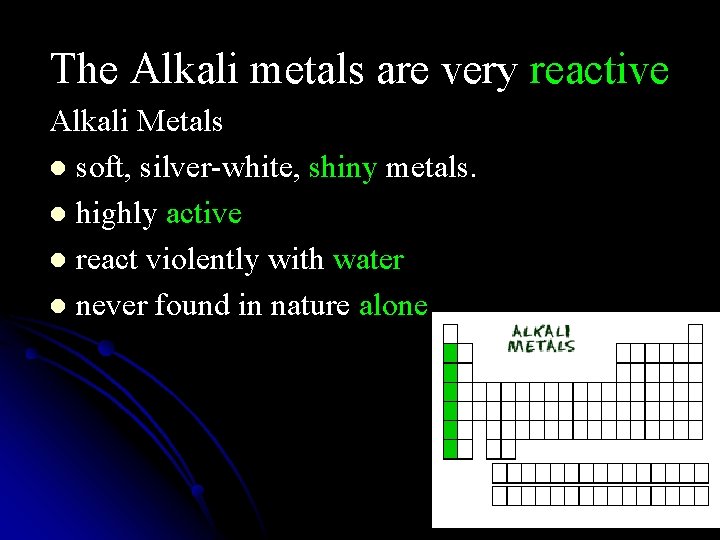
The Alkali metals are very reactive Alkali Metals l soft, silver-white, shiny metals. l highly active l react violently with water l never found in nature alone
Alkali Metals Alkali metals are often stored in oil to prevent them from reacting with moisture in the air. l Ex: Sodium, Lithium, Potassium l l An atom of an alkali metal is very reactive because it has one valence electron that can easily be removed to form a positive ion. l Many alkali metals have similar melting points, boiling points, and densities.
Alkali Metals Compounds of alkali metals are used extensively. Esp: sodium and potassium. l Sodium hydroxide- used to make paper, soap, and synthetic fabrics. l Sodium chloride- table salt l Potassium chloride- table salt substitute l Potassium compounds- fertilizers l Too much sodium in your body can be unhealthy but you do need sodium and potassium for proper nerve functioning. l
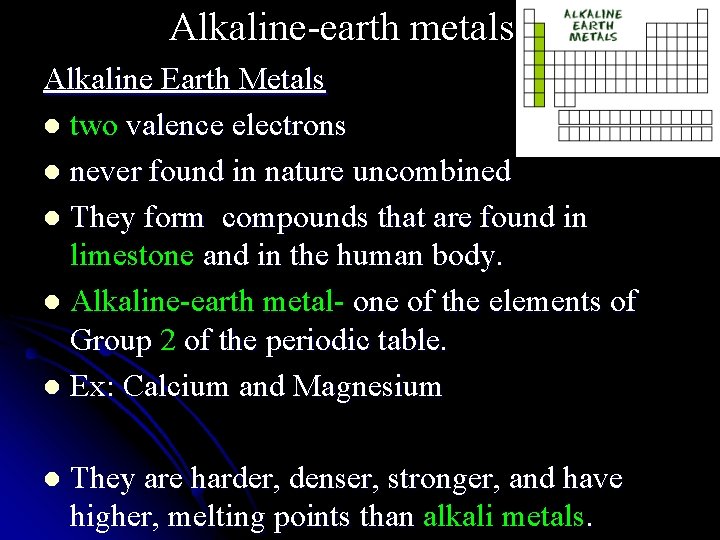
Alkaline-earth metals Alkaline Earth Metals l two valence electrons l never found in nature uncombined l They form compounds that are found in limestone and in the human body. l Alkaline-earth metal- one of the elements of Group 2 of the periodic table. l Ex: Calcium and Magnesium l They are harder, denser, stronger, and have higher, melting points than alkali metals.
Alkaline-earth metals l Calcium compounds make up the hard shells of many sea creatures. l Magnesium is the lightest of all the metals. l Magnesium is used to build some airplanes, and activates many enzymes in our body. l Two magnesium compounds are commonly used in medicines- milk of magnesia and Epson salts.
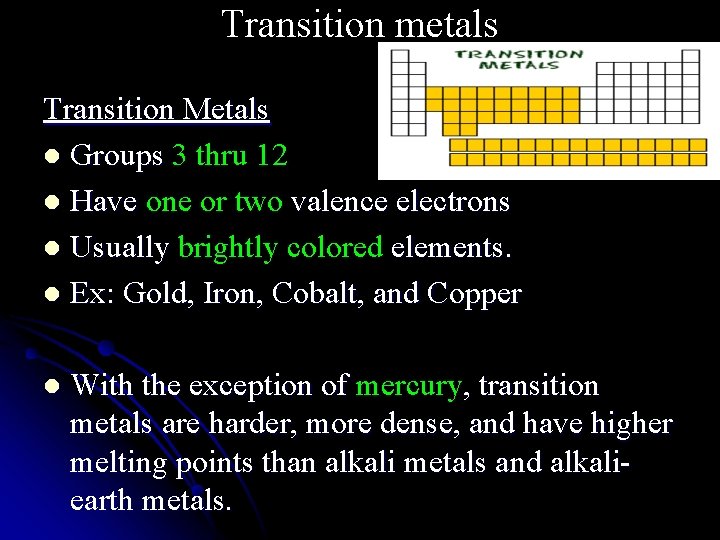
Transition metals Transition Metals l Groups 3 thru 12 l Have one or two valence electrons l Usually brightly colored elements. l Ex: Gold, Iron, Cobalt, and Copper l With the exception of mercury, transition metals are harder, more dense, and have higher melting points than alkali metals and alkaliearth metals.
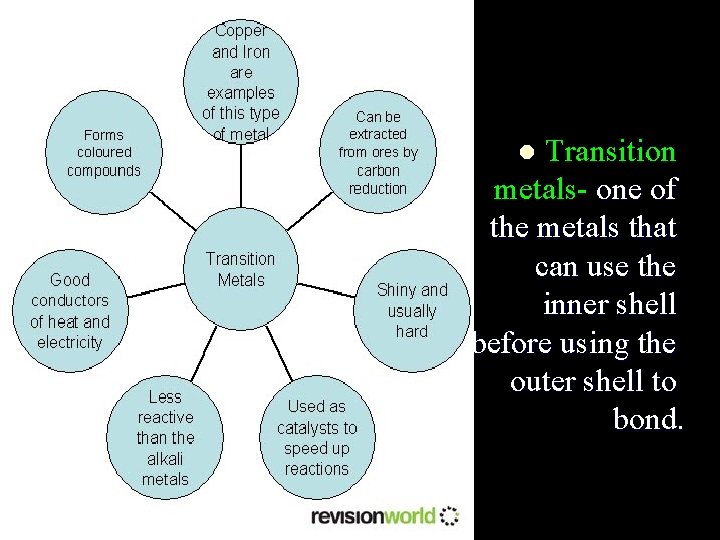
Transition metals- one of the metals that can use the inner shell before using the outer shell to bond. l
Some elements are synthetic Synthetic elements are made in a laboratory. l All of the elements above #92 are synthetic. l Some synthetic elements are radioactive. l Ex: l l Technetium Fig 6 pg. 160 used in brain scans l Promethium is used in glow in the dark paints l Americium- found inside smoke detectors
Nonmetals l Except for Hydrogen, nonmetals are found on the right side of the periodic table. l It includes some elements in Groups 13 -16 and all of the elements in groups 17 -18. l The two types of nonmetals are Noble gases l Halogens l
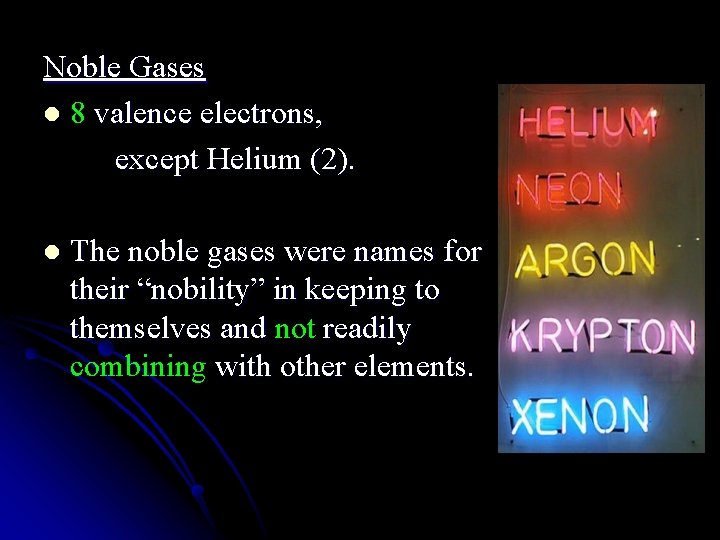
Noble Gases l 8 valence electrons, except Helium (2). l The noble gases were names for their “nobility” in keeping to themselves and not readily combining with other elements.
Noble Gases Noble gas- one of the elements of Group 18 of the periodic table. l Ex: Neon, helium, argon l Noble gases exist as single atoms instead of molecules. l Noble Gases are inert or unreacitve because its s and p orbitals are filled. l Therefore, they do not gain or loose electrons. l Noble gases do not join with other atoms to form compounds. l
Noble gases Neon is responsible for the reddish color used in neon signs. l Mixing neon with other substances can change the color of a sign. l Helium is less dense than air and is used to give lift to blimps and balloons. l Argon is used to fill light bulbs because of its lack of reactivity prevents the bulbs’ filaments from burning. l
Halogens l Halogens- are one of the elements of Group 17 of the periodic table. l The halogens are the most reactive nonmetals. l Halogens have 7 valence electrons. l Halogens combine easily with alkali metals. l Ex: Fluorine, chlorine, bromine, iodine
Halogens Chlorine is used to kill bacteria in pools. l Fluorine is a poisonous yellow gas. l l In toothpaste and sometimes water to prevent tooth decay. Bromine is a dark red liquid. l Iodine is a dark purple solid. l l Iodized salt, you need iodine in your diet for proper thyroid gland function.
Nonmetals and their compounds are plentiful on Earth Oxygen, nitrogen and sulfur are common nonmetals. l They may form compounds or may gain electrons to form negative ions. l The most plentiful gases in the air are nitrogen and oxygen. l Sulfur is an odorless yellow solid, but many sulfur compounds, such as those in rotten eggs and skunk spray, have a terrible smell. l
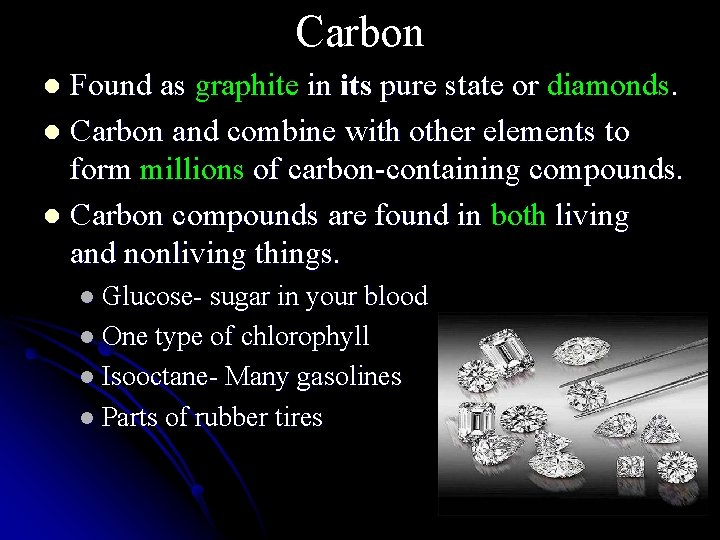
Carbon Found as graphite in its pure state or diamonds. l Carbon and combine with other elements to form millions of carbon-containing compounds. l Carbon compounds are found in both living and nonliving things. l l Glucose- sugar in your blood l One type of chlorophyll l Isooctane- Many gasolines l Parts of rubber tires
Organic Chemistry Organic chemistry is the study of carboncontaining compounds, called organic compounds. Carbon atoms have the ability to form molecule chains thousands of atoms long. l There are over six million organic compounds, including all types of foods (carbs, lipids, and proteins) plastics, synthetic and natural fibers, and petroleum products. l
Semiconductors l There are six semiconductors or metalloids. l Boron, silicon, germanium, arsenic, antimony, tellurium. As their name suggests, semiconductors are elements that are able to conduct heat and electricity under certain conditions. l Silicon atoms account for 28% of the mass of the Earth’s crust. Ex: Sand, computer chips. l Boron- used to make heat resistant glass. l
Hydrogen is in a class by itself l Hydrogen has one proton and one electron. l It does not behave like any other element. l Hydrogen is the most abundant element in the universe. l Most hydrogen is in the form of clouds, gases, and stars.
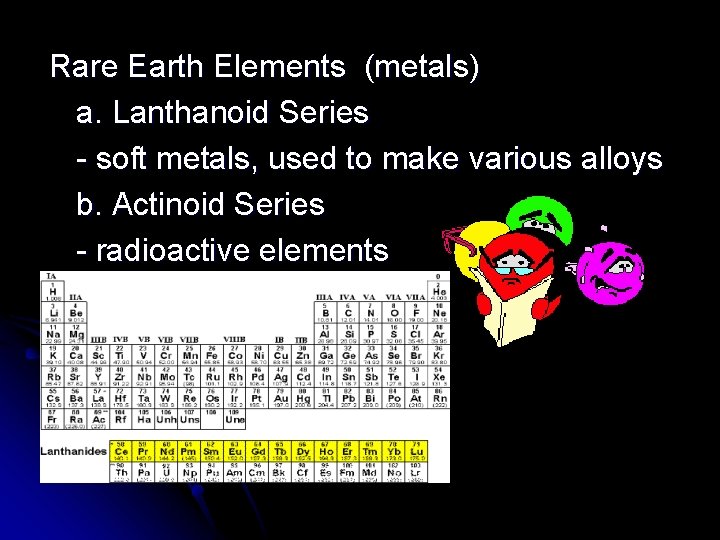
Rare Earth Elements (metals) a. Lanthanoid Series - soft metals, used to make various alloys b. Actinoid Series - radioactive elements
Homework l. Worksheet- Magnesium and predicting properties l. Due tomorrow
A. Periodic Law B. Period C. Group D. Ion E. Metal F. Nonmetal G. Semiconductor H. Alkali Metal I. Alkaline-earth Metal J. Noble Gas K. Halogen L. Transition Metal
Bellringer # 26 l Read How are Silicon Chips Made? On page 165. l Answer journal both question in your
Chapter 5 Review l Open your books to page 170. l On a sheet of paper, answer questions 1 -26. l You should be working quietly the entire period.
- Slides: 82