
Bellringer 1 Draw a model for the following
Bellringer 1. Draw a model for the following elements: A. Sodium B. Chlorine 2. How many valence electrons does sodium have? 3. If sodium lost its valence electrons, what would its charge be? 4. How many valence electrons does chlorine have? 5. If chlorine gained an electron, what would its charge be?
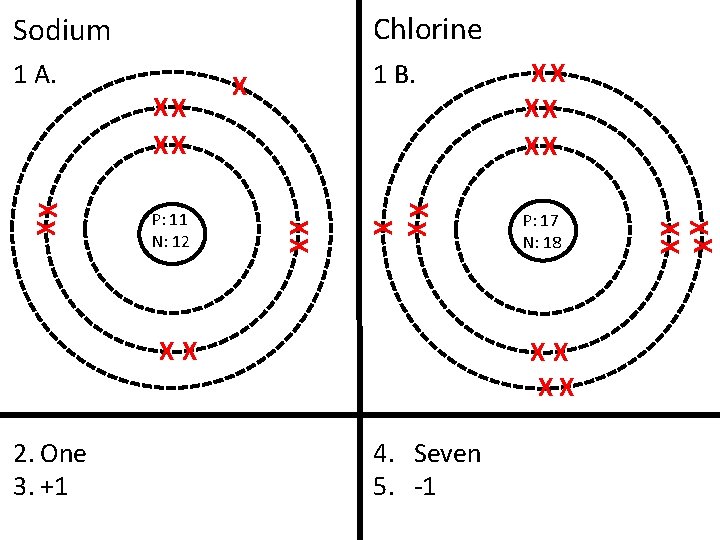
Chlorine Sodium XX 2. One 3. +1 XX XX XX P: 17 N: 18 XX XX 4. Seven 5. -1 XX XX X P: 11 N: 12 XX XX XX 1 B. X XX XX 1 A.
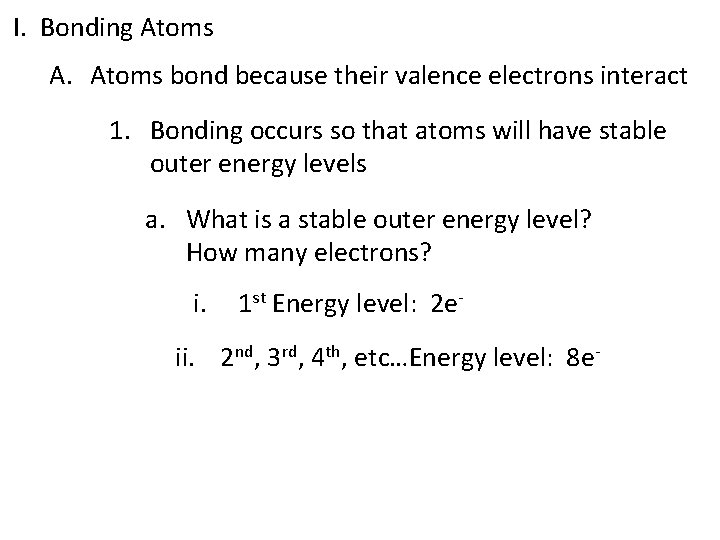
I. Bonding Atoms A. Atoms bond because their valence electrons interact 1. Bonding occurs so that atoms will have stable outer energy levels a. What is a stable outer energy level? How many electrons? i. 1 st Energy level: 2 e- ii. 2 nd, 3 rd, 4 th, etc…Energy level: 8 e-

Example: Hydrogen Valence electrons: 1 Energy levels: 1 X X The valence electron in each hydrogen is shared, giving each atom a stable outer energy level.

II. Ionic Bonds A. Ionic Bonds – Formed between oppositely charged ions 1. Metals form positive ions 2. Nonmetals form negative ions B. When one atom loses an electron, another atom gains that same electron 1. Salt is formed from positively charged sodium ions and negatively charged chlorine ions
![Example: Na Cl + Sodium Ion (positive) + [Na] [ Cl ] Chloride Ion](http://slidetodoc.com/presentation_image_h2/b22cfcf168b23bf19be1d437c948eb50/image-6.jpg "Example: Na Cl + Sodium Ion (positive) + [Na] [ Cl ] Chloride Ion")
Example: Na Cl + Sodium Ion (positive) + [Na] [ Cl ] Chloride Ion (negative)
C. The chemical formula, Na. Cl, tells the ratio of sodium to chloride ions D. Characteristics of ionic compounds: 1. Conduct electricity when dissolved 2. Metallic bonds – the attraction between a nucleus of one atom and the electrons from another atom i. Causes atoms to pack close to each other
III. Covalent Bonds A. Covalent Bond – Molecules, made when electrons are shared between atoms
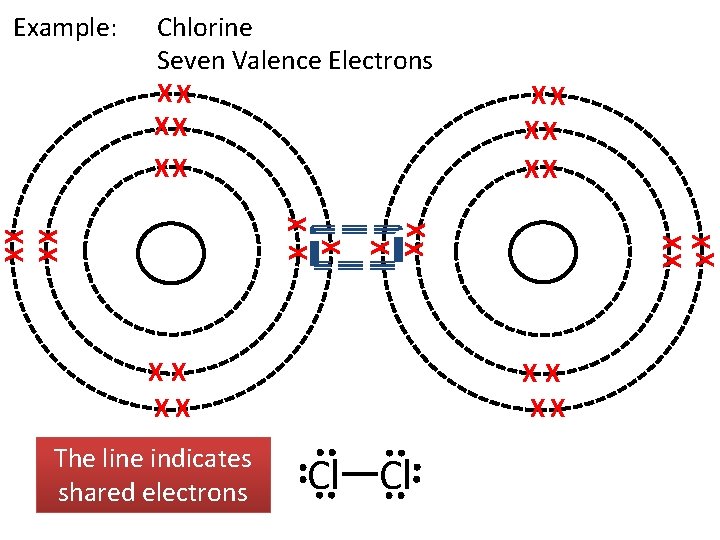
X XX XX XX The line indicates shared electrons XX XX Chlorine Seven Valence Electrons XX XX XX X Example: XX XX Cl Cl
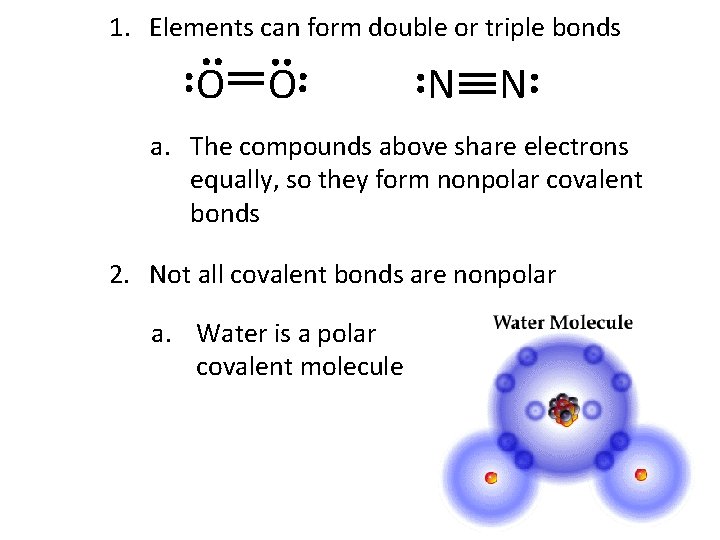
1. Elements can form double or triple bonds O O N N a. The compounds above share electrons equally, so they form nonpolar covalent bonds 2. Not all covalent bonds are nonpolar a. Water is a polar covalent molecule

IV. Polyatomic Ions A. Polyatomic Ions – Groups of covalently bonded atoms that have either gained or lost electrons Polyatomic Ion Examples: NH 4+ ammonium PO 33 - phosphite NO 2 - nitrite NO 3 - nitrate OH- hydroxide
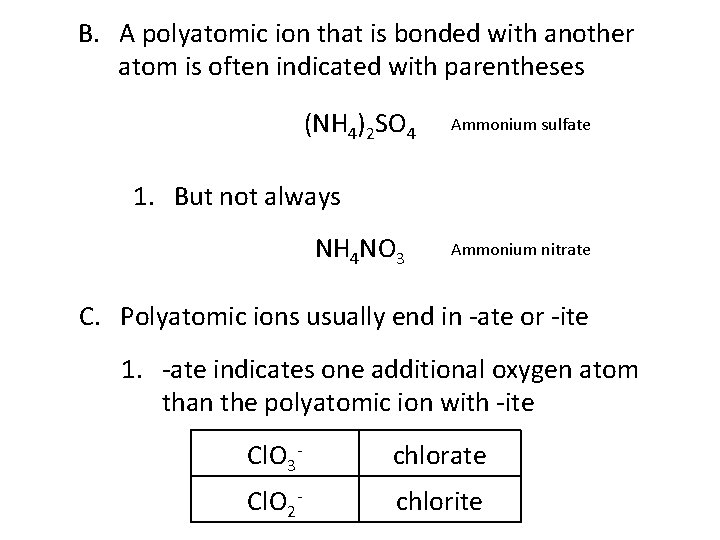
B. A polyatomic ion that is bonded with another atom is often indicated with parentheses (NH 4)2 SO 4 Ammonium sulfate 1. But not always NH 4 NO 3 Ammonium nitrate C. Polyatomic ions usually end in -ate or -ite 1. -ate indicates one additional oxygen atom than the polyatomic ion with -ite Cl. O 3 - chlorate Cl. O 2 - chlorite
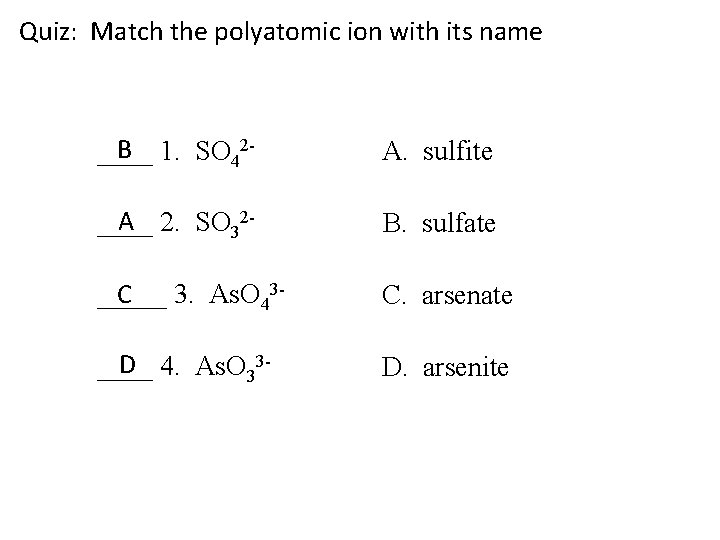
Quiz: Match the polyatomic ion with its name B 1. SO 42____ A. sulfite A 2. SO 32____ B. sulfate C 3. As. O 43_____ C. arsenate D 4. As. O 33____ D. arsenite
- Slides: 13