
Bellows Air Force Station Military Munitions Response Program
Bellows Air Force Station Military Munitions Response Program (MMRP) Virtual Public Meeting Proposed Plans Former Large Bomb Range (TG 001) Former Urban Warfare Training Facility (TM 001) 7 October 2020 1 BUILDING STRONG®

Meeting Agenda § Primary Goals of the Meeting § Military Munitions Response Program (MMRP) Overview § Comprehensive Environmental Response, Compensation, and Liability Act (CERCLA) Process for Munitions Response § CERCLA Public Comment Period § Overview of Proposed Plans § Comments Regarding the Proposed Plans 2 BUILDING STRONG®
Primary Goals § Present to the Public the proposed remedies for the Munitions Response Sites § Describe the process for submitting comments regarding the Proposed Plans § Discuss the Next Steps with the Public 3 BUILDING STRONG®
Military Munitions Response Program § MMRP established in 2001 by the Department of Defense (Do. D) under the Defense Environmental Restoration Program (DERP) § Program addresses unexploded ordnance (UXO), discarded military munitions (DMM), and munitions constituents (MC) located on current and former military installations § MMRP follows processes outlined in CERCLA and the National Oil and the Hazardous Substances Pollution Contingency Plan (NCP) 4 BUILDING STRONG®
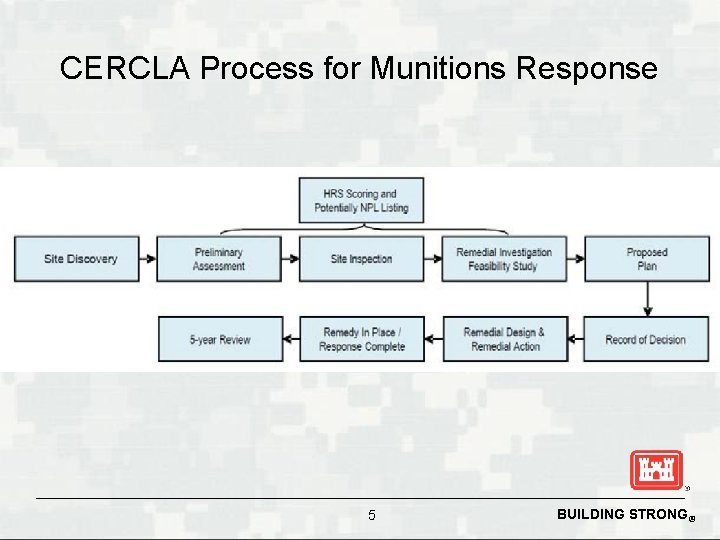
CERCLA Process for Munitions Response 5 BUILDING STRONG®

CERCLA Public Comment Period Final community acceptance is evaluated when the Proposed Plan has been issued and the public meeting and comment period for the Proposed Plan has been conducted. Public / Community concerns are then addressed in the selection of the remedy in the final ROD/DD, and responses are provided in the responsiveness summary section of the ROD/DD. The Public / Community has 30 days to provide comments regarding the Proposed Plans. To request an extension send a request in writing to Todd Fitch by October 16, 2020 5: 00 pm HST. 6 BUILDING STRONG®
This Proposed Plan (PP) identifies the Preferred Alternative for cleaning up the contaminated soil at the Former Large Bomb Range munitions response site (MRS) (TG 001) and provides the rationale for this preference. In addition this plan includes summaries of other cleanup alternatives evaluated for use at this site. This document is issued by the Department of the Air Force (USAF), the lead agency for site activities, and the Hawaii Department of Health (HDOH), the support agency. The USAF, in consultation with the HDOH will select a final remedy for the site after reviewing and considering all information submitted during the 30 -day public comment period. 7 BUILDING STRONG®

8 BUILDING STRONG®
9 BUILDING STRONG®
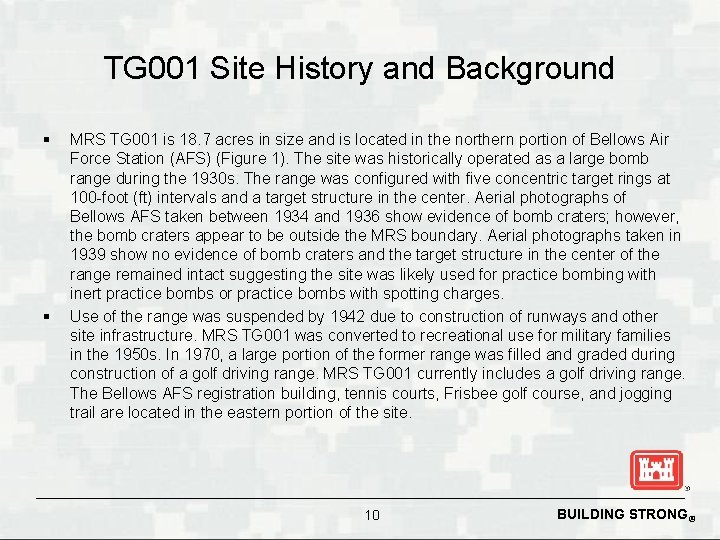
TG 001 Site History and Background § § MRS TG 001 is 18. 7 acres in size and is located in the northern portion of Bellows Air Force Station (AFS) (Figure 1). The site was historically operated as a large bomb range during the 1930 s. The range was configured with five concentric target rings at 100 -foot (ft) intervals and a target structure in the center. Aerial photographs of Bellows AFS taken between 1934 and 1936 show evidence of bomb craters; however, the bomb craters appear to be outside the MRS boundary. Aerial photographs taken in 1939 show no evidence of bomb craters and the target structure in the center of the range remained intact suggesting the site was likely used for practice bombing with inert practice bombs or practice bombs with spotting charges. Use of the range was suspended by 1942 due to construction of runways and other site infrastructure. MRS TG 001 was converted to recreational use for military families in the 1950 s. In 1970, a large portion of the former range was filled and graded during construction of a golf driving range. MRS TG 001 currently includes a golf driving range. The Bellows AFS registration building, tennis courts, Frisbee golf course, and jogging trail are located in the eastern portion of the site. 10 BUILDING STRONG®
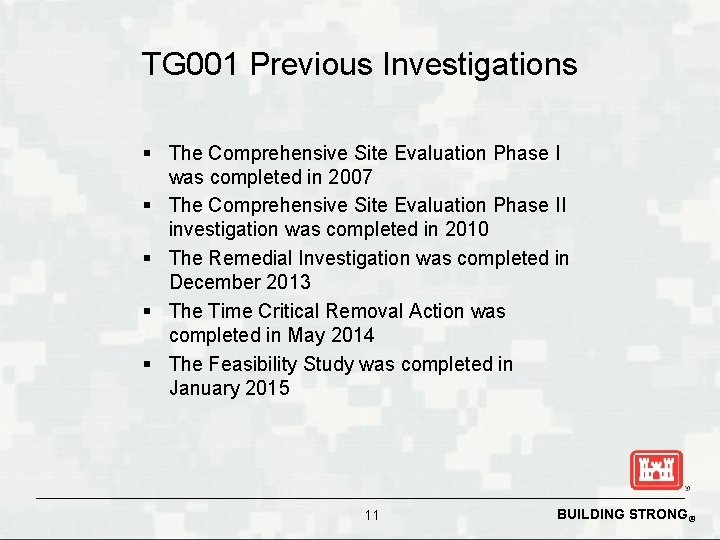
TG 001 Previous Investigations § The Comprehensive Site Evaluation Phase I was completed in 2007 § The Comprehensive Site Evaluation Phase II investigation was completed in 2010 § The Remedial Investigation was completed in December 2013 § The Time Critical Removal Action was completed in May 2014 § The Feasibility Study was completed in January 2015 11 BUILDING STRONG®
TG 001 Nature and Extent § § Surface MEC and MD were not documented during the CSE Phase II, RI, or TCRA. The results of the previous investigations identified MEC items primarily in the northern half of the MRS at depths down to 3. 0 ft bgs. MD items were recovered from the central and northern portions of the MRS at depths down to 4. 0 ft bgs. Both MEC and MD were documented outside the original MRS boundary in the two additional target rings investigated during the TCRA. Small arms debris was documented at depths down to 0. 3 ft bgs. The majority of items recovered were non-munitions-related debris at depths down to 4. 0 ft bgs. The previous investigation sampling results determined that MC was not a concern in surface and subsurface soils. Groundwater, surface water, and sediment were not evaluated. During the TCRA, loose TNT (in solid form) was observed in the soil around the excavation of the 500 -lb M 64 bomb, however, this isolated occurrence is anomalous. 12 BUILDING STRONG®
TG 001 Alternatives § Alternative 1 - No Further Action ► Alternative 1 is for the government to take no further action. The alternative serves as the baseline against which all other remedial alternatives were compared. • The total present-value cost to perform Alternative 1 is $0. 13 BUILDING STRONG®
TG 001 Alternatives § Alternative 2 - Land Use Controls ► Alternative 2 is for the USAF/Do. D to implement institutional LUCs over the entire MRS TG 001. • Public information signs addressing the 3 Rs (Recognize, Retreat, Report) of explosives safety to be posted at public access points; • Public information brochures to be available to anyone entering MRS TG 001; • Prohibition of metal detector use; • Implementation of a dig restriction to any depth; • Annotation and use of geographic information system to provide real-time tracking of sites with LUCs; • Annotate the areas covered by LUCs on the Bellow AFS Installation Development Plan; and • Use of a base-wide dig permit system for reviewing construction requests to ensure the integrity of areas covered by LUCs. • The total present-value cost to implement Alternative 2 is $1, 330, 269. 14 BUILDING STRONG®
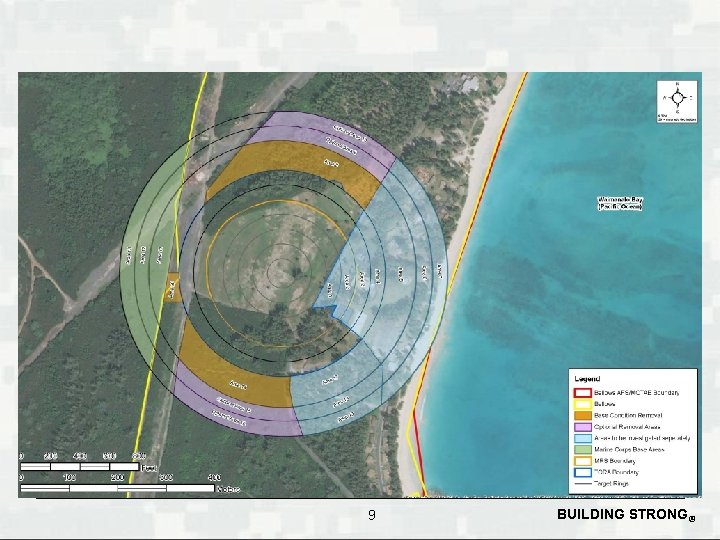
TG 001 Alternatives cont. § Alternative 3 - Subsurface MEC Remedial Action (Select Areas) and LUCs ► Alternative 3 is for the USAF/Do. D to implement LUCs, as defined in Alternative 2, and also includes the following: • Perform additional vegetation clearance and subsurface geophysical surveys in the base condition removal areas designated in the previous map/figure (orange shaded Areas 8, 14, and 20, which comprise 9. 43 acres) to bound MEC hazards in those areas; • Perform remedial action within these orange removal areas to address potential MD and MEC risk within these areas until the risk has been appropriately bounded; and • Implement location-specific LUCs within the proposed step-out areas, as appropriate, including updated status in the Base General Plan. • The total present-value cost to implement Alternative 3 is $2, 516, 050 (base) and $4, 847, 564 (base plus option). 15 BUILDING STRONG®
Summary of Preferred Alternative TG 001 Based on the information presented in the FS Report and PP, Alternative 3, Subsurface MEC Remedial Action (Select Areas) and LUCs, is the most favorable alternative in that it meets the RAO by restricting access and removing subsurface MEC to a depth of 4 ft bgs. Alternative 3 satisfies the NCP evaluation criteria and has the highest overall ranking when compared to the other two alternatives. 16 BUILDING STRONG®
This Proposed Plan (PP) identifies the Preferred Alternative for cleaning up the contaminated soil at the Former Urban Warfare Training Facility munitions response site (MRS) (TM 001) and provides the rationale for this preference. In addition this plan includes summaries of other cleanup alternatives evaluated for use at this site. This document is issued by the Department of the Air Force (USAF), the lead agency for site activities, and the Hawaii Department of Health (HDOH), the support agency. The USAF, in consultation with the HDOH will select a final remedy for the site after reviewing and considering all information submitted during the 30 -day public comment period. 17 BUILDING STRONG®
18 BUILDING STRONG®
19 BUILDING STRONG®
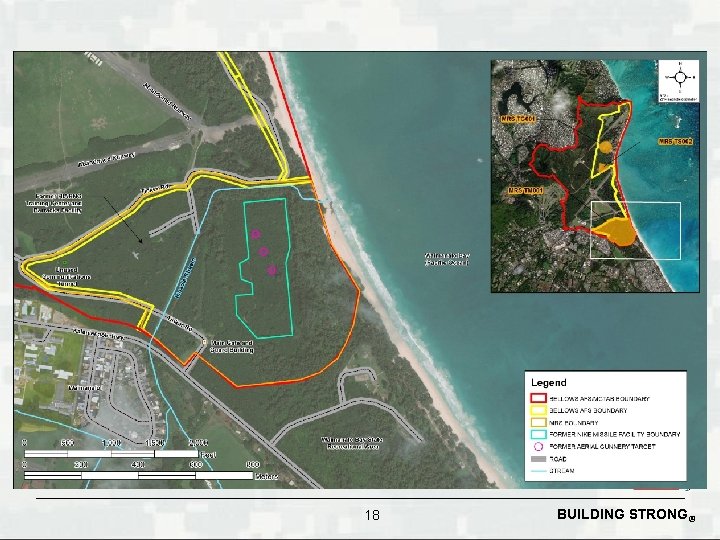
TM 001 Site History and Background MRS TM 001 is approximately 138. 7 acres and is located in the southern portion of Bellows Air Force Station (AFS) (Figure 1). The site was historically operated as an aerial gunnery target range in the 1930 s. In the early 1940 s, the aerial gunnery range was deactivated and redeveloped into a barracks area. The area was a Nike missile facility from the 1960 s to the 1970 s, and then an urban warfare training facility from the 1970 s through 2000. Currently, the USAF only uses MRS TM 001 for non-munitions-related monthly training exercises, including combat readiness response, all-terrain vehicle operations, crowd-control procedures, robbery intervention, helicopter rescue, and canine (K-9) training. 20 BUILDING STRONG®
TM 001 Previous Investigations § Ordnance and Explosives removal actions were conducted at MRS TM 001 in three phases between 1998 and 2002. § The Comprehensive Site Evaluation Phase I was completed in 2010 § The Comprehensive Site Evaluation Phase II investigation was completed in 2010 § The Remedial Investigation was completed in December 2013 § The Feasibility Study was completed in January 2015 21 BUILDING STRONG®
TM 001 Nature and Extent § Previous surface clearance actions performed at MRS TM 001 identified DMM, MEC, and MD in surface soil. No surface or subsurface MEC or MD were documented during the CSE Phase I/II or RI visual surveys, the geophysical survey performed to see objects underground or during the subsequent intrusive investigation efforts during which time objects were excavated from the ground. Small arms debris was identified at depths up to 0. 25 ft bgs. The majority of the anomalies were non-munitions related debris recovered at depths up to 3 ft bgs. 22 BUILDING STRONG®
TM 001 Nature and Extent § The CSE Phase II MC sampling results indicated that none of the surface or subsurface soil samples exceeded HDOH Environmental Action Levels (EAL) but two of the groundwater samples exceeded the HDOH EALs for zinc. The RI sample results indicated that all zinc concentrations were below the HDOH EALs, except in the unfiltered primary sample at TM 001 -06 collected in March 2012; however, the zinc concentration in the corresponding unfiltered duplicate and filtered sample were less than the HDOH EAL. In addition, zinc was detected below the EAL in the unfiltered and filtered TM 001 -06 sample collected in August 2012. Furthermore, multiple lines of evidence strongly suggest that zinc identified in groundwater at MRS TM 001 is naturally occurring, originating from nearby basalt and/or sedimentary rock, and is not the result of a release due to previous munitions activities at MRS TM 001. These analyses were presented in both the RI and the FS reports for TM 001. HDOH reviewed and concurred with the FS Report in February 2015. Figure 2 presents the results of the previous investigations conducted at TM 001. 23 BUILDING STRONG®
TM 001 Alternatives § Alternative 1 - No Further Action ► Alternative 1 is for the government to take no further action. The alternative serves as the baseline against which all other remedial alternatives were compared. • The total present-value cost to perform Alternative 1 is $0. 24 BUILDING STRONG®
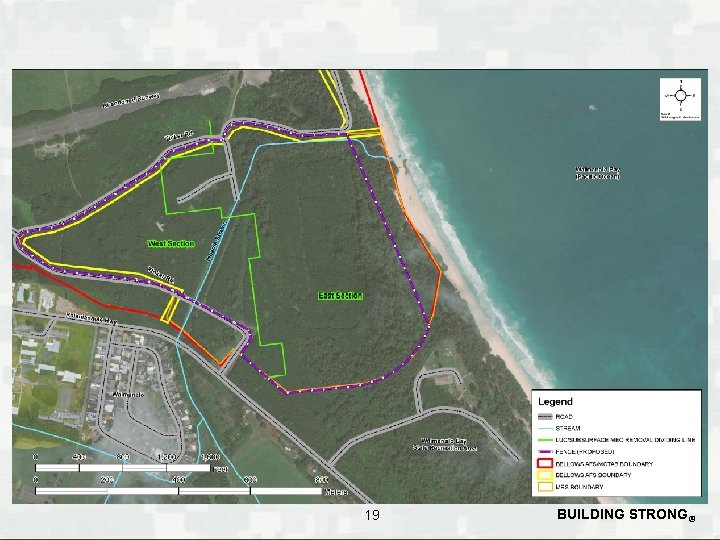
TM 001 Alternatives § Alternative 2 - Land Use Controls ► Alternative 2 is for the USAF/Do. D to implement institutional LUCs over the entire MRS TM 001. • Public information signs addressing the 3 Rs (Recognize, Retreat, Report) of explosives safety to be posted at public access points; • Public information brochures to be available to anyone entering the MRS; • Installation of 6 -ft chain link or 3 -5 strand wire fencing depending on location (using anomaly avoidance) around the perimeter of the MRS boundary. Generally, more visible areas will have the 3 -5 strand wire fence (e. g. , along roadways) and the less visible areas will have 6 -ft chain link placed. On the eastern boundary, the fence will be located approximately 400 ft inland from the water’s edge (See the previous map). Signage will also be installed to warn the public that unexploded ordnance may be present. Locked gates will be installed at access points; • Prohibition of metal detector use; • Annotation and use of geographic information systems to provide real-time tracking on sites covered by LUCs; • Annotate the areas covered by LUCs on Bellows AFS Installation and Development Plan; and • Use of a base-wide dig permit system for reviewing construction requests to ensure the integrity of areas covered by LUCs. • The total present-value cost to implement Alternative 2 is $2, 482, 123. 25 BUILDING STRONG®
TM 001 Alternatives cont. § Alternative 3 - Subsurface MEC Remedial Action (East Section) and LUCs ► Alternative 3 is for the Subsurface MEC Remedial Action in the East Section and LUCs throughout the site. This alternative was developed to create an area-specific remedial action plan within MRS TM 001 which includes the division of the MRS into two distinct areas: East Section and West Section. • The division would be based on the existing grids used in the OE Removal Action, where the western portion of the MRS contained significantly less MEC, MD and small arms debris as compared to the eastern section of the site. The East Section is approximately 87. 3 acres, while the West Section is approximately 51. 4 acres. This alternative includes vegetation clearance, geophysical surveys, intrusive investigations, and subsurface MEC removal up to 4 ft bgs in the East Section of the MRS. The same LUCs described in Alternative 2 would also be implemented in the East Section. For the West Section, only LUCs would be implemented. • The total present-value cost to implement Alternative 3 is $17, 846, 533. 26 BUILDING STRONG®
TM 001 Alternatives cont. § Alternative 4 - Site wide Subsurface MEC Remedial Action ► Alternative 4 is for the Site wide Subsurface MEC Remedial Action. • This alternative includes vegetation clearance, geophysical surveys, and an intrusive investigation across the entire 138. 7 acres of MRS TM 001. Subsurface removal of MEC would be performed to a removal depth of 4 ft bgs. Additionally, the same LUCs identified in Alternatives 2 and 3 would be retained to provide notice of any MEC that may remain below 4 ft bgs. • The total present-value cost to implement Alternative 4 is $22, 047, 818. 27 BUILDING STRONG®
Summary of Preferred Alternative TM 001 Based on the information presented in the FS Report and PP, Alternative 2 LUCs, is the most cost-effective alternative that meets the RAO by restricting access to subsurface MEC. Alternative 2 satisfies the NCP evaluation criteria and has the highest overall ranking when compared to the other three alternatives. 28 BUILDING STRONG®
Process for Submitting Comments § Comments provided by the public are valuable in helping the USAF select a final cleanup remedy for the site. § Comments must be postmarked by October 16, 2020. If you have questions about the comment period, please contact Todd Fitch at 907 -552 -3544. § To request an extension send a request in writing to Todd Fitch by October 16, 2020 5: 00 pm HST. § Those with access to email may submit their comments to the USAF at the following address: todd. fitch. 2@us. af. mil. 29 BUILDING STRONG®
Questions and/or Comments? Todd Fitch Remedial Project Manager AFCEC/CZOP 10471 20 th St Ste 348 JBER AK 99506 -2201 Cell 907 -347 -1822 todd. fitch. 2@us. af. mil 30 BUILDING STRONG®
- Slides: 30