
Belle of Amherst Emily Dickinson 1830 1886 Biographical
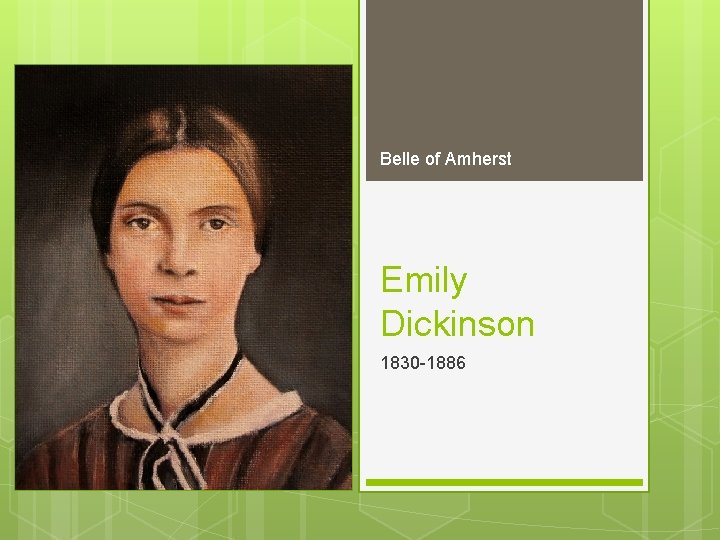
Belle of Amherst Emily Dickinson 1830 -1886
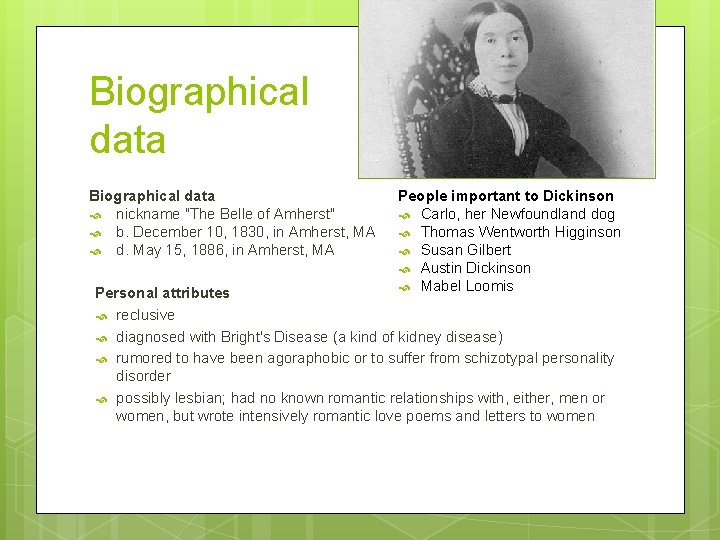
Biographical data nickname "The Belle of Amherst" b. December 10, 1830, in Amherst, MA d. May 15, 1886, in Amherst, MA People important to Dickinson Carlo, her Newfoundland dog Thomas Wentworth Higginson Susan Gilbert Austin Dickinson Mabel Loomis Personal attributes reclusive diagnosed with Bright's Disease (a kind of kidney disease) rumored to have been agoraphobic or to suffer from schizotypal personality disorder possibly lesbian; had no known romantic relationships with, either, men or women, but wrote intensively romantic love poems and letters to women
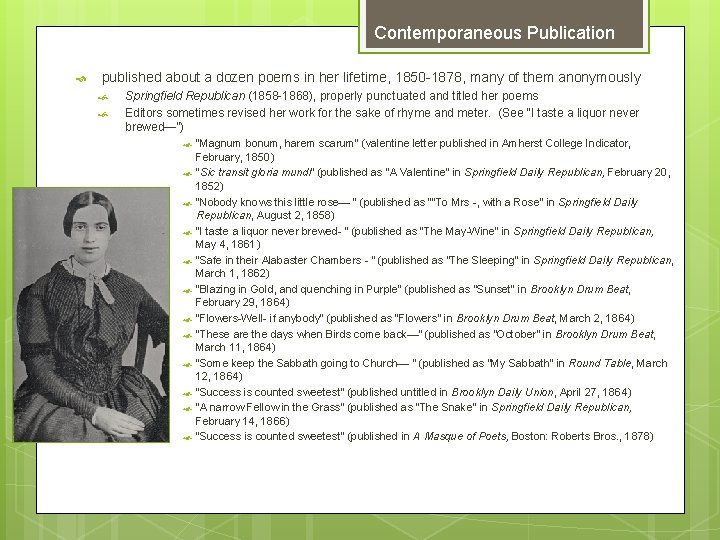
Contemporaneous Publication published about a dozen poems in her lifetime, 1850 -1878, many of them anonymously Springfield Republican (1858 -1868), properly punctuated and titled her poems Editors sometimes revised her work for the sake of rhyme and meter. (See “I taste a liquor never brewed—”) “Magnum bonum, harem scarum” (valentine letter published in Amherst College Indicator, February, 1850) “Sic transit gloria mundi” (published as “A Valentine” in Springfield Daily Republican, February 20, 1852) "Nobody knows this little rose— “ (published as ““To Mrs -, with a Rose” in Springfield Daily Republican, August 2, 1858) “I taste a liquor never brewed- ” (published as “The May-Wine” in Springfield Daily Republican, May 4, 1861) "Safe in their Alabaster Chambers - ” (published as “The Sleeping” in Springfield Daily Republican, March 1, 1862) "Blazing in Gold, and quenching in Purple” (published as “Sunset” in Brooklyn Drum Beat, February 29, 1864) "Flowers-Well- if anybody” (published as “Flowers” in Brooklyn Drum Beat, March 2, 1864) "These are the days when Birds come back—” (published as “October” in Brooklyn Drum Beat, March 11, 1864) "Some keep the Sabbath going to Church— ” (published as “My Sabbath” in Round Table, March 12, 1864) “Success is counted sweetest” (published untitled in Brooklyn Daily Union, April 27, 1864) "A narrow Fellow in the Grass” (published as “The Snake” in Springfield Daily Republican, February 14, 1866) "Success is counted sweetest” (published in A Masque of Poets, Boston: Roberts Bros. , 1878)
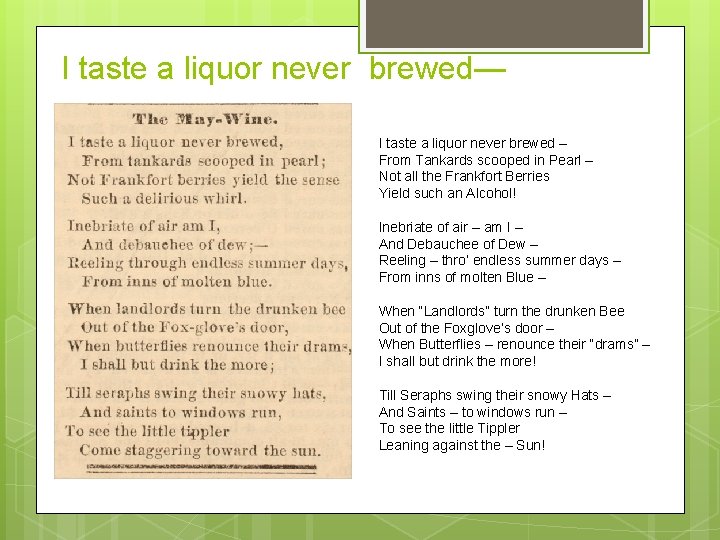
I taste a liquor never brewed— I taste a liquor never brewed – From Tankards scooped in Pearl – Not all the Frankfort Berries Yield such an Alcohol! Inebriate of air – am I – And Debauchee of Dew – Reeling – thro’ endless summer days – From inns of molten Blue – When “Landlords” turn the drunken Bee Out of the Foxglove’s door – When Butterflies – renounce their “drams” – I shall but drink the more! Till Seraphs swing their snowy Hats – And Saints – to windows run – To see the little Tippler Leaning against the – Sun!
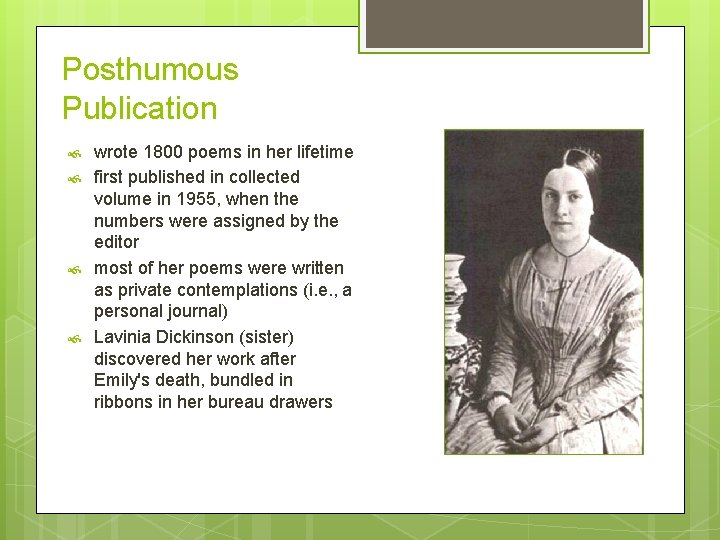
Posthumous Publication wrote 1800 poems in her lifetime first published in collected volume in 1955, when the numbers were assigned by the editor most of her poems were written as private contemplations (i. e. , a personal journal) Lavinia Dickinson (sister) discovered her work after Emily's death, bundled in ribbons in her bureau drawers
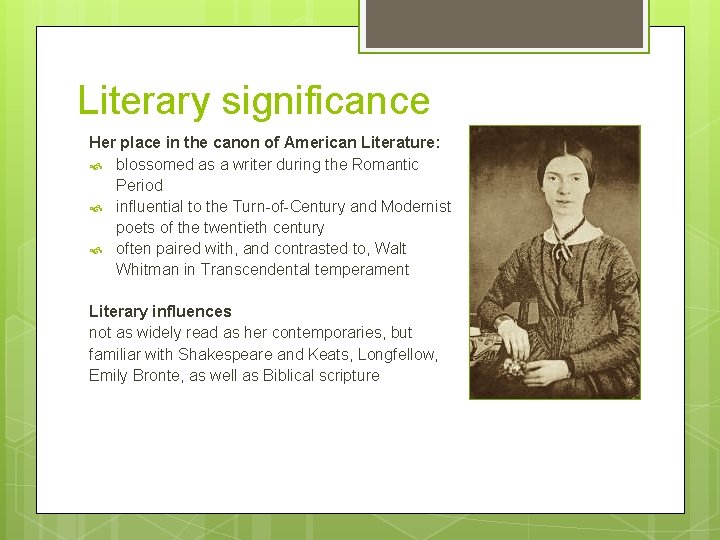
Literary significance Her place in the canon of American Literature: blossomed as a writer during the Romantic Period influential to the Turn-of-Century and Modernist poets of the twentieth century often paired with, and contrasted to, Walt Whitman in Transcendental temperament Literary influences not as widely read as her contemporaries, but familiar with Shakespeare and Keats, Longfellow, Emily Bronte, as well as Biblical scripture
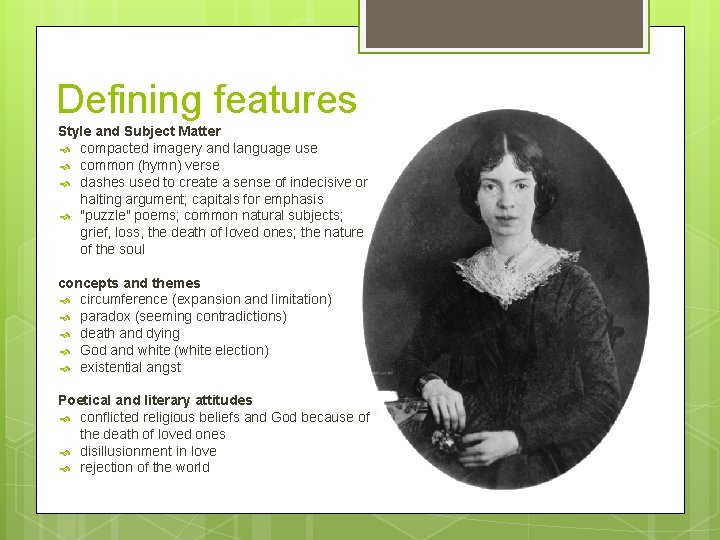
Defining features Style and Subject Matter compacted imagery and language use common (hymn) verse dashes used to create a sense of indecisive or halting argument; capitals for emphasis "puzzle" poems; common natural subjects; grief, loss, the death of loved ones; the nature of the soul concepts and themes circumference (expansion and limitation) paradox (seeming contradictions) death and dying God and white (white election) existential angst Poetical and literary attitudes conflicted religious beliefs and God because of the death of loved ones disillusionment in love rejection of the world
- Slides: 7