
Bell Work UNIT 4 Polynomial and Rational Functions
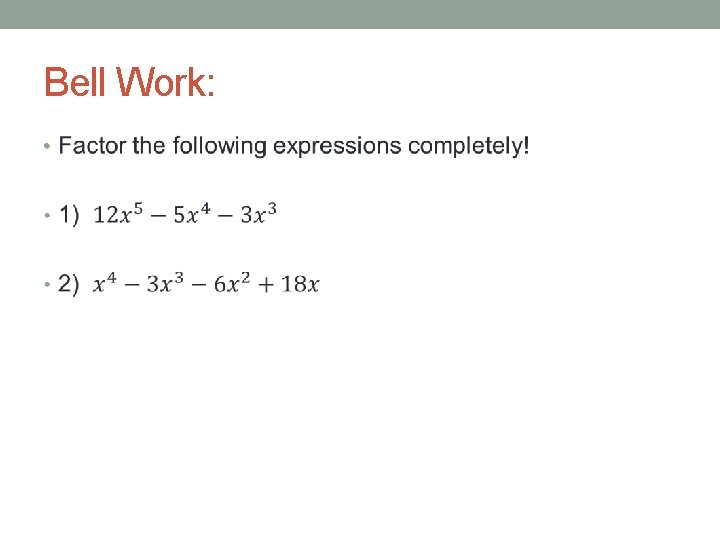
Bell Work: •
UNIT 4 Polynomial and Rational Functions
LESSON 4. 1 Polynomial Functions with Degree Greater Than 2
Degree of a Polynomial • The degree of a polynomial is the highest order exponent that the function has. • The functions we will be looking at in this lesson have a degree that is greater than two, which means the functions will not be linear or quadratic.
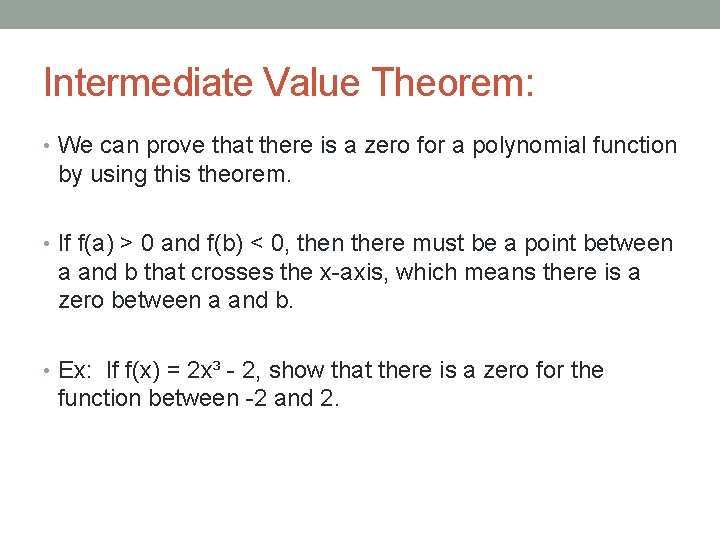
Intermediate Value Theorem: • We can prove that there is a zero for a polynomial function by using this theorem. • If f(a) > 0 and f(b) < 0, then there must be a point between a and b that crosses the x-axis, which means there is a zero between a and b. • Ex: If f(x) = 2 x³ - 2, show that there is a zero for the function between -2 and 2.
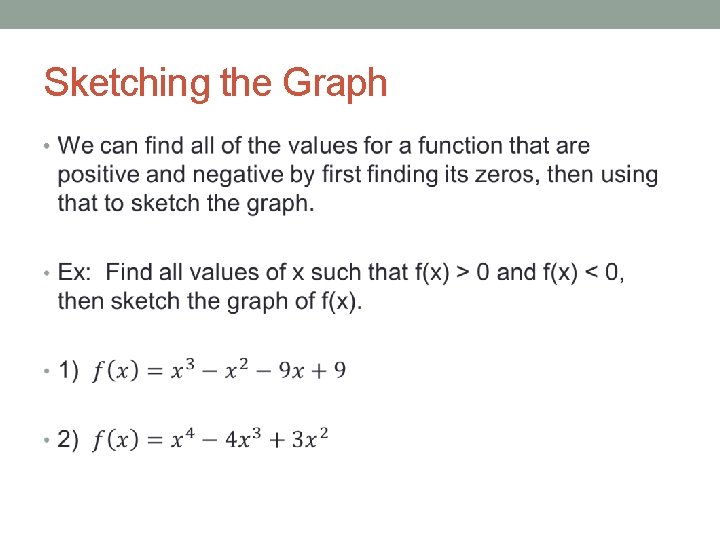
Sketching the Graph •
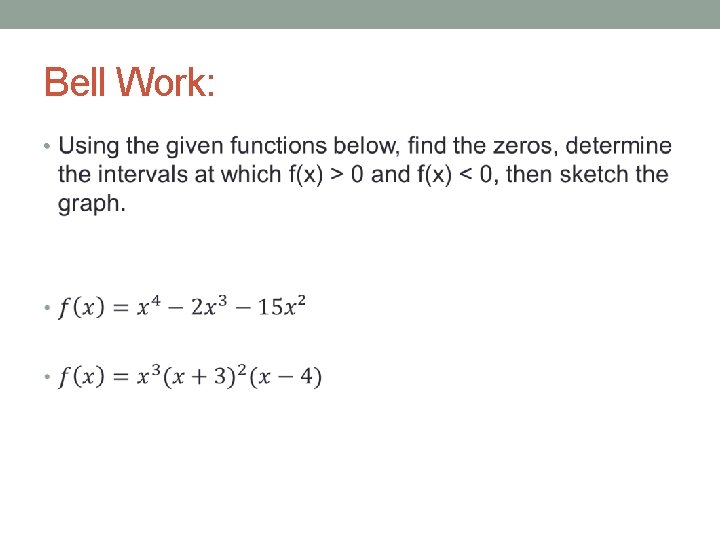
Bell Work: •
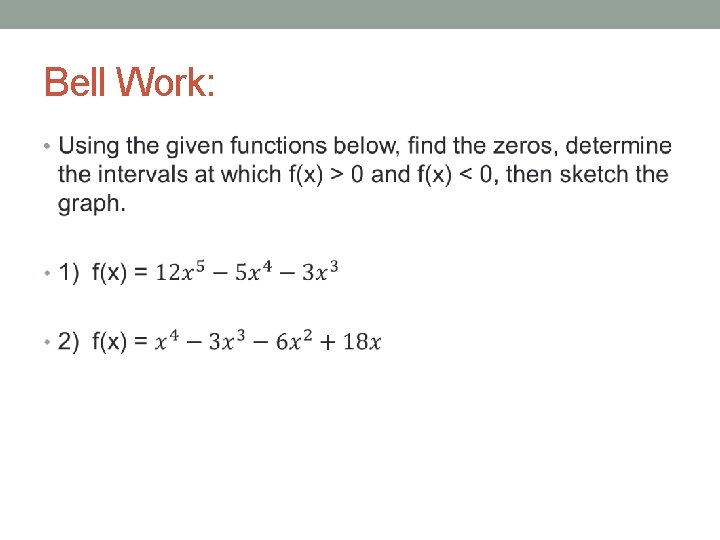
Bell Work: •
Class Work: • Pages 269 -271 #’s 33, 35, 39, 41
Homework: • Pages 269 -271 #’s 5 -9 odds, 17 -27 odds, 34, 36, 43
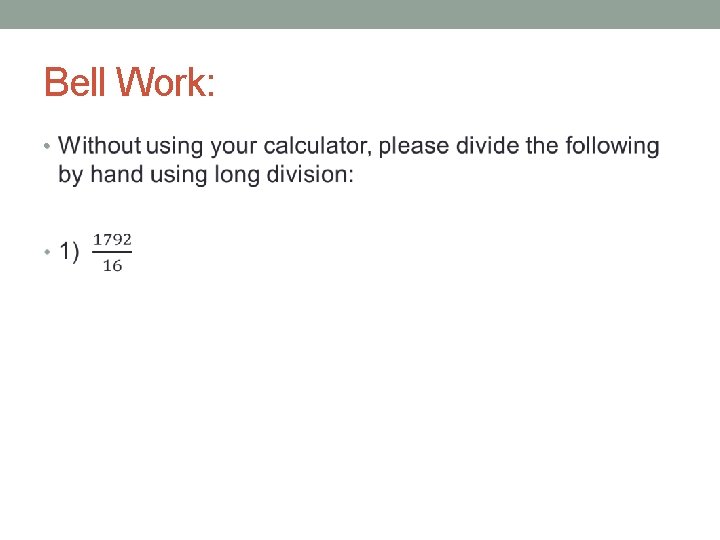
Bell Work: •
LESSON 4. 2 Dividing Polynomials
LESSON ESSENTIAL QUESTION • What are the different properties of division pertaining to polynomials and how are the used?
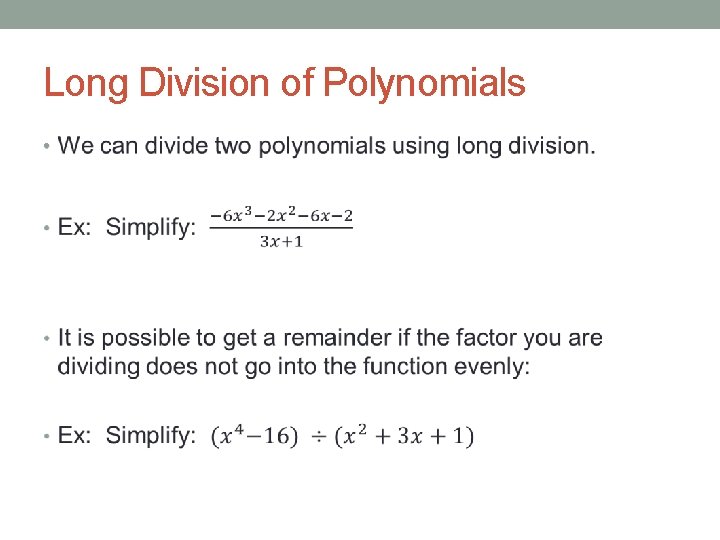
Long Division of Polynomials •
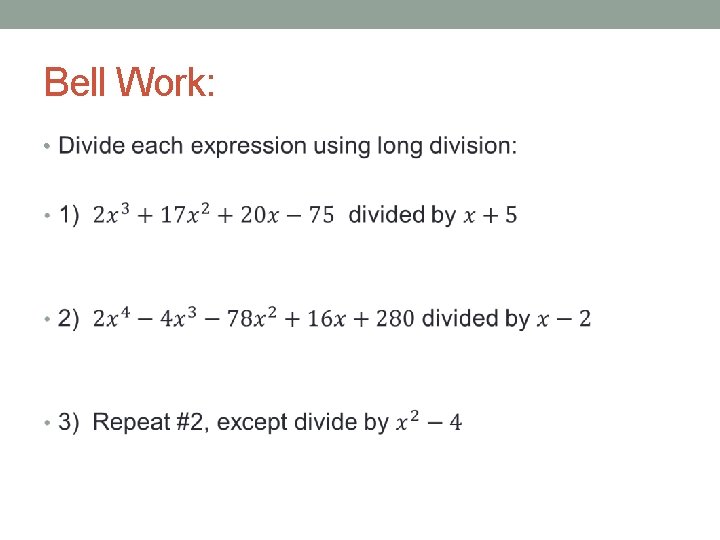
Bell Work: •
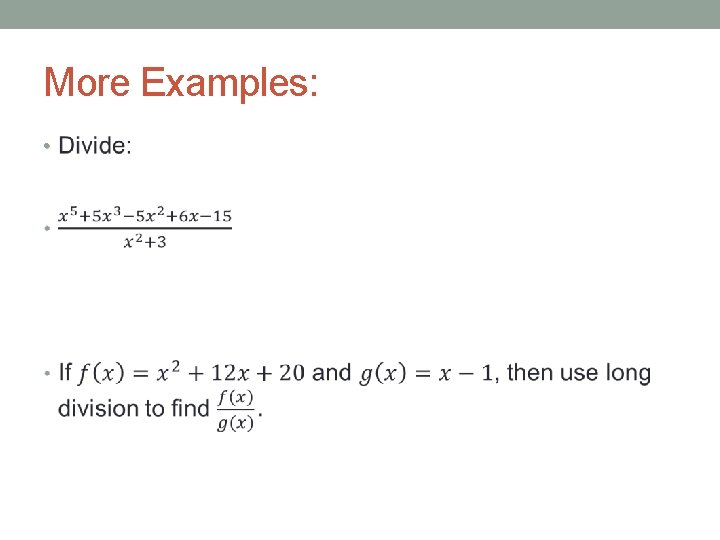
More Examples: •
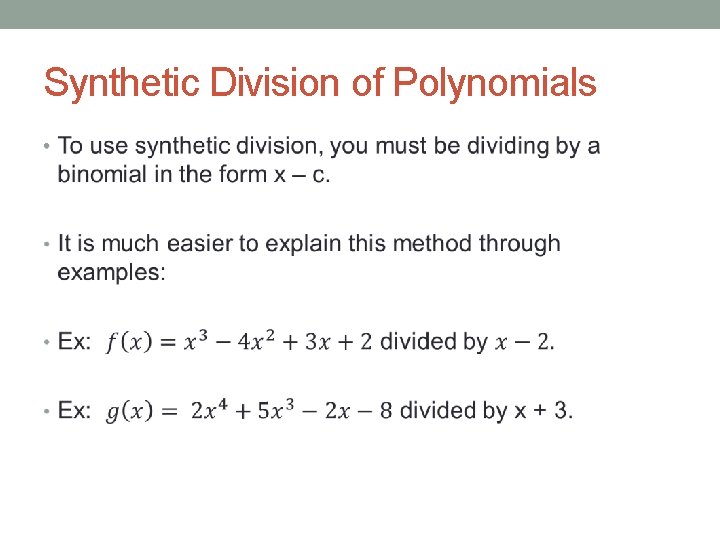
Synthetic Division of Polynomials •
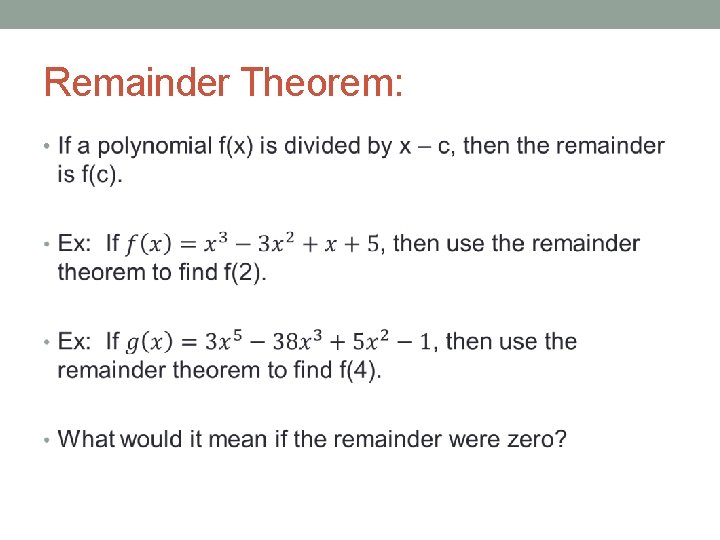
Remainder Theorem: •
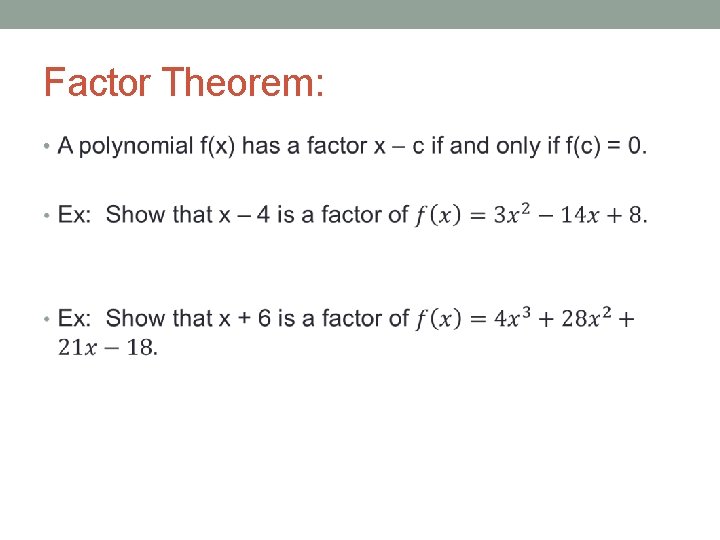
Factor Theorem: •
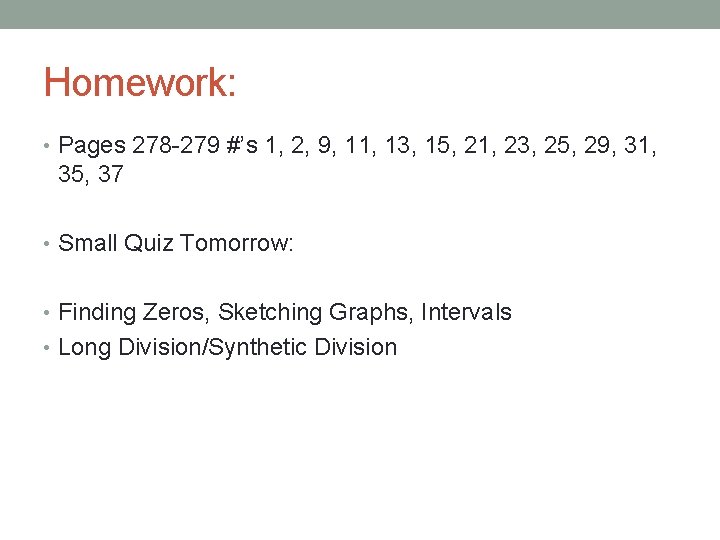
Homework: • Pages 278 -279 #’s 1, 2, 9, 11, 13, 15, 21, 23, 25, 29, 31, 35, 37 • Small Quiz Tomorrow: • Finding Zeros, Sketching Graphs, Intervals • Long Division/Synthetic Division
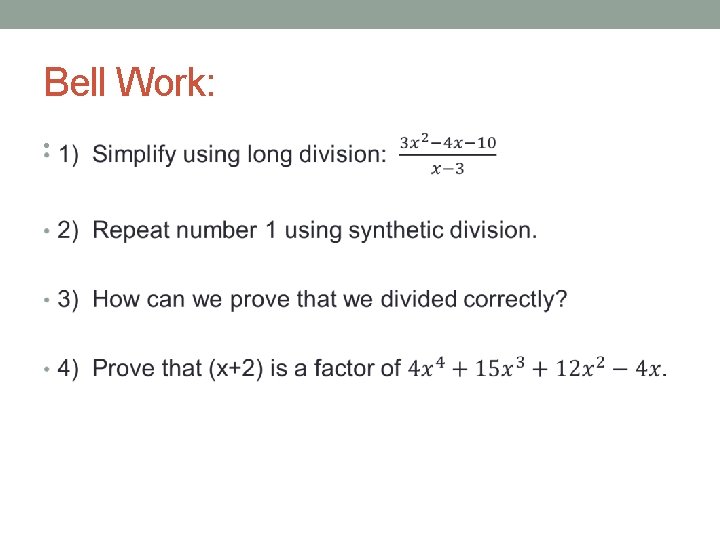
Bell Work: •
Class Work/Homework: • Pages 278 -279 #’s 10, 12, 14, 16, 22, 24, 26, 28, 30, 36
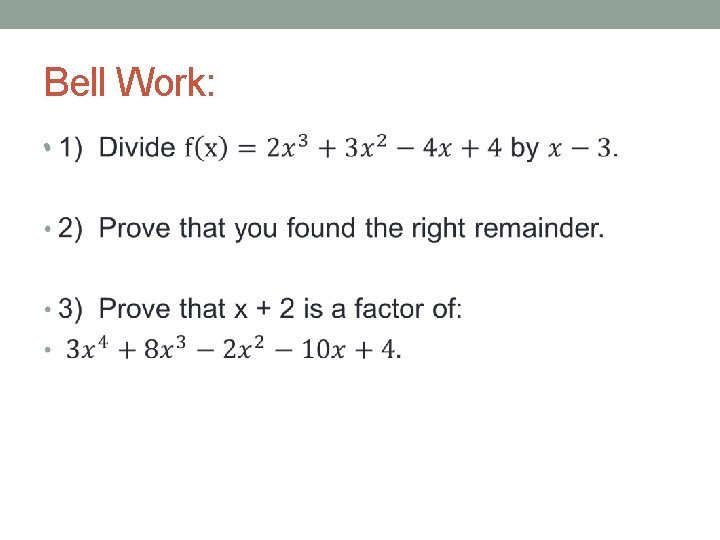
Bell Work: •
LESSON 4. 3 Zeros of Polynomials
LESSON ESSENTIAL QUESTION • How do we find the total number of zeros for a function, and how do we determine the number of real/imaginary, positive/negative, rational/irrational zeros?
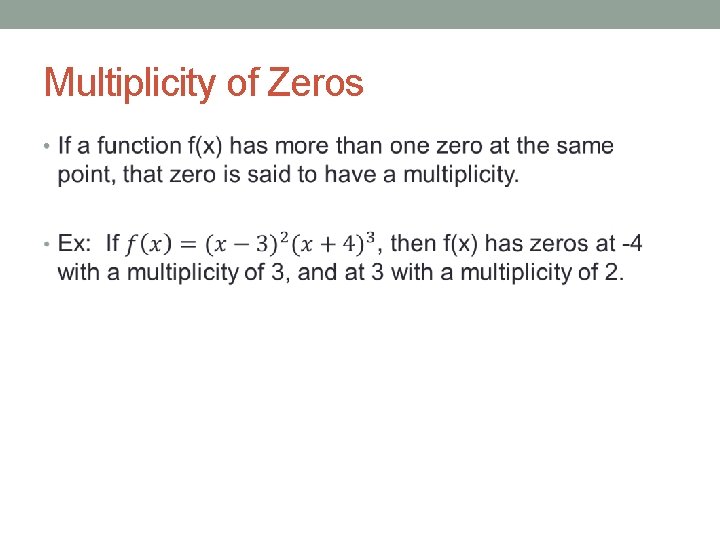
Multiplicity of Zeros •
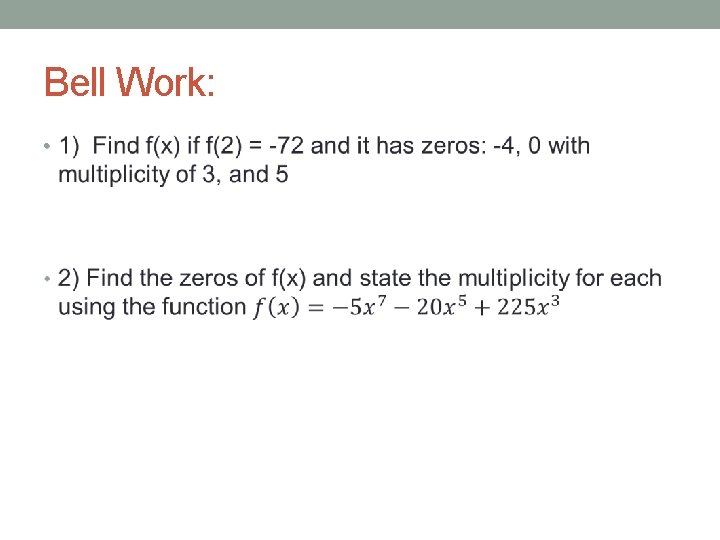
Finding the Polynomial • We can find a polynomial f(x) if we know its zeros and one other point on the function. • Ex: Find f(x) if f(-4) = -504 and it has zeros: -1 with multiplicity of 2, 3, 4 • Ex: Find f(x) if f(5) = 68 and it has zeros: ± 3 i, 0, 3
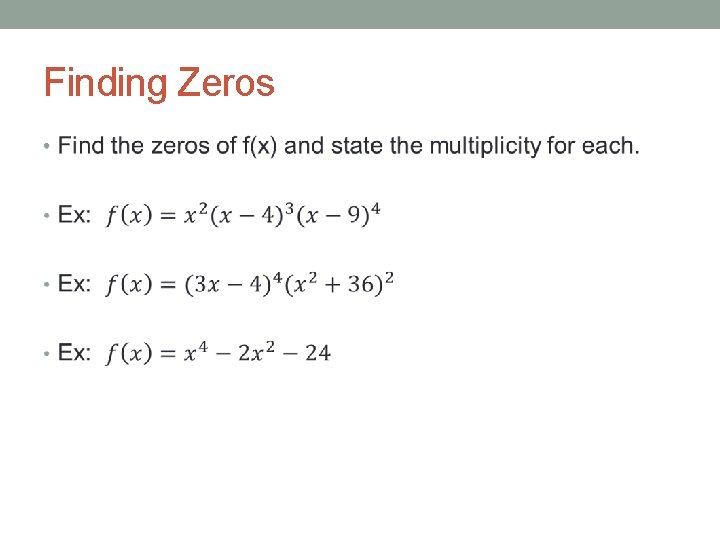
Finding Zeros •
Homework: • Pages 291 -293 #’s 1 – 25 odds
Bell Work: •

Classwork/Homework: • Pages 291 -293 #’s 2, 6, 10, 12, 14, 16, 18, 22, 24 • This assignment will be collected tomorrow at the beginning of class!!!
Bell Work: • Warning, the lesson you are about to learn is off the heezy fo sheezy…viewer discretion may be advised.
LESSON 4. 4 Complex and Rational Zeros of Polynomials
Lesson Essential Question: • How do we determine the rational and complex solutions to a polynomial function?
Find the function knowing the zeros… • Example: Find a polynomial function f(x) of degree 4 that has zeros of (2 + i) and (-3 i) that has a leading coefficient of 1. • Example: Find a polynomial function f(x) of degree 5 that has zeros of (2), (5 i) and (2 + 3 i) that has a leading coefficient of 1.
Dear 4 th Period Pre-Calculus Class, • I would like to apologize for a mistake that I made yesterday. I incorrectly typed the notes into the Power. Point slide which caused confusion at the end of class. I hope that some day you all can forgive me for this horrific and tragic error that I have made. I know it is hard to understand because you all see me as a superhuman math machine, but like all superheroes, I have flaws. Am I implying I am a superhero? I guess so. Anyway, back to the point. I sincerely apologize and beg for your forgiveness. • Sincerely, • Mr. Kelsey (aka Math Man aka The Fabulous Factorer)
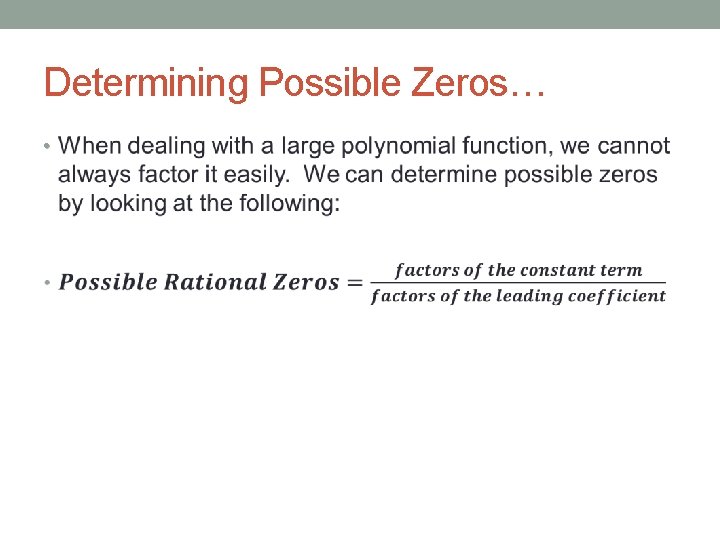
Determining Possible Zeros… •
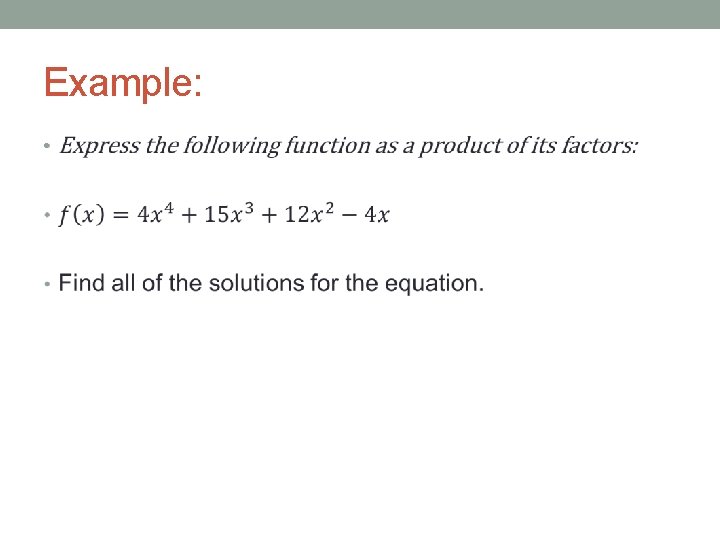
Example: •
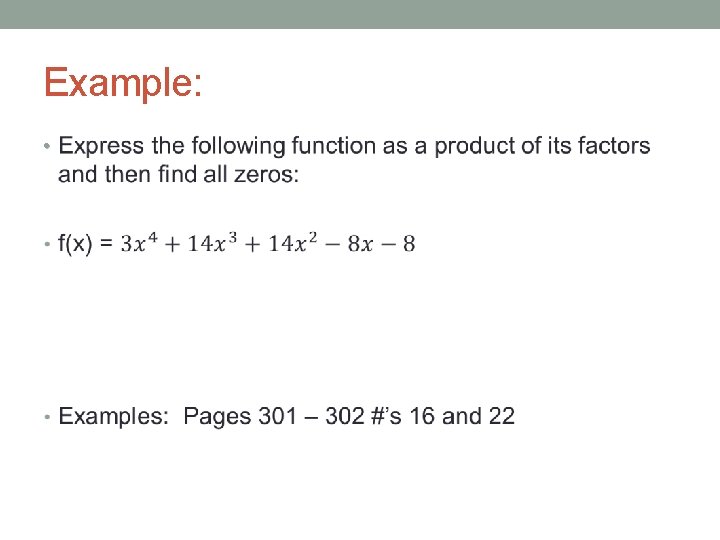
Example: •
Homework: • Pages 301 – 302 #’s 1, 5, 9, 15, 17, 19, 23
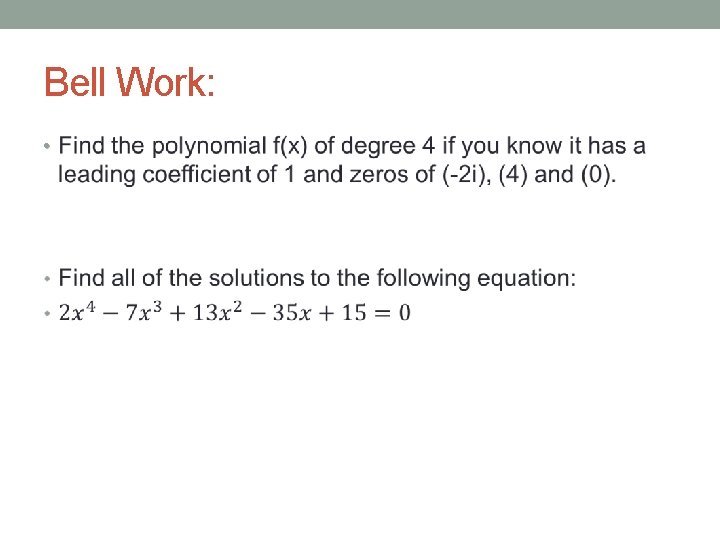
Bell Work: •

Classwork/Homework: • Pages 301 – 302 #’s 2, 6, 10, 18, 20, 24 • This will be collected tomorrow!!!
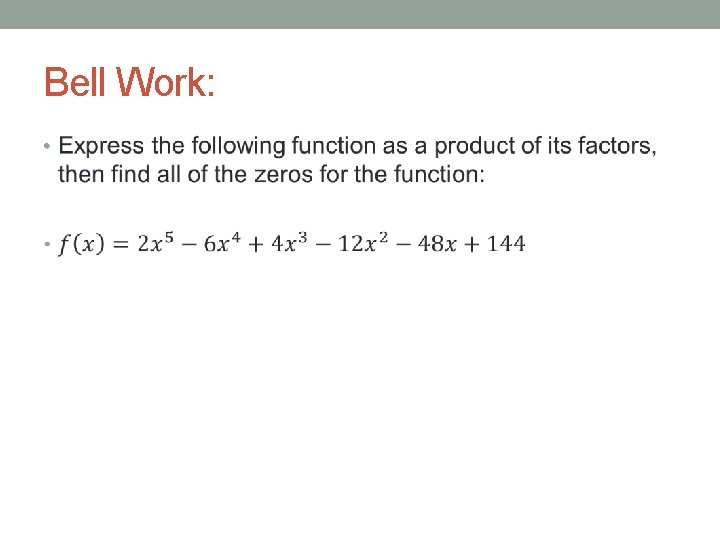
Bell Work: •
Bell Work: • Warning: The lesson you are about to witness is off the hook, which can be extremely dangerous and not appropriate for all audiences. Viewers discretion may be advised.
LESSON 4. 5 Behaviors of Rational Functions
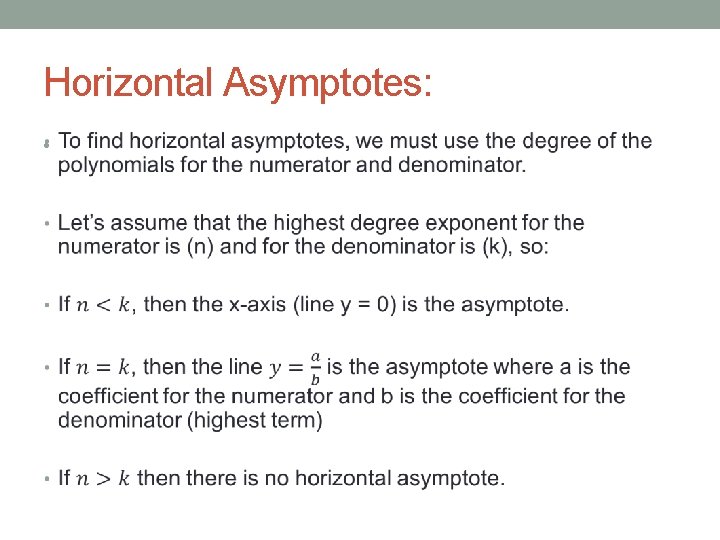
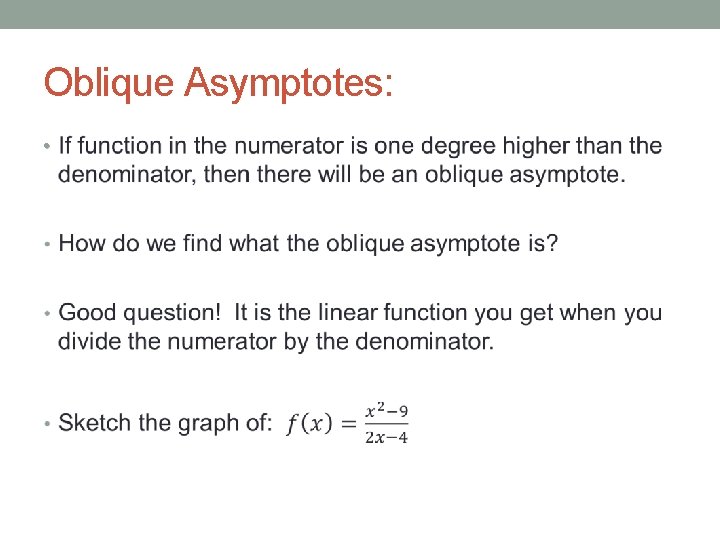
Lesson Essential Question: • How do we determine the horizontal, vertical, and oblique asymptotes for a rational function, and the behavior about those asymptotes?
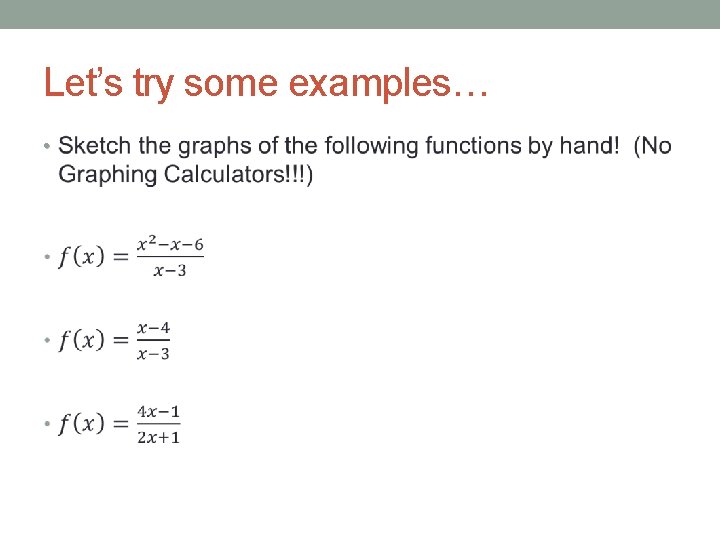
Let’s try some examples… •
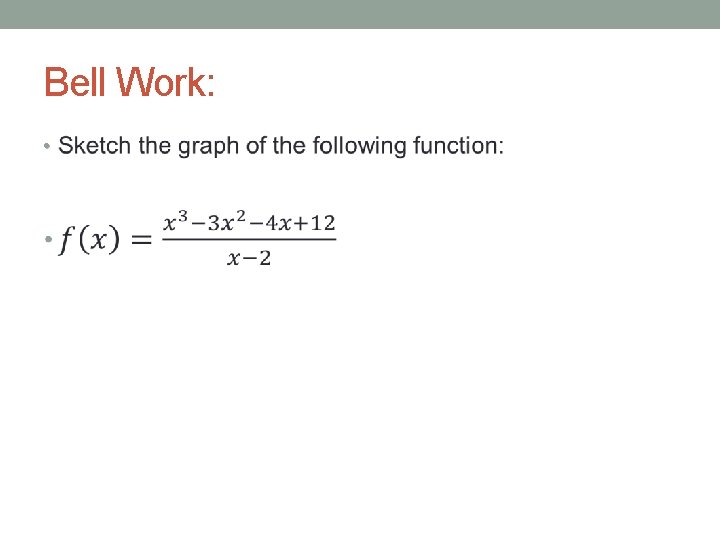
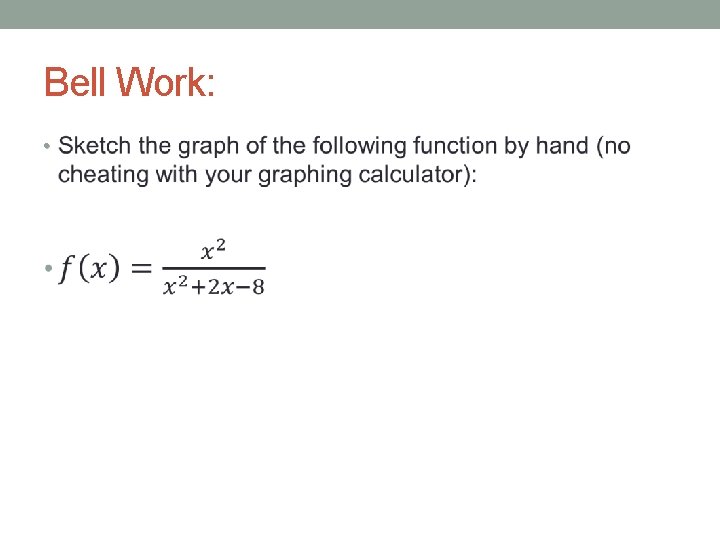
Bell Work: •
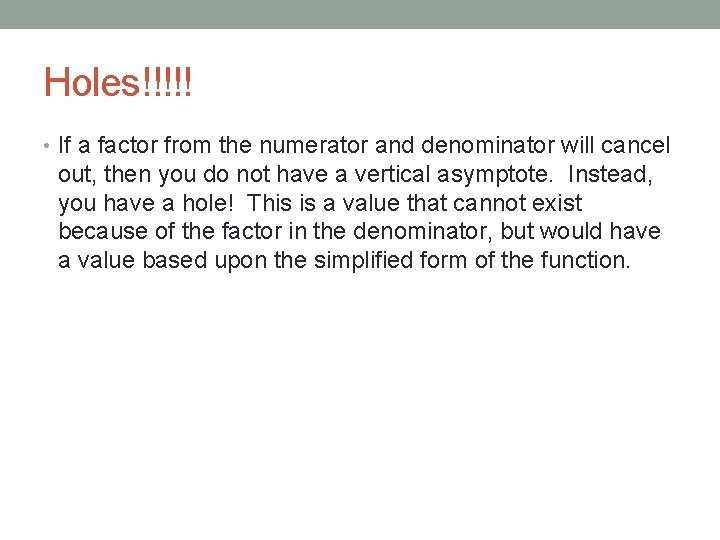
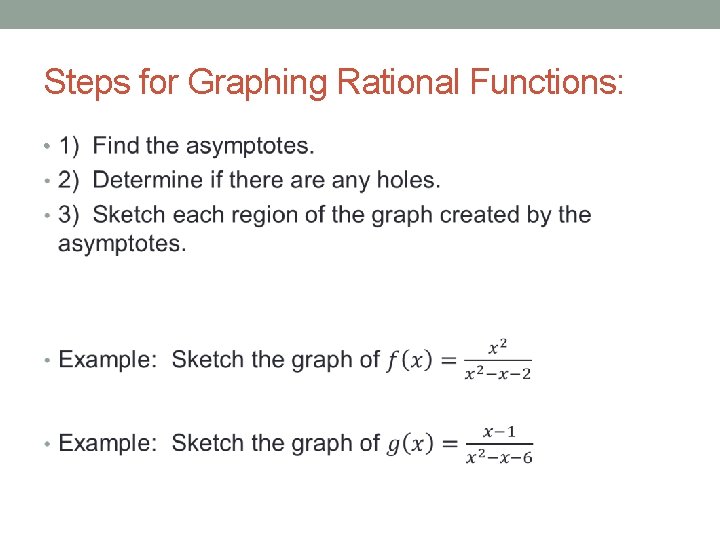
Holes!!!!! • If a factor from the numerator and denominator will cancel out, then you do not have a vertical asymptote. Instead, you have a hole! This is a value that cannot exist because of the factor in the denominator, but would have a value based upon the simplified form of the function.
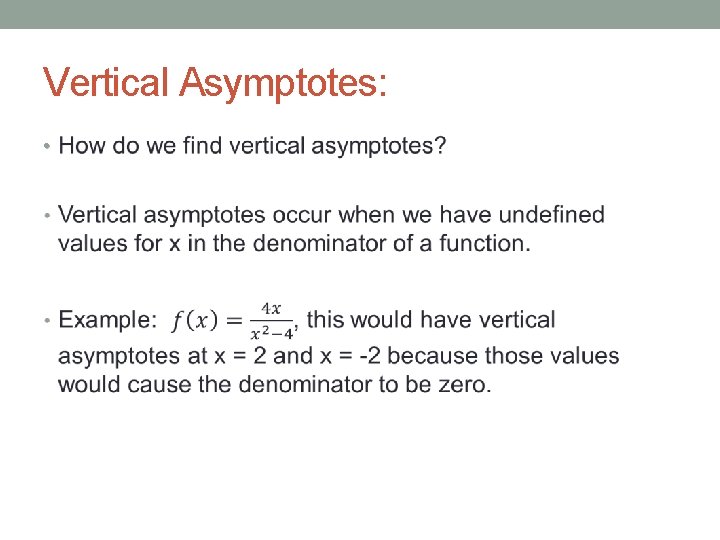
Vertical Asymptotes: •
Horizontal Asymptotes: •
Bell Work: •
Oblique Asymptotes: •
Steps for Graphing Rational Functions: •
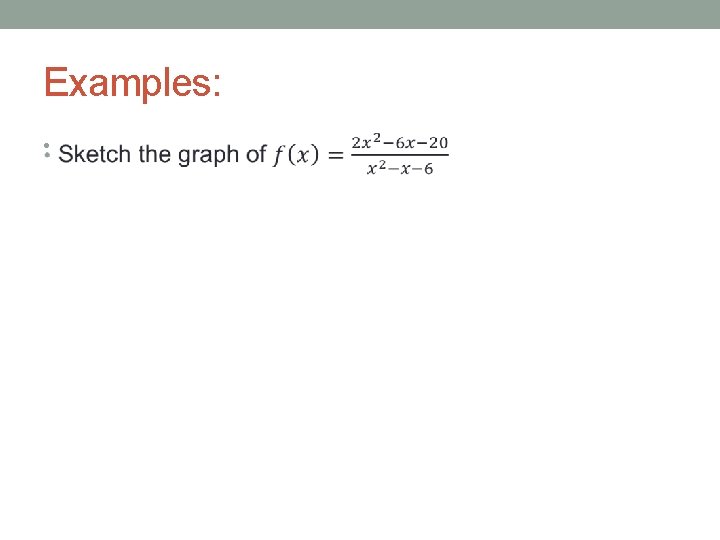
Examples: •
Homework: • Pages 318 – 319 #’s 7, 9, 15, 17, 21, 25, 29, 33
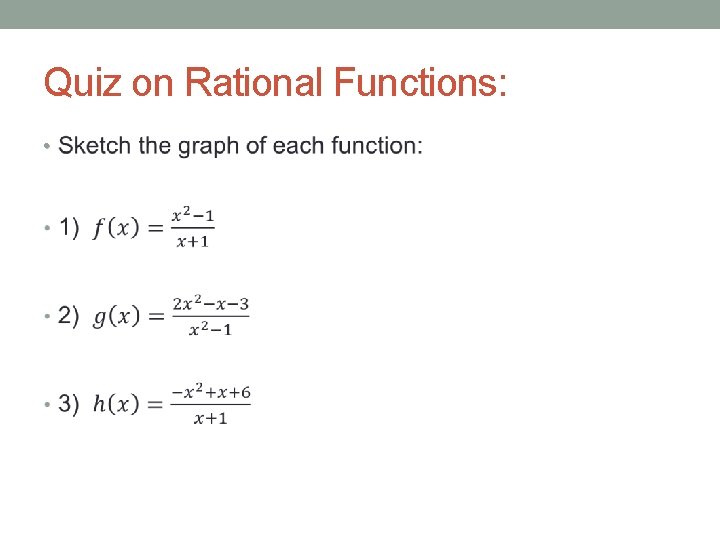
Quiz on Rational Functions: •
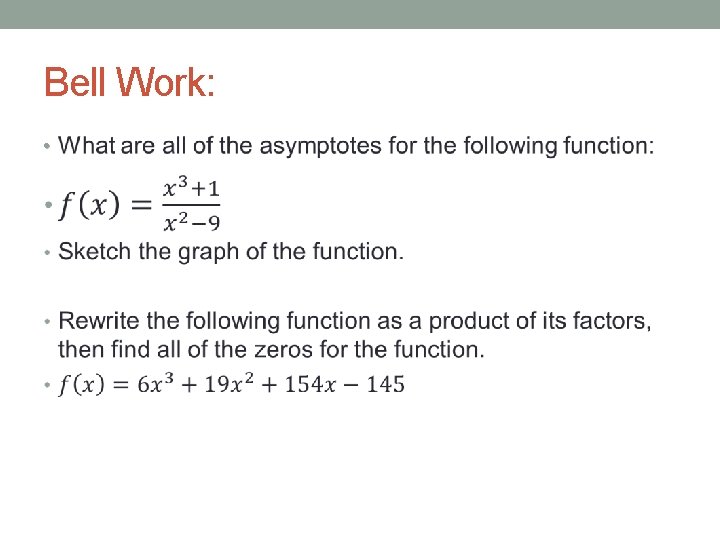
Bell Work: •
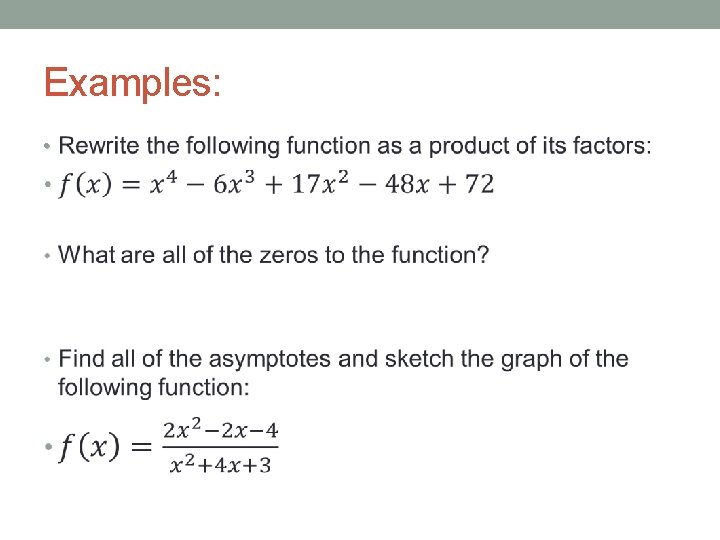
Examples: •
Unit 4 Test Upcoming! • The Test will be on: • Sketching Polynomial Functions Using its Zeros • Find Intervals in which f(x) is positive or negative • Division of Polynomials (Long and Synthetic) • Remainder and Factor Theorem • Finding Zeros of Polynomials (Real, Complex, Irrational) • Find the Polynomial based upon its zeros and an additional point • Sketching graphs of Rational Functions
Class Work: • Pages 321 -322 • #’s 3 -6, 10 -13, 15 -20, 24 – 27, 29, 31, 33, 35
- Slides: 61