
Bell Work Analyze cartoon What is a Juvenile
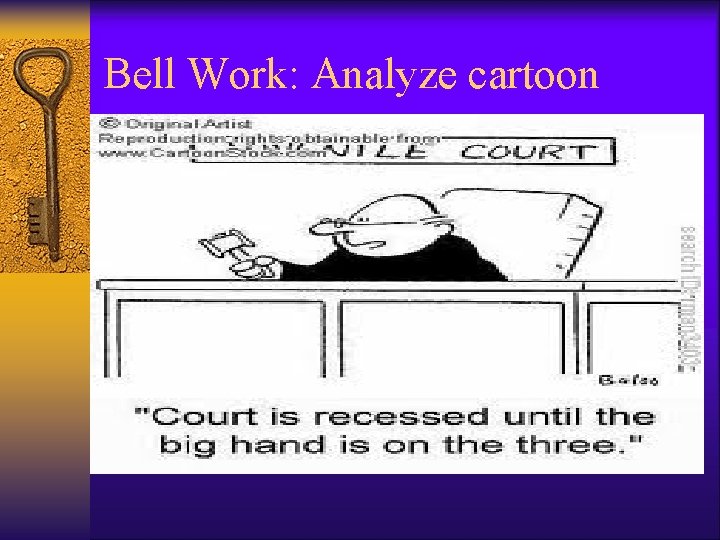
Bell Work: Analyze cartoon
What is a Juvenile offender? ¨ An offender who is too young to be tried as an adult. The age varies between states. ¨ What happens in Juvenile court? ¨ When a juvenile is charged with a criminal offense and is sent to JC, the focus is on what will rehabilitate the juvenile, rather than on punishment.
If a juvenile is convicted in adult court, will he be sentenced as an adult? ¨ This depends on state law, and can vary significantly depending upon such factors as subsequent criminal activity or the type of crime committed. ¨ If a juvenile is convicted of certain sex offenses, he may be required to register as a sex offender for the rest of his life.
¨ In some states which automatically seal a juvenile’s record once he passes a certain age, that record may remain unsealed if the defendant is convicted of an adult offense before he reaches that age. ¨ In some states, a person must petition a court to seal a juvenile record shortly after reaching age of majority, or the record will remain public.
The History of our Juvenile system Houses of Refuge In the late 18 th and early 19 th century, courts punished and confined youth in jails and penitentiaries. Since few other options existed, youth of all ages and genders were often indiscriminately confined with hardened adult criminals and the mentally ill in large overcrowded and decrepit penal institutions. Many of these youth were confined for noncriminal behavior simply because there were no other options. At the same time, American cities were confronting high rates of child poverty and neglect putting pressure on city leaders to fashion a solution to this emerging social issue.
¨ In response, reformers Thomas Eddy and John Griscom, organized the Society for the Prevention of Pauperism, to oppose housing youth in adult jails and prisons and urge the creation of a new type of institution. Their work led to the establishment of the New York House of Refuge in 1825, the first institution designed to house poor, destitute and vagrant youth who were deemed by authorities to be on the path towards delinquency.
Houses of Refuge ¨ The New York House of Refuge became the first movement in what was to later become the juvenile justice system. Within three years of its opening, similar institutions were opened in Boston and Philadelphia. By the 1840 s, approximately 25 more facilities were constructed throughout the country. ¨ Houses of Refuge were large fortress-like institutions located in urban areas for youth designated as abandoned, delinquent or incorrigible. The average number of youth in a house of refuge was 200, but some, like the New York House of Refuge, housed over 1, 000 youth.
Reform, Training or Industrial Schools ¨ Houses of Refuge quickly confronted the same issues that plagued adult jail and prisons – overcrowding, deteriorating conditions, and staff abuse. In addition, with the emerging public school movement and compulsory education, social reformers began arguing for a new type of institution that placed greater emphasis on education. Through this movement the reform school, also called training and industrial schools, became an indelible part of America’s juvenile justice system. Today, reform schools are typically called youth correctional institutions and continue to follow a classic institutional model concentrating large number of youth in highly regimented, penitentiary-like institutions.

Juvenile Courts ¨Individuals under the age of 18 are generally not subject to the justice of the courts in which adults are tried.
Juvenile Justice ¨ The System is designed to address the special needs and problems of young people. It’s intention is to intervene early in delinquent behavior and act to prevent adolescents from engaging in criminal behavior as adults. ¨ Generally emphasizes rehabilitation over punishment.
¨ Juvenile crimes are crimes committed by individuals under the age of eighteen. Juvenile offenders, also known as juvenile delinquents, are the fastest growing group of criminals in the United States. Millions of dollars are spent each year on costs associated with punishing and rehabilitating juvenile offenders. Many attribute the rise in juvenile crime to the increased availability of street drugs, growing levels of poverty, and inadequate prevention and intervention programs in schools.
In Re Gault (1967) ¨ Gerald Gault(15) was assigned to six years in a state juvenile detention facility for an alleged obscene phone call. ¨ As a class we will read the court case I’ve passed out to you.
Rights denied 1. Right to receive notice of the charges 2. The right to counsel 3. Right to confrontation and cross-examination 4. Privilege against selfincrimination
Rights denied 5. The right to a transcript of the proceedings 6. The right to appellate review.
Miranda Rights (mandated in 1966) The person arrested or held in custody must be notified that they have the following Miranda rights: ¨ You have the right to remain silent. ¨ Anything you say can and will be used against you in a court of ¨ ¨ law. You have the right to the presence of an attorney to assist you prior to questioning and to be with you during questioning , if you desire. If you cannot afford an attorney, you have the right to have an attorney appointed for you prior to questioning. Do you understand these rights? Now having been advised of these rights and understanding these rights, will you answer my questions?

Juvenile Miranda Rights ¨ You have the right to remain silent. ¨ Anything you say can and will be used against you in a court of ¨ ¨ ¨ law. You have the right to the presence of your parent or guardian as well as an attorney to assist you prior to questioning and to be with you during questioning , if you desire. If you cannot afford an attorney, you have the right to have an attorney appointed for you prior to questioning. There is a possibility that the juvenile court will waive its jurisdiction over you and you will be tried as an adult. Do you understand these rights? Now having been advised of these rights and understanding these rights, will you answer my questions?
¨ In the late 1990 s Americans faced growing concern over highly publicized and violent juvenile crime. A series of school shootings (34 shooting events, Columbine High School massacre 4/20/99, being the worst) and other horrendous offenses caused the public to fear a new breed of "juvenile superpredators, " defined as"juveniles for whom violence was a way of life - new delinquents unlike youth of past generations. " ¨ The result is significant changes to the United State's approach to juvenile crime
¨ The Columbine shooting resulted in an increased emphasis on school security, and a moral panic aimed at goth culture, social outcasts, gun culture, the use of pharmaceutical anti-depressants by teenagers, teenage Internet use and violent video games.
Child’s play? ¨ Under certain circumstances (like murder) juvenile courts refer certain offenders to an adult criminal court for trial. In all but four states, (Mass. Nebraska, New Mexico, and New York) juvenile court judges have the power to assign cases to adult courts.
Criteria for Adult Court ¨ Twenty-one states and the District of Columbia have no minimum age requirements for transferring juveniles to criminal court. Among the remaining 29 states, minimum age requirements range from seven to 16.
¨ 31 states now have “once and adult/always an adult” provisions. This means if a juvenile has been tried as an adult one time he/she is automatically prosecuted as an adult for later offenses.
Trial by Jury: 6 th amendment ¨ In all criminal prosecutions, the accused shall enjoy the right to a speedy and public trial, by an impartial jury of the State and district wherein the crime shall have been committed, which district shall have been previously ascertained by law, and to be informed of the nature and cause of the accusation; to be confronted with the witnesses against him; to have compulsory process for obtaining witnesses in his favor, and to have the Assistance of Counsel for his defense. ¨ This refers to adults not juveniles. Juveniles do NOT have the right to trial by jury. This is why the cases may be waived to an adult court.
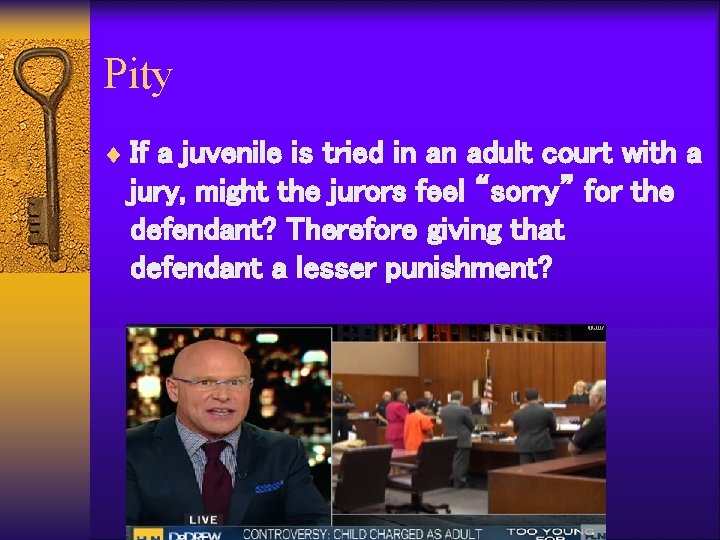
Pity ¨ If a juvenile is tried in an adult court with a jury, might the jurors feel “sorry” for the defendant? Therefore giving that defendant a lesser punishment?
Youth Violence: Why Are Kids Killing? Coincidence—or Scary Trend ¨ Kids today lack meaningful connections to the community – while rural life was once filled with chores and responsibilities, now kids are left alone with TV and video games – an unsupervised emptiness that can have dangerous results.
Supreme Court Decision 2012 ¨ A juvenile cannot be sentenced to a life term without the possibility of parole , no matter what the crime was. ¨ Justice Elena Kagan said it would be wrong for states to ignore the chance that these now-adult inmates may someday be rehabilitated. ¨ "The mandatory sentencing schemes before us violate this principle of proportionality, and so violate the Eighth Amendment's ban on cruel and unusual punishment, " Kagan said.
The cases the USSC looked at ¨ First case: Alabama boy (14 yrs old), with an accomplice, robbed a neighbor and then beat the man to death and set his house on fire. ¨ Facts: 14 -year-old boy holding a baseball bat stood over a man he had robbed and repeatedly beaten, telling him, "I am God. I've come to take your life. " ¨ After hitting the man in the head a final time with the bat, the 14 -year-old and a friend set the man's trailer on fire. Despite the beating, Cole Cannon was still alive and conscious. He managed to ask, "Why are y'all doing this to me? " Then he was burned alive.
Miller v. Alabama ¨ The boy, Evan Miller, was sentenced to life in prison without parole, even though he was just 14 when he committed the crime. His friend, 16 at the time of the crime, was allowed to plead guilty to felony murder in exchange for testimony, and sentenced to life with a chance of parole.
Jackson v. Hobbs ¨ Second case an Arkansas youth who was part of a group of teens who robbed a video store where the clerk was blasted to death with a shotgun. ¨ He too was tried and convicted as an adult and received the minimum sentences allowed under state law for felony capital murder.
¨ What do you do when human beings who are "works in progress" commit acts that are "unspeakably sad"?
¨ About 2, 500 prisoners are serving life sentences without parole for crimes committed as juveniles, at least 79 of whom were 14 years or younger at the time.
¨ Attorney Bryan Stevenson had urged the justices not to "give up" on child offenders, who he said are fundamentally different from adults. He said that while they must be held accountable for their actions, youths are also works in progress, emotionally and developmentally.
¨ Two recent large-scale studies indicate that juveniles who receive harsher penalties when tried as adults are not "scared straight. " In fact, after their release, they tend to reoffend sooner and more often than those treated in the juvenile system. ¨ The % of juveniles that reoffend is over 50%.
¨ There an estimated 250, 000 youth who are tried, sentenced or incarcerated as adults each year. Crime rates in the U. S. have gone down, but our prison populations have steadily climbed.
Youth incarcerated in adult facilities are more likely to suffer physical and emotional abuse and to end up back in prison– realities that are at odds with the goal of rehabilitating youth and protecting public safety: ¨ Studies have found that young people transferred to the adult criminal justice system have approximately 34% more rearrests for felony crimes than youth retained in the youth justice system. Around 80% of youth released from adult prisons reoffend often going on to commit more serious crimes.
¨ Studies show that youth in adult prisons are twice as likely to report being beaten by staff, and nearly 50% more likely to be attacked with a weapon than children placed in youth facilities. ¨ Youth in adult prisons face the highest risk of sexual assault.
¨ Youth in adult prisons are often placed in solitary confinement. The isolation young people face in adult facilities is destructive to their mental health and can cause irreparable harm. ¨ Youth are 36 times more likely to commit suicide in an adult facility than in a juvenile facility.
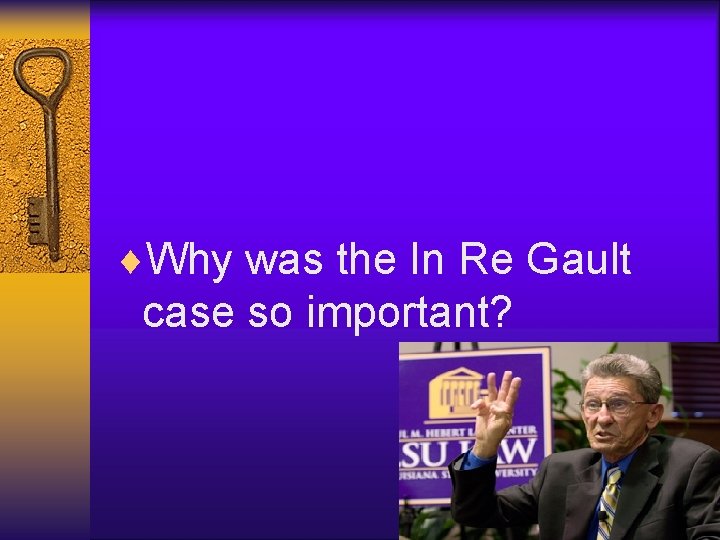
¨Why was the In Re Gault case so important?
¨ Because of his case, youth today have the right to counsel, the right to formal notice of proceedings against them, and the right to a series of due process protections. Mr. Gault, went on to serve in the military for over 21 years.
- Slides: 38