
BELL RINGER List and define the 5 stages
BELL RINGER! List and define the 5 stages of suffrage! DO IT NOW!
BELL RINGER! Study for your quiz!!!
Election next class!!! • Campaign Teams: üDress nicely! üPres/VP: Inspirational intro speech (1 min) üIn-depth knowledge of issues • Media Teams: • Lobbyists: üQs for moderators to Mrs. Zimmer! üStill missing liberal newspaper! üFulfillment of ALL contract items for campaigns
UNIT 2. 3 THE ELECTORAL PROCESS NOMINATING PROCESS
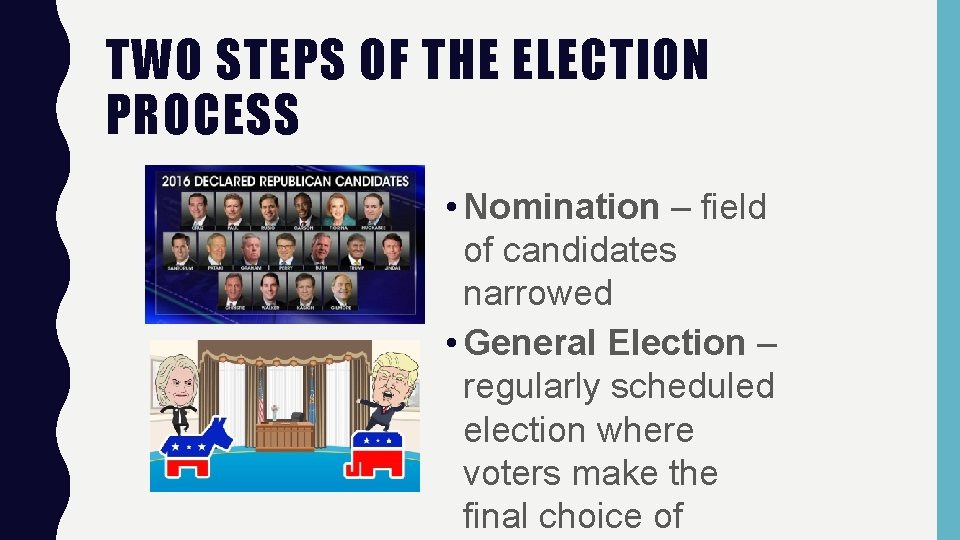
TWO STEPS OF THE ELECTION PROCESS • Nomination – field of candidates narrowed • General Election – regularly scheduled election where voters make the final choice of
FIVE WAYS TO NOMINATE 1. Self-Announcement – person who wants to run for office announces their candidacy – Used early in history & for write in candidates 2. Petition – candidate gathers a required # of signatures – Used for local nonpartisan level & state/federal level to make it difficult for minor parties 3. Caucus – private meetings of local bigwigs, not widely used since 1820 s 4. Direct Primary – party election to choose candidate – https: //www. youtube. com/watch? v=U 4 HEYeb. W 4 SU 5. Convention - delegates selected to choose candidate
ELECTIONS • Voters choose about 500, 000 elected positions • Most election law in U. S. is State Law Elections are held on the Tuesday after the first Monday in November of even numbered years Why, you ask? !!! https: //www. youtube. com/watch? v=UFqln 0 eyy. HM
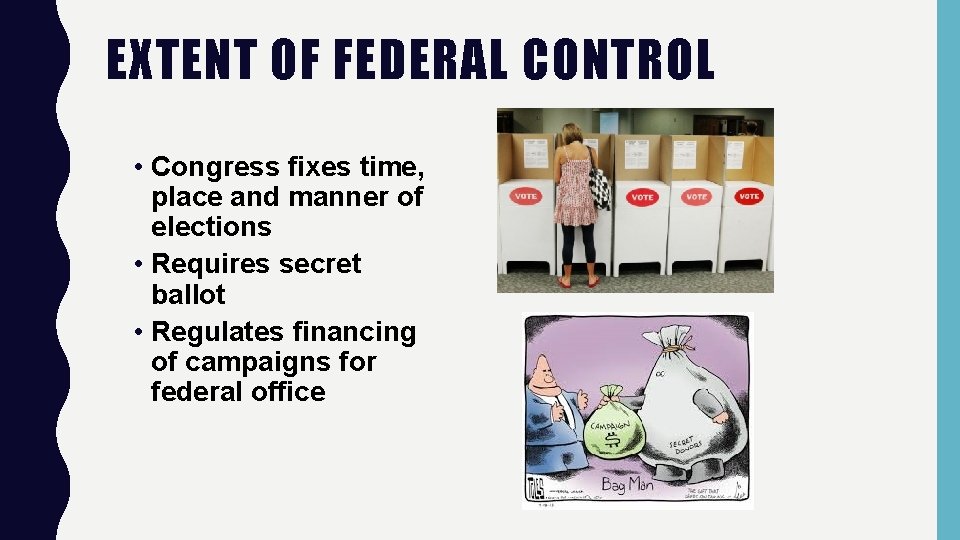
EXTENT OF FEDERAL CONTROL • Congress fixes time, place and manner of elections • Requires secret ballot • Regulates financing of campaigns for federal office
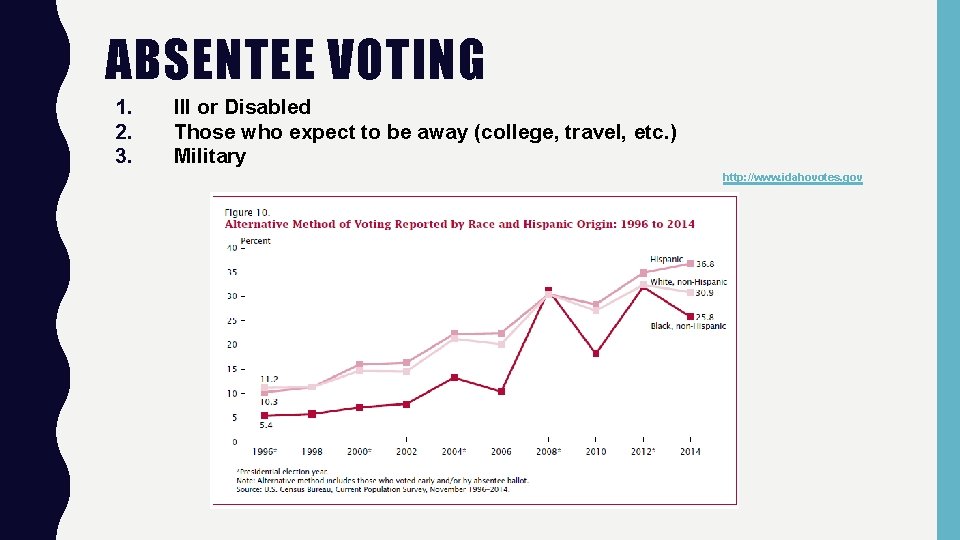
ABSENTEE VOTING 1. 2. 3. Ill or Disabled Those who expect to be away (college, travel, etc. ) Military http: //www. idahovotes. gov
PRECINCTS AND POLLING PLACES Precinct - voting district –Smallest political unit in elections –About 500 to 1, 000 voters Polling place - where those in a precinct vote Poll watchers - from each party help monitor fairness at polling place http: //www. idahovotes. gov/Absentee. Ballot/Default. aspx

TYPES OF BALLOTS
ELECTORAL COLLEGE What do you already know about the Electoral College? List everything! http: //www. youtube. com/watch? v=W 9 H 3 gvn. N 468 1. What is the Electoral College? 2. How many electors have there been since 1964? 3. How many electors do candidates need to win? 4. List reasons people criticize the Electoral College. 5. How does the Electoral College protect “small” states? 6. What type of state is Idaho? What impact do you think this may have on voters?
ELECTORAL VOTES A breakdown…not notes! • Representatives + Senators = Electoral Votes • Total of 538 electoral votes – (435 Reps, 3 from DC and 100 Sen) –Candidate must win majority of electoral votes to win presidency (270) • Delegates vote based on popular vote • “Winner Takes All” – ALL electoral votes go to the candidate who won the most popularity votes in that state
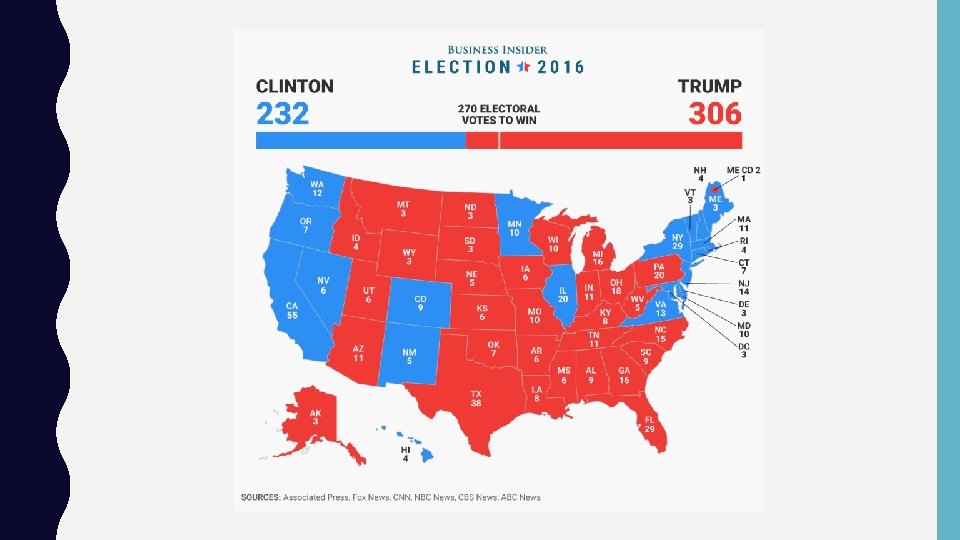
ELECTORAL VOTES Some possible dilemmas… • What about a tie? – House of Representatives votes (each state = 1 vote) • What if a candidate wins POPULAR VOTE but not the ELECTORAL VOTE? – Candidate does NOT become president Some historical (and present) examples 1. 2. 3. 4. 5. Andrew Jackson/ John Quincy Adams 1824 Samuel Tilden/ Rutherford B. Hayes 1876 Grover Cleveland/ Benjamin Harrison 1888 Al Gore/ George W. Bush 2000 Hillary Clinton/ Donald Trump 2016
WHY THE ELECTORAL COLLEGE? Three reasons the Framers of the Constitution 1. Equality – balanced between big states and small states (population) 2. Fear – general public wasn’t educated enough to cast adequate votes 3. Knowledge - No way for people to know about candidates from other places (no media!)
ELECTORAL PROCESS $$$$$$$$$$$$$$
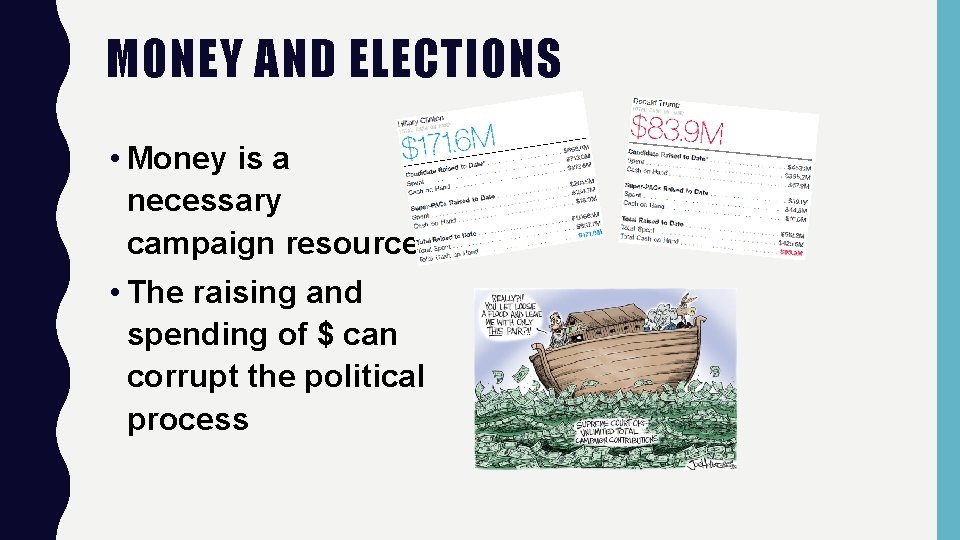
MONEY AND ELECTIONS • Money is a necessary campaign resource • The raising and spending of $ can corrupt the political process
SOURCES OF FUNDING Private and Public Sources of Campaign Money Small contributors ($200 or less) Examples: Bernie Sanders 77% total contributions Wealthy supporters Examples: $21. 8 M Sussman (Clinton) & $10. 5 M Adelson (Trump) Candidates Examples: Ross Perot $65 Million & Donald Trump $56. 1 M Nonparty groups such as PACs (Political Action Committees) Examples: $173 M Priorities USA (Clinton) & $20. 3 M Rebuilding America Now (Trump) Temporary fundraising organizations Examples: direct mail requests, telethons, Internet solicitations)
WHY DO PEOPLE DONATE? 1. 2. 3. 4. 5. 6. Political participation Believe in party or candidate Access to government Want appoint to office Social recognition Organizations want things done
REGULATING CAMPAIGN FINANCE The Federal Election Commission (FEC) enforces: • Timely disclosure of campaign finance information • Limits on campaign contributions • Limits on campaign expenditures • Provisions for public funding of presidential campaigns
LOOPHOLES IN THE LAW “More loophole than law…” —Lyndon Johnson • Soft money— money given to state and local party organizations for “party-building activities” • Independent campaign spending— a person unrelated/unconnected to candidate/party can spend as much money as they want to benefit or work against candidates • Issue ads— take a stand on certain issues in order to criticize or support a certain candidate without actually mentioning that person’s name – https: //www. youtube. com/watch? v=qulpuc. Vac. M 8
- Slides: 22