
Bell Ringer Crash Course World History Indian Ocean
Bell Ringer �Crash Course World History: Indian Ocean Basin • Who traded in the Indian Ocean Trade? • What made the Indian Ocean Trade? • What types of goods were traded throughout the Indian Ocean Basin? • What types of technologies made trade easier for these merchants?
India and the Indian Ocean Basin Chapter 15
Islamic and Hindu Kingdoms • The quest for centralized imperial rule �North India (Centralized rule collapsed in 451 CE b/c of white Huns) �Tension and invasions by Nomadic Turks left Indian society chaotic and politically fragmented �Harsha (reigned 606 -648 C. E. ) temporarily restored unified rule in north India but in the long run meant very little • Lack of political unity made foreign invasion easy �The Sind were conquered by Arab Muslims �Muslim merchants formed small communities in all major cities of coastal India �The sultanate of Delhi (1206 -1526 C. E. ) �Established an Islamic state known as the sultanate of Delhi �Sultans' authority did not extend far beyond the capital at Delhi �Islam began to have a place in India, successful at spreading Islam
Islamic and Hindu Kingdoms • The Hindu kingdoms of southern India �The south: politically divided but relatively peaceful �Does not have the invasions and attacks that the North will suffer �The Chola kingdom (850 -1267 C. E. ) was a larger kingdom; �Navy dominated waters from South China Sea to Arabian Sea �Not a tightly centralized state; local autonomy was strong �Began to decline by the twelfth century • The kingdom of Vijayanagar (1336 -1565 C. E. ) �Established by two Indian brothers �They renounced Islam in 1336 and returned to their Hindu faith
Production and Trade in the Indian Ocean basin • Agriculture in the monsoon world �The monsoons (rains in spring and summer) �Irrigation systems were needed for dry months �No big river in south India; waterworks included dams, reservoirs, canals, wells �Stored rainwater in large reservoirs connected to canals �One reservoir constructed during the eleventh century covered 250 square miles �Population growth: 53 million in 600 C. E. to 105 million in 1500 C. E. �Urbanization took place in Delhi (400, 000) and other large port cities
Production and Trade in the Indian Ocean basin • Trade and Economic development of southern India �Internal trade �Self-sufficient in staple food �Metals, spices, special crops found only in certain regions �Through trade, south India and Ceylon experienced rapid economic growth �Temples and society in south India �Hindu temples served as economic and social centers �Possessed large tracts of land, hundreds of employees �Temple administrators were to maintain order, deliver taxes �Served as banks; engaged in business ventures
Production and Trade in the Indian Ocean basin • Cross-cultural trade in Indian Ocean basin �Dhows and junks--large ships involved in maritime trade in Indian Ocean �Emporia, Indian port cities, were clearinghouses of trade and cosmopolitan centers �Trade goods �Silk and porcelain from China �Spices from southeast Asia �Pepper, gems, pearls, and cotton from India �Incense and horses from Arabia and southwest Asia �Gold, ivory, and slaves from east Africa �Specialized production �Production of high-quality cotton textiles thrived �Other specialized industries: sugar, leather, stone, carpets, iron and steel
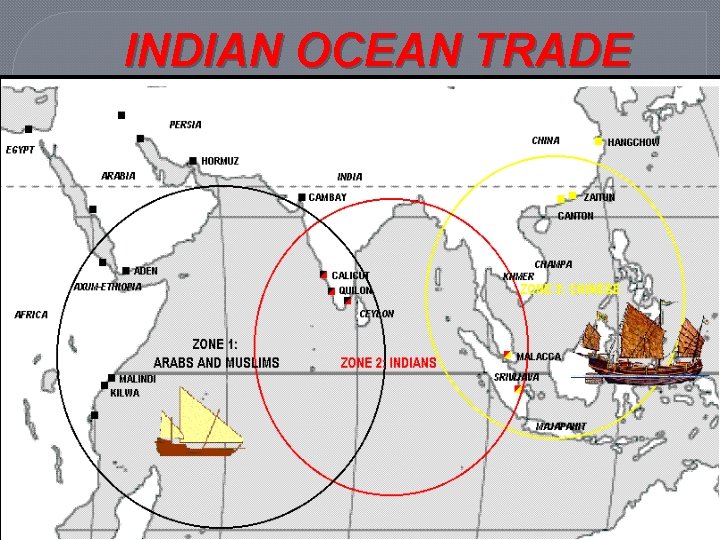
INDIAN OCEAN TRADE
Production and Trade in the Indian Ocean basin • Caste and society: caste provided guidance in absence of centralized political authority �Caste and social change: guilds and subcastes (jatis) �Merchant Guilds and great merchant families controlled international & local trade …and they in turn had much power in Indian social life, politics, & culture. �The guilds were allies to royal families of India by providing wealth thru taxation, important products from foreign lands, lending money to kings, & financing cultural activities (temples & monasteries). �Some guilds were so powerful that they had own armies to defend guilds’ interests or be mercenaries!
The Meeting of Hindu and Islamic Traditions • The development of Hinduism �Hinduism predominated in southern India, Islam in the north �Vishnu and Shiva �Decline of Buddhism benefited Hinduism �The growth of Vishnu and Shiva cults (and other gods associated with them) �Devotional cults: to achieve mystic union with gods as a way of salvation �Shankara: philosopher (ninth century) who preferred disciplined logical reasoning �Ramanuja: philosopher (eleventh and twelfth centuries) believed that understanding of ultimate reality was less important than devotion
The Meeting of Hindu and Islamic Traditions • Islam and its appeal �Conversion to Islam occurred in a slow and gradual way �Some converted for improving their lower social statuses, enjoyed the idea of equality �By 1500, about 25 million Indian Muslims (1/4 of population) �Sufis �The most effective missionaries, they had a devotional approach to Islam �Personal and emotional �Permitted followers to observe old rituals and worship old spirits �Emphasized piety and devotion �The bhakti movement �Sought to erase distinction between Hinduism and Islam �Guru Kabir (1440 -1518), important bhakti teacher, taught that Shiva, Vishnu, and Allah were one deity
The Influence of Indian Society in Southeast Asia • The states of southeast Asia �Indian influence in southeast Asia �Indian merchants brought their faiths to southeast Asia �Ruling elite of southeast Asia adapted some Indian political traditions �The states sponsored Hinduism and Buddhism �Showed no interest in Indian caste system • The arrival of Islam in southeast Asia �Conversion to Islam was slow and quiet �Ruling elite converted in cities while rural residents retained their traditions �Islam was not an exclusive faith in southeast Asia �Sufis appealed to a large public in these countries �Melaka was powerful Islamic state during fifteenth century
- Slides: 12