
Bell ringer Analyze the political cartoon and answer
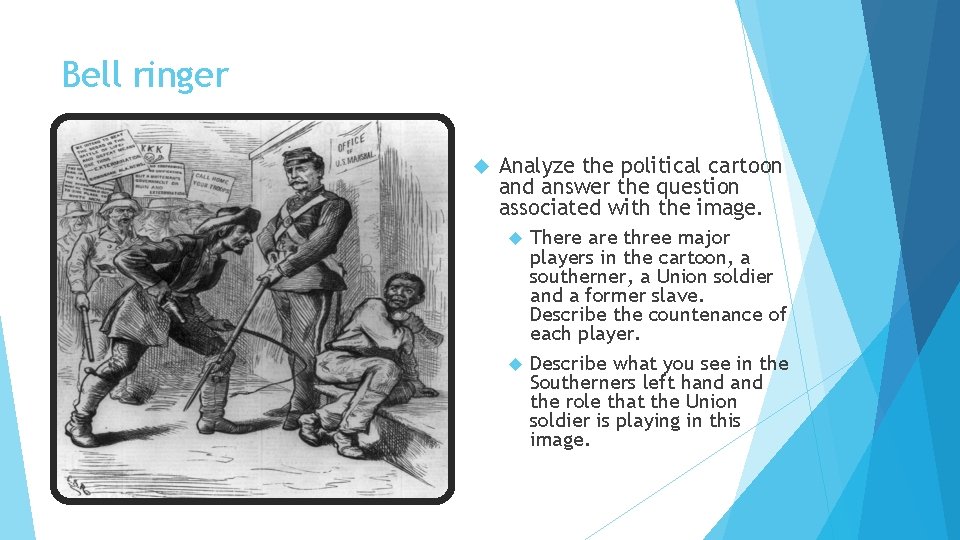
Bell ringer Analyze the political cartoon and answer the question associated with the image. There are three major players in the cartoon, a southerner, a Union soldier and a former slave. Describe the countenance of each player. Describe what you see in the Southerners left hand the role that the Union soldier is playing in this image.
RECONSTRUCTION PRESENTED BY: THE HHS U. S. HISTORY DEPARTMENT

ENGAGEMENT!!
GEORGIA STANDARDS OF EXCELLENCE SSUSH 9 Evaluate key events, issues, and individuals related to the Civil War SSUSH 10 Identify legal, political, and social dimensions of Reconstruction.
ADVANCED PLACEMENT U. S. HISTORY STANDARDS NAT-2. 0 Explain how interpretations of the Constitution and debates over rights, liberties, and definitions of citizenship have affected American values, politics, and society POL-3. 0 Explain how different beliefs about the federal government’s role in U. S. social and economic life have affected political debates and policies.
LEARNING TARGETS Students will be able to analyze and describe key events, issues and events associated with the American Civil War. Students will be able to identify and describe the legal, political, and social dimensions of the Reconstruction Era.
KEY ACADEMIC VOCABULARY Gettysburg Address 13 th Amendment Surrender at Appomattox 14 th Amendment Election of 1864 15 th Amendment Lincoln’s Second Inaugural Address Freedman’s Bureau Reconstruction Impeachment of Andrew Johnson Presidential Reconstruction Black Codes Abraham Lincoln Ku Klux Klan Andrew Johnson Presidential Election of 1876 Congressional Reconstruction Compromise of 1877

EXPLORE, EXPLAIN, & ELABORATE !!
GEORGIA STANDARDS OF EXCELLENCE SSUSH 9 Evaluate key events, issues, and individuals related to the Civil War SSUSH 10 Identify legal, political, and social dimensions of Reconstruction.
ADVANCED PLACEMENT U. S. HISTORY STANDARDS NAT-2. 0 Explain how interpretations of the Constitution and debates over rights, liberties, and definitions of citizenship have affected American values, politics, and society POL-3. 0 Explain how different beliefs about the federal government’s role in U. S. social and economic life have affected political debates and policies.
LEARNING TARGETS Students will be able to analyze and describe key events, issues and events associated with the American Civil War. Students will be able to identify and describe the legal, political, and social dimensions of the Reconstruction Era.
KEY ACADEMIC VOCABULARY Gettysburg Address 13 th Amendment Surrender at Appomattox 14 th Amendment Election of 1864 15 th Amendment Lincoln’s Second Inaugural Address Freedman’s Bureau Reconstruction Impeachment of Andrew Johnson Presidential Reconstruction Black Codes Abraham Lincoln Ku Klux Klan Andrew Johnson Presidential Election of 1876 Congressional Reconstruction Compromise of 1877
POINTS TO PONDER: Explain what it means to reconstruct something. Explain why the United States of America needed to be “reconstructed” after the American Civil War. How would Reconstruction impact newly freed slaves?
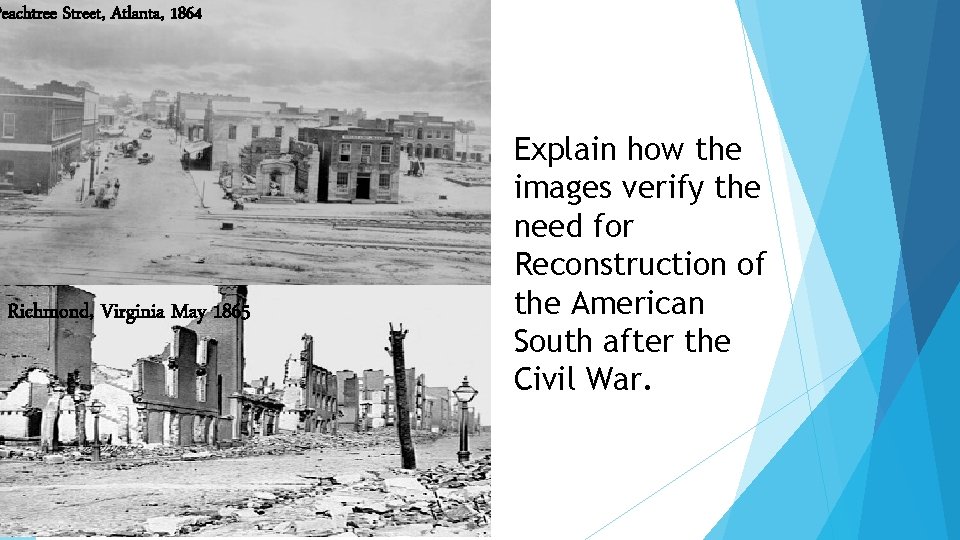
Peachtree Street, Atlanta, 1864 Richmond, Virginia May 1865 Explain how the images verify the need for Reconstruction of the American South after the Civil War.
RECONSTRUCTION BASICS Reconstruction is the era from 1865 to 1877 when the U. S. government attempted to rebuild the nation after the Civil War During Reconstruction, the government had to readmit the seceded Southern states back into the Union End slavery and protect newly emancipated slaves Rebuild the South after more than four years of fighting
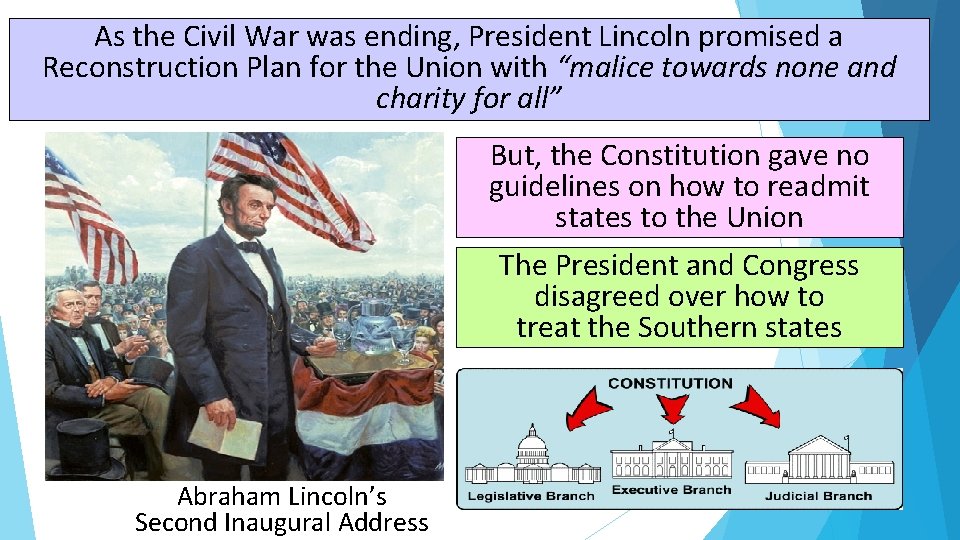
As the Civil War was ending, President Lincoln promised a Reconstruction Plan for the Union with “malice towards none and charity for all” But, the Constitution gave no guidelines on how to readmit states to the Union The President and Congress disagreed over how to treat the Southern states Abraham Lincoln’s Second Inaugural Address
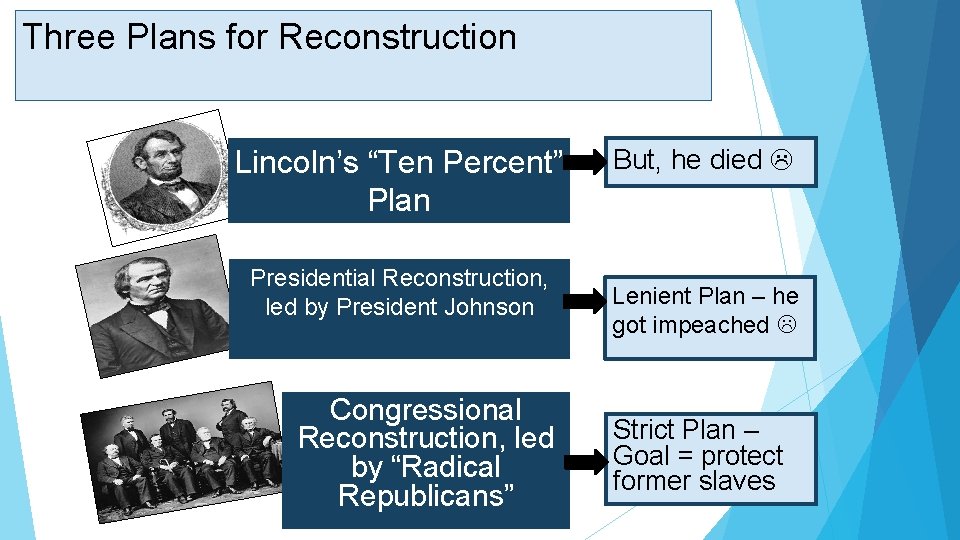
Three Plans for Reconstruction Lincoln’s “Ten Percent” Plan Presidential Reconstruction, led by President Johnson Congressional Reconstruction, led by “Radical Republicans” But, he died Lenient Plan – he got impeached Strict Plan – Goal = protect former slaves
Reconstruction How would you “reconstruct” the south after the civil war? Please consider how you would reconstruct the nation from legal social and political perspective. Think about it…then turn to a neighbor and share your plan.
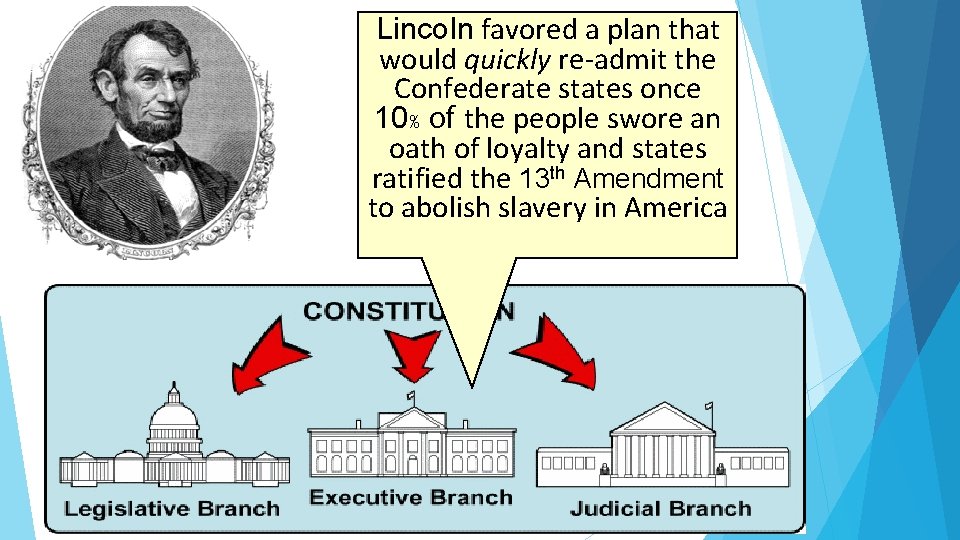
Lincoln favored a plan that would quickly re-admit the Confederate states once 10% of the people swore an oath of loyalty and states ratified the 13 th Amendment to abolish slavery in America
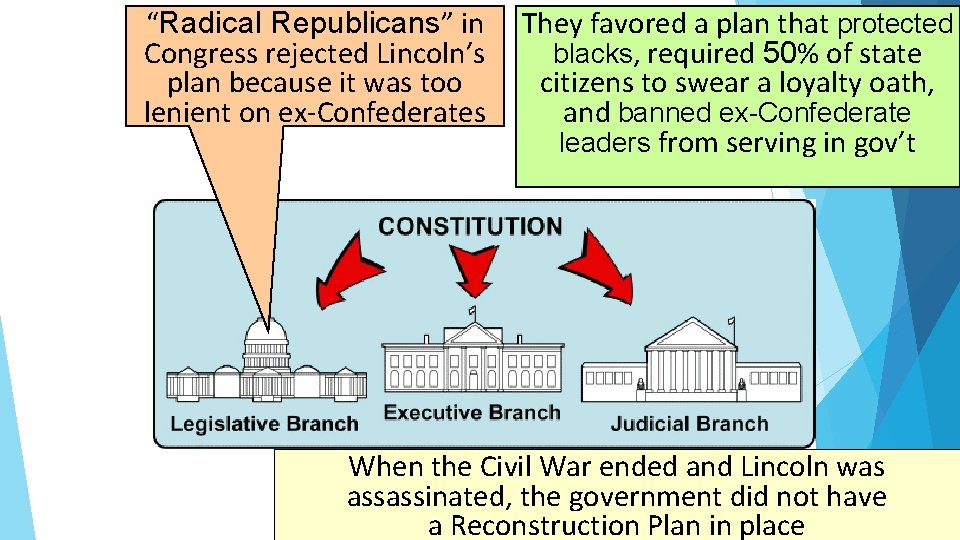
“Radical Republicans” in Congress rejected Lincoln’s plan because it was too lenient on ex-Confederates They favored a plan that protected blacks, required 50% of state citizens to swear a loyalty oath, and banned ex-Confederate leaders from serving in gov’t When the Civil War ended and Lincoln was assassinated, the government did not have a Reconstruction Plan in place
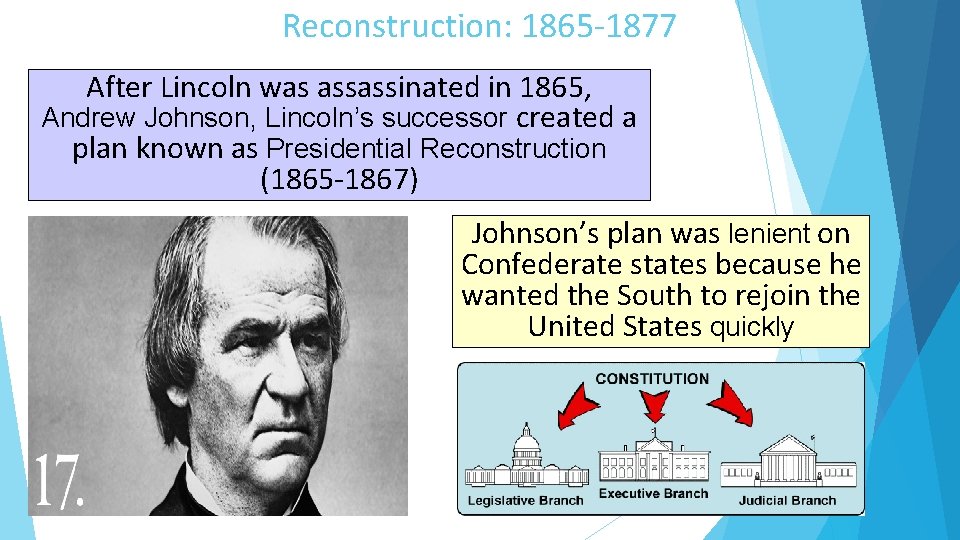
Reconstruction: 1865 -1877 After Lincoln was assassinated in 1865, Andrew Johnson, Lincoln’s successor created a plan known as Presidential Reconstruction (1865 -1867) Johnson’s plan was lenient on Confederate states because he wanted the South to rejoin the United States quickly
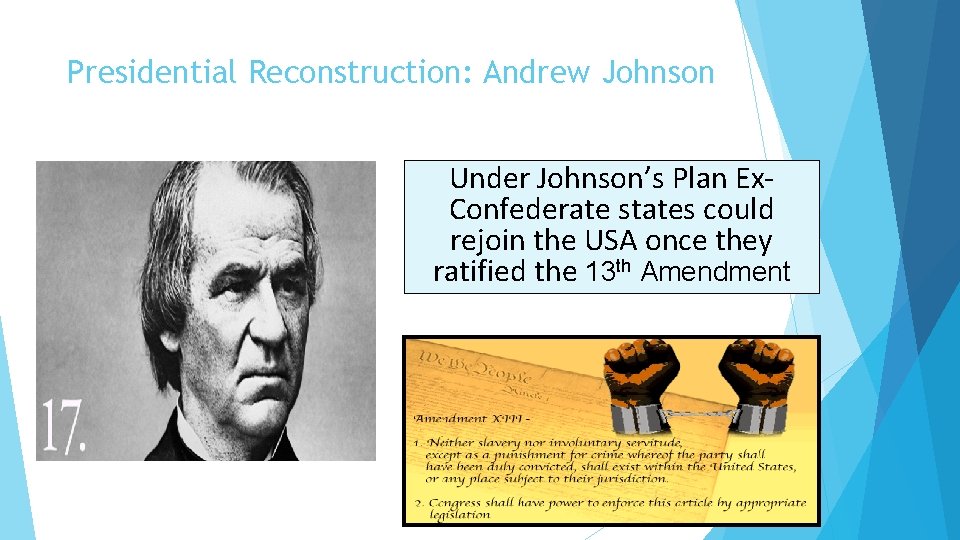
Presidential Reconstruction: Andrew Johnson Under Johnson’s Plan Ex. Confederate states could rejoin the USA once they ratified the 13 th Amendment
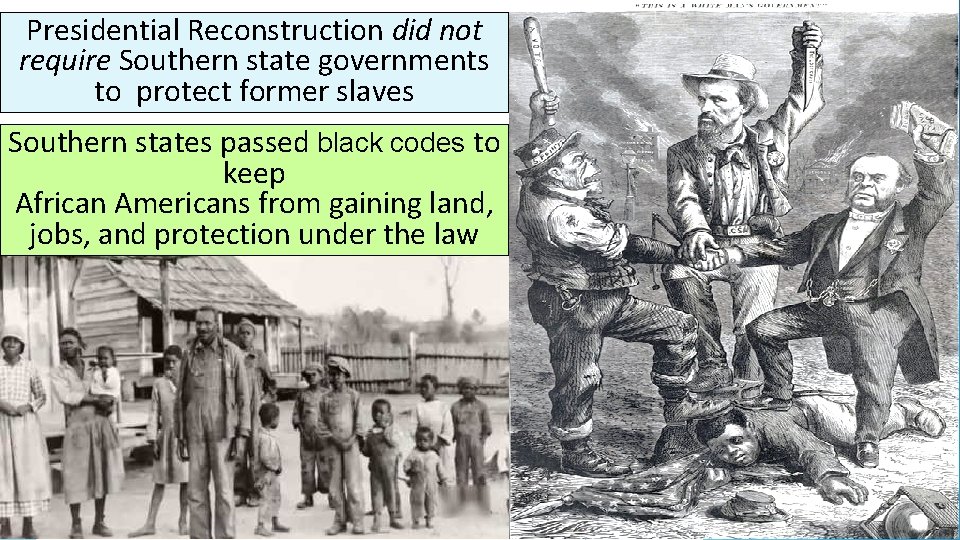
Presidential Reconstruction did not require Southern state governments to protect former slaves Southern states passed black codes to keep African Americans from gaining land, jobs, and protection under the law
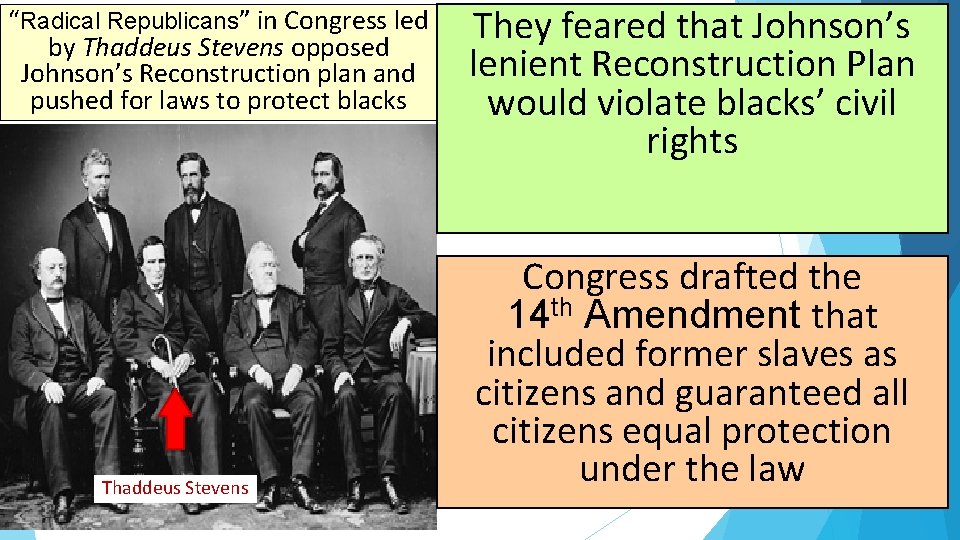
“Radical Republicans” in Reconstruction: Congress led 1865 -1877 They feared that Johnson’s by Thaddeus Stevens opposed lenient Reconstruction Plan Johnson’s Reconstruction plan and pushed for laws to protect blacks would violate blacks’ civil rights Thaddeus Stevens Congress drafted the 14 th Amendment that included former slaves as citizens and guaranteed all citizens equal protection under the law
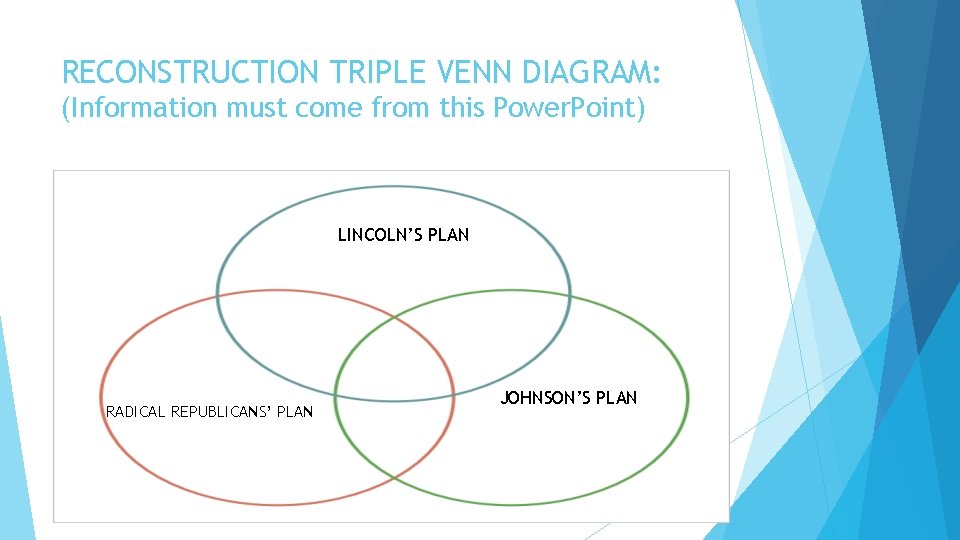
RECONSTRUCTION TRIPLE VENN DIAGRAM: (Information must come from this Power. Point) LINCOLN’S PLAN RADICAL REPUBLICANS’ PLAN JOHNSON’S PLAN
THE “DEBATE” OVER PROTECTIONS FOR AFRICAN-AMERICANS President Johnson thought that these new protections former slaves would anger Southerners and slow down Reconstruction Johnson opposed the Freedman’s Bureau and tried to convince states not to ratify the 14 th Amendment By 1867, moderate and radical Republicans realized that they needed to take control of Reconstruction from the president
CONGRESSIONAL RECONSTRUCTION Congressional Reconstruction was strict, protected the rights of former slaves, and kept Confederate leaders from regaining power in the South Congress passed the Reconstruction Act of 1867 The South was divided into 5 military zones with US troops to enforce Reconstruction Ex-Confederate states were required to give black men the right to vote at the state level To be readmitted, states had to ratify the 14 th Amendment protecting black citizenship
CONGRESSIONAL RECONSTRUCTION WRITING ACTIVITY Please explain why many Southerners resented Congressional Reconstruction. Please support your response with evidence from the text in the notes provided in this Power. Point.
PRESIDENT JOHNSON’S RESPONSE TO CONGRESSIONAL RECONTRUCTION President Johnson obstructed Congressional Reconstruction by firing military generals appointed by Congress to oversee Southern military zones He violated a new law called the Tenure of Office Act when he tried to fire his Secretary of War who supported Congress’ plan
THE IMPEACHMENT OF ANDREW JOHNSON He violated a new law called the Tenure of Office Act when he tried to fire his Secretary of War who supported Congress’ plan Radical Republicans used this as an opportunity to impeach the president The House of Representatives voted 126 -47 to charge Johnson with a crime After an 11 week trial, the Senate fell 1 vote short of removing the president from office
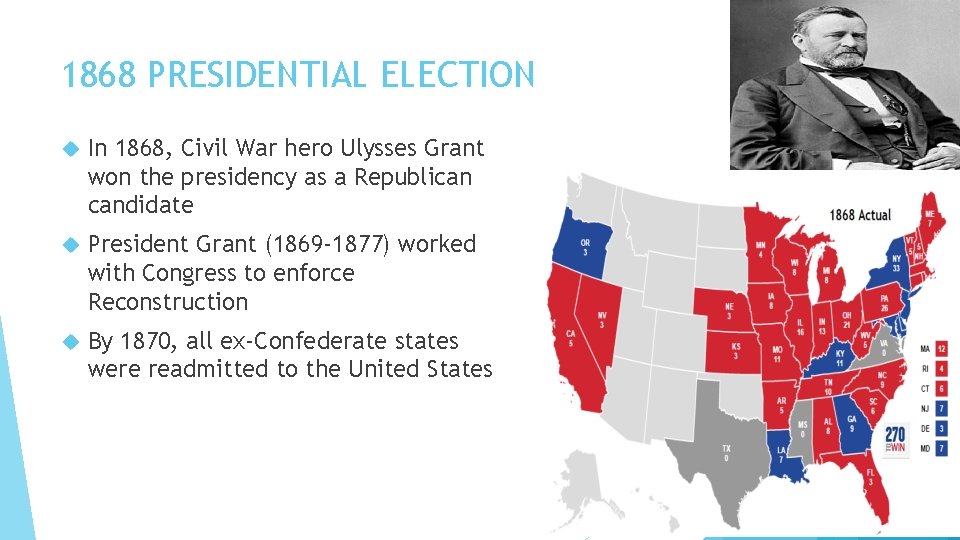
1868 PRESIDENTIAL ELECTION In 1868, Civil War hero Ulysses Grant won the presidency as a Republican candidate President Grant (1869 -1877) worked with Congress to enforce Reconstruction By 1870, all ex-Confederate states were readmitted to the United States
CONGRESSIONAL RECONSTRUCTION’S IMPACT ON AFRICAN-AMERICANS During Congressional Reconstruction, African Americans experienced unprecedented rights The 15 th Amendment gave black men the right to vote in 1870 The 1 st black politicians were elected to state and national offices Literacy and education increased among blacks Black families were reunited, marriages were legally recognized, and black workers could make their own money
RECONSTRUCTION’S IMPACT ON THE SOUTHERN ECONOMY After the Civil War, the Southern economy became more diverse with new iron, steel, and textile mills The new industrial economy required hired workers The government built railroads and helped repair the South
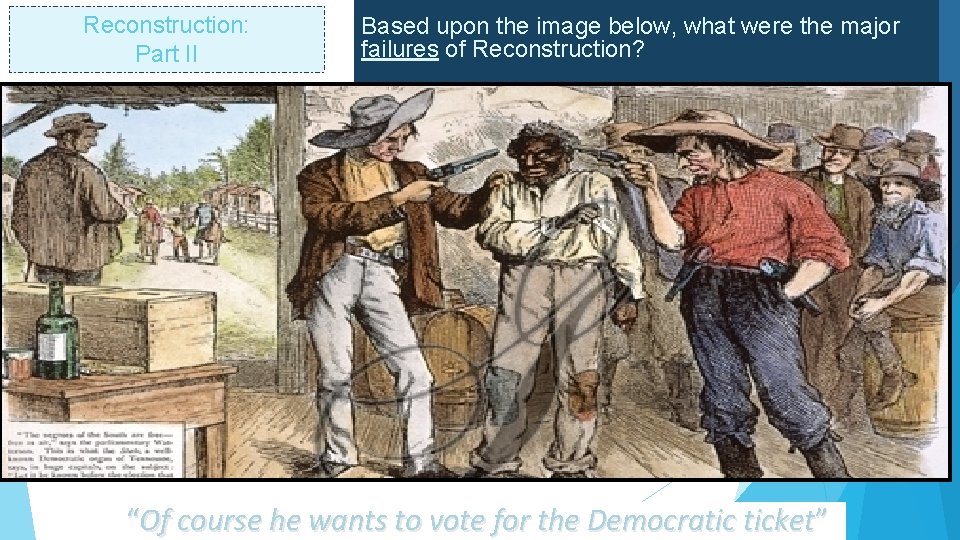
Reconstruction: Part II Based upon the image below, what were the major failures of Reconstruction? “Of course he wants to vote for the Democratic ticket”
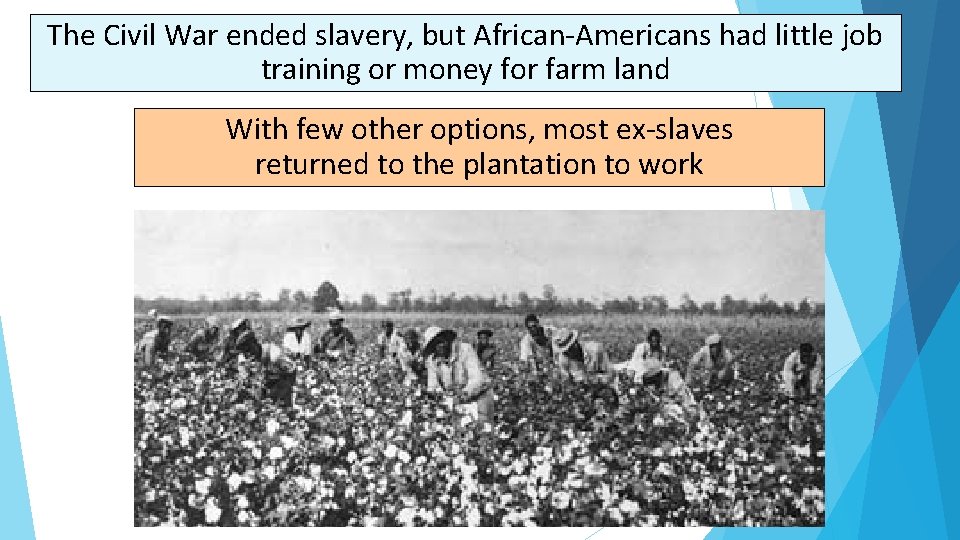
The Civil War ended slavery, but African-Americans had little job training or money for farm land With few other options, most ex-slaves returned to the plantation to work
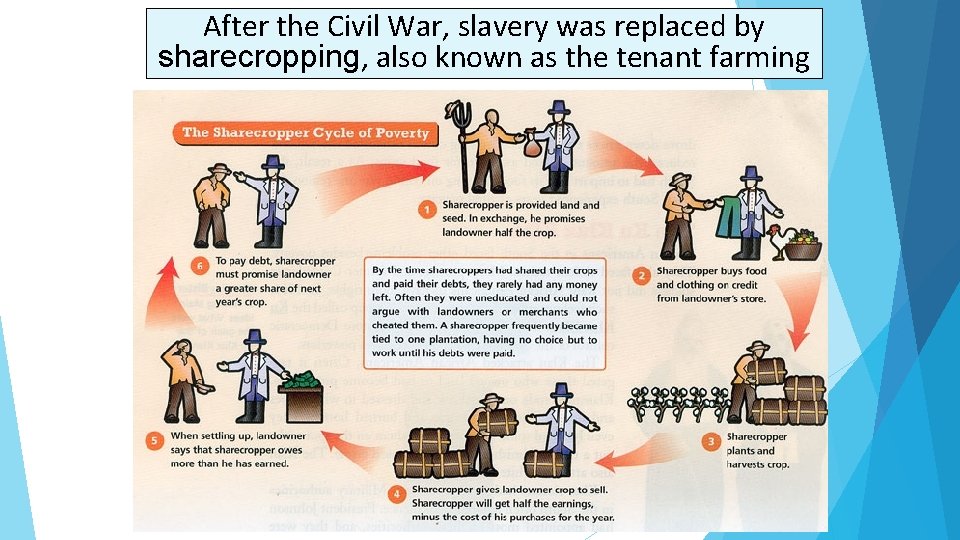
After the Civil War, slavery was replaced by sharecropping, also known as the tenant farming
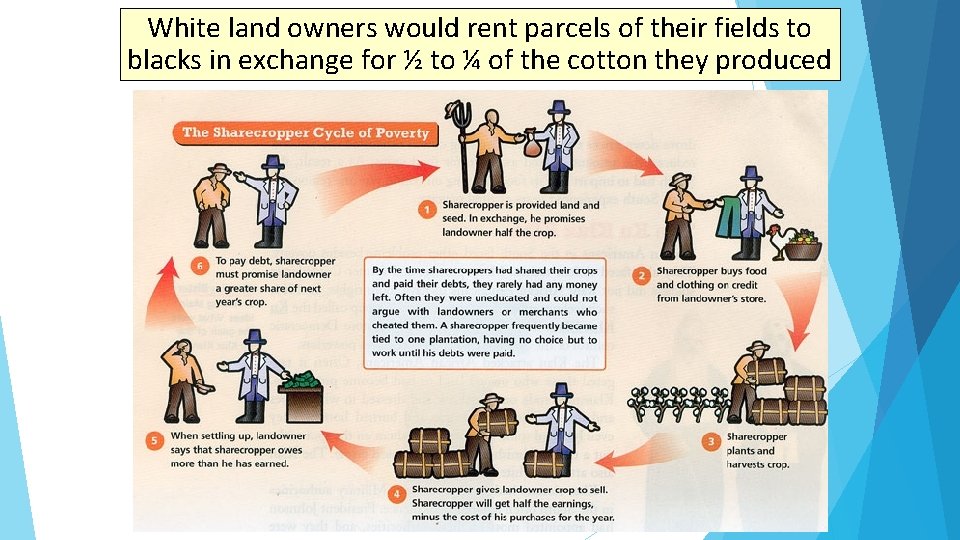
White land owners would rent parcels of their fields to blacks in exchange for ½ to ¼ of the cotton they produced
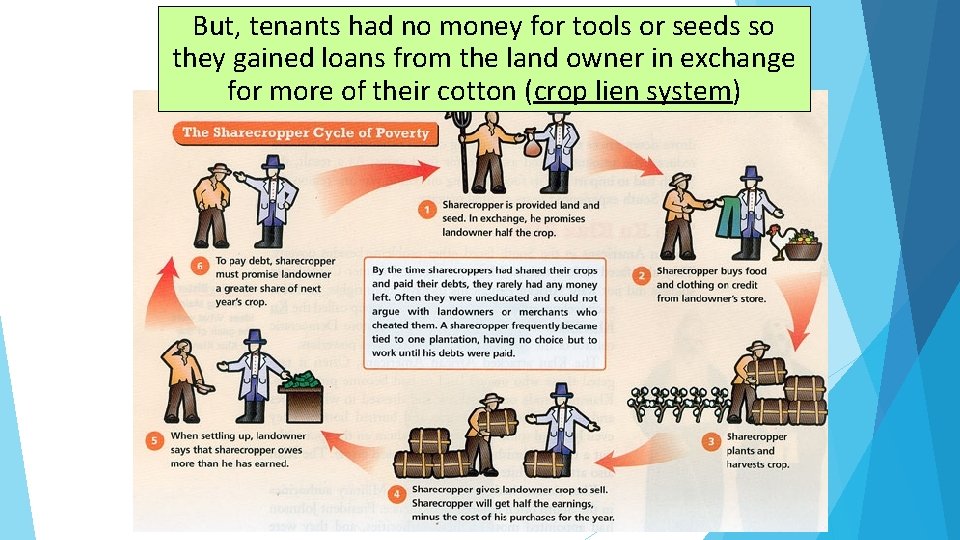
But, tenants had no money for tools or seeds so they gained loans from the land owner in exchange for more of their cotton (crop lien system)
PRESIDENT HAYES COMES TO POWER By the mid-1870 s, the Democratic Party returned to power in most Southern states The only thing protecting blacks were federal troops In the 1876 election, neither Democrat Tilden nor Republican Hayes won a majority of electoral vote Republicans and Democrats in Congress agreed to the “Compromise of 1877” in which Democrats agreed to vote for Hayes as president if federal troops were removed from the South When President Hayes removed federal troops in 1877, Reconstruction officially ended
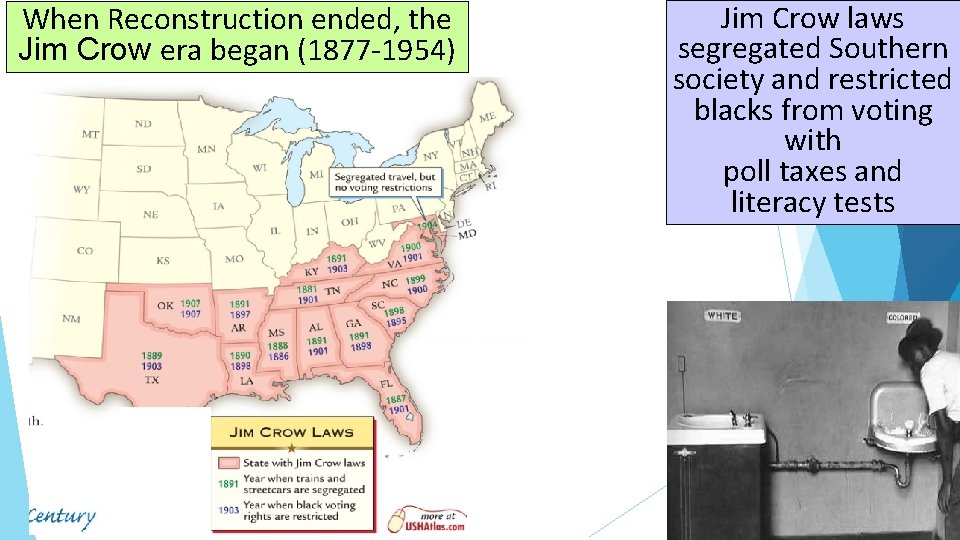
When Reconstruction ended, the Jim Crow era began (1877 -1954) Jim Crow laws segregated Southern society and restricted blacks from voting with poll taxes and literacy tests
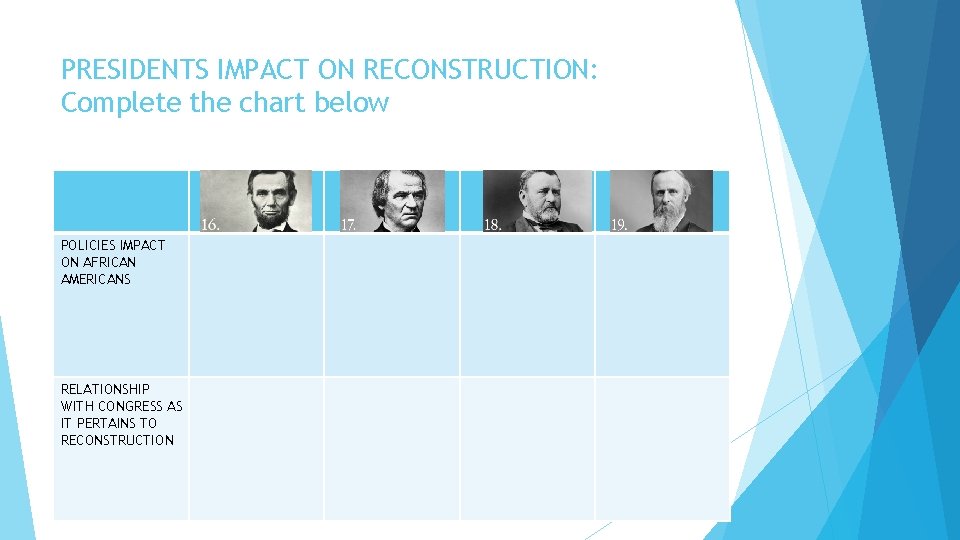
PRESIDENTS IMPACT ON RECONSTRUCTION: Complete the chart below POLICIES IMPACT ON AFRICAN AMERICANS RELATIONSHIP WITH CONGRESS AS IT PERTAINS TO RECONSTRUCTION

EVALUATION!!
GEORGIA STANDARDS OF EXCELLENCE SSUSH 9 Evaluate key events, issues, and individuals related to the Civil War SSUSH 10 Identify legal, political, and social dimensions of Reconstruction.
ADVANCED PLACEMENT U. S. HISTORY STANDARDS NAT-2. 0 Explain how interpretations of the Constitution and debates over rights, liberties, and definitions of citizenship have affected American values, politics, and society POL-3. 0 Explain how different beliefs about the federal government’s role in U. S. social and economic life have affected political debates and policies.
KEY ACADEMIC VOCABULARY Gettysburg Address 13 th Amendment Surrender at Appomattox 14 th Amendment Election of 1864 15 th Amendment Lincoln’s Second Inaugural Address Freedman’s Bureau Reconstruction Impeachment of Andrew Johnson Presidential Reconstruction Black Codes Abraham Lincoln Ku Klux Klan Andrew Johnson Presidential Election of 1876 Congressional Reconstruction Compromise of 1877
TICKET OUT THE DOOR DESCRIBE BOTH THE POSITIVE AND NEGATIVE IMPACT THAT RECONSTRUCTION HAD ON AFRICAN-AMERICANS
- Slides: 46