
BELL RINGER 23 What is heat Explain OBJECTIVE

BELL RINGER 2/3: What is heat? Explain. OBJECTIVE: SWBAT describe the relationship between all 4 gas variables AGENDA: -POGIL
7. In Model 1, what does a dot represent?
7. In Model 1, what does a dot represent? 6. Name the two factors related to molecular movement that influence the pressure of a gas. 13. Complete the following table for the three experiments in model 2.
SUMMARY: 1. When volume and temperature are constant, what is the relationship between number of molecules and pressure? 2. What causes that relationship? 3. When volume and number of moles are constant, what is the relationship between temperature and pressure? 4. What causes that relationship?
BELL RINGER 2/4: A gas in a glass flask with an initial temperature of 150 K is heated up until it reaches a temperature of 400 K. Compared to its initial pressure, will the gas’s new pressure be greater or lesser? OBJECTIVE: SWBAT describe the relationship between all 4 gas variables AGENDA: -POGIL -PRACTICE CALCULATIONS
7. In Model 1, what does a dot represent? 6. Name the two factors related to molecular movement that influence the pressure of a gas. 13. Complete the following table for the three experiments in model 2.
POGIL Discussion • 1 st Responder: Answer, with evidence • 2 nd Responder: Agree or Disagree (provide counter-evidence, as necessary) • 3 rd Responder: Summarize what each responder has said
POGIL Wrap Up • Why do you think they used a flexible container in Model 2? • What relationships (think Model 2) do you notice between: • Amount of gas (number of moles) and volume? • Temperature and volume? • Pressure and volume? • What is happening with the molecules in each of the above situations?
POGIL Wrap Up • Are each of the variables related individually, or are they all related? • If they are all related, how might they be related (equation? )?
BELL RINGER 2/6: Can more energy be stored in air or water? Hint: Think back to chemistry and specific heat! OBJECTIVE: SWBAT explain how the specific heat of an object and calculate specific heat and factors that contribute to it using C=Q/m. T. AGENDA: -Wrap up Ideal Gas Law Notes -Reading -Specific Heat Notes -Practice Calculations
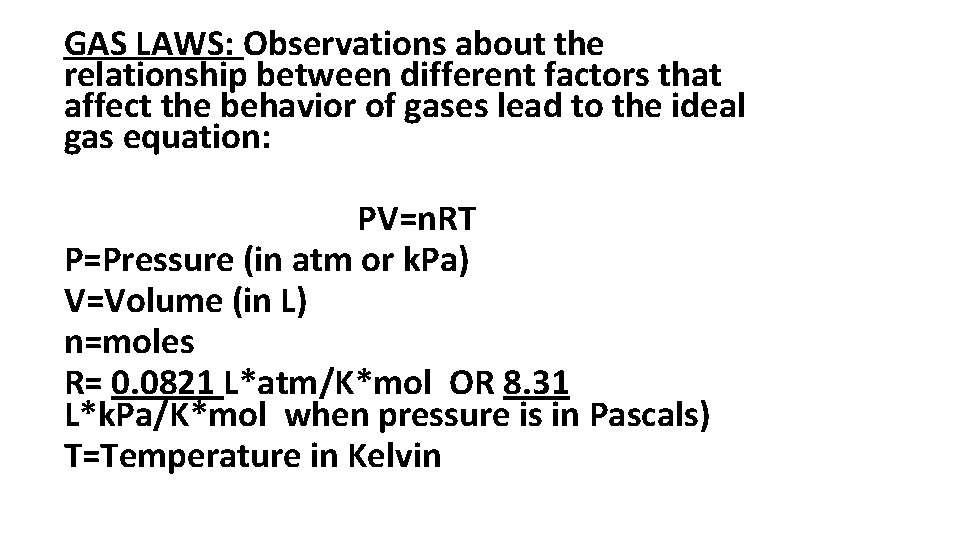
GAS LAWS: Observations about the relationship between different factors that affect the behavior of gases lead to the ideal gas equation: PV=n. RT P=Pressure (in atm or k. Pa) V=Volume (in L) n=moles R= 0. 0821 L*atm/K*mol OR 8. 31 L*k. Pa/K*mol when pressure is in Pascals) T=Temperature in Kelvin
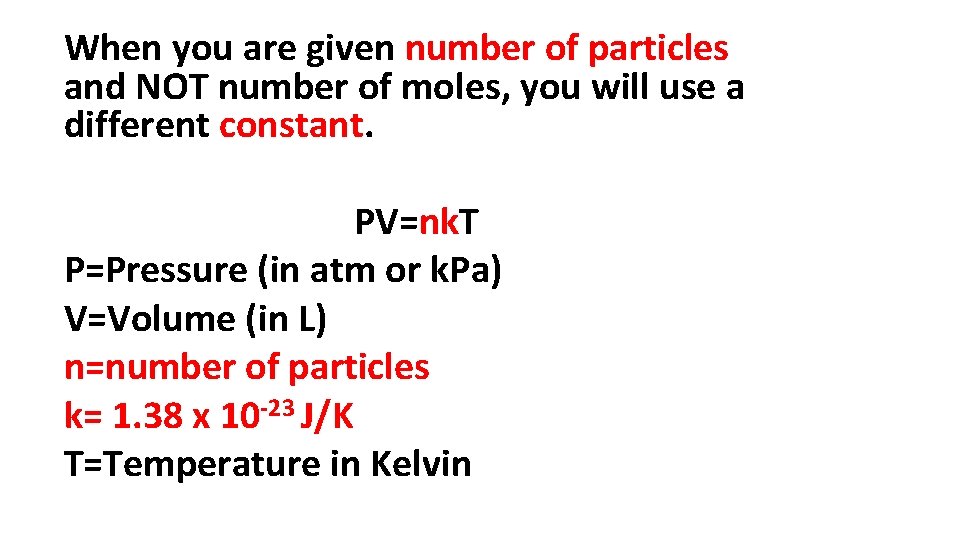
When you are given number of particles and NOT number of moles, you will use a different constant. PV=nk. T P=Pressure (in atm or k. Pa) V=Volume (in L) n=number of particles k= 1. 38 x 10 -23 J/K T=Temperature in Kelvin
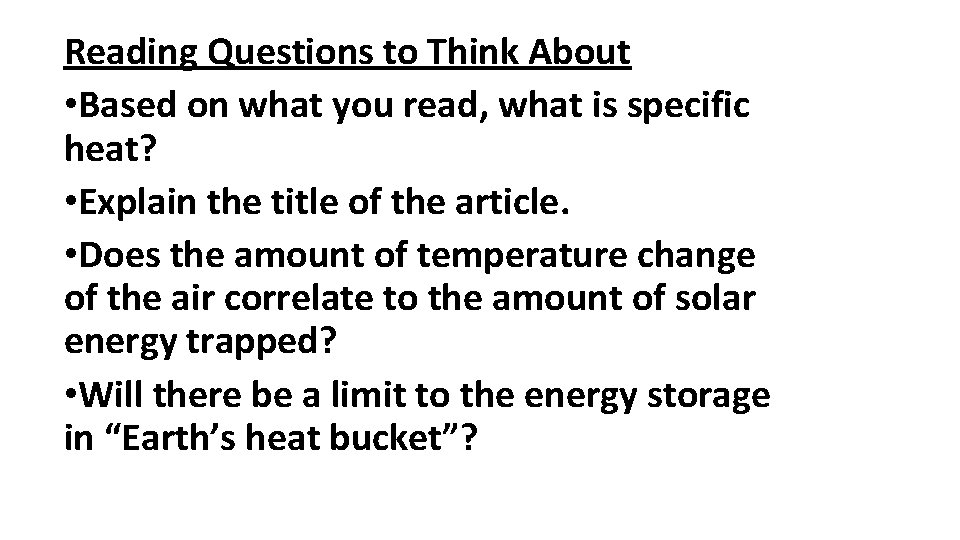
Reading Questions to Think About • Based on what you read, what is specific heat? • Explain the title of the article. • Does the amount of temperature change of the air correlate to the amount of solar energy trapped? • Will there be a limit to the energy storage in “Earth’s heat bucket”?
Reviewing Specific Heat • Specific heat capacity is the amount of energy required to raise the temperature of 1 g of a substance by 10 C. • More particles in substance = more heat energy! • Higher temperature = more heat energy!
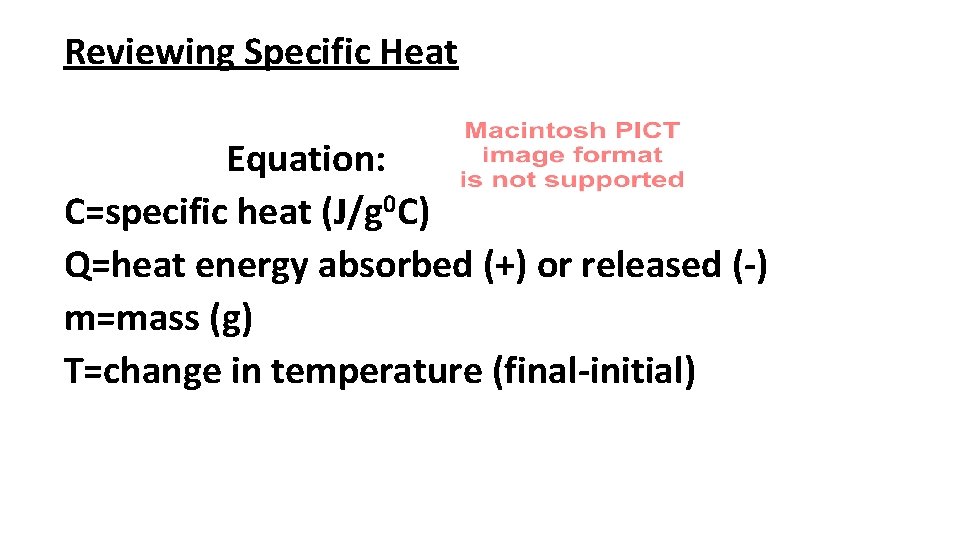
Reviewing Specific Heat Equation: C=specific heat (J/g 0 C) Q=heat energy absorbed (+) or released (-) m=mass (g) T=change in temperature (final-initial)
Bellringer: If the specific heat of water is 4. 18 J/g 0 C, and 120 g of water is heated from 130 C to 380 C, how much energy was added to raise the temperature? OBJECTIVE: SWBAT explain how the specific heat of an object and calculate specific heat and factors that contribute to it using C=Q/m. T. AGENDA: -Bellringer -Review Homework -Quiz!!
Bellringer: Is energy added or released during a phase change? OBJECTIVE: SWBAT practice reading phase change diagrams. AGENDA: -Bellringer -Open Response Quiz -Reading a Heating Curve
Bellringer: Based on what you read in the article yesterday, what is thermal expansion? OBJECTIVE: SWBAT practice calculating latent heat values form example problems. AGENDA: -Bellringer -Article Discussion -Practice latent heat calculations
Article Discussion Questions • How has thermal expansion been utilized by man? • What would happen if thermal expansion wasn’t considered in tooth fillings? • How is thermal expansion related to what we have discussed in class so far?
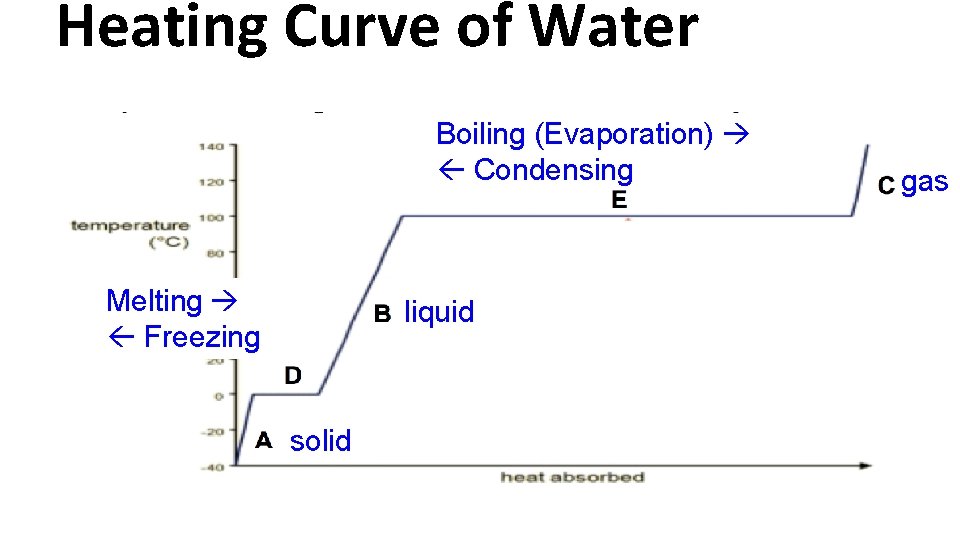
Heating Curve of Water Boiling (Evaporation) Condensing Melting Freezing liquid solid gas
**Key Point • Latent Heat: is the energy absorbed or released during a constant temperature process. • Example: Most examples of latent heat are phase Changes!
Discuss • Think about the equation for heat energy (Q=C m ΔT). Why doesn’t this equation work during parts D and E on the graph?
Types of Latent Heat • Heat of Vaporization (ΔHv) = The amount of heat needed to change state from a liquid to a gas. *Note: If a substance changes phase from a gas to a liquid ΔHv is negative.
Types of Latent Heat • Heat of Fusion (ΔHf)= The amount of heat needed to change state from a solid to liquid. *Note: If a substance changes phase from a liquid to a solid ΔHf is negative.
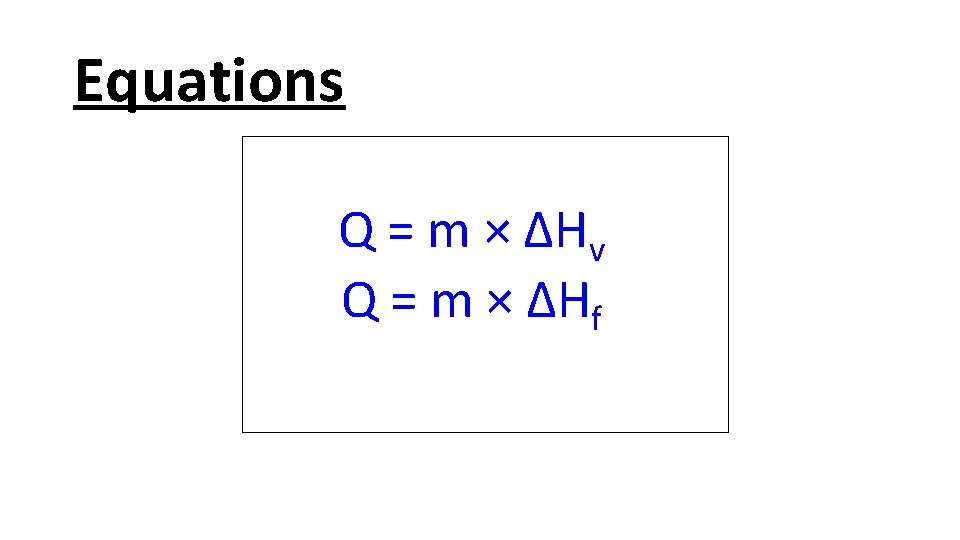
Equations Q = m × ΔHv Q = m × ΔHf
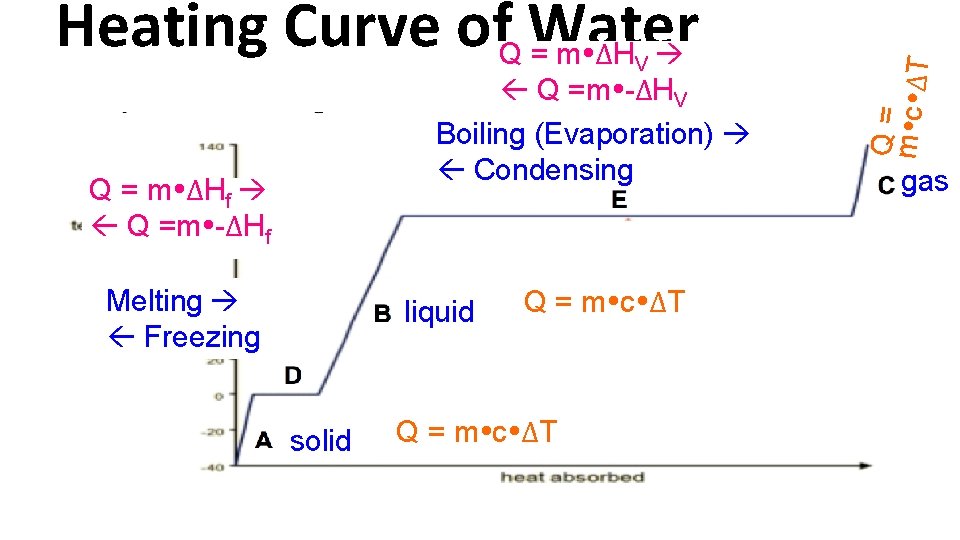
V Q =m -ΔHV Boiling (Evaporation) Condensing Q = m ΔHf Q =m -ΔHf Melting Freezing liquid solid Q = m c ΔT Q= m c ΔT Heating Curve of. Q Water = m ΔH gas
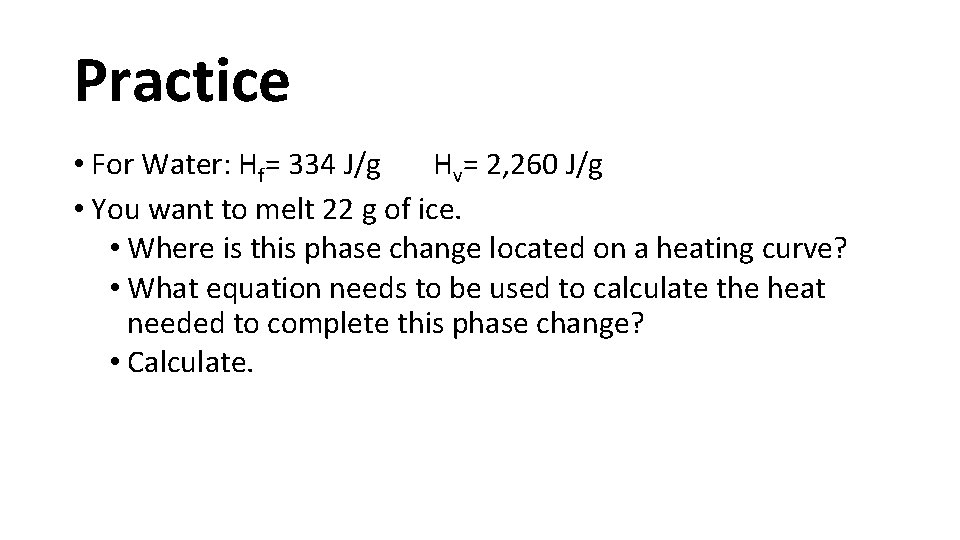
Practice • For Water: Hf= 334 J/g Hv= 2, 260 J/g • You want to melt 22 g of ice. • Where is this phase change located on a heating curve? • What equation needs to be used to calculate the heat needed to complete this phase change? • Calculate.
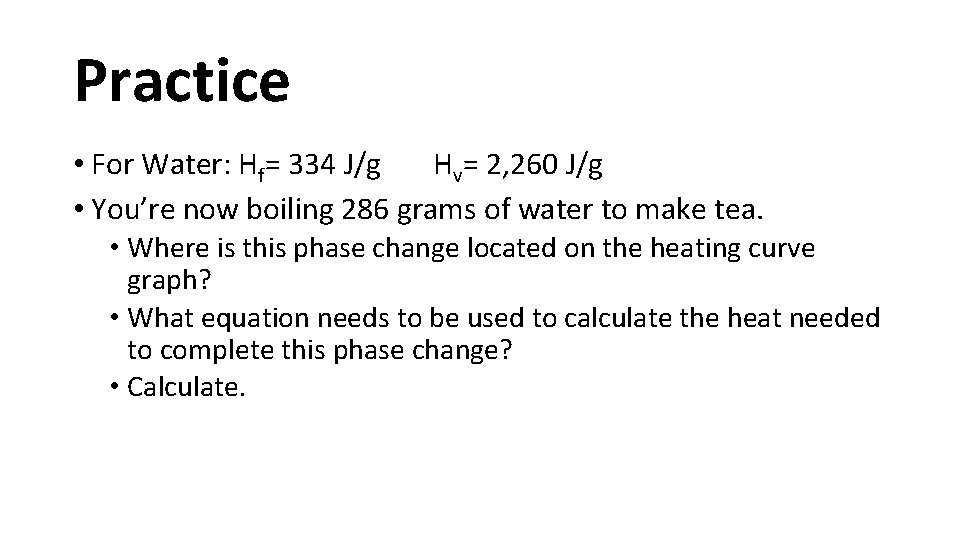
Practice • For Water: Hf= 334 J/g Hv= 2, 260 J/g • You’re now boiling 286 grams of water to make tea. • Where is this phase change located on the heating curve graph? • What equation needs to be used to calculate the heat needed to complete this phase change? • Calculate.
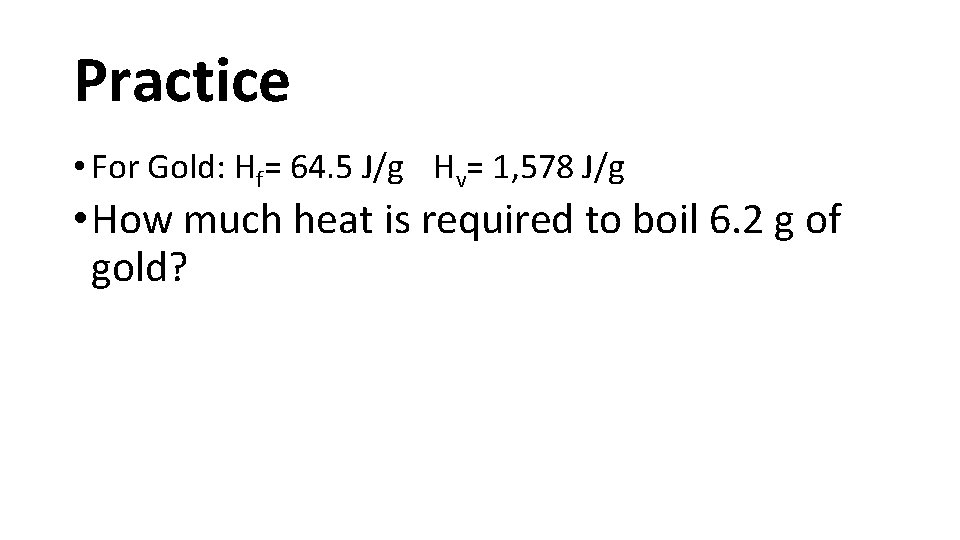
Practice • For Gold: Hf= 64. 5 J/g Hv= 1, 578 J/g • How much heat is required to boil 6. 2 g of gold?
Practice • For Gold: Hf= 64. 5 J/g Hv= 1, 578 J/g • How much heat is required to boil 6. 2 g of gold?
• For Water: Hf= 334 J/g Hv= 2, 260 J/g • 1. Calculate the energy absorbed when 8. 5 g of ice is melted at 0. 0°C. • 2. Calculate the energy released when 2. 2 g of water vapor condenses on a soda can at 100. 0°C. • 3. Calculate the energy absorbed when 89. 3 g of water is boiled at 100. 0°C. • 4. Calculate the energy released when 20. 0 g of water forms an ice cube in a freezer at 0. 0°C. • 5. Calculate the energy needed to evaporate 400. 0 g water from an ocean to form water vapor. • 6. How much energy is required to heat 25 g of liquid water from 25°C to 100. 0°C and chage it to steam at 100. 0°C. • 7. Calculate the energy released when 14 g of liquid water lowers from 14°C to 0. 0°C and then freezes at 0. 0°C. • 8. Calculate the energy absorbed when 12 g of liquid water raises from 55°C to 100. 0°C and then boils at 100. 0°C.
- Slides: 31