
Bell ringer 2 When making a decision any
Bell ringer #2 When making a decision, any decision, is it best to get input from others(Trustee Theory) or just make the decision with what you know(Delegate Theory)? Give an example.
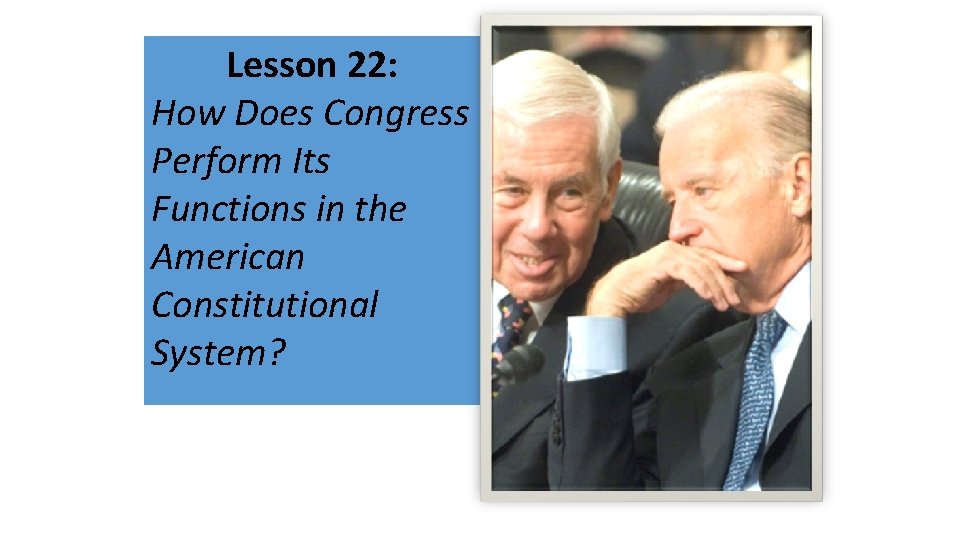
Lesson 22: How Does Congress Perform Its Functions in the American Constitutional System?
Purpose • Congress is one of few national assemblies with the power to initiate legislation, not simply vote on executive’s proposals. • Congress also conducts investigations that lead to important changes in policy and removal of officials. • Despite its rules and leadership structures, the 535 member Congress faces challenges representing their growing and diverse constituencies.
Objectives Describe the role of rules, committees, and political parties in Congress. Describe the lawmaking process. Identify the primary sources members rely upon. Explain the importance of Congress’ power to investigate. Explain why compromise is required in the deliberative process. Evaluate, take, and defend positions on how Congress functions and whether it should streamline its procedures.

The Role of Rules & Committees • Rules and Committees not specified in Constitution, but instead created by each chamber (Art. 1 Sec. 5) • Committees • Standing (permanent) Committees have jurisdiction over particular subjects, appoint more specific subcommittees • Hold hearings to hear public testimony or conduct gov’t oversight • Select Committees (task forces) exist for limit time for specific purpose
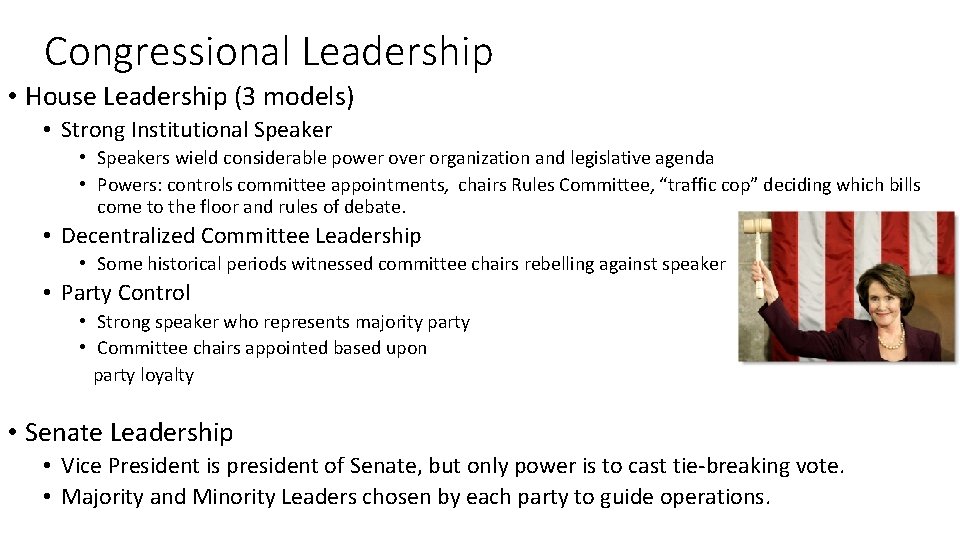
Congressional Leadership • House Leadership (3 models) • Strong Institutional Speaker • Speakers wield considerable power over organization and legislative agenda • Powers: controls committee appointments, chairs Rules Committee, “traffic cop” deciding which bills come to the floor and rules of debate. • Decentralized Committee Leadership • Some historical periods witnessed committee chairs rebelling against speaker • Party Control • Strong speaker who represents majority party • Committee chairs appointed based upon party loyalty • Senate Leadership • Vice President is president of Senate, but only power is to cast tie-breaking vote. • Majority and Minority Leaders chosen by each party to guide operations.
Majority Rule and Compromise in Congressional Deliberation • Bill vs. Resolution • Simple Resolutions address rules or express sentiments of Congress • Joint Resolutions device for proposing Amendments or other matters. If signed (or override), has force of law • Most proposals take form of a bill • Bills introduced in either House (revenue bills must begin in House) • Numbers with prefix S or H • The process is as follows… • Bill must win majority support at each phase • Sponsors of bill must be persistent and willing to compromise • Lawmaking process demonstrates American system of representative gov’t, limited gov’t and checks and balances at work. • Law Craft
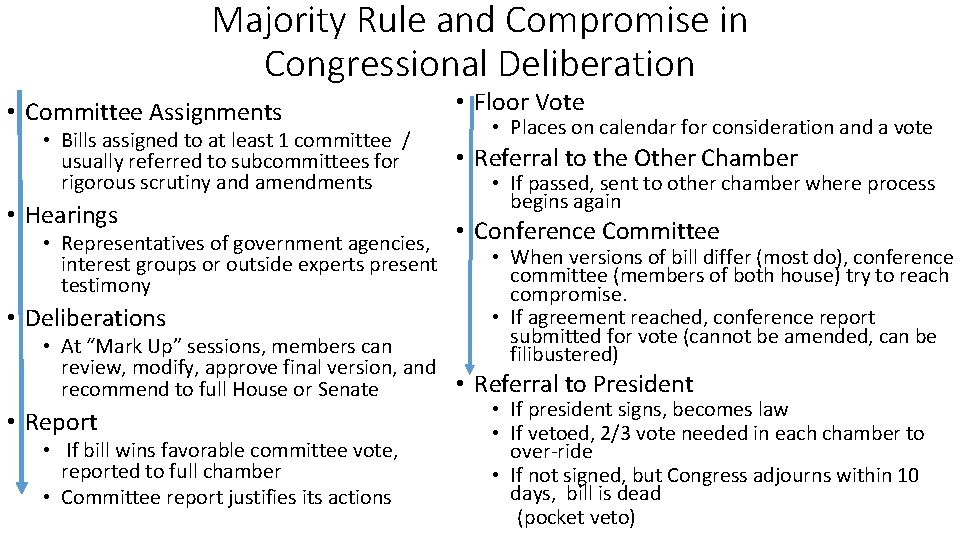
Majority Rule and Compromise in Congressional Deliberation • Committee Assignments • Bills assigned to at least 1 committee / usually referred to subcommittees for rigorous scrutiny and amendments • Hearings • Floor Vote • Places on calendar for consideration and a vote • Referral to the Other Chamber • If passed, sent to other chamber where process begins again • Representatives of government agencies, • Conference Committee • When versions of bill differ (most do), conference interest groups or outside experts present committee (members of both house) try to reach testimony compromise. • If agreement reached, conference report • Deliberations submitted for vote (cannot be amended, can be • At “Mark Up” sessions, members can filibustered) review, modify, approve final version, and • Referral to President recommend to full House or Senate • If president signs, becomes law • Report • If vetoed, 2/3 vote needed in each chamber to • If bill wins favorable committee vote, over-ride reported to full chamber • If not signed, but Congress adjourns within 10 days, bill is dead • Committee report justifies its actions (pocket veto)
Ideas for Legislation & Deciding Which Bills to Support • Campaign Promises • Responses to Crisis • Legislation Introduced by Others • Library of Congress and Congressional Budget Office provide research, analysis, and projected costs. • Executive Branch • President outlines legislative agenda at State of the Union • Party members sponsor president’s legislation • Legislation also introduces by Executive departments / agencies • Constituents recommend enactment or repeal of laws through various forms of communication (letters, opinion polls, blogs) • Interest Groups • Organizations, industries, and interest groups employ lobbyists to help influence legislation • Reflects right to free speech, assembly, and petition • Effective Lobbyists are well-informed on issue, knowledgeable of process, wellorganized, and cooperative.
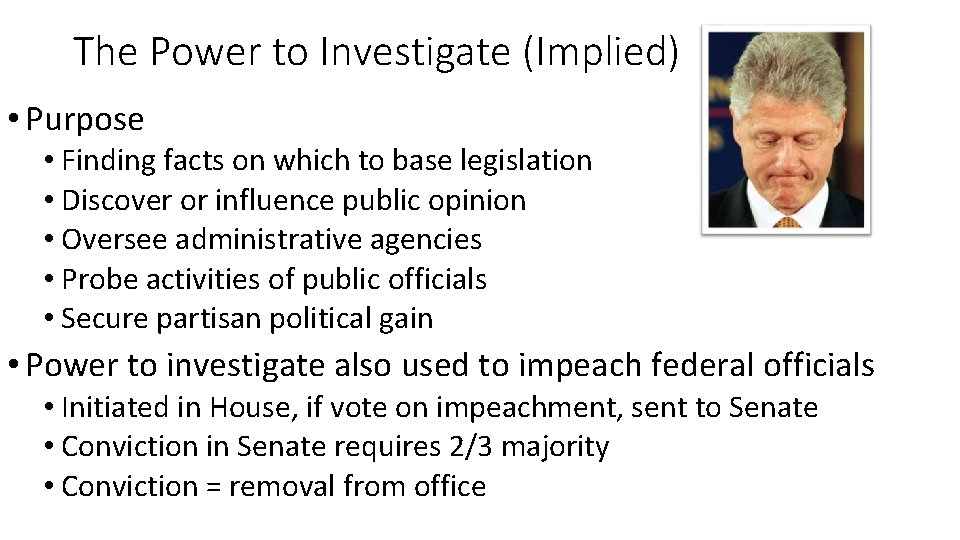
The Power to Investigate (Implied) • Purpose • Finding facts on which to base legislation • Discover or influence public opinion • Oversee administrative agencies • Probe activities of public officials • Secure partisan political gain • Power to investigate also used to impeach federal officials • Initiated in House, if vote on impeachment, sent to Senate • Conviction in Senate requires 2/3 majority • Conviction = removal from office
- Slides: 10