
Bell Ringer 1 What is the Rational Root
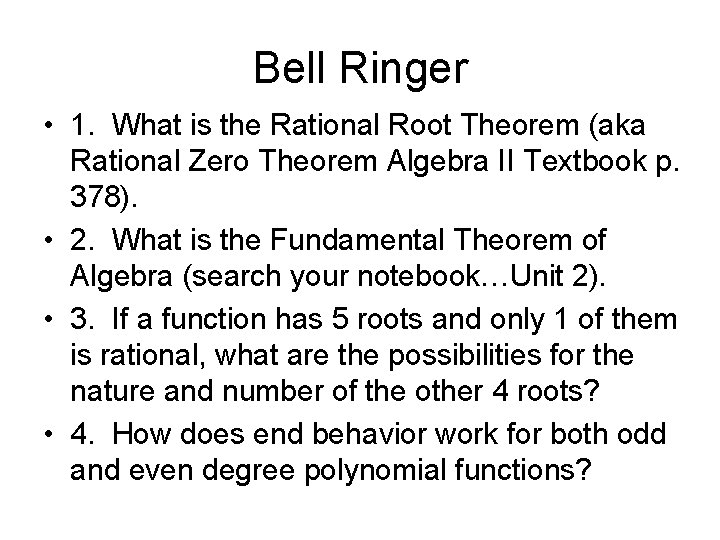
Bell Ringer • 1. What is the Rational Root Theorem (aka Rational Zero Theorem Algebra II Textbook p. 378). • 2. What is the Fundamental Theorem of Algebra (search your notebook…Unit 2). • 3. If a function has 5 roots and only 1 of them is rational, what are the possibilities for the nature and number of the other 4 roots? • 4. How does end behavior work for both odd and even degree polynomial functions?
Applying the Rational Root Theorem Monday, October 12, 2015
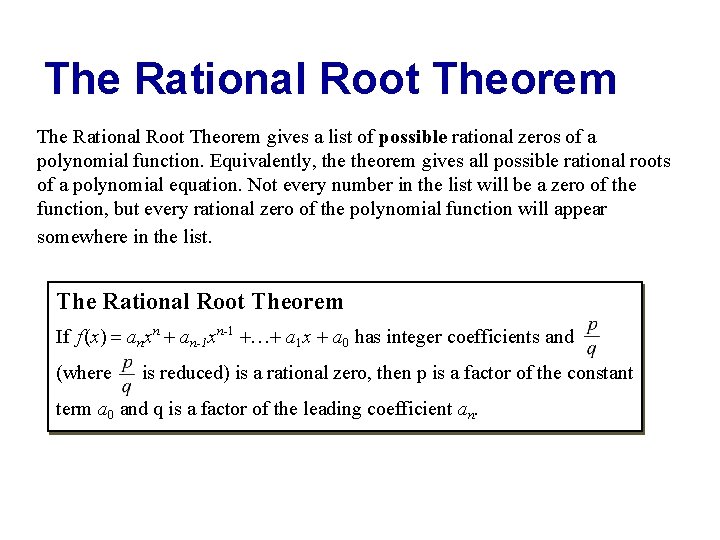
The Rational Root Theorem gives a list of possible rational zeros of a polynomial function. Equivalently, theorem gives all possible rational roots of a polynomial equation. Not every number in the list will be a zero of the function, but every rational zero of the polynomial function will appear somewhere in the list. The Rational Root Theorem If f (x) = anxn + an-1 xn-1 +…+ a 1 x + a 0 has integer coefficients and (where is reduced) is a rational zero, then p is a factor of the constant term a 0 and q is a factor of the leading coefficient an.
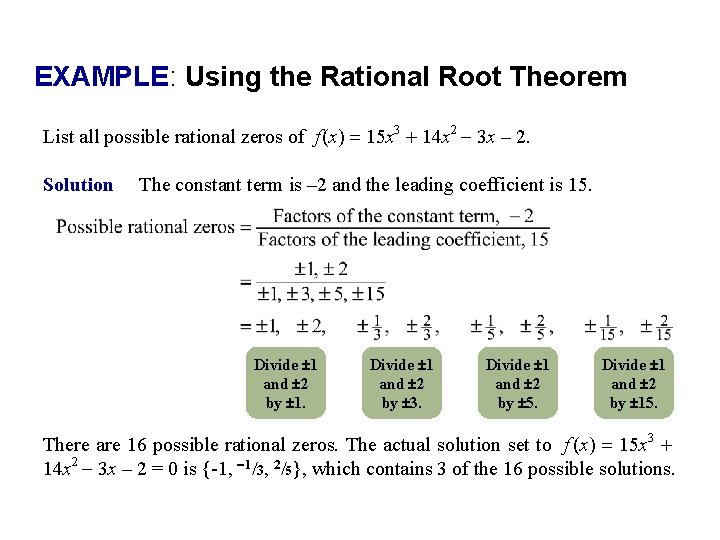
EXAMPLE: Using the Rational Root Theorem List all possible rational zeros of f (x) = 15 x 3 + 14 x 2 - 3 x – 2. Solution The constant term is – 2 and the leading coefficient is 15. Divide 1 and 2 by 1. Divide 1 and 2 by 3. Divide 1 and 2 by 5. Divide 1 and 2 by 15. There are 16 possible rational zeros. The actual solution set to f (x) = 15 x 3 + 14 x 2 - 3 x – 2 = 0 is {-1, -1/3, 2/5}, which contains 3 of the 16 possible solutions.
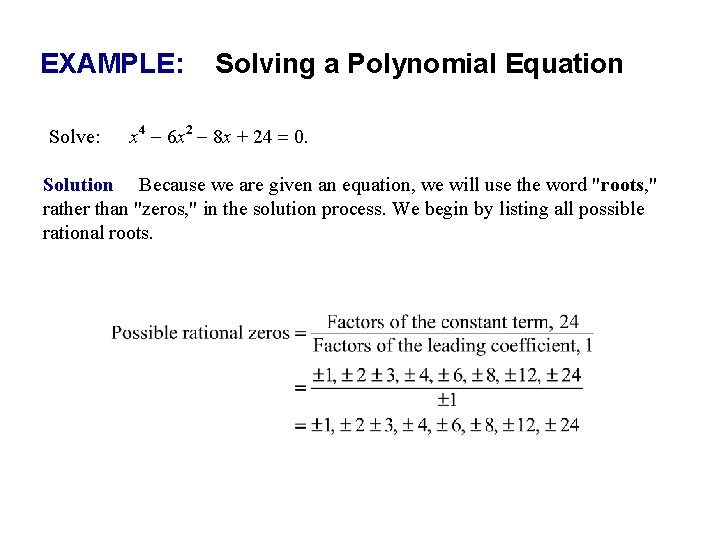
EXAMPLE: Solve: Solving a Polynomial Equation x 4 - 6 x 2 - 8 x + 24 = 0. Solution Because we are given an equation, we will use the word "roots, " rather than "zeros, " in the solution process. We begin by listing all possible rational roots.
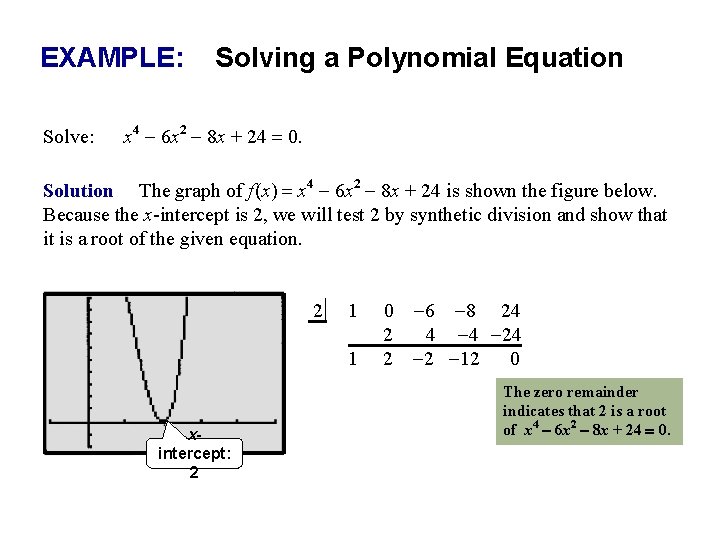
EXAMPLE: Solve: Solving a Polynomial Equation x 4 - 6 x 2 - 8 x + 24 = 0. Solution The graph of f (x) = x 4 - 6 x 2 - 8 x + 24 is shown the figure below. Because the x-intercept is 2, we will test 2 by synthetic division and show that it is a root of the given equation. 2 1 1 xintercept: 2 0 -6 -8 24 2 4 -4 -24 2 -2 -12 0 The zero remainder indicates that 2 is a root of x 4 - 6 x 2 - 8 x + 24 = 0.
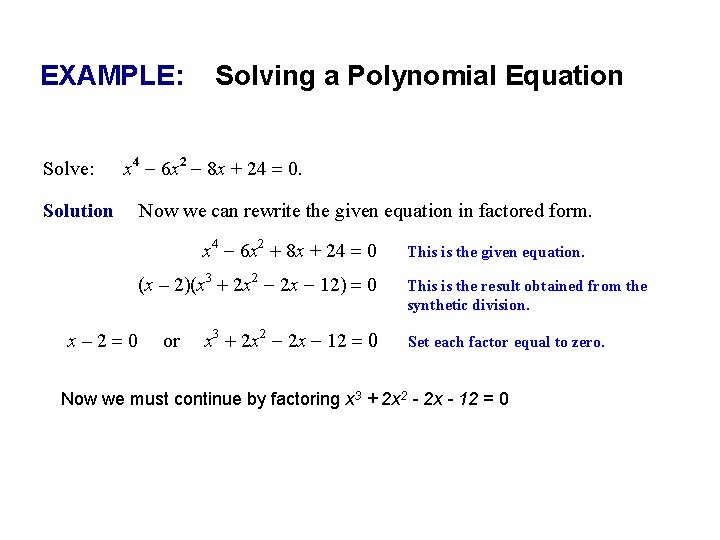
EXAMPLE: Solve: Solving a Polynomial Equation x 4 - 6 x 2 - 8 x + 24 = 0. Solution Now we can rewrite the given equation in factored form. x 4 - 6 x 2 + 8 x + 24 = 0 (x – 2)(x 3 + 2 x 2 - 2 x - 12) = 0 x– 2=0 or x 3 + 2 x 2 - 2 x - 12 = 0 This is the given equation. This is the result obtained from the synthetic division. Set each factor equal to zero. Now we must continue by factoring x 3 + 2 x 2 - 2 x - 12 = 0
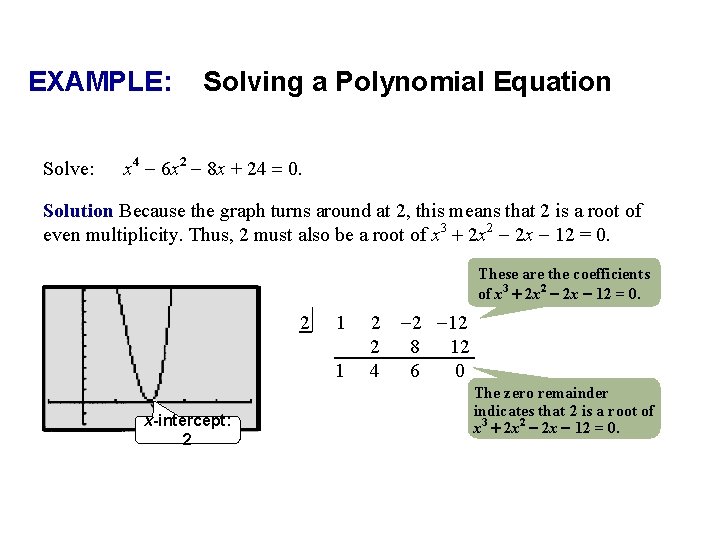
EXAMPLE: Solve: Solving a Polynomial Equation x 4 - 6 x 2 - 8 x + 24 = 0. Solution Because the graph turns around at 2, this means that 2 is a root of even multiplicity. Thus, 2 must also be a root of x 3 + 2 x 2 - 2 x - 12 = 0. These are the coefficients of x 3 + 2 x 2 - 2 x - 12 = 0. 2 1 1 x-intercept: 2 2 -2 -12 2 8 12 4 6 0 The zero remainder indicates that 2 is a root of x 3 + 2 x 2 - 2 x - 12 = 0.
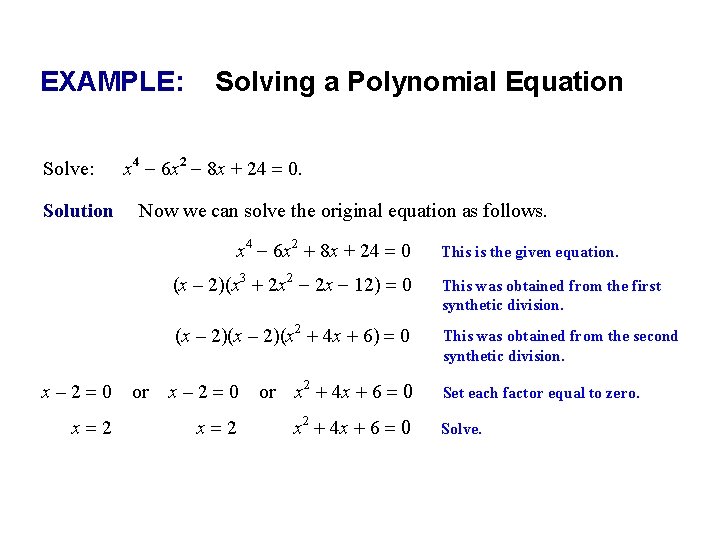
EXAMPLE: Solve: Solution Solving a Polynomial Equation x 4 - 6 x 2 - 8 x + 24 = 0. Now we can solve the original equation as follows. x 4 - 6 x 2 + 8 x + 24 = 0 x– 2=0 x=2 or This is the given equation. (x – 2)(x 3 + 2 x 2 - 2 x - 12) = 0 This was obtained from the first synthetic division. (x – 2)(x 2 + 4 x + 6) = 0 This was obtained from the second synthetic division. x– 2=0 x=2 or x 2 + 4 x + 6 = 0 Set each factor equal to zero. x 2 + 4 x + 6 = 0 Solve.
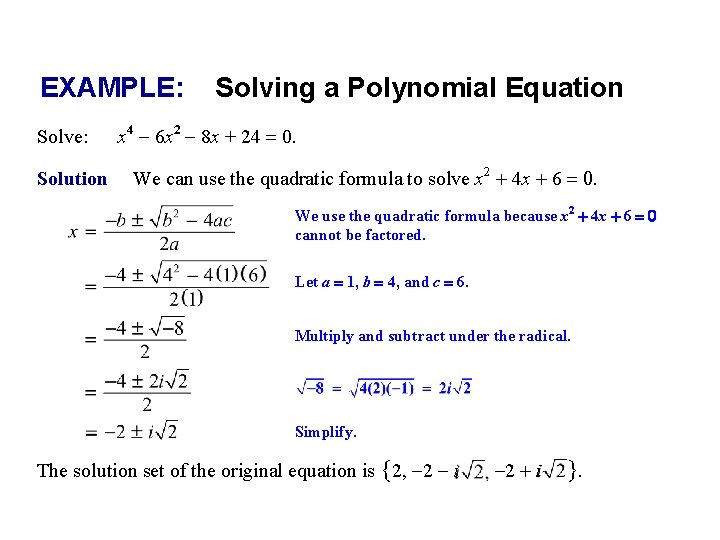
EXAMPLE: Solve: Solution Solving a Polynomial Equation x 4 - 6 x 2 - 8 x + 24 = 0. We can use the quadratic formula to solve x 2 + 4 x + 6 = 0. We use the quadratic formula because x 2 + 4 x + 6 = 0 cannot be factored. Let a = 1, b = 4, and c = 6. Multiply and subtract under the radical. Simplify. The solution set of the original equation is {2, -2 - i -2 + i }.
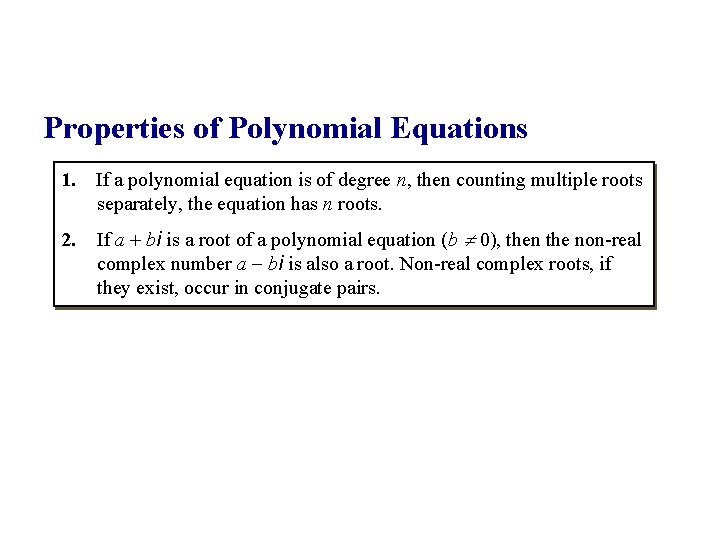
Properties of Polynomial Equations 1. If a polynomial equation is of degree n, then counting multiple roots separately, the equation has n roots. 2. If a + bi is a root of a polynomial equation (b 0), then the non-real complex number a - bi is also a root. Non-real complex roots, if they exist, occur in conjugate pairs.
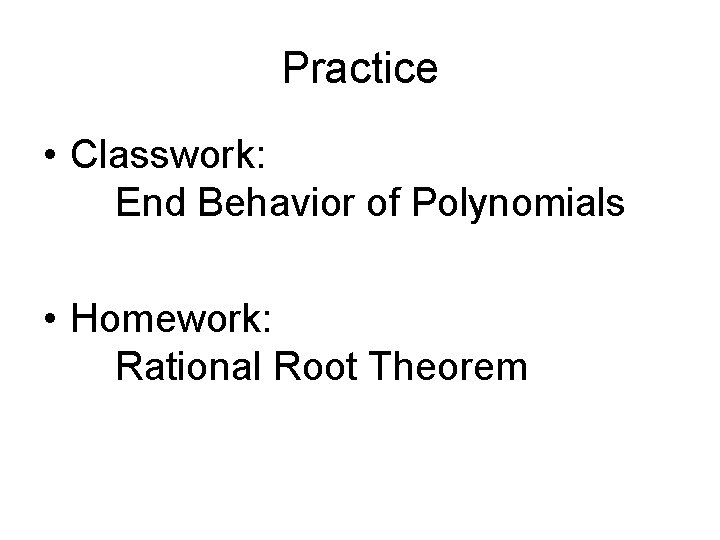
Practice • Classwork: End Behavior of Polynomials • Homework: Rational Root Theorem
- Slides: 12