
Belize Census 2020 An Integration between Geospatial Information
Belize Census 2020: An Integration between Geospatial Information and Statistics Maritza Canto System Development & Data Processing
Table of Contents • Statistical Institute of Belize (SIB) and Census • Role of Census Mapping • Census Mapping Methodology in 2010 • Census Mapping Methodology in 2020 • Linking census mapping with Survey Solutions • Future Linking of GIS and other statistical data
SIB and Census • Census is the most important statistical collection undertaken by SIB • Census: Collect, compile, Evaluate, Analyze & Disseminate information • Census in Belize has been recorded since December 1816. • Census Mapping was introduced in 2010
Role of Census Mapping Pre-Enumeration – Ensure map consistency and facilitating census operation Enumeration – Supporting data collection stage in order to eliminate overlapping or omission of enumeration areas and also can help to monitor census activities Post-Enumeration – Maps makes it easier to present, analyse, and disseminate census results by using spatial analysis techniques for producing statistical thematic maps.
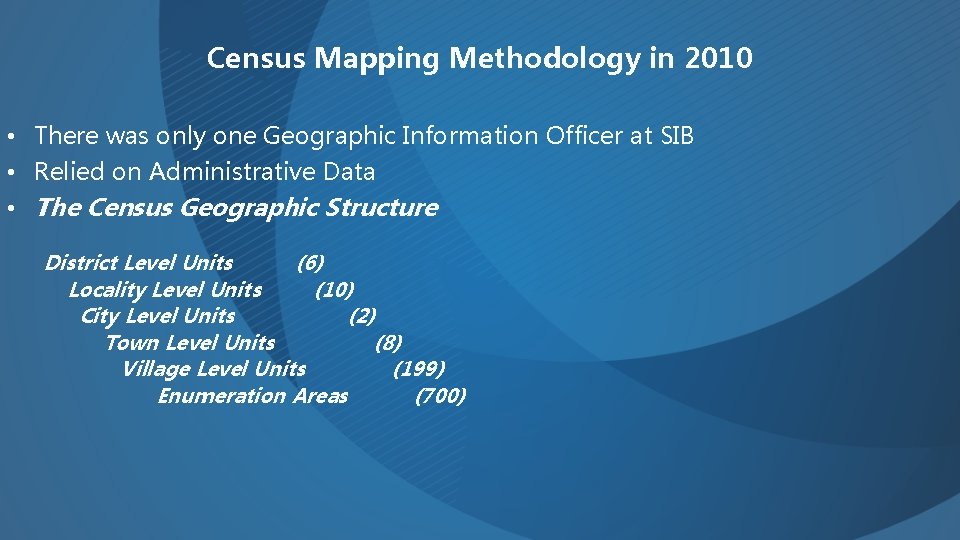
Census Mapping Methodology in 2010 • There was only one Geographic Information Officer at SIB • Relied on Administrative Data • The Census Geographic Structure District Level Units (6) Locality Level Units (10) City Level Units (2) Town Level Units (8) Village Level Units (199) Enumeration Areas (700)
Census Mapping Methodology in 2020 Formation of the GIS Unit at SIB The SIB established the GIS Unit within the System Development & Data Processing Department Function of the GIS unit - Updating the enumeration district spatial database by conducting the census mapping exercise - Assist with the design and implementation of a Master Sample Frame - Increasing the accuracy and effectiveness of census and survey data collection - Building an accurate geo-statistical database
Census Mapping Methodology 2020 Cont’d • Existing base data within SIB - visitation records from recent surveys - Listing exercise data collected in 2017 - Enumeration Boundaries - Building Footprints, Building Points - Road and Rivers • Existing base data from other organization - Parcel/Cadastral Data - Administrative Boundaries – Country, District - Electoral Divisions
Census Mapping Methodology in 2020 Cont’d GIS Software and Hardware • Arc. GIS desktop for Advanced 10. 5 • Arc. GIS Online • Trimble TDC (1 -2 m) • Collector for Arc. GIS
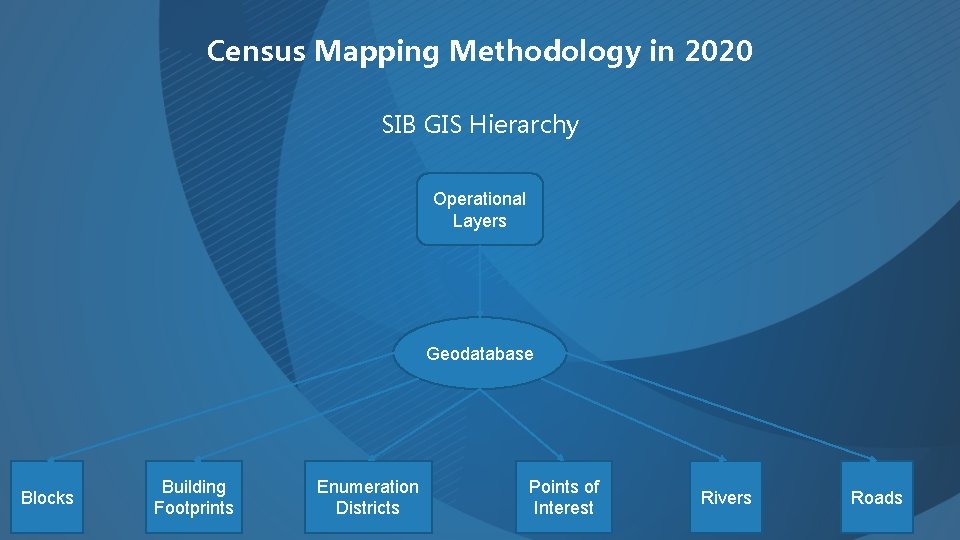
Census Mapping Methodology in 2020 SIB GIS Hierarchy Operational Layers Geodatabase Blocks Building Footprints Enumeration Districts Points of Interest Rivers Roads
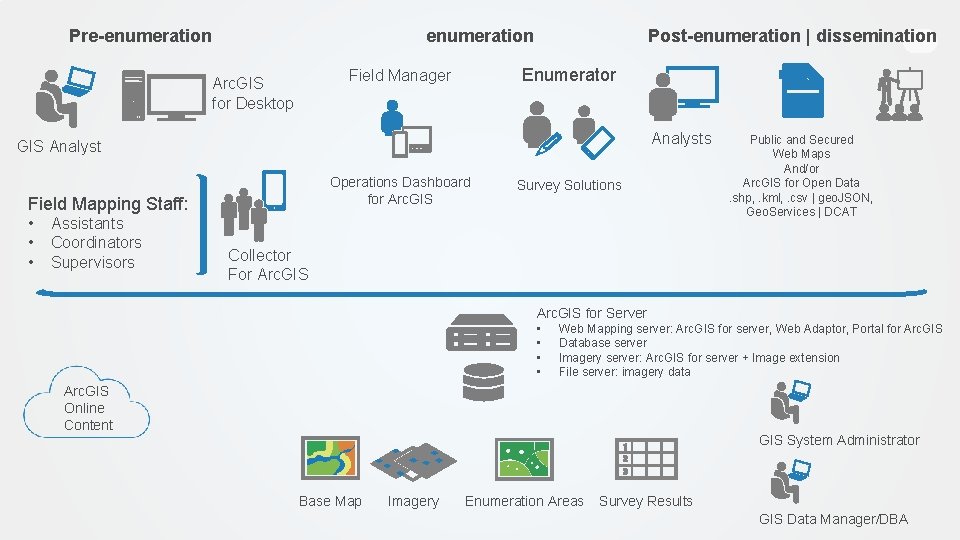
Pre-enumeration Enumerator Field Manager Arc. GIS for Desktop Post-enumeration | dissemination Analysts GIS Analyst Operations Dashboard for Arc. GIS Field Mapping Staff: • • • Assistants Coordinators Supervisors Survey Solutions Public and Secured Web Maps And/or Arc. GIS for Open Data. shp, . kml, . csv | geo. JSON, Geo. Services | DCAT Collector For Arc. GIS for Server • • Web Mapping server: Arc. GIS for server, Web Adaptor, Portal for Arc. GIS Database server Imagery server: Arc. GIS for server + Image extension File server: imagery data Arc. GIS Online Content GIS System Administrator Base Map Imagery Enumeration Areas Survey Results GIS Data Manager/DBA

Census Mapping Methodology 2020 Mobile Field Data Collection - Digitize Building Footprint from High Resolution ESRI Satellite Imagery - Digitize Road Network from ESRI Satellite Imagery - Digitize Road Network – Assist with Creation of Blocks - Creation of Web Map in Arc. GIS Online - Download web map on Collector for ARCGIS Installed on Trimble TDC 100 for offline use - Conduct ground truthing exercise to validate/update building footprint and road network - Collect attribute information (land-use and pictures) of each building footprint - Videos of buildings within a block were taken and pictures extracted and attached to corresponding buildings.
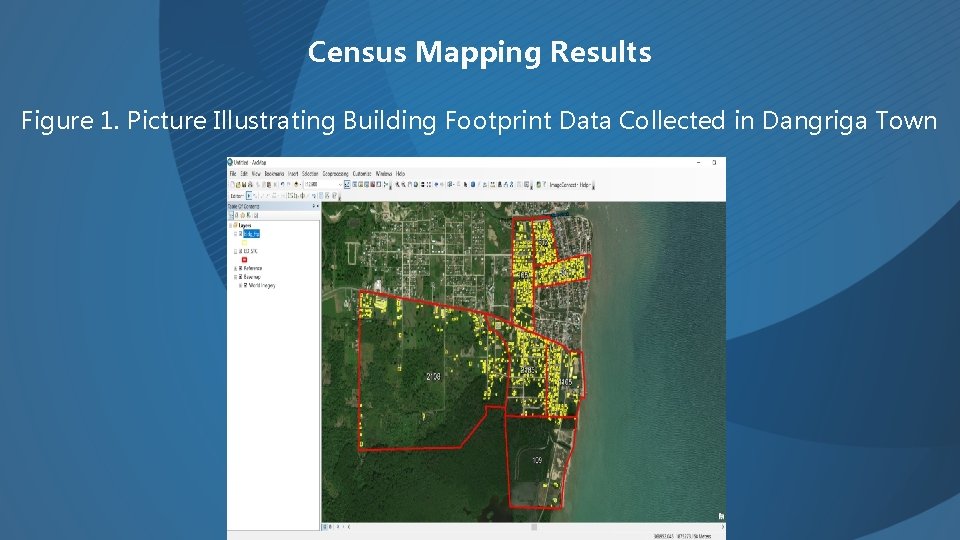
Census Mapping Results Figure 1. Picture Illustrating Building Footprint Data Collected in Dangriga Town
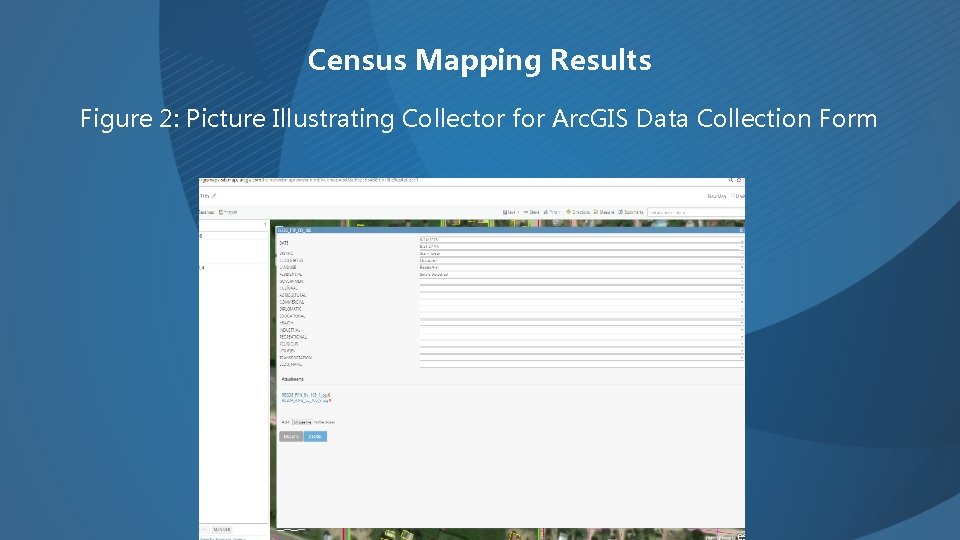
Census Mapping Results Figure 2: Picture Illustrating Collector for Arc. GIS Data Collection Form
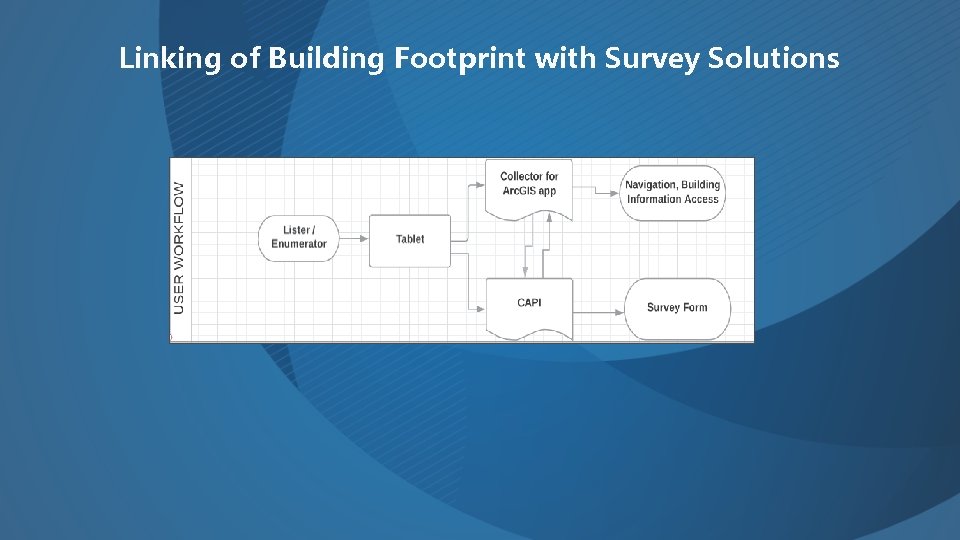
Linking of Building Footprint with Survey Solutions • Enumerator, uses Collector for Arc. GIS to Navigate to Buildings in their assigned Enumeration District. • Enumerator is in front of the building, he/she will click on the building point or building footprint on the Collector’s App map which will show a pop-up box with information. The Pop-up box shows: Building Unique Identifier (BUID) Building Picture Street Name (optional) • The Lister/Enumerator copy the BUID and switches to the Survey Solutions CAPI app, opens a survey form and enters the BUID, which is then followed by Dwelling Number and/or Household Number, which then follows questions regarding Census 2020.
Linking of Building Footprint with Survey Solutions
Linking of Building Footprint with Survey Solutions BUID Assignment • BUID is assigned to Existing Buildings • Building are Numbered from 0001 to 99, 000, in the order of ten (10), example, 00010, 00020, 00030, 00040, etc. • If a new building is encountered, the new building is assigned the increment of one (1), by the previous building encountered, example, 00011, 00021, 00032, etc. BUID Formation • Building Unique ID = (District# - Grid Code - CTV Code – Building #) Example: Toledo District #= 6 Grid Code = FEN CTV Code (San Benito Poite) = 50 Building # = 00010 BUID = 6 FEN 5000010
Future Linking of GIS and Statistical Data Business Register Belize National Statistical System Belize National Spatial Data Infrastructure

Keep in touch http: //www. facebook. com/belizestatistics/ Sign up to receive emails of our releases http: //www. sib. org. bz/contact-us For more information, visit our website http: //www. sib. org. bz
- Slides: 18