
Belief Propagation in a Continuous World Andrew Frank

Belief Propagation in a Continuous World Andrew Frank 11/02/2009 Joint work with Alex Ihler and Padhraic Smyth
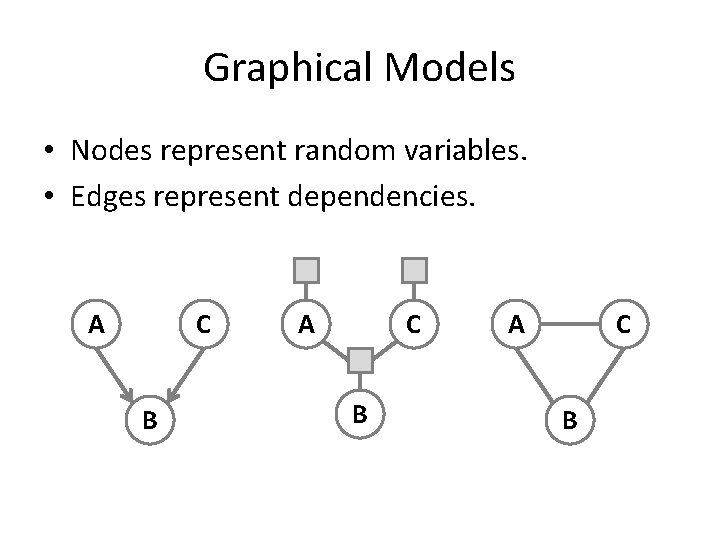
Graphical Models • Nodes represent random variables. • Edges represent dependencies. A C B
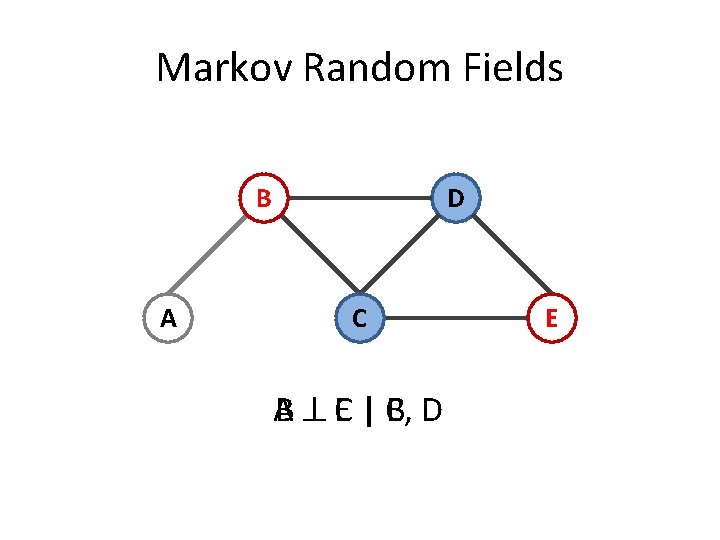
Markov Random Fields B A D C A B C E | C, B D E
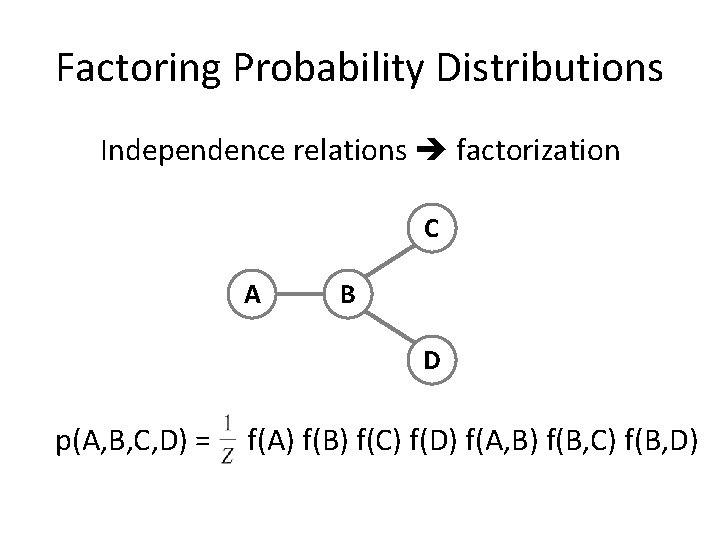
Factoring Probability Distributions Independence relations factorization C A B D p(A, B, C, D) = f(A) f(B) f(C) f(D) f(A, B) f(B, C) f(B, D)
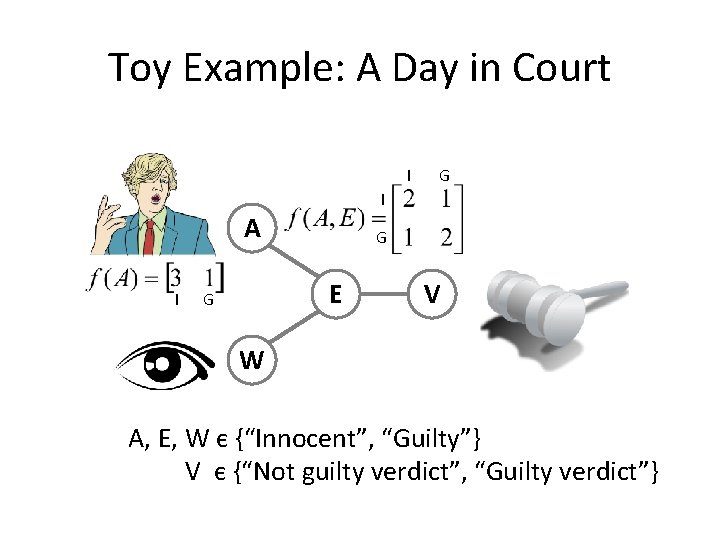
Toy Example: A Day in Court I G I A I G E G V W A, E, W є {“Innocent”, “Guilty”} V є {“Not guilty verdict”, “Guilty verdict”}
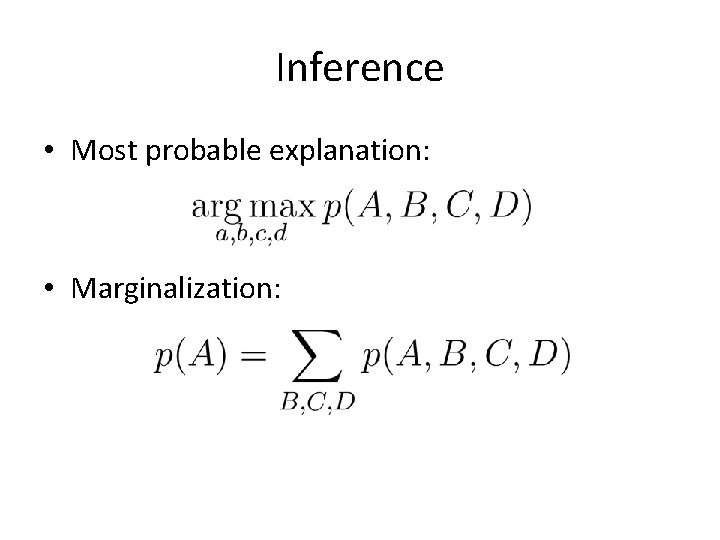
Inference • Most probable explanation: • Marginalization:
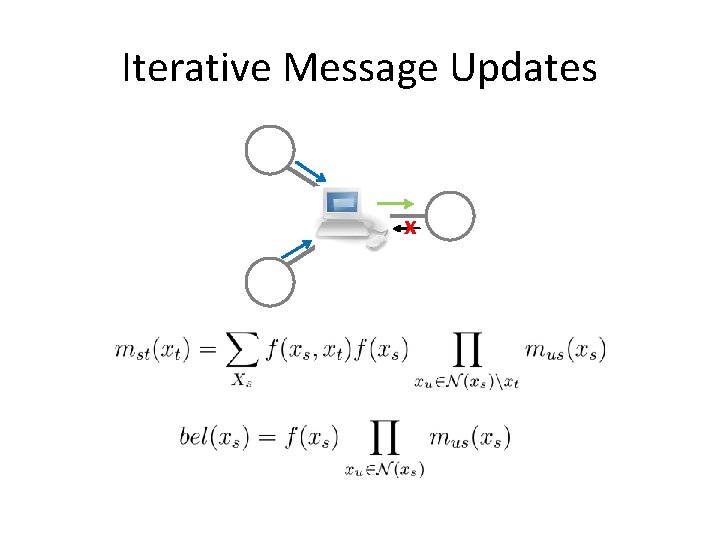
Iterative Message Updates x

Belief Propagation A m. AE(E) m. EV(V) E W m. WE(E) V
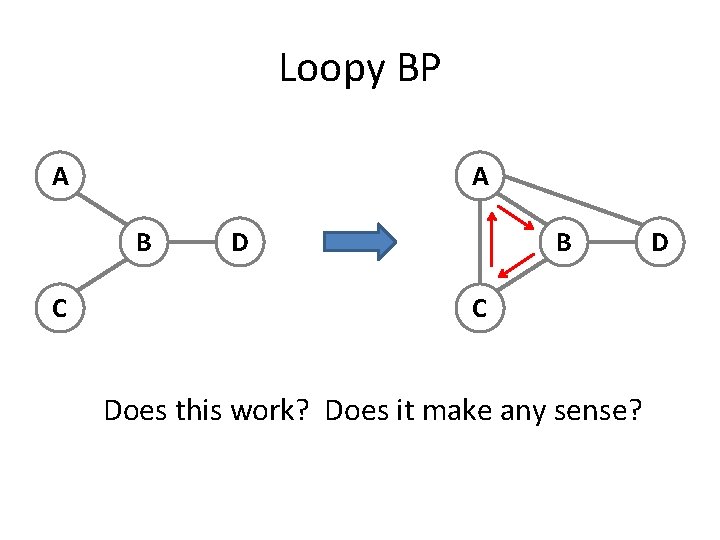
Loopy BP A A B C Does this work? Does it make any sense? D
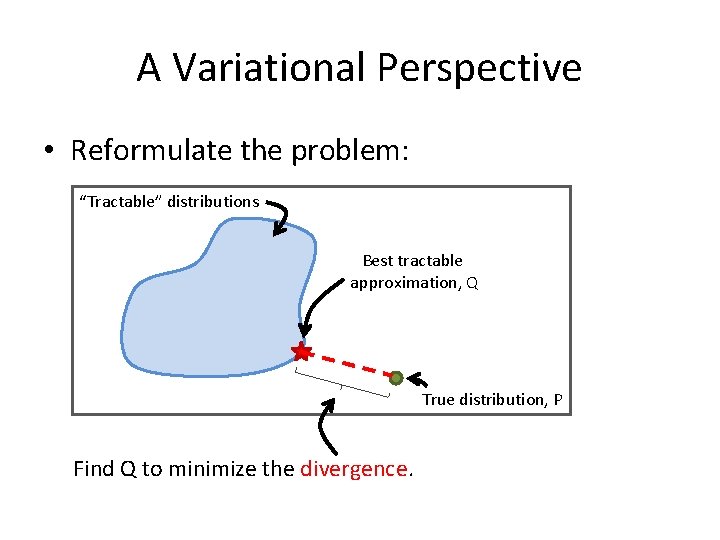
A Variational Perspective • Reformulate the problem: “Tractable” distributions Best tractable approximation, Q True distribution, P Find Q to minimize the divergence.
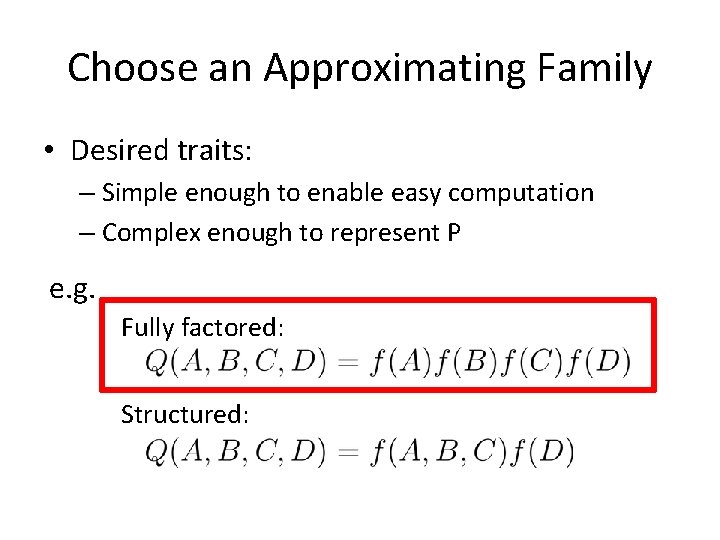
Choose an Approximating Family • Desired traits: – Simple enough to enable easy computation – Complex enough to represent P e. g. Fully factored: Structured:
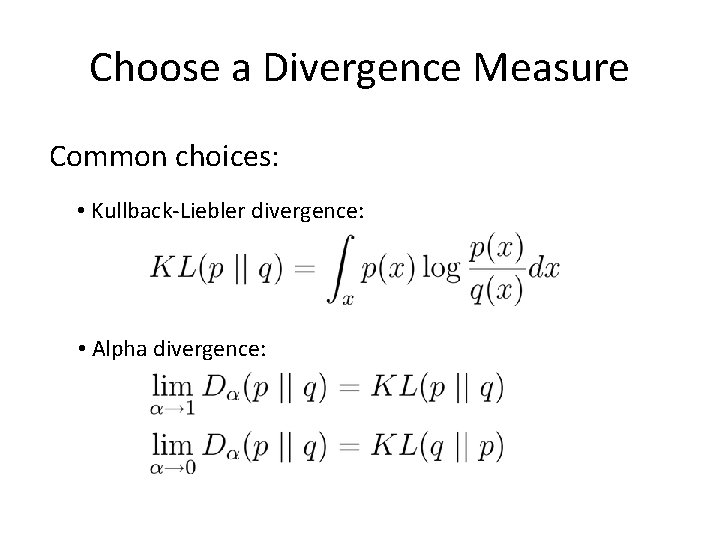
Choose a Divergence Measure Common choices: • Kullback-Liebler divergence: • Alpha divergence:
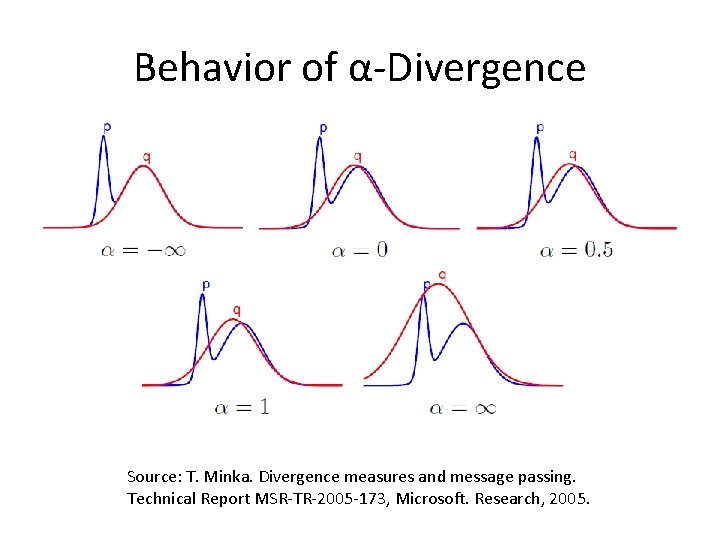
Behavior of α-Divergence Source: T. Minka. Divergence measures and message passing. Technical Report MSR-TR-2005 -173, Microsoft. Research, 2005.
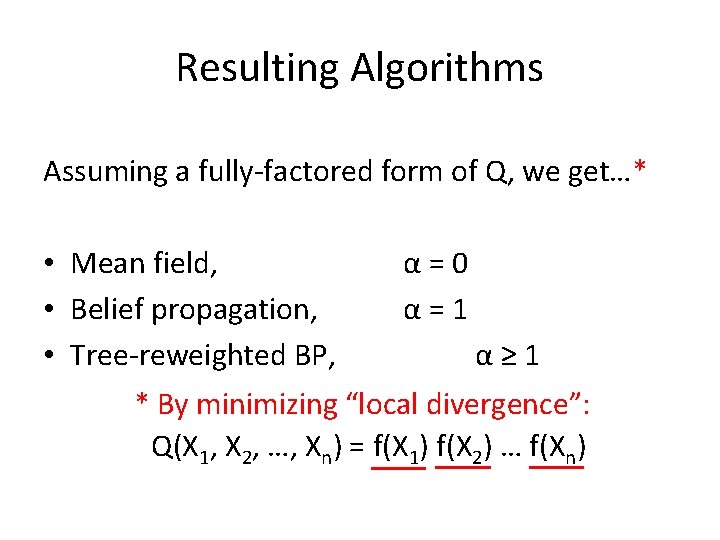
Resulting Algorithms Assuming a fully-factored form of Q, we get…* • Mean field, α=0 • Belief propagation, α=1 • Tree-reweighted BP, α≥ 1 * By minimizing “local divergence”: Q(X 1, X 2, …, Xn) = f(X 1) f(X 2) … f(Xn)
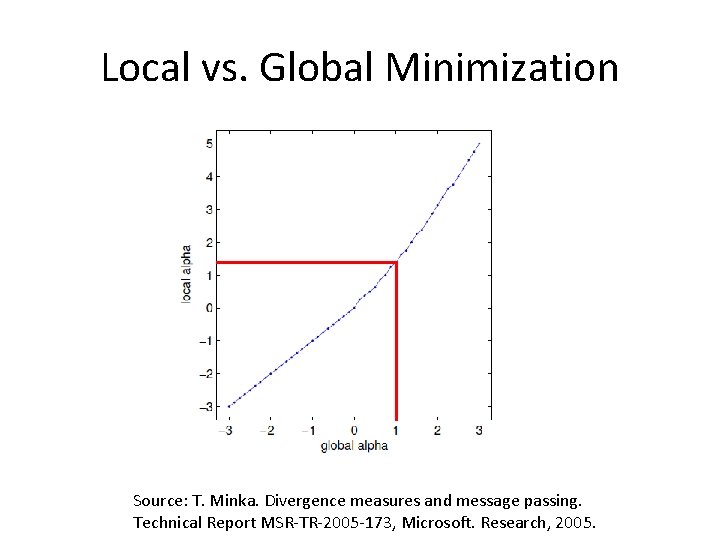
Local vs. Global Minimization Source: T. Minka. Divergence measures and message passing. Technical Report MSR-TR-2005 -173, Microsoft. Research, 2005.

Applications
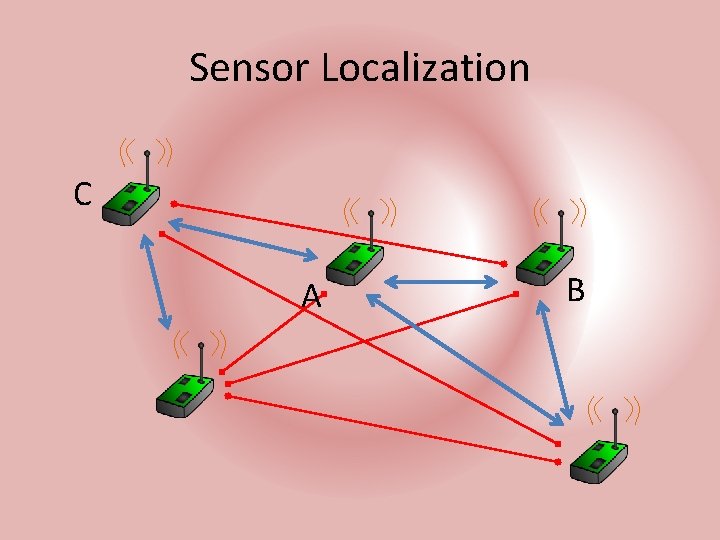
Sensor Localization C A B
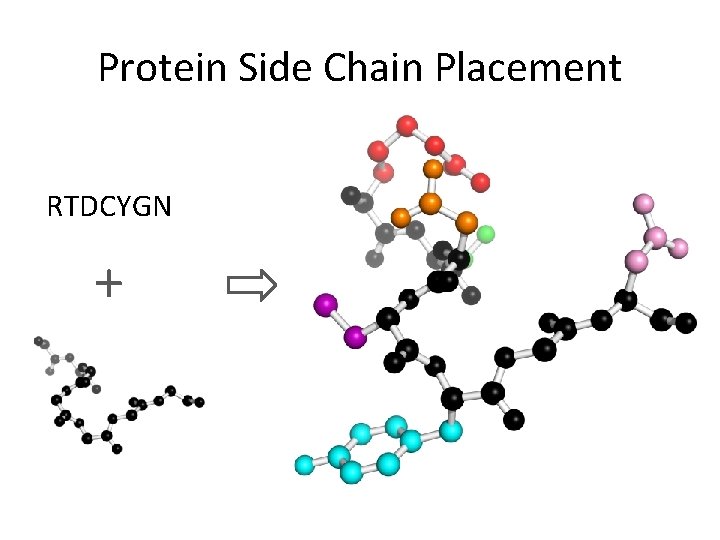
Protein Side Chain Placement RTDCYGN +
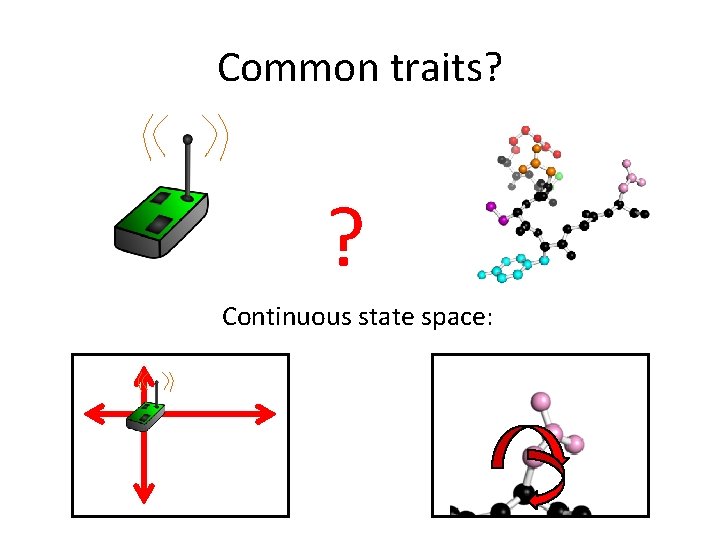
Common traits? ? Continuous state space:
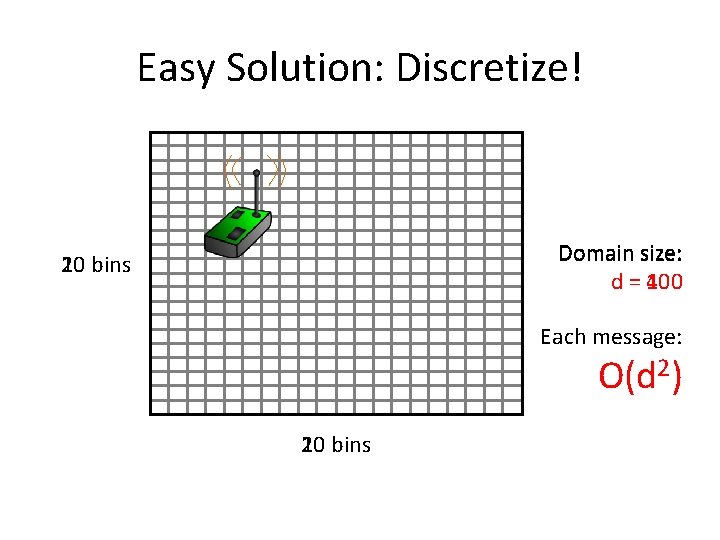
Easy Solution: Discretize! Domain size: d = 400 100 20 10 bins Each message: O(d 2) 20 10 bins
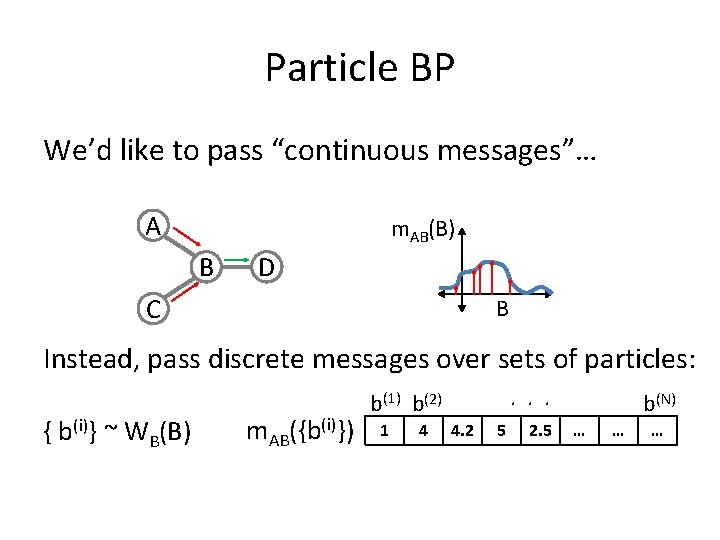
Particle BP We’d like to pass “continuous messages”… A m. AB(B) B D C B Instead, pass discrete messages over sets of particles: { b(i)} ~ WB(B) m. AB({b(i)}) . . . b(1) b(2) 1 4 4. 2 5 2. 5 b(N) … … …
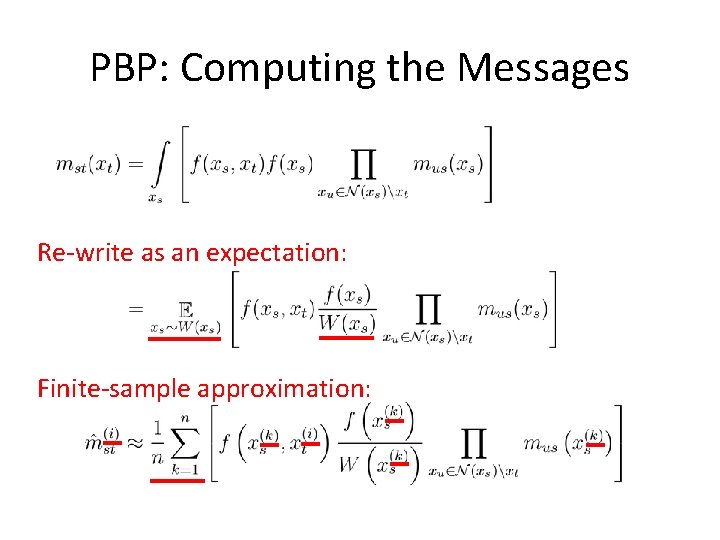
PBP: Computing the Messages Re-write as an expectation: Finite-sample approximation:
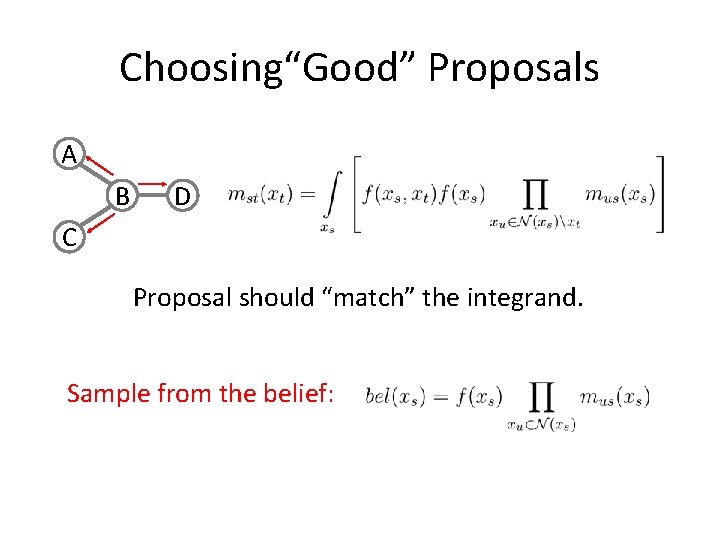
Choosing“Good” Proposals A B D C Proposal should “match” the integrand. Sample from the belief:
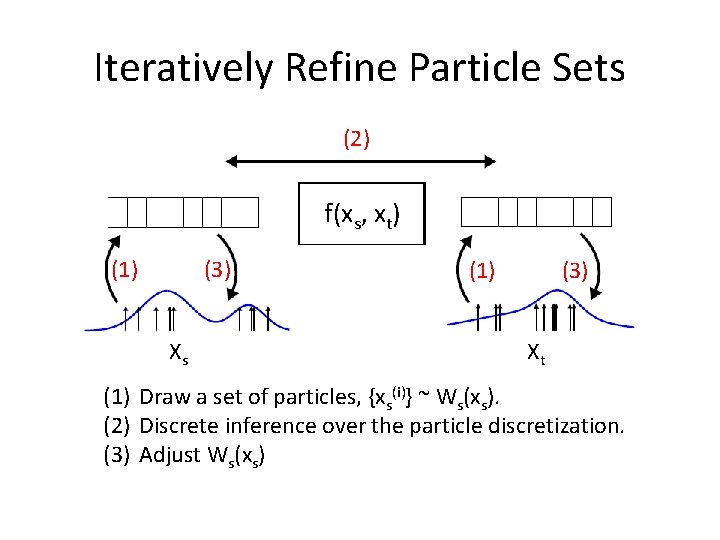
Iteratively Refine Particle Sets (2) f(xs, xt) (1) (3) Xs (1) (3) Xt (1) Draw a set of particles, {xs(i)} ~ Ws(xs). (2) Discrete inference over the particle discretization. (3) Adjust Ws(xs)
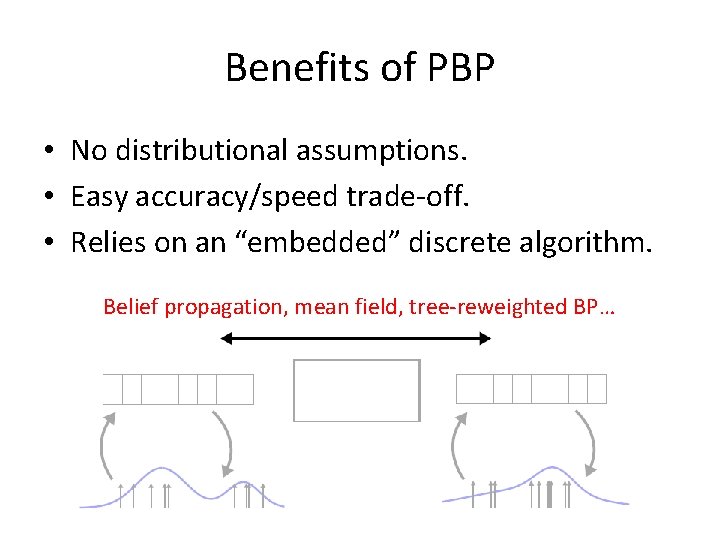
Benefits of PBP • No distributional assumptions. • Easy accuracy/speed trade-off. • Relies on an “embedded” discrete algorithm. Belief propagation, mean field, tree-reweighted BP…
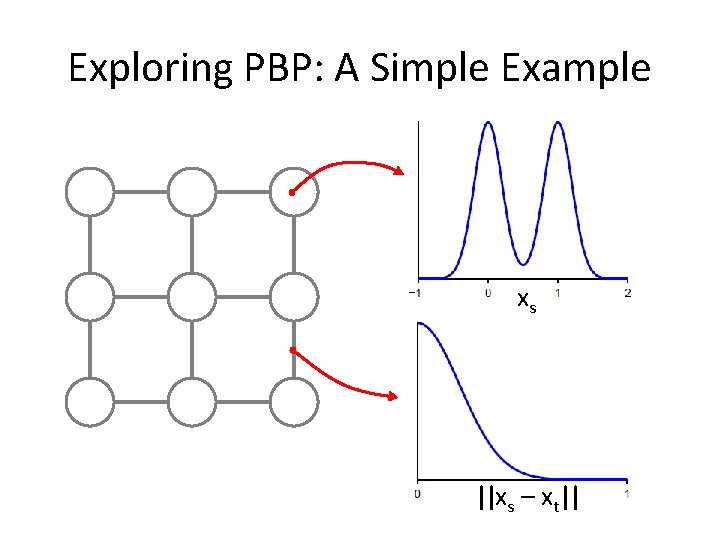
Exploring PBP: A Simple Example xs ||xs – xt||
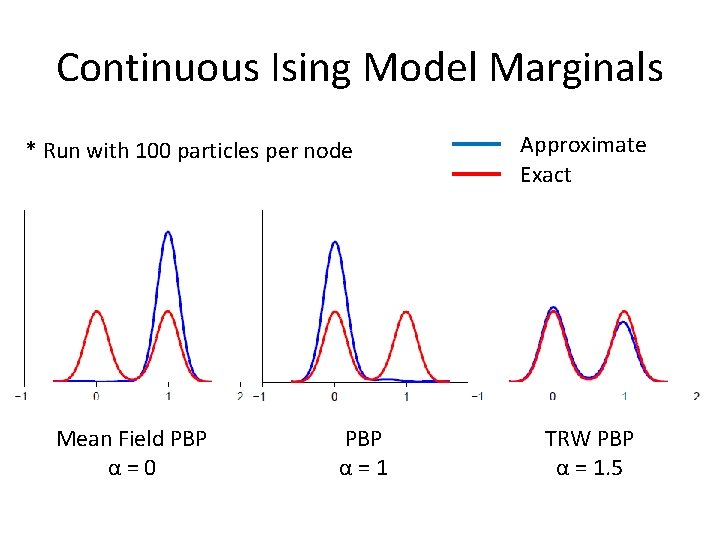
Continuous Ising Model Marginals * Run with 100 particles per node Mean Field PBP α=0 PBP α=1 Approximate Exact TRW PBP α = 1. 5
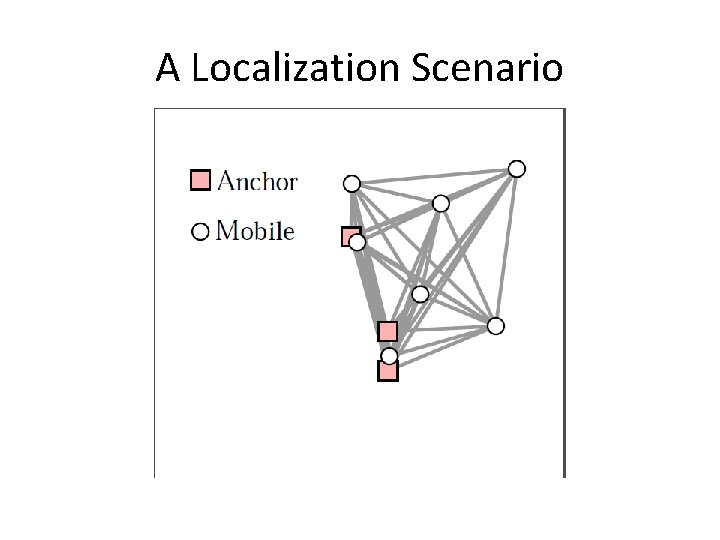
A Localization Scenario
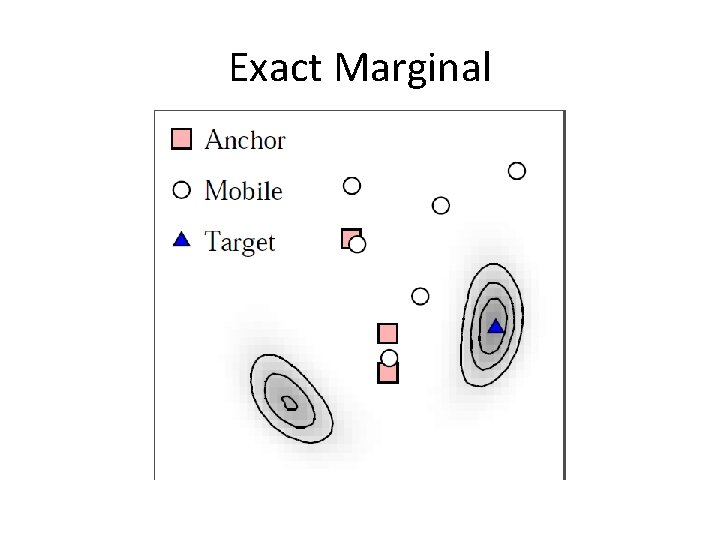
Exact Marginal
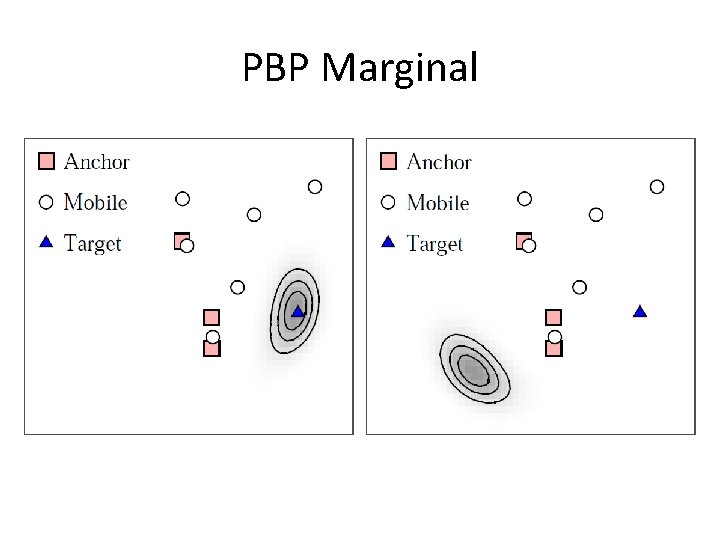
PBP Marginal
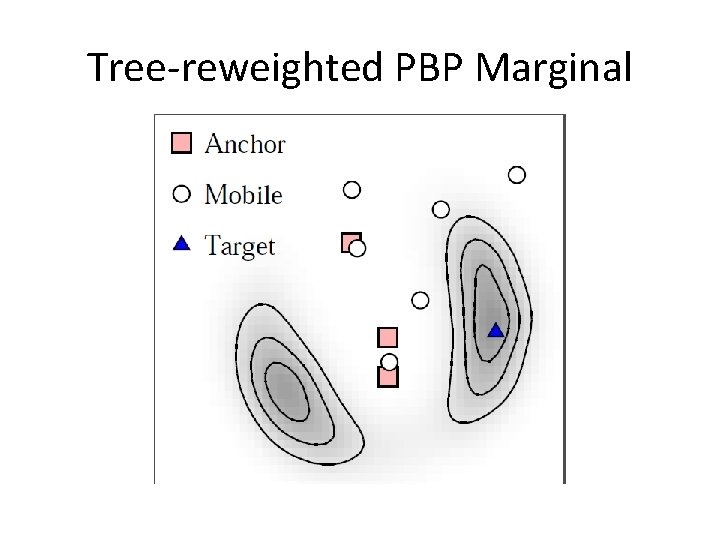
Tree-reweighted PBP Marginal
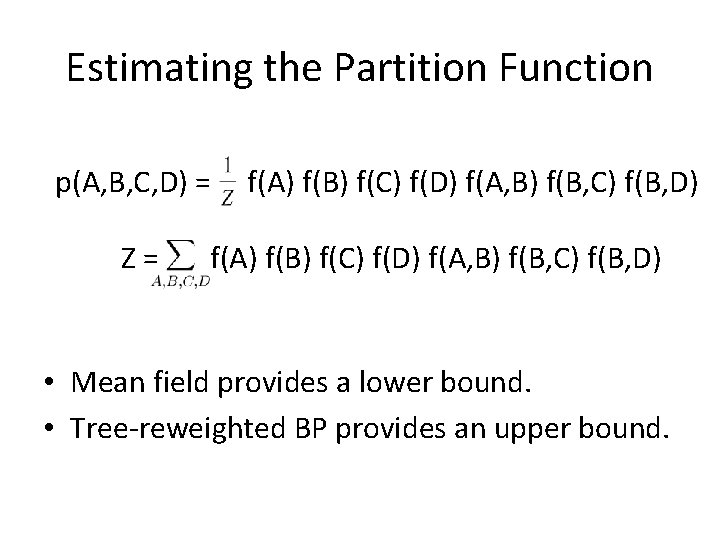
Estimating the Partition Function p(A, B, C, D) = Z= f(A) f(B) f(C) f(D) f(A, B) f(B, C) f(B, D) • Mean field provides a lower bound. • Tree-reweighted BP provides an upper bound.
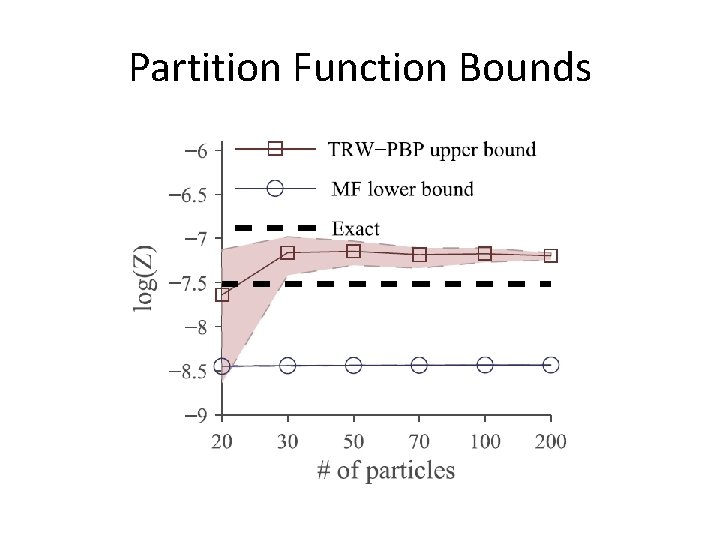
Partition Function Bounds
Conclusions • BP and related algorithms are useful! • Particle BP let’s you handle continuous RVs. • Extensions to BP can work with PBP, too. Thank You!
- Slides: 34