
Being Trauma Informed Responsive in Health Care Settings
Being Trauma Informed & Responsive in Health Care Settings
The Training Environment • Safety is priority • Voluntary participation • Demonstrate respect • Preserve confidentiality • Limit over-sharing of student or personal concerns • Encourage self-protection • Attend to self and others
PART I: Trauma & Sensory Processing 101
Part I Objectives By the end of this section, attendees will be able to: • Define traumatic stress, its characteristics and prevalence • Discuss the potential impacts of trauma on the developing brain & sensory processing • Discuss long term physical and mental health impacts of trauma • Discuss compassion fatigue and self-care strategies
Defining Trauma (3 Es) Trauma is an event, series of events, or set of circumstances that is experienced by an individual as physically or emotionally harmful or threatening and has lasting adverse effects on the individual's functioning and physical, social, emotional, or spiritual well-being. www. SAMHSA. gov
Trauma…. • is pervasive • can impact childhood development and behavior • has a far reaching and long lasting impact • affects how youth and families approach services designed to help them
Long Term Impacts: The Adverse Childhood Experiences (ACE) Study • 1997 study conducted by CDC & Kaiser Permanente • Surveyed 17, 000 adults (middle aged, white, middle income) • Counted adverse childhood experiences (up to 10) • 2/3 had at least one ACE; 12% had 4 or more Principal Investigators: R. Anda, MD, MS and V. Felitti, MD
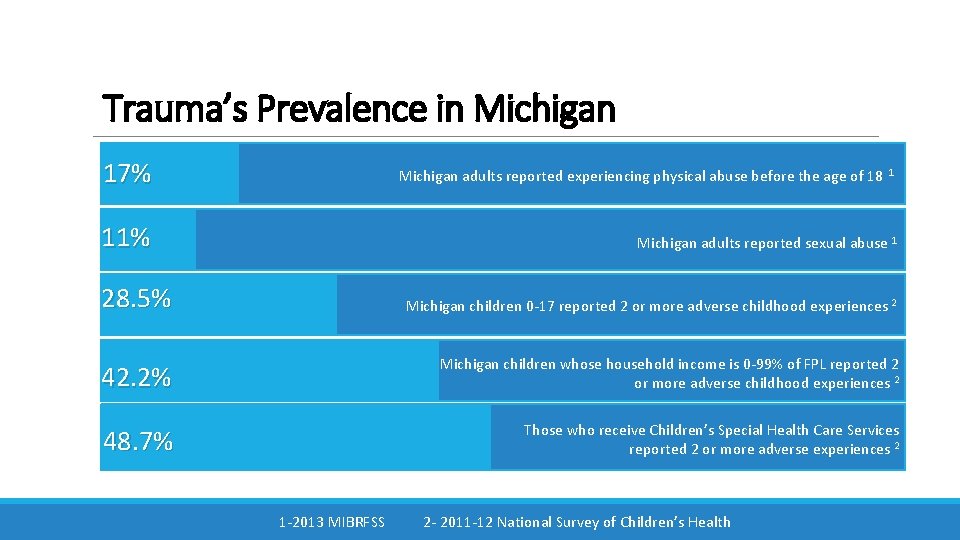
Trauma’s Prevalence in Michigan 17% Michigan adults reported experiencing physical abuse before the age of 18 1 11% Michigan adults reported sexual abuse 1 28. 5% Michigan children 0 -17 reported 2 or more adverse childhood experiences 2 42. 2% Michigan children whose household income is 0 -99% of FPL reported 2 or more adverse childhood experiences 2 48. 7% Those who receive Children’s Special Health Care Services reported 2 or more adverse experiences 2 1 -2013 MIBRFSS 2 - 2011 -12 National Survey of Children’s Health
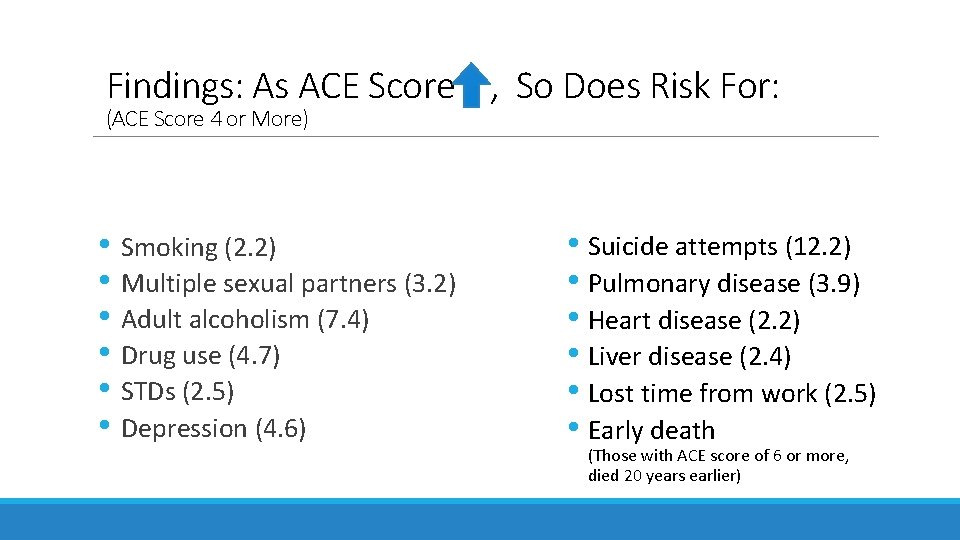
Findings: As ACE Score , So Does Risk For: (ACE Score 4 or More) • Smoking (2. 2) • Multiple sexual partners (3. 2) • Adult alcoholism (7. 4) • Drug use (4. 7) • STDs (2. 5) • Depression (4. 6) • Suicide attempts (12. 2) • Pulmonary disease (3. 9) • Heart disease (2. 2) • Liver disease (2. 4) • Lost time from work (2. 5) • Early death (Those with ACE score of 6 or more, died 20 years earlier)

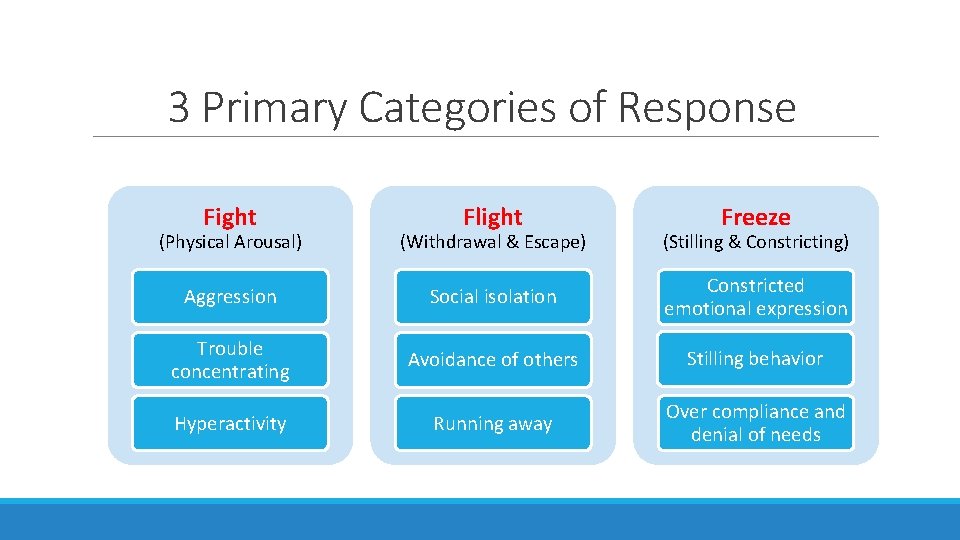
3 Primary Categories of Response Fight Flight Freeze (Physical Arousal) (Withdrawal & Escape) (Stilling & Constricting) Aggression Social isolation Constricted emotional expression Trouble concentrating Avoidance of others Stilling behavior Hyperactivity Running away Over compliance and denial of needs
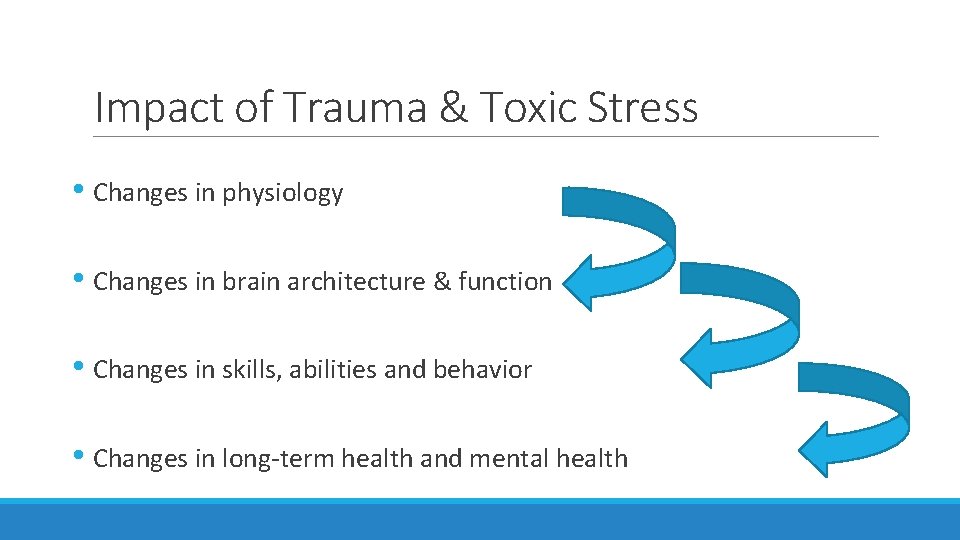
Impact of Trauma & Toxic Stress • Changes in physiology • Changes in brain architecture & function • Changes in skills, abilities and behavior • Changes in long-term health and mental health
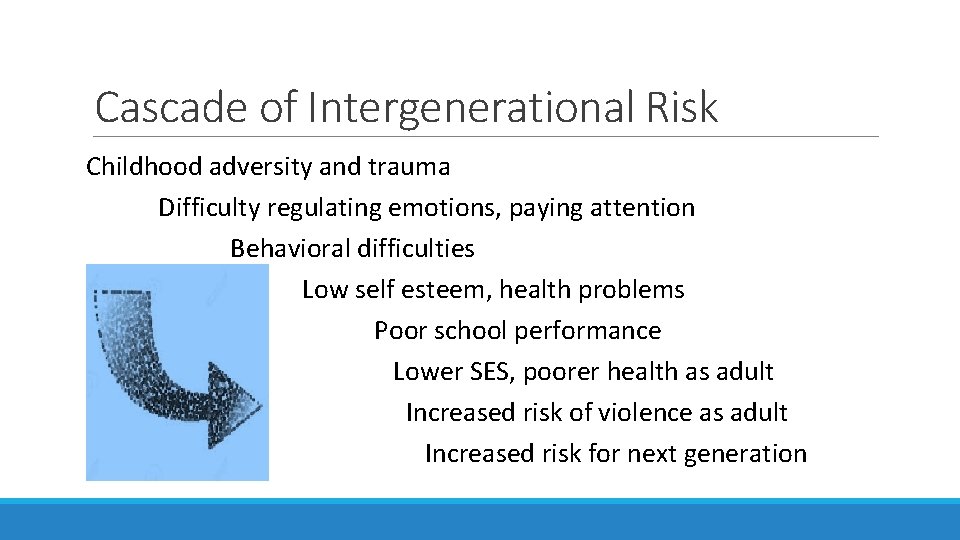
Cascade of Intergenerational Risk Childhood adversity and trauma Difficulty regulating emotions, paying attention Behavioral difficulties Low self esteem, health problems Poor school performance Lower SES, poorer health as adult Increased risk of violence as adult Increased risk for next generation
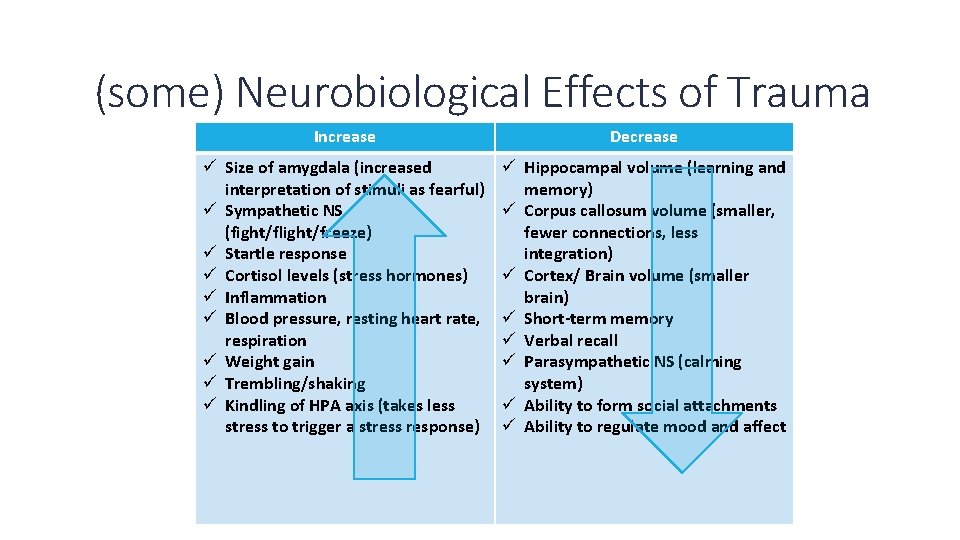
(some) Neurobiological Effects of Trauma Increase Decrease ü Size of amygdala (increased interpretation of stimuli as fearful) ü Sympathetic NS (fight/flight/freeze) ü Startle response ü Cortisol levels (stress hormones) ü Inflammation ü Blood pressure, resting heart rate, respiration ü Weight gain ü Trembling/shaking ü Kindling of HPA axis (takes less stress to trigger a stress response) ü Hippocampal volume (learning and memory) ü Corpus callosum volume (smaller, fewer connections, less integration) ü Cortex/ Brain volume (smaller brain) ü Short-term memory ü Verbal recall ü Parasympathetic NS (calming system) ü Ability to form social attachments ü Ability to regulate mood and affect
How Trauma Affects Health • Directly affects biology, including neuroendocrine & inflammatory response • Increases likelihood of high-risk behaviors • Affects health care utilization • Alters life trajectory in ways that can affect health
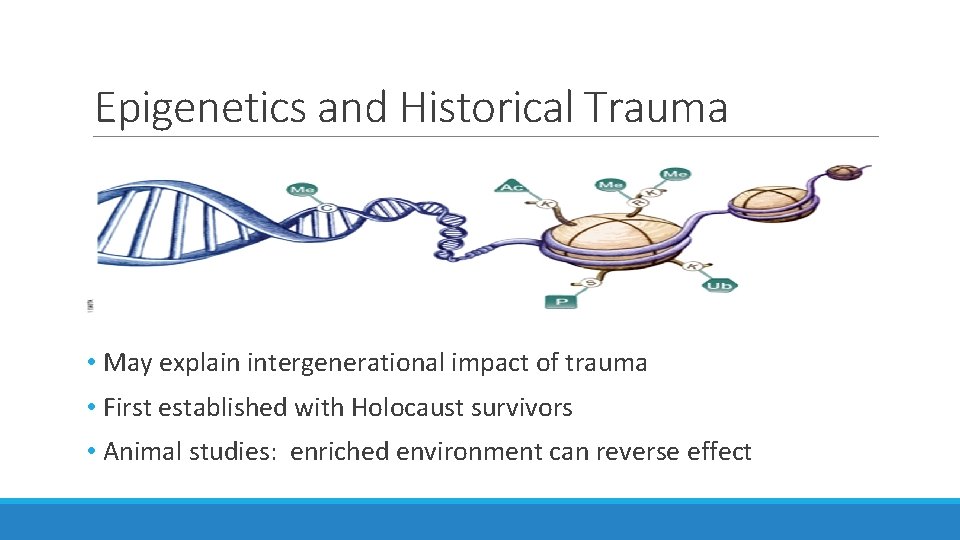
Epigenetics and Historical Trauma • May explain intergenerational impact of trauma • First established with Holocaust survivors • Animal studies: enriched environment can reverse effect
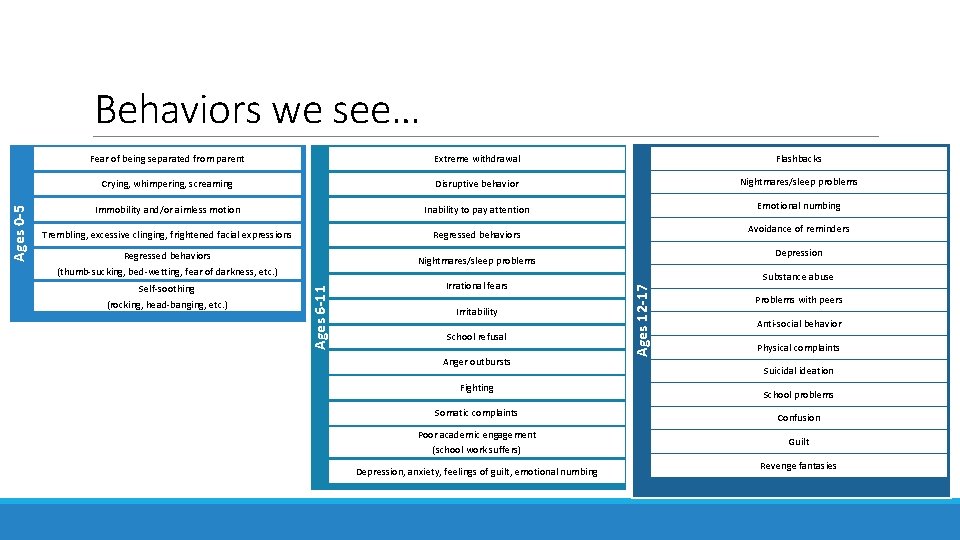
Fear of being separated from parent Extreme withdrawal Flashbacks Crying, whimpering, screaming Disruptive behavior Nightmares/sleep problems Immobility and/or aimless motion Inability to pay attention Emotional numbing Trembling, excessive clinging, frightened facial expressions Regressed behaviors (thumb-sucking, bed-wetting, fear of darkness, etc. ) Nightmares/sleep problems Self-soothing (rocking, head-banging, etc. ) Irrational fears Irritability School refusal Anger outbursts Fighting Avoidance of reminders Depression Substance abuse Ages 12 -17 Ages 6 -11 Ages 0 -5 Behaviors we see… Problems with peers Anti-social behavior Physical complaints Suicidal ideation School problems Somatic complaints Confusion Poor academic engagement (school work suffers) Guilt Depression, anxiety, feelings of guilt, emotional numbing Revenge fantasies
Trauma Triggers (Reminders) • Are rarely clear • Often unnoticed, even by the individual • Can be invisible (sensory oriented) • Can seem trivial/minor • Are often uncontrolled factors • Don’t always make sense • Revert us to less functional versions of ourselves
Explaining The Brain to Children & Adolescents https: //vimeo. com/109042767 (4: 40 Minutes)
Trauma is a SENSORY EXPERIENCE because of what happens to the brain and memory during trauma.
Sensory Processing and Trauma Children with a history of trauma demonstrate a significant prevalence of sensory processing disorders, (Atchison, 2008)
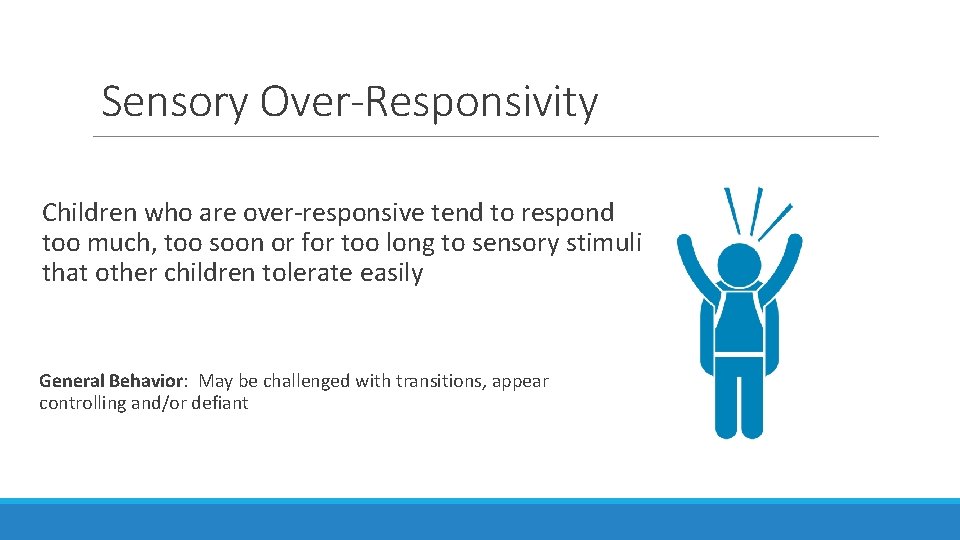
Sensory Over-Responsivity Children who are over-responsive tend to respond too much, too soon or for too long to sensory stimuli that other children tolerate easily General Behavior: May be challenged with transitions, appear controlling and/or defiant
Sensory Under-Responsivity Children who are under-responsive tend to respond less, or more slowly to sensory stimuli that other children respond to General Behavior: May be challenged with transitions, appear lethargic or inattentive
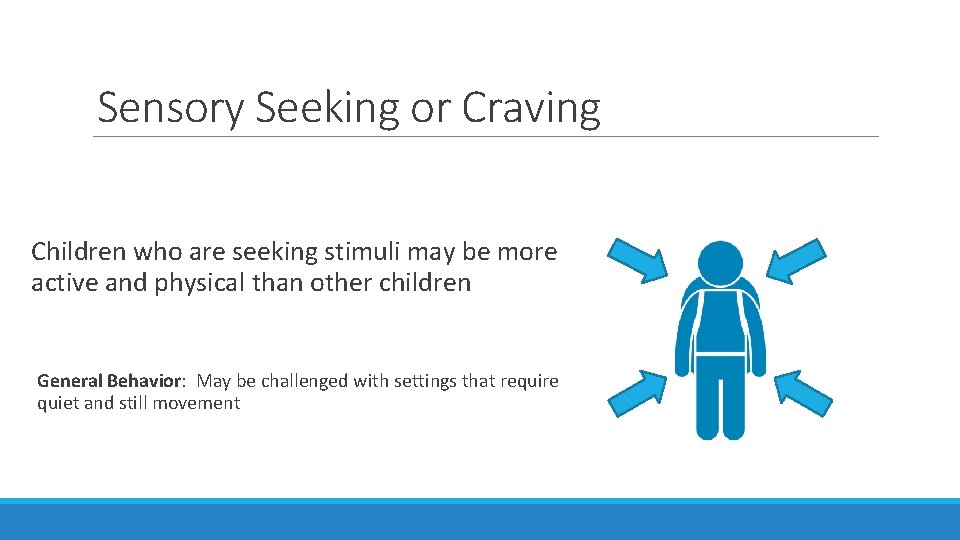
Sensory Seeking or Craving Children who are seeking stimuli may be more active and physical than other children General Behavior: May be challenged with settings that require quiet and still movement
Good News: The Amazing Brain • Neuroplasticity- Changes in response to trauma, and in response to supportive adults • Neurogenesis- the ability to grow neurons, to increase connectivity. • Neural Networks- The more intensely and frequently a neural network “fires, ” the stronger its “wiring. ” In short, repetition is a good thing.
Pause PAUSE 1. What is your reaction to the information so far? Did anything surprise you? 2. Does it change the way you see the youth you work with? How so? 3. Can you think of youth/adults you work with who have any of these behaviors? 4. How does/might traumatic stress affect the youth/families you work with?
![Compassion Fatigue Increased exposure to trauma affected [youth] Unsupportive work environment Organizational constraints Insufficient](http://slidetodoc.com/presentation_image_h/33915ad65d068cef92bbbbc3b3455c29/image-27.jpg "Compassion Fatigue Increased exposure to trauma affected [youth] Unsupportive work environment Organizational constraints Insufficient")
Compassion Fatigue Increased exposure to trauma affected [youth] Unsupportive work environment Organizational constraints Insufficient supervision Ability to engage empathically with others Symptoms of anxiety, intrusive thoughts, anhedonia, isolation, and career dissatisfaction
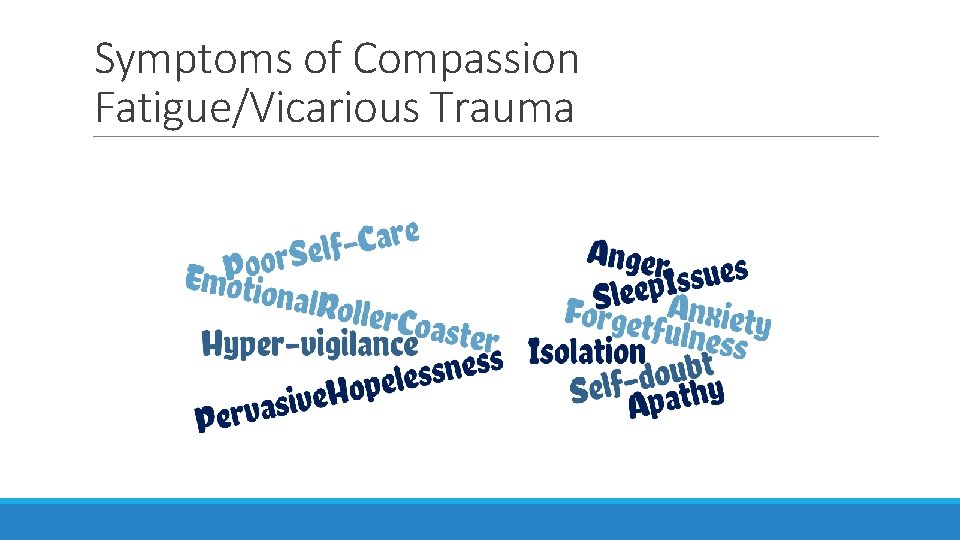
Symptoms of Compassion Fatigue/Vicarious Trauma
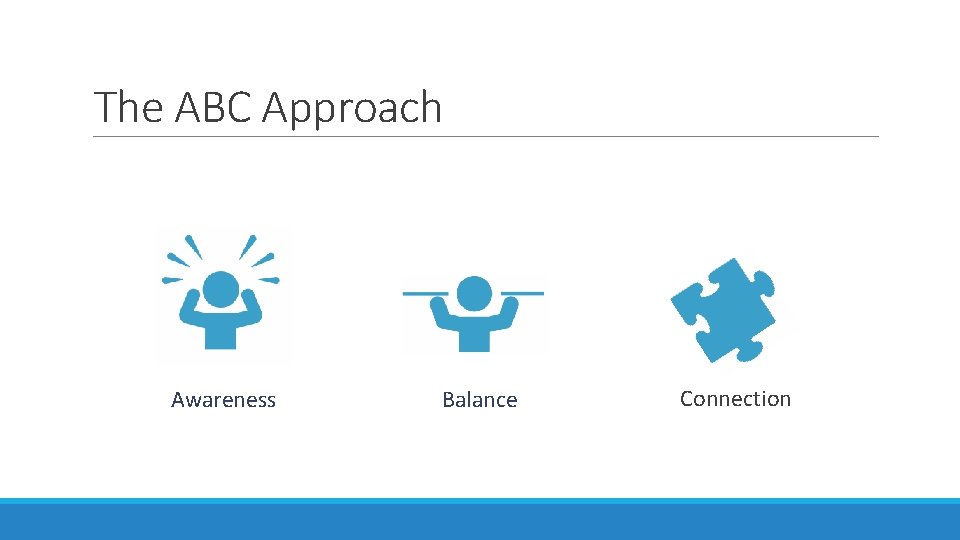
The ABC Approach Awareness Balance Connection
Personal & Professional Boundaries Reflect: • What sort of personal/professional boundaries do you create for yourself? • Who is there to help you manage the stress of your job? • Where do you feel supported at work? peer-supervision/consultation? • What steps are possible for you to take in your building to support staff?
Organizational Strategies to Prevent Secondary Trauma • General Wellness • Organizational Culture • Education and Training • Reflective Supervision
PART II: Trauma & Sensory Related Strategies
Part II Objectives • Discuss keys for integrating trauma informed principles • Describe strategies for responding to trauma-related behaviors • Identify environmental strategies that support healing & resilience
Trauma Informed Services • Compassionate care • An approach not an intervention • Supports healing & resilience
Why Trauma Informed Services? • Recovery and healing are possible • Protective factors facilitate healing and resilience • Healing occurs within the context of RELATIONSHIPS. (adapted from Fallot and Harris, 2002)
What Does It Mean to Provide Trauma Informed Services? Delivers services, (mental health, legal, child welfare, education, public health, addiction, housing supports, vocational or employment counseling services, etc. , ) in a manner that acknowledges the role that trauma, (violence and victimization) plays in the lives of many people seeking these services. . . (adapted from Fallot and Harris, 2001)
Trauma-Informed Professionals… • Appreciate the high prevalence of traumatic experiences among youth • Understand the profound neurological, biological and social effects of trauma and violence • Engage with youth in a manner that recognizes and addresses trauma-related issues • Are collaborative, supportive, and skilled (adapted from Harris and Fallot, 2001 and NASMHPD, 2003 -present)
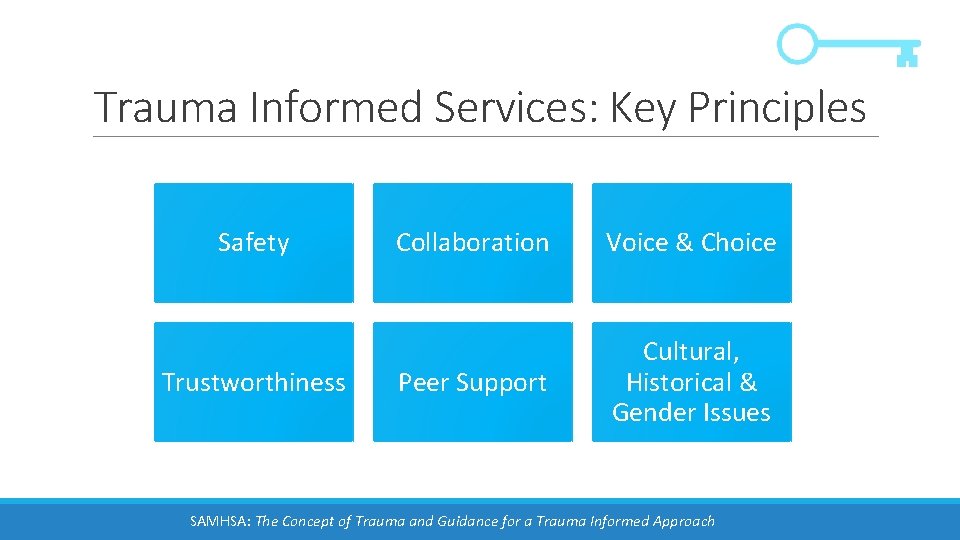
Trauma Informed Services: Key Principles Safety Trustworthiness Collaboration Voice & Choice Peer Support Cultural, Historical & Gender Issues SAMHSA: The Concept of Trauma and Guidance for a Trauma Informed Approach
Elements of Trauma Informed Environments • • SAFETY precedes learning FEAR overrides ability to think clearly BEHAVIORS communicate feelings ENVIRONMENT & ACTIVITIES can calm RELATIONSHIPS can heal NON-VERBALS are powerful TEAMWORK and shared responsibility are vital CONNECTIONS across system Adapted from NCTSN: Child Trauma Toolkit for Educators (2008)
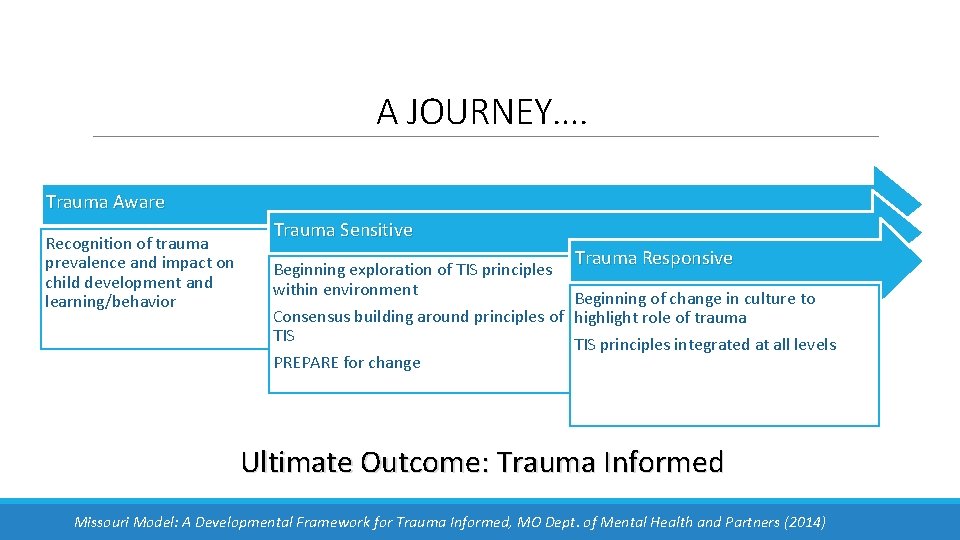
A JOURNEY…. Trauma Aware Recognition of trauma prevalence and impact on child development and learning/behavior Trauma Sensitive Trauma Responsive Beginning exploration of TIS principles within environment Beginning of change in culture to Consensus building around principles of highlight role of trauma TIS principles integrated at all levels PREPARE for change Ultimate Outcome: Trauma Informed Missouri Model: A Developmental Framework for Trauma Informed, MO Dept. of Mental Health and Partners (2014)
Intergenerational Public Health Approach • Use evidence- and culturally-based prevention programs to reduce high-risk behaviors • Use trauma-informed healthcare to improve medical engagement https: //www. healthcaretoolbox. org/ • Use neurobiology-based approaches to heal traumatic impacts • Build trauma-informed communities to support healthy life trajectories http: //www. rwjf. org/en/library/research/2016/06/self-healingcommunities. html
Overall…. Not “What is wrong with you? ” But “What happened to you? ”
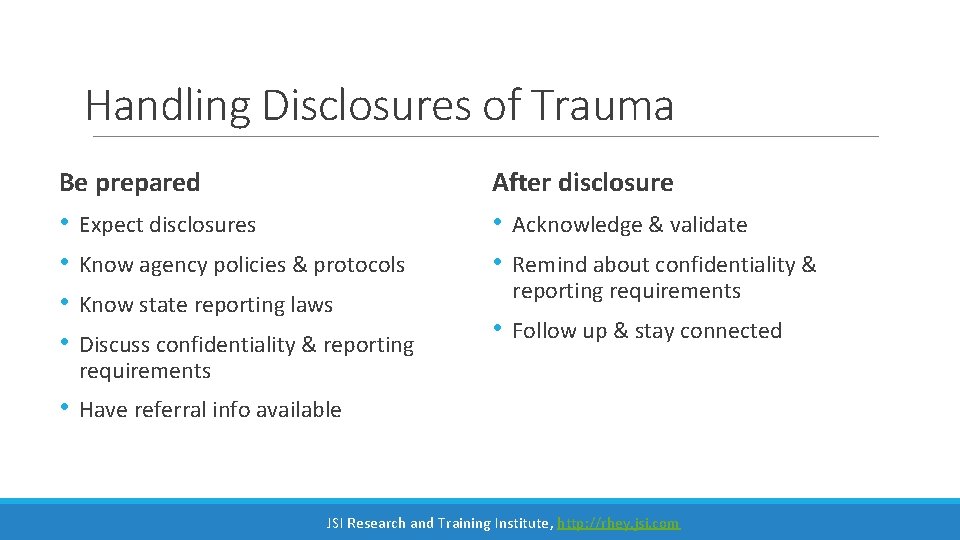
Handling Disclosures of Trauma Be prepared After disclosure • • Expect disclosures • • Acknowledge & validate • Follow up & stay connected • Have referral info available Know agency policies & protocols Know state reporting laws Discuss confidentiality & reporting requirements Remind about confidentiality & reporting requirements JSI Research and Training Institute, http: //rhey. jsi. com
Pause 1. What is your reaction to the information about trauma-informed services? Did anything surprise you? 2. Does it change the way you may work with youth in your organization? How so? 3. How might you apply trauma informed principles to the youth/adults you thought about earlier? Use the following worksheet to compare your current practices with practices that might be more trauma-informed.
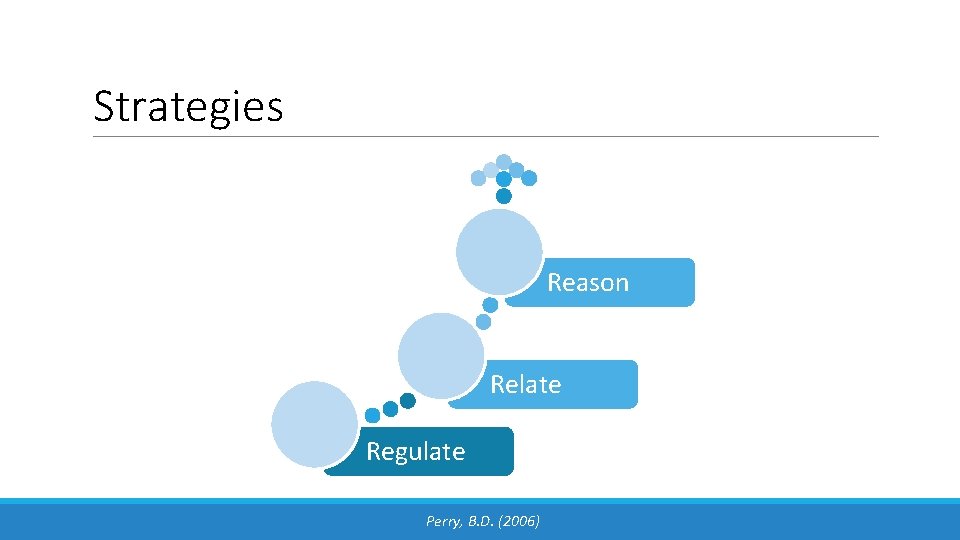
Strategies Reason Relate Regulate Perry, B. D. (2006)
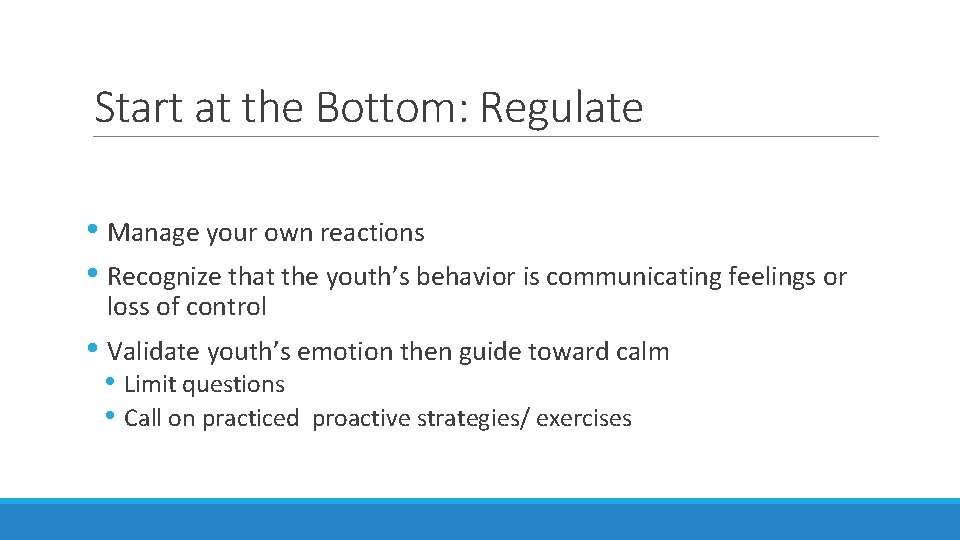
Start at the Bottom: Regulate • Manage your own reactions • Recognize that the youth’s behavior is communicating feelings or loss of control • Validate youth’s emotion then guide toward calm • Limit questions • Call on practiced proactive strategies/ exercises
Regulate: Consider the Environment • Create quiet/safe spaces • Be aware of lighting and background noises • Encourage respect for personal space • Develop predictable routines • Provide advance notice for transitions and changes of routines • Create opportunities for sensory organizing movement throughout the day
Regulate: Proactive Strategies • Reorient to the present • Focus on immediate environment • Imagery • Breathing/ mindfulness meditation/ yoga • Exercise/ experience with nature • Teach about the brain & senses & how they react
Here’s Some Recommendations Oral-Sensory Strategies: Chewing gum, biting your nails, eating snacks Movement Strategies: Rocking in your chair, going for a run, bending over, dancing Touch Strategies: Twirling your hair, squeezing a stress ball, holding something soft in your hand Auditory Strategies: Do you listen to a particular type of music or hum to yourself? Visual Strategies: Watching a fire or fish tank, reading a book, watching a lava lamp.
Next Step Up: Relate • The connection between youth who have experienced trauma and adults is essential to the healing process • The brains of children who have experienced trauma may have learned to associate adults with negative emotions • Youth benefit from positive interactions with adults
Relate First regulate with the youth, then Relate: • • • Tone of voice and volume? Youth’s relational needs? What communication modes will support them in this moment? Body language to support a relationship? Positive communication Listen without trying to solve Avoid trying to make it better
Relate: Build Empathy with Youth • REFRAME: “What happened to you? ” not, “What’s wrong with you? ” • REFRAME: “Symptoms” are adaptive coping necessary to survive, not as pathology • REFRAME: “Behaviors” as communication that can lead to understanding • PTSD symptoms are typical reactions to atypical circumstances. • The individual is a survivor. Celebrate their survival mechanism(s)
At the Top: Reason Think Consequences (vs. Punishment) • • Consistent and Individualized Responses Appropriate to Developmental stage Consider triggers and experiences Retain youth in learning/services Consider function of behavior & encourage skill development Help youth to recognize impact Recognize that change is slow and incremental Adapted from Adolescent Health Workgroup, 2013
Reason • • Reframe negative behavior as growth opportunity Review strategies used and consider need for modified/new strategies Support autonomous decision-making and independent functioning Emphasize student’s ability to make changes Foster hope Celebrate healthy insights and change Provide pro-social opportunities and encourage restorative practices, community interaction and support Focus on future strategies
Trauma and Sensory Friendly Environments • Routines/ consistency • Choices • Clear, firm limits for inappropriate behavior • Sensitive to environmental cues that can trigger reactions • Anticipate difficulties and provide additional supports • Provide warnings • Understand trauma re-enactment
Next Steps
References A detailed list of references is provided in the Being Trauma Informed and Responsive Toolkit
Contact: Mary Mueller, LMSW Project Coordinator, Trauma Informed Systems Michigan Department of Health & Human Services Mueller. M 1@michigan. gov Lauren Kazee, LMSW Mental Health Consultant Michigan Department of Education Michigan Department of Health & Human Services Kazee. L@michigan. gov
- Slides: 58