
Being Proactive An Exploration of How College Students
Being Proactive: An Exploration of How College Students Prevent Stress Mikayla Woodard, Junior, Psychology Major Lisa L. Scherer, Ph. D. Department of Psychology, University of Nebraska at Omaha Presentation for the University of Nebraska at Omaha Research and Creativity Fair March 3, 2017
Stress in college students: why does it matter? According to the U. S. Department of Health and Human Services, the 18 -25 yr age group, which corresponds with the average of college students, is more likely than any other age group to have a major depressive episode (2015) Woodard, Scherer, 2017
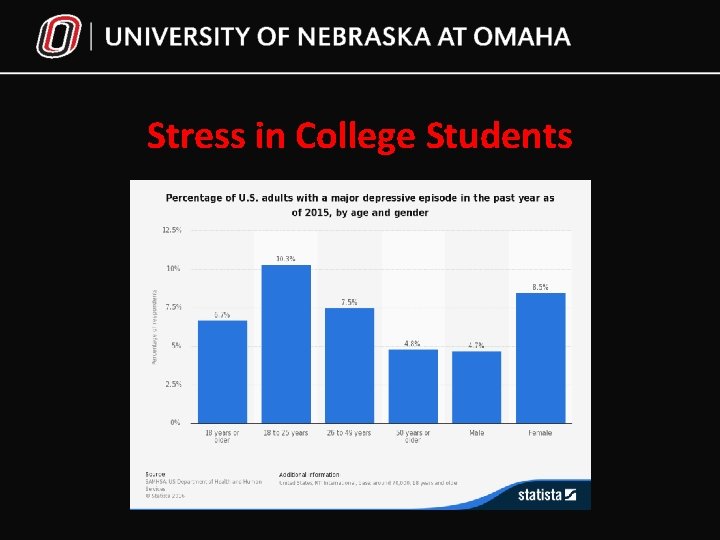
Stress in College Students
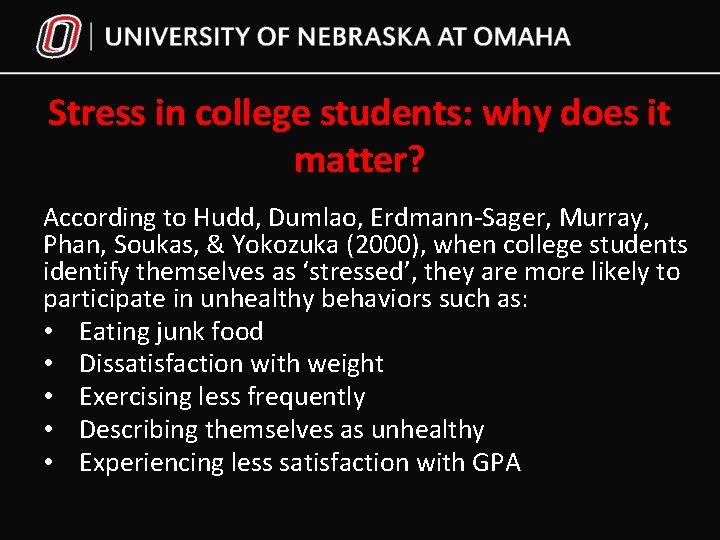
Stress in college students: why does it matter? According to Hudd, Dumlao, Erdmann-Sager, Murray, Phan, Soukas, & Yokozuka (2000), when college students identify themselves as ‘stressed’, they are more likely to participate in unhealthy behaviors such as: • Eating junk food • Dissatisfaction with weight • Exercising less frequently • Describing themselves as unhealthy • Experiencing less satisfaction with GPA
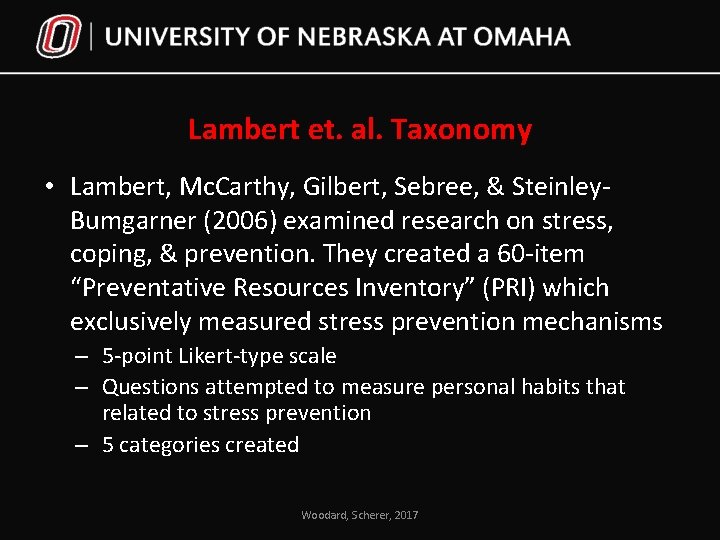
Lambert et. al. Taxonomy • Lambert, Mc. Carthy, Gilbert, Sebree, & Steinley. Bumgarner (2006) examined research on stress, coping, & prevention. They created a 60 -item “Preventative Resources Inventory” (PRI) which exclusively measured stress prevention mechanisms – 5 -point Likert-type scale – Questions attempted to measure personal habits that related to stress prevention – 5 categories created Woodard, Scherer, 2017
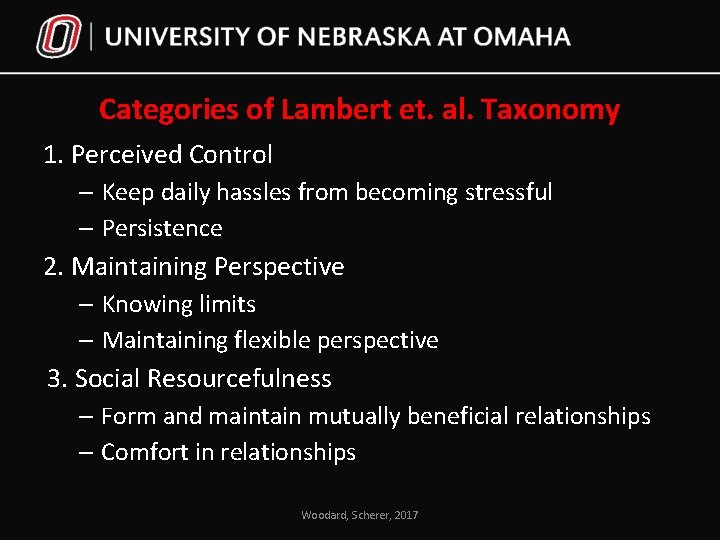
Categories of Lambert et. al. Taxonomy 1. Perceived Control – Keep daily hassles from becoming stressful – Persistence 2. Maintaining Perspective – Knowing limits – Maintaining flexible perspective 3. Social Resourcefulness – Form and maintain mutually beneficial relationships – Comfort in relationships Woodard, Scherer, 2017
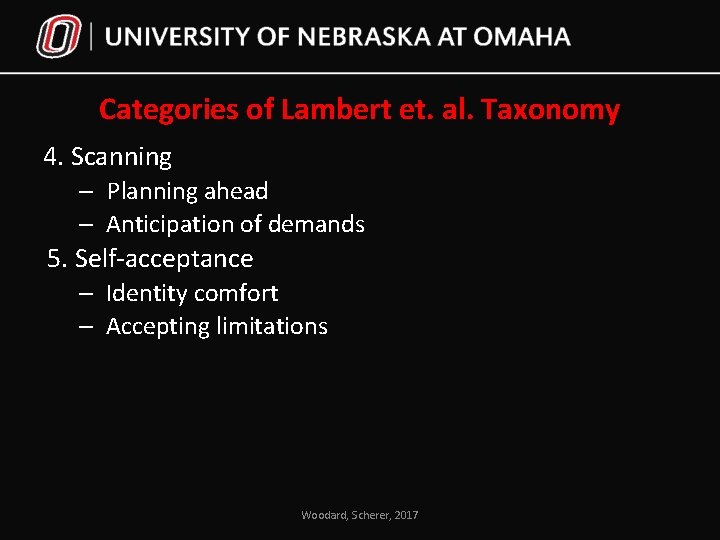
Categories of Lambert et. al. Taxonomy 4. Scanning – Planning ahead – Anticipation of demands 5. Self-acceptance – Identity comfort – Accepting limitations Woodard, Scherer, 2017
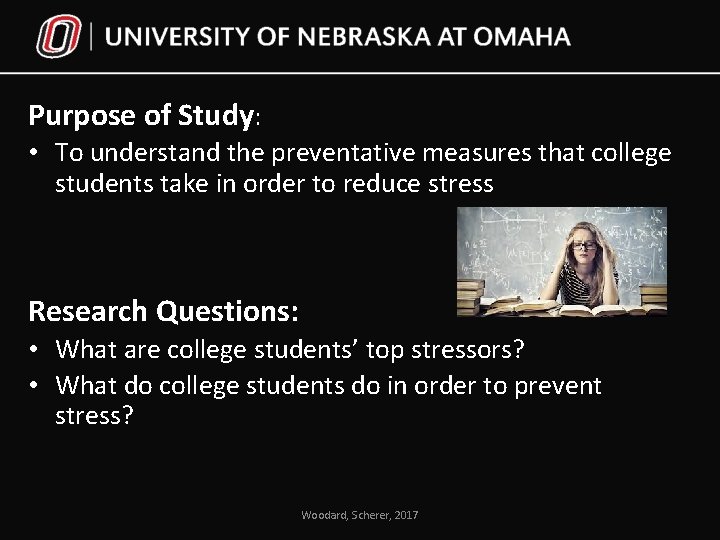
Purpose of Study: • To understand the preventative measures that college students take in order to reduce stress Research Questions: • What are college students’ top stressors? • What do college students do in order to prevent stress? Woodard, Scherer, 2017
Primary Research Question Lambert et. al. (2006) taxonomy of stress prevention strategies that are included in the Preventative Resources Inventory, were used in order to categorize the responses made by UNO college students and calculate the frequency of each category Woodard, Scherer, 2017
METHOD Woodard, Scherer, 2017
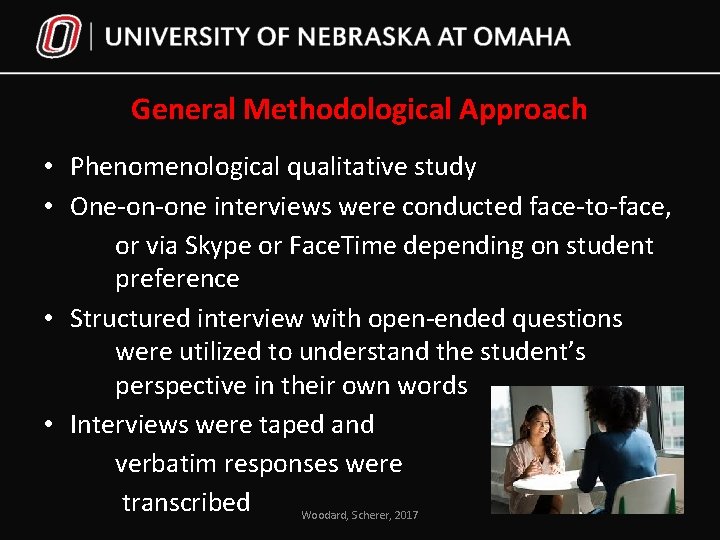
General Methodological Approach • Phenomenological qualitative study • One-on-one interviews were conducted face-to-face, or via Skype or Face. Time depending on student preference • Structured interview with open-ended questions were utilized to understand the student’s perspective in their own words • Interviews were taped and verbatim responses were transcribed Woodard, Scherer, 2017
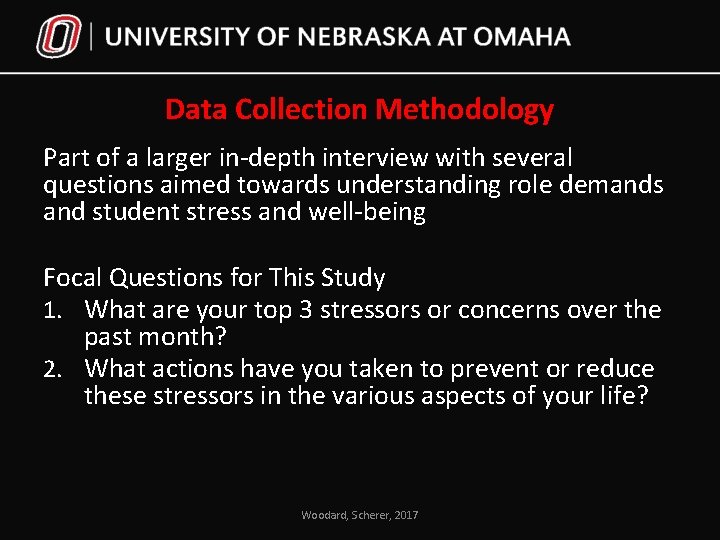
Data Collection Methodology Part of a larger in-depth interview with several questions aimed towards understanding role demands and student stress and well-being Focal Questions for This Study 1. What are your top 3 stressors or concerns over the past month? 2. What actions have you taken to prevent or reduce these stressors in the various aspects of your life? Woodard, Scherer, 2017
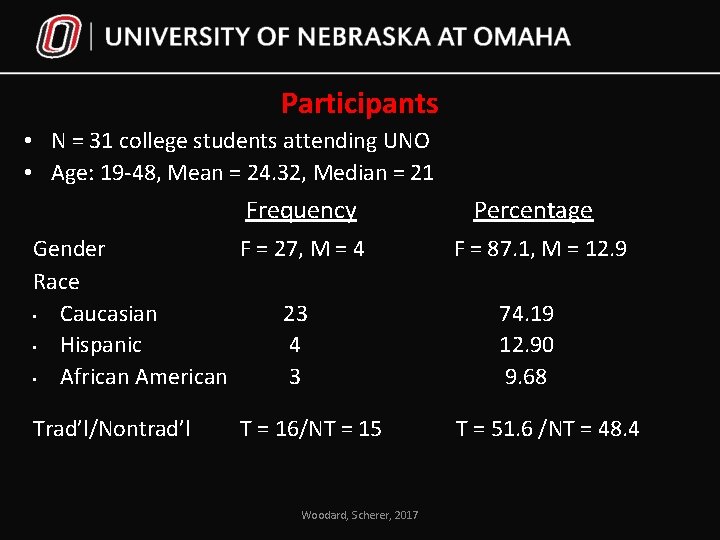
Participants • N = 31 college students attending UNO • Age: 19 -48, Mean = 24. 32, Median = 21 Frequency Percentage Gender F = 27, M = 4 Race • Caucasian 23 • Hispanic 4 • African American 3 F = 87. 1, M = 12. 9 Trad’l/Nontrad’l T = 51. 6 /NT = 48. 4 T = 16/NT = 15 Woodard, Scherer, 2017 74. 19 12. 90 9. 68
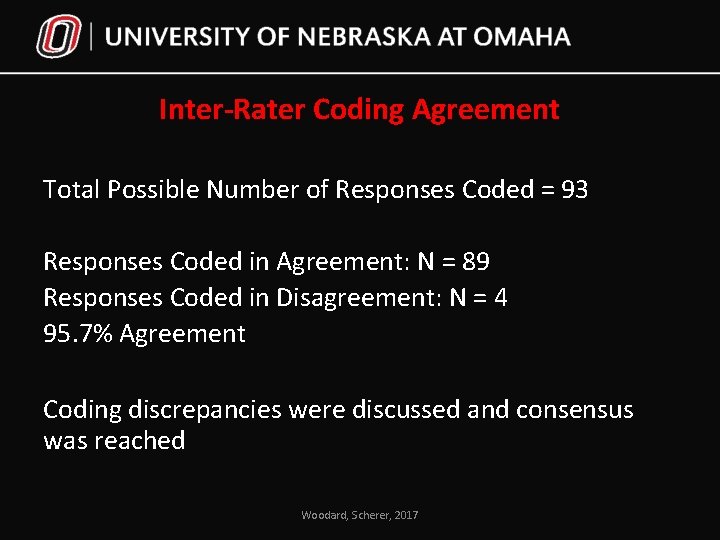
Inter-Rater Coding Agreement Total Possible Number of Responses Coded = 93 Responses Coded in Agreement: N = 89 Responses Coded in Disagreement: N = 4 95. 7% Agreement Coding discrepancies were discussed and consensus was reached Woodard, Scherer, 2017
RESULTS & DISCUSSION Woodard, Scherer, 2017
Prevention Strategy: Enjoyable Activities • Comparison of UNO student responses revealed a category of responses not included in the Lambert et. al. (2006) taxonomy • UNO students prevented stress by participating in activities they enjoyed • A category was created entitled “Time for Enjoyable Activities” defined as participation in hobbies and passions Woodard, Scherer, 2017
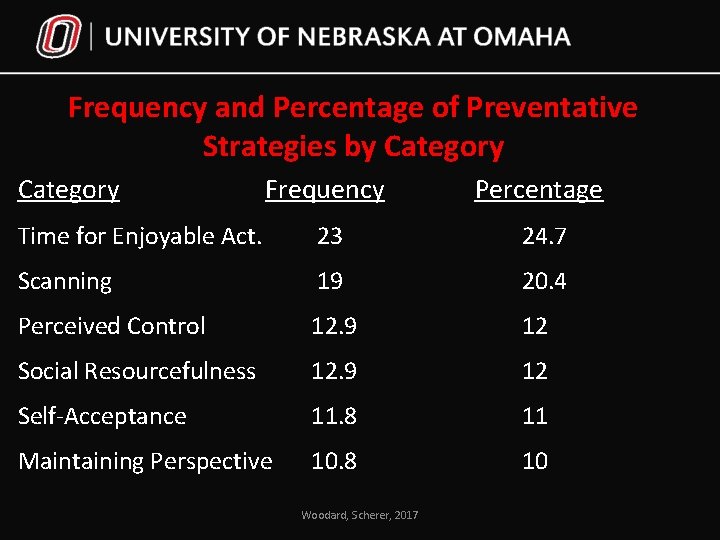
Frequency and Percentage of Preventative Strategies by Category Frequency Percentage Time for Enjoyable Act. 23 24. 7 Scanning 19 20. 4 Perceived Control 12. 9 12 Social Resourcefulness 12. 9 12 Self-Acceptance 11. 8 11 Maintaining Perspective 10. 8 10 Woodard, Scherer, 2017
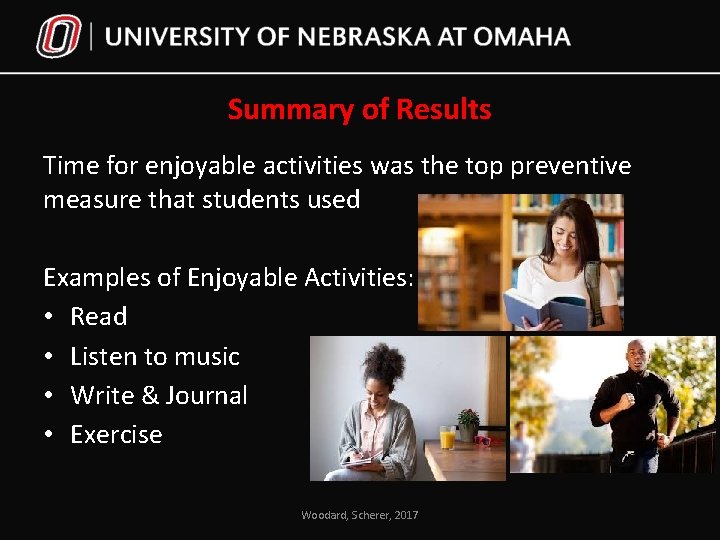
Summary of Results Time for enjoyable activities was the top preventive measure that students used Examples of Enjoyable Activities: • Read • Listen to music • Write & Journal • Exercise Woodard, Scherer, 2017
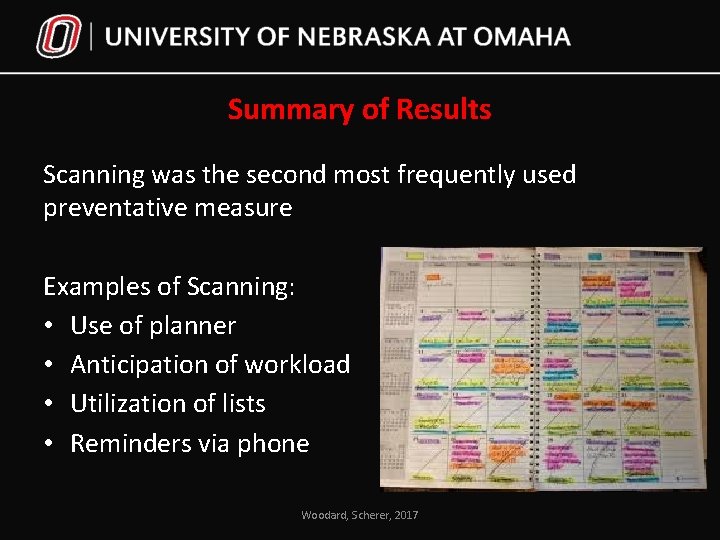
Summary of Results Scanning was the second most frequently used preventative measure Examples of Scanning: • Use of planner • Anticipation of workload • Utilization of lists • Reminders via phone Woodard, Scherer, 2017
Interpretation of Results • Lambert et. al. (2006) found that Scanning was the most frequently used preventative measure with Perceived Control coming in second • In contrast, this study revealed that Time for Enjoyable Activities was utilized most frequently followed by Scanning • The Lambert et. al. (2006) taxonomy needs to add a Time for Enjoyable Activities dimension to more accurately capture college student preventative stress strategies • According to Iwaskaki (2001), leisure activities cause a reduction in stress and provide stress coping benefits Woodard, Scherer, 2017
Limitations • • Majority of students were female and caucasian Most students were psychology majors No freshmen were represented in our sample Possible that impression management concerns exaggerated the amount or type of preventative stress strategies used Woodard, Scherer, 2017
Future Research • Association of preventative stress strategies with overall wellbeing, happiness, and stress levels • If certain strategies work more effectively to mitigate negative outcomes such as stress, burnout, and ultimately attrition for college students then those strategies should be taught and reinforced • Utilize short-term longitudinal approaches (diary studies) to determine if daily engagement in preventative stress behaviors predict greater well-being and lower stress Woodard, Scherer, 2017
Key References • Hudd, S. S. , Dumlao, J. , Erdmann-Sager, D. , Murray, D. , Phan, E. , Soukas, N. , & Yokozuka, N. (2000). Stress at college: Effects on health habits, health status and self-esteem. College Student Journal, 34(2), 217. • Iwaskaki, Y. (2001). Contributions of leisure to coping with daily hassles in university students’ lives. Canadian Journal of Behavioural Science, 33(2), 128 -141. • Lambert, R. G. , Mc. Carthy, C. J. , Gilbert, T. , Sebree, M. , & Steinley. Bumgarner, M. (2006). Validity Evidence for the use of the preventive resources inventory with college students. Measurement and Evaluation in Counseling and Development, 39, 66 -80. • SAMHSA, & US Department of Health and Human Services. (n. d. ). Percentage of U. S. adults with a major depressive episode in the past year as of 2015, by age and gender. In Statista - The Statistics Portal. Woodard, Scherer, 2017
Thank you to Dr. Scherer and everyone in Dr. Scherer’s Positive Organizational Psychology Lab. Thank you to the University for allowing us to present our research. Questions? The University of Nebraska does not discriminate based on race, color, ethnicity, national origin, sex, pregnancy, sexual orientation, gender identity, religion, disability, age, genetic information, veteran status, marital status, and/or political affiliation in its programs, activities, or employment. Woodard, Scherer, 2017
- Slides: 25