
Being Cultural Concepts of Culture Origin of the
Being Cultural Concepts of Culture
Origin of the Term l Arose in the 19 th century as a way to discuss systematic nature of human thought and action. l Previously, environmental determinism served as an explanation.

Theory of Environmental Determinism l Physical environment, rather than social conditions, determines culture. l Those who believe this say that humans develop and change based on their environment.
l Physical environment, especially climate, affects thinking, behavior, and culture.
l Positive Benefits: helps to explain differences in humans, culture l Negative Limitations: too simplistic, generalizes groups based on incomplete data
l Why do people in Alps believe in witches? l l because of the thin mountain air Why are people in Latin America or Indonesia inferior to Europeans? l Their hot, unchanging climate doesn’t challenge them like Europe’s cold winters.
Problems with Environmental Determinism: Bad Inferences l Claims that British were obsessed with building ships because they live on an island. l Arctic peoples (Eskimos) were primitive nomads because of the harshness of their environment.
Bad inferences are contradicted l Tasmanian peoples never built ships despite living on an island. l Arctic peoples developed complex civilizations despite their harsh climate.
Unscientific Assumptions l At one time, people in the northern parts of the world were considered brave, vigorous, insensitive to pain, weakly sexed, intelligent, and drunkards. l Northern languages have lots of consonants because people afraid to open mouths and let in cold air.
Human Nature l Other extreme explained in terms of some basic traits common to all humans. l Or else by traits thought to vary biologically from one population to another. l With development of racial and biological thinking, human nature was thought to be in our blood or genes.
Human Nature l Explanations of human action were caught between external nature, the environment, and internal nature (heredity, genes). l vague sense that there was something in the middle, l neither biologically nor environmentally determined l called custom, tradition, lifestyle, mentality, habit
l Human behavior is too complex to be determined only by environment. l Environment plays a role, but other phenomena come in to play.
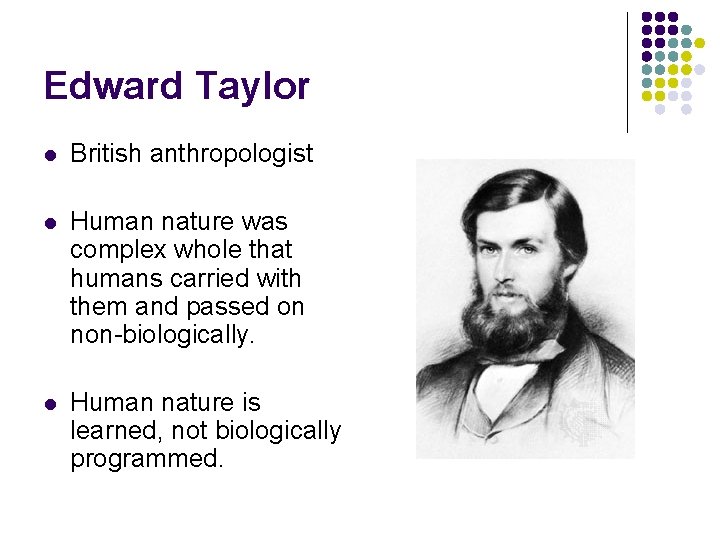
Edward Taylor l British anthropologist l Human nature was complex whole that humans carried with them and passed on non-biologically. l Human nature is learned, not biologically programmed.

Learned Culture l Culture varies independently of biology. l People who look very different can share same culture. l Carried on by a chain of learning. l Doesn’t mean that culture must be consciously taught.
l It is shared from one individual to another; from one group to another. l It includes cultural products, practices, perspectives.

Environment vs. Biology l Does not mean that the environment and our biological natures are irrelevant. l Environment/biology affect culture in many ways.
l Examples: l Bad assumption: People who live in the desert tend to stay out late and sleep late…are laid back and easy going. l Better assumption: Because the environment in certain areas is harsh during the day, people who live in the desert tend to run their errands at night. l However, this is not true of all desert dwellers.
l Despite many valid debates, one thing we know for sure: neither the environment nor biology explains everything.
Culture is a Game l A game has a set of rules, procedures, assumptions. l l What is the prize? What are the moves? How do you win? With rules both written and unwritten, moral and immoral.
l l l Boxers who clench with an opponent to rest. Soccer players who roll around pretending to be in pain after a foul. Rules against violence; but you must be ready to fight if needed.
l Games create their own world: the institution of soccer, basketball. l The world seems natural, inevitable when they are really artificial, arbitrary.
Culture is like grammar l Everyone has grammar…it is not something that needs to be consciously taught. l Learn by growing up in a language community, learning to speak. l In English we all pronounce a “P” at the beginning of a word with a puff of air, but not in Spanish.
l We learn very complex sets of rules without knowing we know them. l Culture may be seen as a kind of grammar, even more complex, for action and thought.
Chairs are not culture… l But rules for making chairs are… l l l ideas about how to sit in them when to sit when to stand what are good chairs how much a leather chair should cost, etc.
Culture is ubiquitous l Absolutely everything we do is affected by cultural assumptions and understandings. l Affects how we hold our bodies, how close or far we keep from others, whether we can touch them or not, eye contact.
Encountering Difference l Best way to understand culture is to encounter difference. l Americans will talk about ANYTHING with strangers on a plane, except money. l Troops of different European countries marched differently, so much so that British regiment could not march to music of a French band.
l Bathroom rules: l l In the USA, leave space between urinals if possible, never make eye contact, speak only if necessary. Why? To avoid mistaken identity.
l Rules for clothing: l l l In Honduras, locals were shocked at tourists in bikinis. But locals often stripped to the waste to wash clothes in a river, men often bath near their house without coverings. Every possible area of life is at least partly governed by cultural understandings. Such understandings are ubiquitous.
Cultural Relativism l Cultures differ widely on fundamental moral issues. l Anthropology asks that one suspend judgments, at least for the moment. l Even if one makes a moral judgment, one must avoid reflexive ethnocentrism, judging the whole world by our culture’s standards. l Suspending judgment about something we hate is much harder.
- Slides: 29