
Behaviourism Methodological Behaviourism n In the early 20
Behaviourism
Methodological Behaviourism n In the early 20 th C psychology used ‘introspection’ to study the mind. n n n Not reliable, not repeatable, not objective Not scientific. REJECTED!
Methodological Behaviourism n Restrict psychological data to just the relevant observable data of the organism n n Mental phenomena do not count as psychological data, but their existence doesn’t have to be denied Problem: there are difficulties in formulating useful explanations of psychological phenomena.
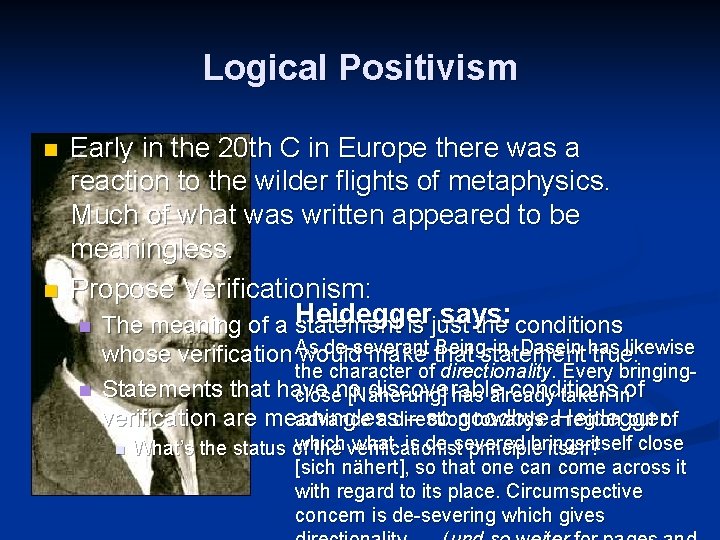
Logical Positivism n n Early in the 20 th C in Europe there was a reaction to the wilder flights of metaphysics. Much of what was written appeared to be meaningless. Propose Verificationism: Heidegger says: n The meaning of a statement is just the conditions n de-severant Being-in, Dasein has likewise whose verification As would make that statement true. the character of directionality. Every bringing. Statements that have discoverable conditions closeno [Näherung] has already taken inof verification are meaningless – so goodbye advance a direction towards a. Heidegger region out of n which what is de-severed brings What’s the status of the verificationist principle itself? itself close [sich nähert], so that one can come across it with regard to its place. Circumspective concern is de-severing which gives
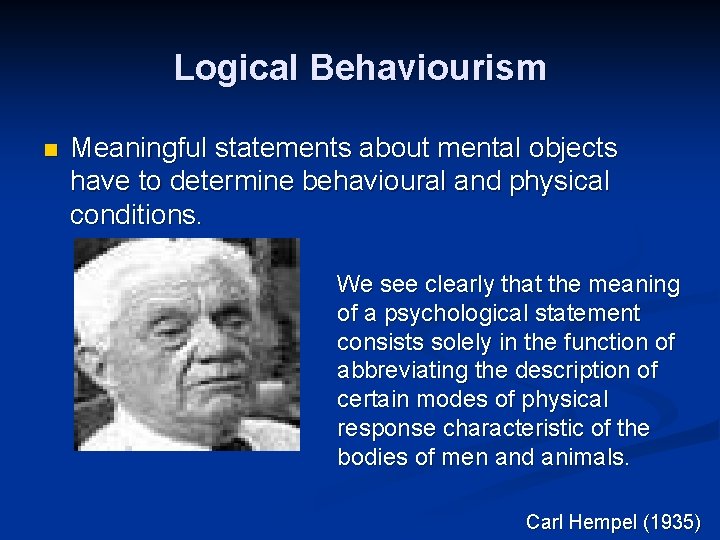
Logical Behaviourism n Meaningful statements about mental objects have to determine behavioural and physical conditions. We see clearly that the meaning of a psychological statement consists solely in the function of abbreviating the description of certain modes of physical response characteristic of the bodies of men and animals. Carl Hempel (1935)
Logical Behaviourism n Ryle reacted against the ‘Official Doctrine’ of Dualism. a human exists in two realms; a public, outer, physical manifestation, and a private, inner, mental manifestation. The realms are different but they belong to the same ‘category. ’ n This is the dogma of the ‘Ghost in the Machine’ and it is a logical error that Ryle calls the Category Mistake
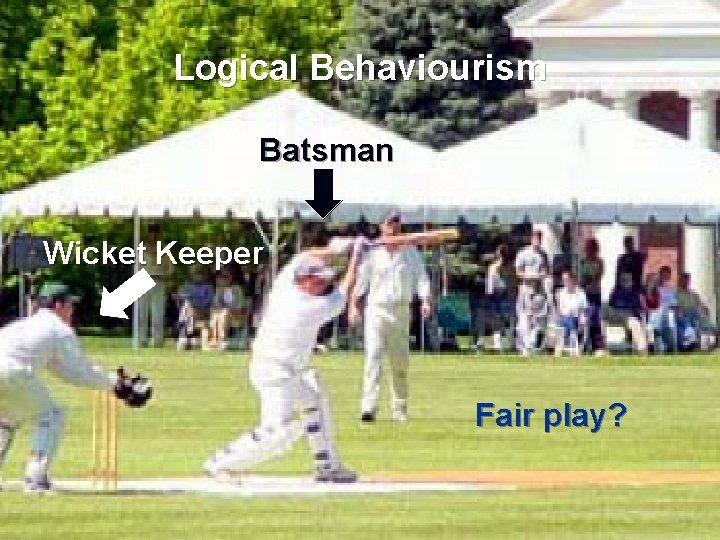
Logical Behaviourism Batsman Wicket Keeper Fair play?
Logical Behaviourism n n We are in an analogous position wrt our mental operations. Where, we ask, is the faculty to which intelligence is due? According to Ryle the intelligence epithets apply not to distinct causal entities but are descriptive of the performance of functions. n Note that as a consequence, we are able to know about other people’s mental conditions.
Logical Behaviourism n To say that Alice is in pain is to say that Alice is showing pain-behaviours. n n n Alice could be in pain and yet exhibit no pain behaviours Alice could be not in pain and yet exhibiting pain behaviours. To say that Alice is in pain is to say that Alice is disposed to show pain-behaviours.
Logical Behaviourism n n Ryle compares this with the description of glass as brittle. It is brittle because it is disposed to break when struck sharply But isn’t there an explanation for why glass is brittle? Yes. Brittleness is due to the internal structure of the glass. By analogy we could suppose that painbehaviour dispositions are due to some internal structure.
Ontological Behaviourism n What should a behaviourist say about the existence of mental things? 1. 2. Behaviourist ways of speaking reflect the fact that there are no such things as mental objects. The logical behaviourist view. (Ryle says he thinks this. ) Behaviourist ways of speaking are justified whether or not there are really mental objects. The methodological behaviourist view. (Seems like Ryle should think this. )
Ontological Behaviourism n Mental objects just are categories of behaviours n n n LB does not imply OB OB does not imply LB Problems: n n Pain hurts ‘Reversed spectrum’ is possible.
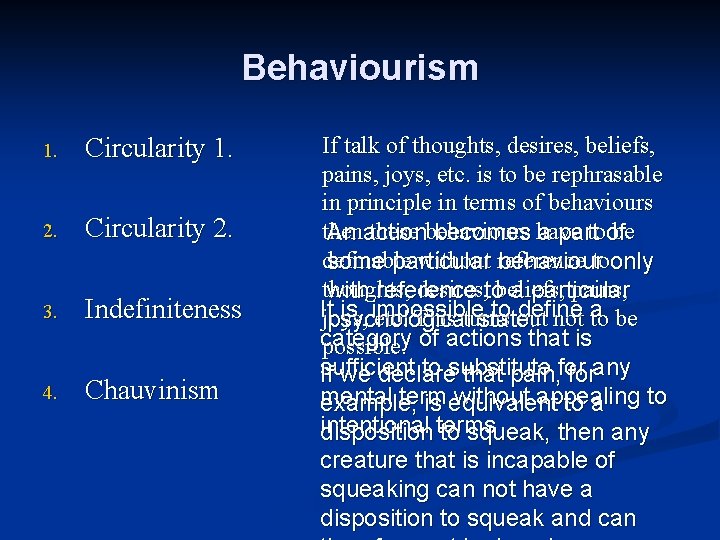
Behaviourism 1. Circularity 1. 2. Circularity 2. 3. Indefiniteness 4. Chauvinism If talk of thoughts, desires, beliefs, pains, joys, etc. is to be rephrasable in principle in terms of behaviours then these behaviours be An action becomes have a parttoof definable without reference some particular behaviourtoonly thoughts, desires, tobeliefs, pains, with reference a particular Itjoys, is impossible to out define etc. This turns not a to be psychological state. category possible. of actions that is sufficient to substitute If we declare that pain, forany mental term without appealing to example, is equivalent to a intentional disposition terms to squeak, then any creature that is incapable of squeaking can not have a disposition to squeak and can
- Slides: 13