
Behavioural Finance Lecture 12 Part 1 The Global
Behavioural Finance Lecture 12 Part 1 The Global Financial Crisis Empirical Data & Modelling
Biggest crisis since the Great Depression. . • For almost every country – Australia (you’re standing in it) the exception – Reasons why discussed later • First: the US (and European) experience • Crisis not anticipated by neoclassical economists – Saw “Great Moderation” as key macroeconomic issue: • Explaining the linked phenomena of: – Falling inflation; – Less extreme cycles in employment • Attributed it to better macroeconomic policy:
The Great Moderation • “As it turned out, the low-inflation era of the past two decades has seen not only significant improvements in economic growth and productivity but also a marked reduction in economic volatility, both in the United States and abroad, a phenomenon that has been dubbed "the Great Moderation. " • Recessions have become less frequent and milder, and quarter-to-quarter volatility in output and employment has declined significantly as well. • The sources of the Great Moderation remain somewhat controversial, but as I have argued elsewhere, there is evidence for the view that improved control of inflation has contributed in important measure to this welcome change in the economy. ” (Bernanke 2004)
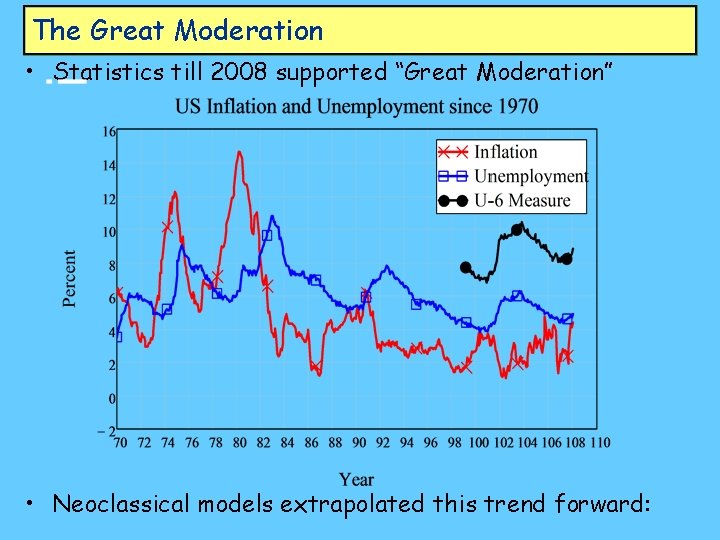
The Great Moderation • Statistics till 2008 supported “Great Moderation” • Neoclassical models extrapolated this trend forward:
Did (neoclassical) economists see this coming? • “the current economic situation is in many ways better than what we have experienced in years… • Our central forecast remains indeed quite benign: – a soft landing in the United States, – a strong and sustained recovery in Europe, – a solid trajectory in Japan – and buoyant activity in China and India. – In line with recent trends, sustained growth in OECD economies would be underpinned by strong job creation and falling unemployment. ” (p. 9) • OECD Chief Economist Jean-Philippe Cotis – in OECD Economic Outlook June 2007 • Then all hell broke loose…
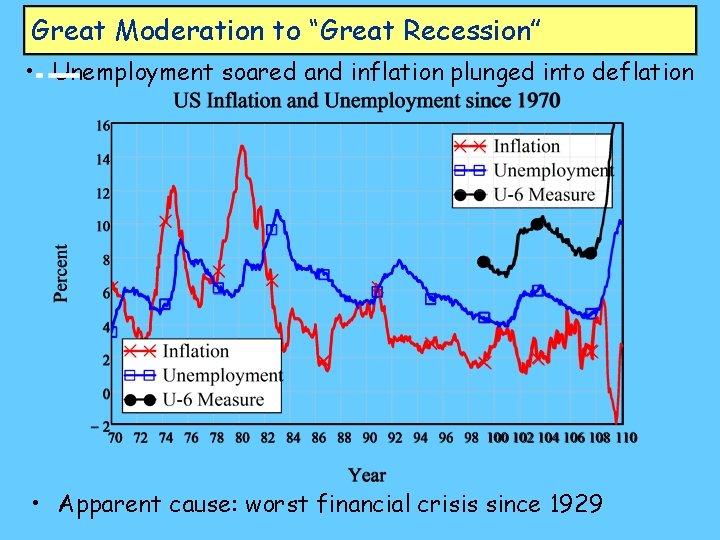
Great Moderation to “Great Recession” • Unemployment soared and inflation plunged into deflation • Apparent cause: worst financial crisis since 1929
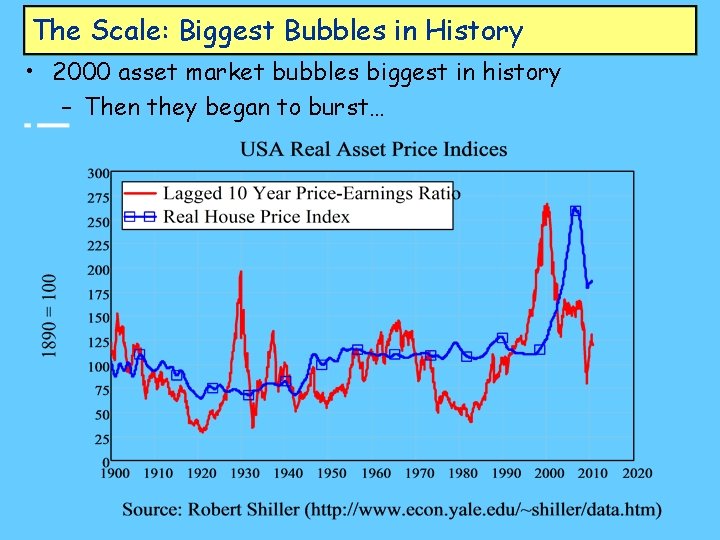
The Scale: Biggest Bubbles in History • 2000 asset market bubbles biggest in history – Then they began to burst…
A “Black Swan” event? • Neoclassical economists prefer to regard crisis as “unpredictable” – “I do not know anyone who predicted this course of events. – This should give us cause to reflect on how hard a job it is to make genuinely useful forecasts. – What we have seen is truly a ‘tail’ outcome – the kind of outcome that the routine forecasting process never predicts. – But it has occurred, it has implications, and so we must reflect on it. ” (Glenn Stevens, “Interesting Times”, 2008; see my comment on this speech here) • In fact at least 12 economists predicted and warned of the crisis…

A “Black Swan” event? Analyst Country Dean Baker US Wynne Godley US Fred Harrison UK Capacity Forecast … plunging housing investment will likely push the economy into recession. (2006) Co-director, Center for Economic and Policy Research The small slowdown in the rate at which US household debt levels are rising resulting Distinguished Scholar, Levy form the house price decline, will immediately lead to a … growth recession … before Economics Institute of Bard College 2010 (2006). " [will] start to rise significantly and does not come down again. " (2007) The next property market tipping point is due at end of 2007 or early 2008 … only way Economic commentator prices can be brought back to affordable levels is a slump or recession (2005). Michael Hudson US Professor, University of Missouri Debt deflation will shrink the " economy, drive down real wages, and push our debtridden economy into Japan-style stagnation or worse. (2006) Eric Janszen US Investor and i. Tulip commentator The US will enter a recession within years (2006). " stock markets are likely to begin in 2008 to experience a " Deflation Bear Market" (2007) Associate Professor, University of Long before we manage to reverse the current rise in debt, the economy will be in a recession. On current data, we may already be in one. (2006) Western Sydney Jakob Brøchner We are seeing large bubbles and if they bust, there is no backup. The outlook is very Professor & graduate student, Madsen & Jens Kjaer Denmark bad (2005)" The bursting of this housing bubble will have a severe impact on the world Copenhagen University Sørensen economy and may even result in a recession" (2006). The new housing bubble – together with the bond and stock bubbles – will invariably implode in the foreseeable future, plunging the U. S. Economy into a protracted, deep private consultant and investment Kurt Richebächer US recession (2001). "recession and bear market in asset prices are inevitable for the U. S. newsletter writer economy… All remaining questions pertain solely to speed, depth and duration of the economy' downturn. " (2006) Real home prices are likely to fall at least 30% over the next 3 years; "itself this house Nouriel Roubini US Professor, New York University price slump is enough to trigger a US recession. " (2006) Stephen Keen Australia Peter Schiff US Robert Shiller US Stock broker, investment adviser and The United States economy is like the Titanic. . . I see a real financial crisis coming for the United States. (2006). " will be an economic collapse" (2007). commentator There is significant risk of a very bad period, with rising default and foreclosures, Professor, Yale University serious trouble in financial markets, and a possible recession sooner than most of us expected. (2006) • Bezemer, Dirk J, “No One Saw This Coming": Understanding Financial Crisis Through Accounting Models, Groningen University, 16 June 2009
A “Black Swan” event? • Common factors in 12 economists identified by Bezemer: – “a concern with financial assets as distinct from realsector assets, – with the credit flows that finance both forms of wealth, – with the debt growth accompanying growth in financial wealth, and – with the accounting relation between the financial and real economy. ” (p. 8) • Key causal factor—as with Great Depression—blowout in private debt levels
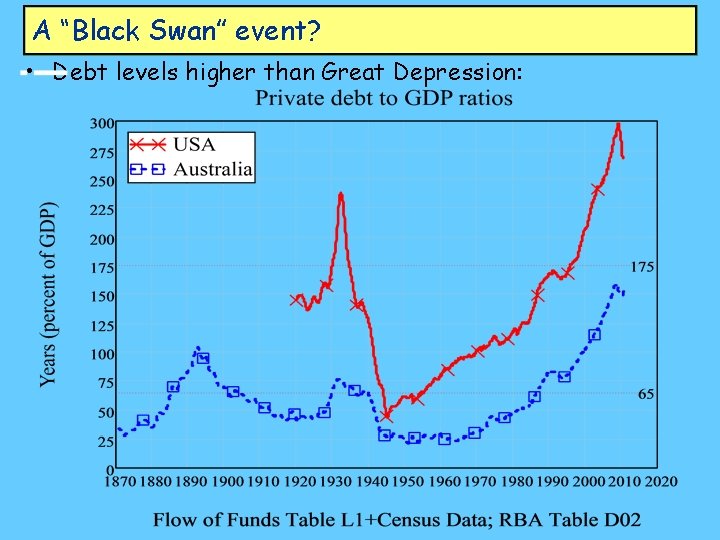
A “Black Swan” event? • Debt levels higher than Great Depression:
A “Black Swan” event? • Mainstream economists ignored Debt/GDP – Focused instead on inflation, unemployment & interest rates – Saw economy as well balanced now – Complemented “good monetary policy” for outcome • (“Taylor Rule”) – Blamed previous major crisis (Great Depression) on “bad monetary policy”:
A “Black Swan” event? • "Let me end my talk by abusing slightly my status as an official representative of the Federal Reserve. • I would like to say to Milton and Anna: Regarding the Great Depression. You're right, we did it. We're very sorry. • But thanks to you, we won't do it again. “ – Ben Bernanke 2002: Remarks by Governor Ben S. Bernanke, At the Conference to Honor Milton Friedman, University of Chicago, Illinois, November 8, 2002 On Milton Friedman's Ninetieth Birthday) • Bernanke on failings of 1930 s Fed:
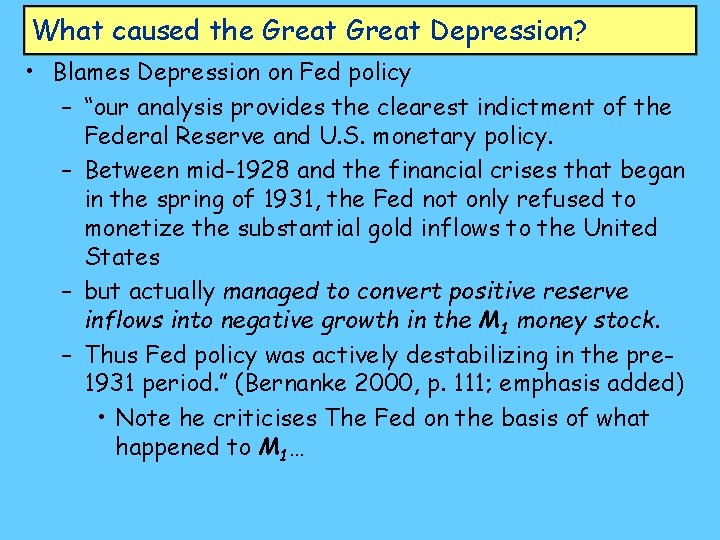
What caused the Great Depression? • Blames Depression on Fed policy – “our analysis provides the clearest indictment of the Federal Reserve and U. S. monetary policy. – Between mid-1928 and the financial crises that began in the spring of 1931, the Fed not only refused to monetize the substantial gold inflows to the United States – but actually managed to convert positive reserve inflows into negative growth in the M 1 money stock. – Thus Fed policy was actively destabilizing in the pre 1931 period. ” (Bernanke 2000, p. 111; emphasis added) • Note he criticises The Fed on the basis of what happened to M 1…
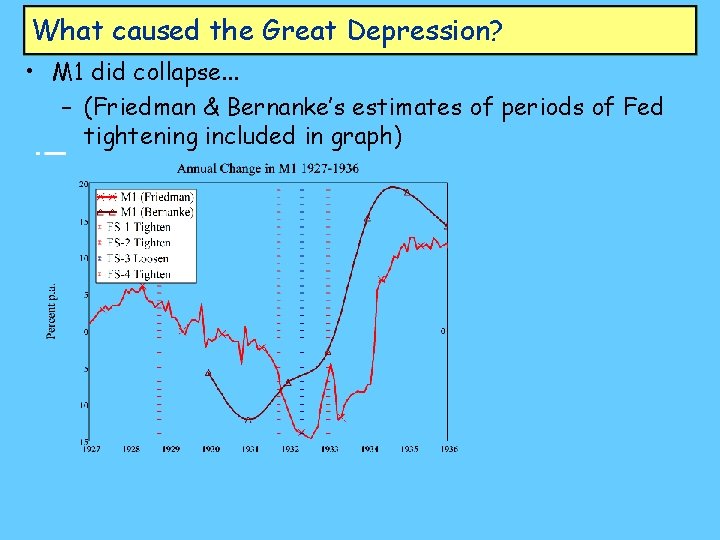
What caused the Great Depression? • M 1 did collapse. . . – (Friedman & Bernanke’s estimates of periods of Fed tightening included in graph)
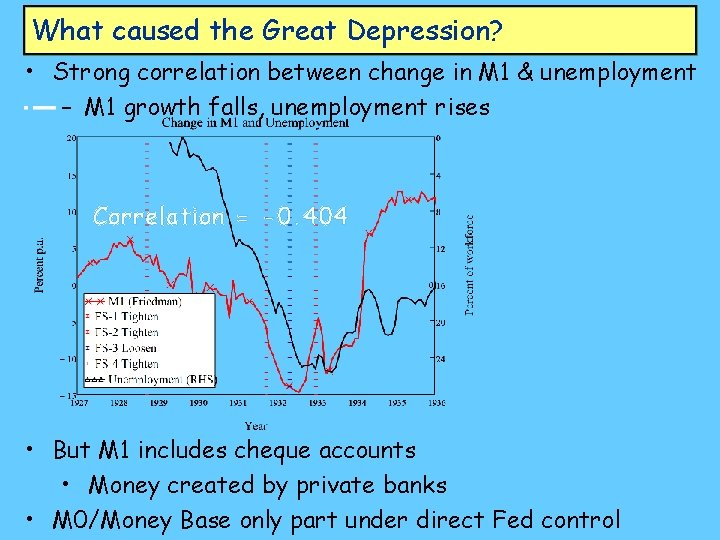
What caused the Great Depression? • Strong correlation between change in M 1 & unemployment – M 1 growth falls, unemployment rises Correlation = -0. 404 • But M 1 includes cheque accounts • Money created by private banks • M 0/Money Base only part under direct Fed control
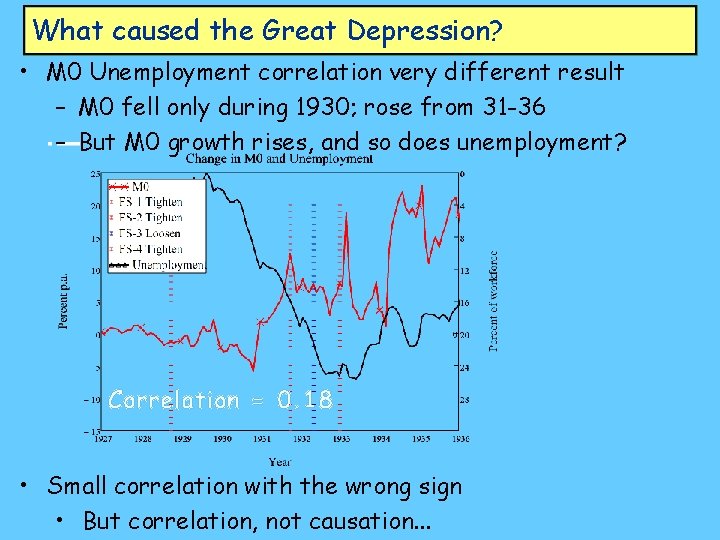
What caused the Great Depression? • M 0 Unemployment correlation very different result – M 0 fell only during 1930; rose from 31 -36 – But M 0 growth rises, and so does unemployment? Correlation = 0. 18 • Small correlation with the wrong sign • But correlation, not causation. . .
What caused the Great Depression? • Implies 1930 s Fed did try to boost money supply • But fall in private credit more than outweighed increase in fiat money • Bernanke’s criticism of Fed assumes “money multiplier”— ”deposits create loans” relation between M 0/Money Base and broader credit • Bernanke also ignored Fisher’s debt-deflation theory & Minsky’s “Financial Instability Hypothesis” • Firstly, Bernanke on Fisher: – “Fisher envisioned a dynamic process in which falling asset and commodity prices created pressure on nominal debtors, forcing them into distress sales of assets, which in turn led to further price declines and financial difficulties.
What caused the Great Depression? – His diagnosis led him to urge President Roosevelt to subordinate exchange-rate considerations to the need for reflation, advice that (ultimately) FDR followed. – Fisher’s idea was less influential in academic circles, though, because of the counterargument that debtdeflation represented no more than a redistribution from one group (debtors) to another (creditors). – Absent implausibly large differences in marginal spending propensities among the groups, it was suggested, pure redistributions should have no significant macroeconomic effects. ” (Bernanke 2000, Essays on the Great Depression, p. 24; emphasis added) • Compare to Fisher himself (lecture 11, slides 13 -20):
What caused the Great Depression? • Bernanke ignores – Key role of disequilibrium in Fisher • Theoretically … there must be—over-or underproduction, over-or under-consumption, …, and over or under everything else. • It is as absurd to assume that, for any long period of time, the variables in the economic organization, or any part of them, will “stay put, ” in perfect equilibrium, as to assume that the Atlantic Ocean can ever be without a wave. ” • Bernanke instead considers equilibrium transfer from debtors to creditors – Starting point of excessive debt…
What caused the Great Depression? • Fisher: – The “two dominant factors” which cause depressions are “over-indebtedness to start with and deflation following soon after” • Bernanke – “Fisher envisioned a dynamic process in which falling asset and commodity prices…” • Even sloppier treatment of Minsky: – “Hyman Minsky (1977) and Charles Kindleberger (1978) have … argued for the inherent instability of the financial system but in doing so have had to depart from the assumption of rational economic behaviour…”
What caused the Great Depression? • A footnote adds – “I do not deny the possible importance of irrationality in economic life; however it seems that the best research strategy is to push the rationality postulate as far as it will go. ” (Bernanke 2000, p. 43; emphases added) • Remember “rationality” from 1 st 3 lectures? – Rationality in microeconomics: ability to have “complete” preference set computationally impossible – Rationality as assumed in macroeconomics even worse: • Neoclassicals assume “Meta-rationality” – Ability to know how the entire economy behaves – E. g. , original “rational expectations” paper in economics
What caused the Great Depression? • “Rational expectations” introduced into macro by Robert Lucas (1976): “Econometric Testing of the Natural Rate Hypothesis”, The Econometrics of Price Determination Conference, Board of Governors of the Federal Reserve System, October 30 -31, 1970 Washington • Rejected Friedman’s “adaptive expectations” because it implied that monetary policy could have real effects: – It “promises unlimited real output gains from a wellchosen inflationary policy. Even a once-and-for-all price increase, … will induce increased output over the (infinity of) transition periods. ” (53) – To “prove” that monetary policy is ineffective, you need to assume that people can accurately predict future inflation:
What caused the Great Depression? • “the hypothesis of adaptive expectations was rejected … on the grounds that, under some policy: E{Pt-P*} [gap between expected and actual inflation] is non-zero. • If the impossibility of a non-zero value for Expression 6 is taken as an essential feature of the natural rate theory, one is led simply to • adding the assumption that Expression 6 is zero as an additional axiom • or to assume that expectations are rational in the sense of Muth” (Lucas, p. 54) – i. e. , “rational expectations” is equivalent to assuming that people can predict the future! • This is “meta-rationality”: not merely rational but capable of successful prophecy
What caused the Great Depression? • No wonder neoclassicals didn’t see crisis coming – Assumed world consists of people capable of foreseeing future – Crises would never occur in such a world • Have to abandon equilibrium-obsessed, prophetic agents model of neoclassicals to understand Great Depression • Begins with reversing money-creation model • Not “Deposits create loans” but “Loans create deposits” – Deleveraging drove broad money supply down – Reduced cash flow in economy caused collapse • Key role of debt in aggregate demand. . .
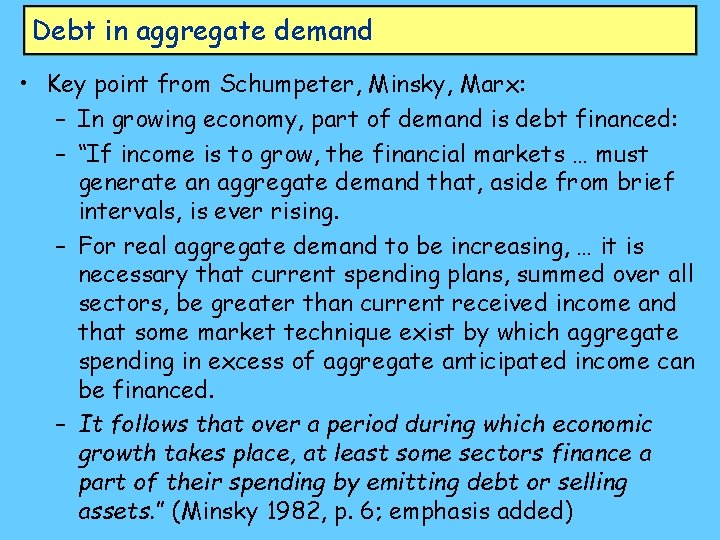
Debt in aggregate demand • Key point from Schumpeter, Minsky, Marx: – In growing economy, part of demand is debt financed: – “If income is to grow, the financial markets … must generate an aggregate demand that, aside from brief intervals, is ever rising. – For real aggregate demand to be increasing, … it is necessary that current spending plans, summed over all sectors, be greater than current received income and that some market technique exist by which aggregate spending in excess of aggregate anticipated income can be financed. – It follows that over a period during which economic growth takes place, at least some sectors finance a part of their spending by emitting debt or selling assets. ” (Minsky 1982, p. 6; emphasis added)
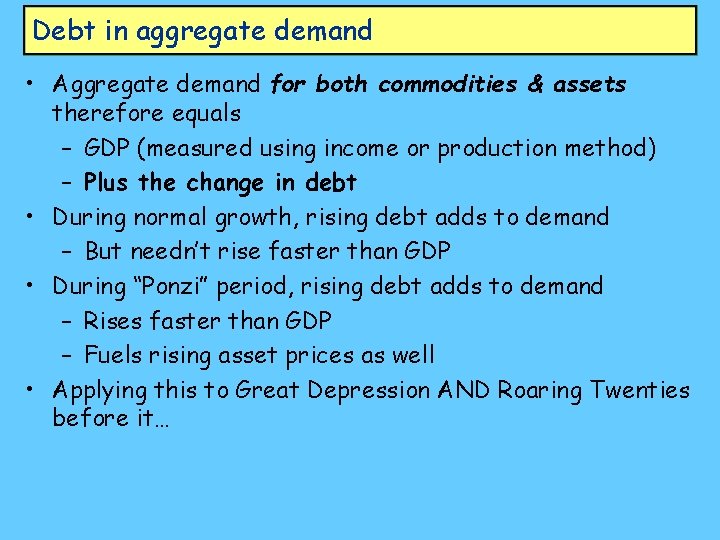
Debt in aggregate demand • Aggregate demand for both commodities & assets therefore equals – GDP (measured using income or production method) – Plus the change in debt • During normal growth, rising debt adds to demand – But needn’t rise faster than GDP • During “Ponzi” period, rising debt adds to demand – Rises faster than GDP – Fuels rising asset prices as well • Applying this to Great Depression AND Roaring Twenties before it…
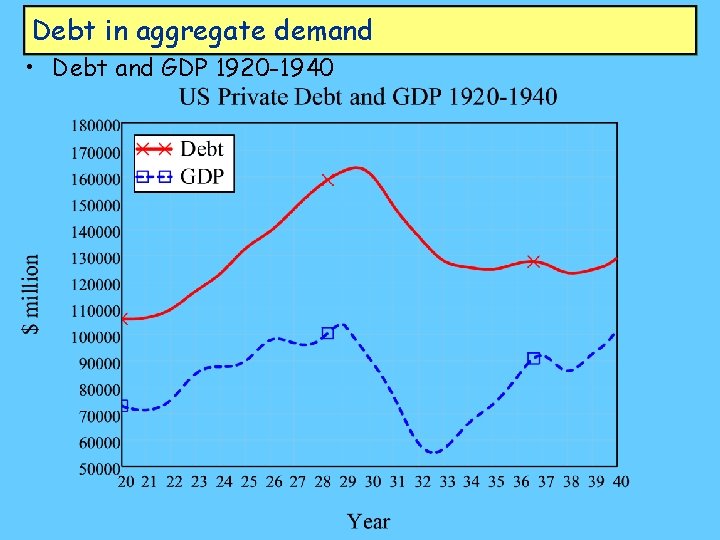
Debt in aggregate demand • Debt and GDP 1920 -1940
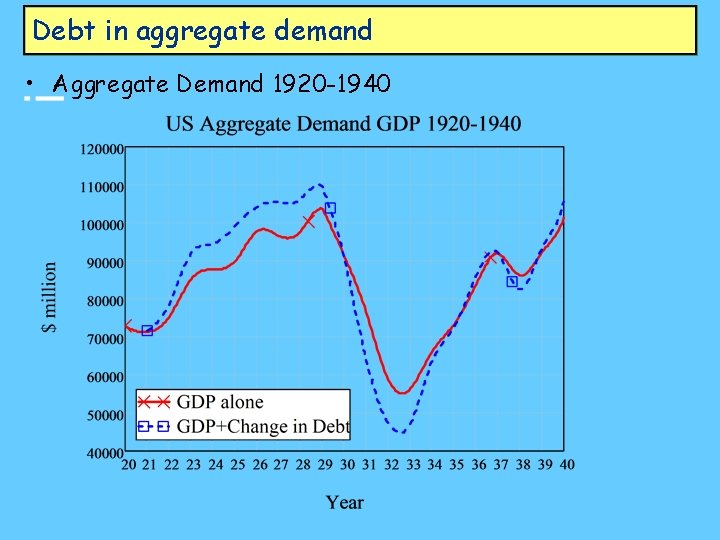
Debt in aggregate demand • Aggregate Demand 1920 -1940
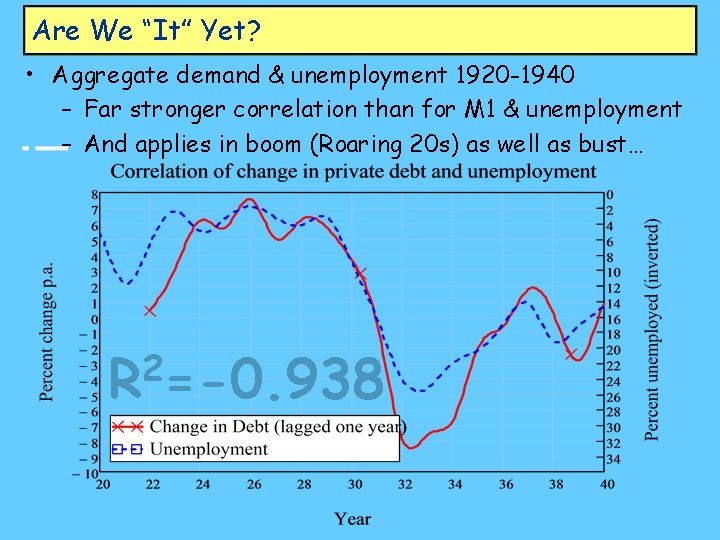
Are We “It” Yet? • Aggregate demand & unemployment 1920 -1940 – Far stronger correlation than for M 1 & unemployment – And applies in boom (Roaring 20 s) as well as bust… 2 R =-0. 938
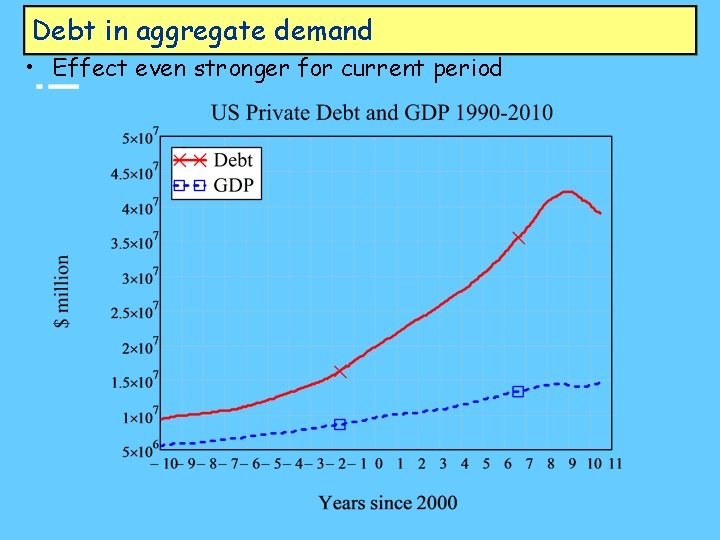
Debt in aggregate demand • Effect even stronger for current period
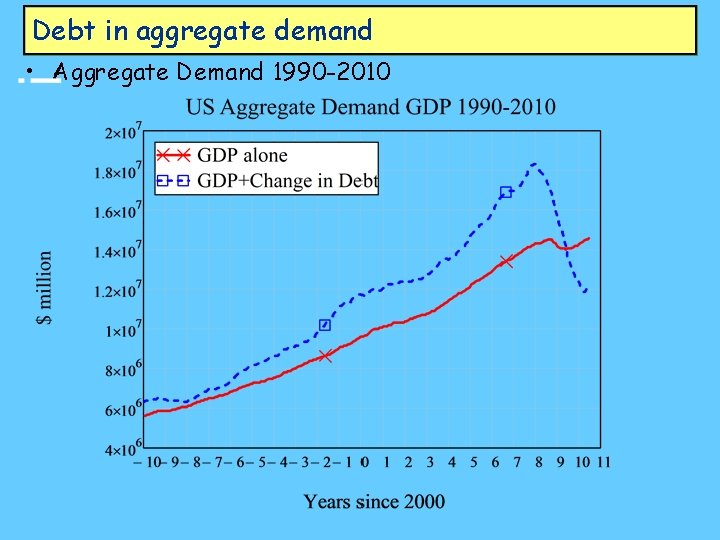
Debt in aggregate demand • Aggregate Demand 1990 -2010
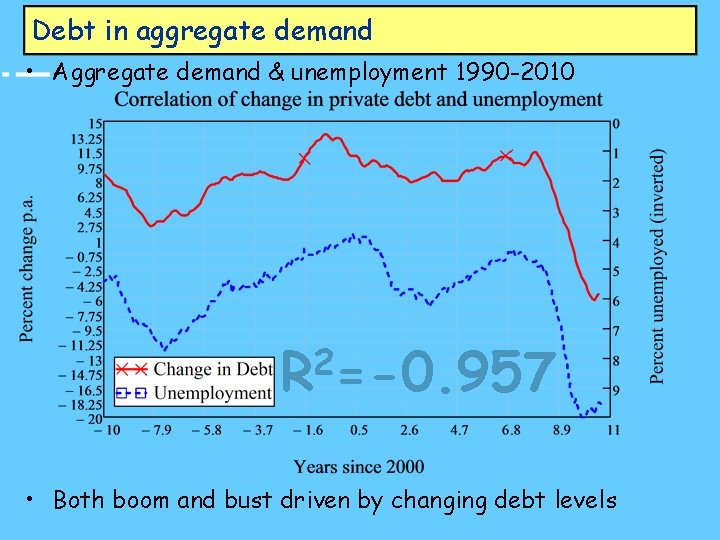
Debt in aggregate demand • Aggregate demand & unemployment 1990 -2010 2 R =-0. 957 • Both boom and bust driven by changing debt levels
Debt in aggregate demand • Expansion of debt initially causes a boom – Demand much higher than with constant debt/GDP • But contraction of debt during slump reduces demand – “Deleveraging” • When debt/GDP ratio low, debt contribution to demand less significant • When ratio high, debt contribution can be most important determinant of economic activity • E. g. , compare USA 1955 -1975 with USA 1920 -1940 and 1990 -2010
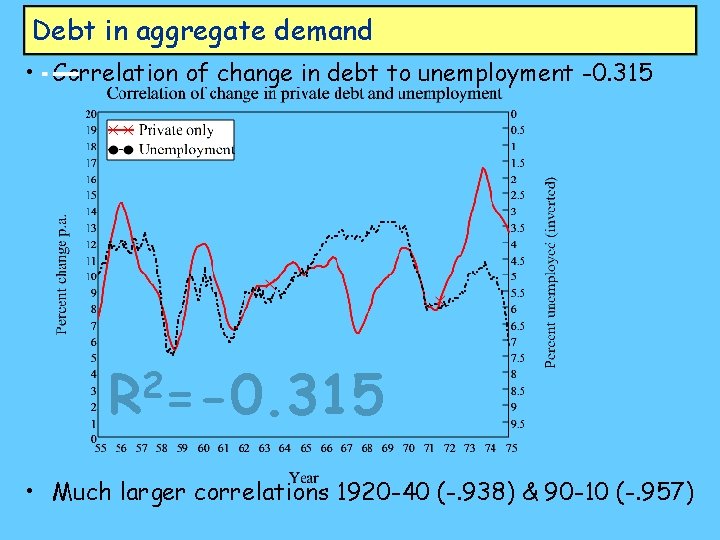
Debt in aggregate demand • Correlation of change in debt to unemployment -0. 315 2 R =-0. 315 • Much larger correlations 1920 -40 (-. 938) & 90 -10 (-. 957)
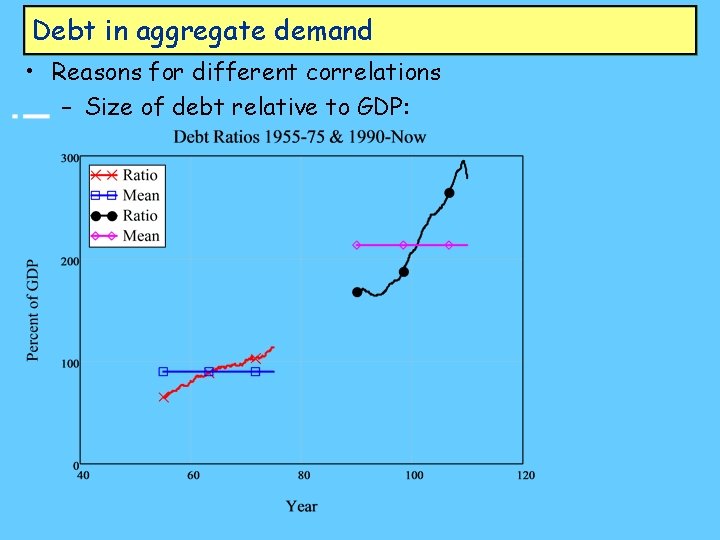
Debt in aggregate demand • Reasons for different correlations – Size of debt relative to GDP:
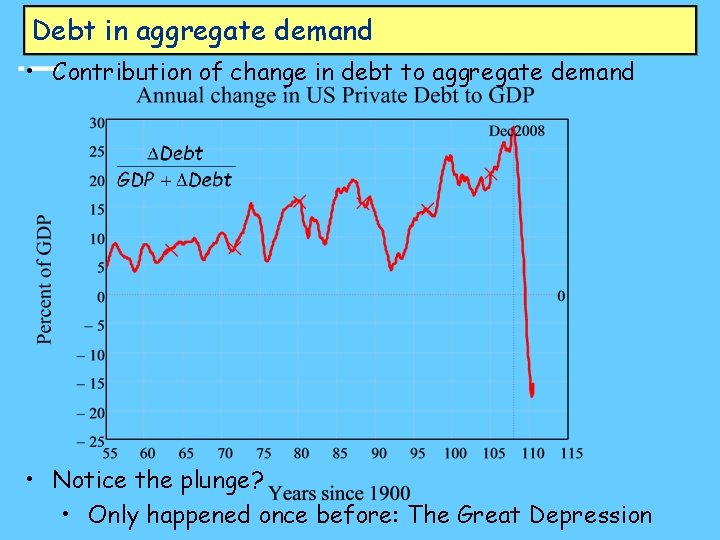
Debt in aggregate demand • Contribution of change in debt to aggregate demand • Notice the plunge? • Only happened once before: The Great Depression
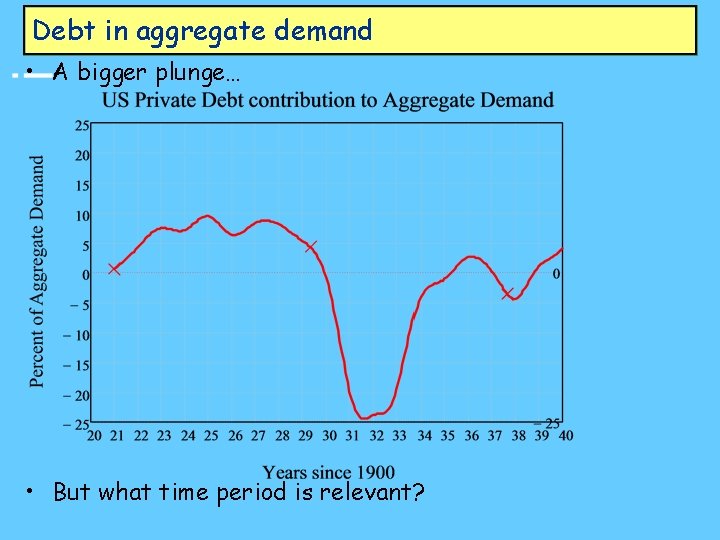
Debt in aggregate demand • A bigger plunge… • But what time period is relevant?
Debt in aggregate demand • Compare from time of “Peak Debt” in both cases – Measure debt-driven downturn in aggregate demand • From point where debt-driven boost reached peak – 1920 -1940—peak was mid-1927 • Lagged one year to mid-1928 since data yearend annual back then – 1990 -Now—peak was December 2007 • Only 4 episodes of falling private debt – Two during Great Depression – One during end of WWII – And now…
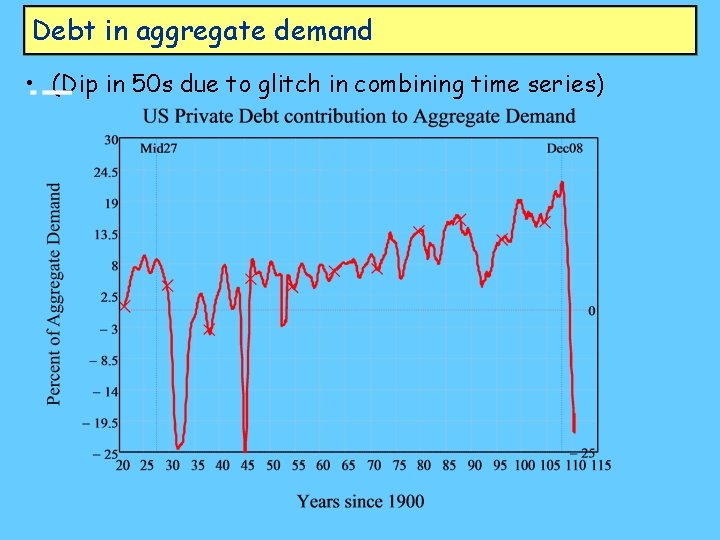
Debt in aggregate demand • (Dip in 50 s due to glitch in combining time series)
Debt in aggregate demand • Comparing “Now” to “Then” from similar starting point – Mid-1928 Then similar to December 2008 Now • Debt boosted demand by 7% then, 22% Now – Now (mid-2010) similar to late 1930 Then • Deleveraging reduced demand by 15% then, 20% now • So deleveraging worse Now than Then • Sole positive—scale of government intervention – Government fiscal stimulus adding about 12% to aggregate demand Now versus 3% Then
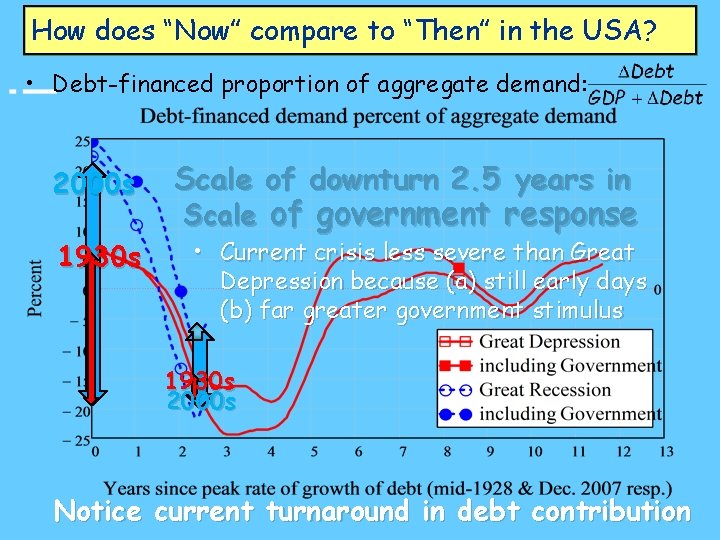
How does “Now” compare to “Then” in the USA? • Debt-financed proportion of aggregate demand: 2000 s 1930 s Scale of downturn 2. 5 years in Scale of government response • Current crisis less severe than Great Depression because (a) still early days (b) far greater government stimulus 1930 s 2000 s Notice current turnaround in debt contribution
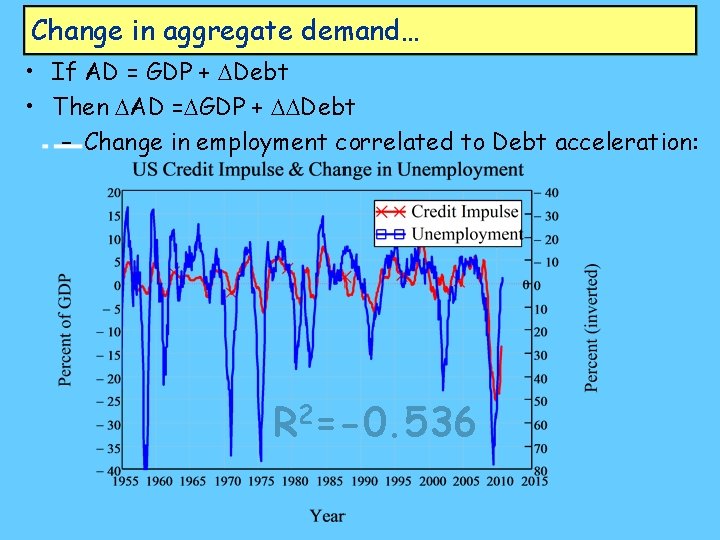
Change in aggregate demand… • If AD = GDP + DDebt • Then DAD =DGDP + DDDebt – Change in employment correlated to Debt acceleration: R 2=-0. 536
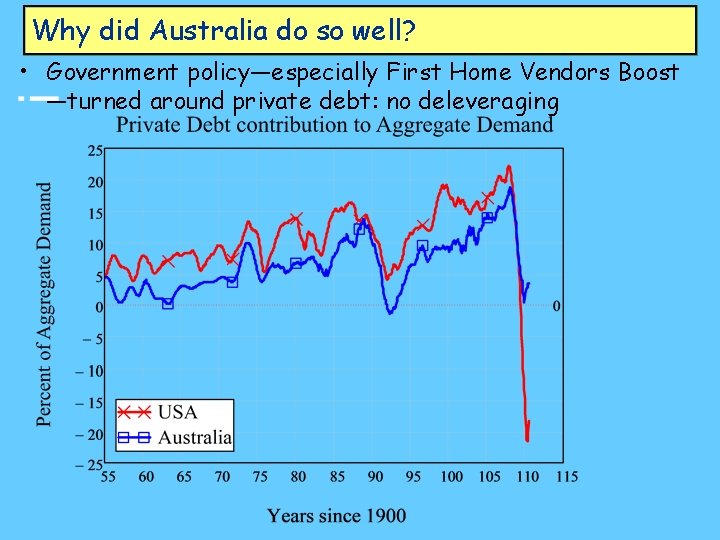
Why did Australia do so well? • Government policy—especially First Home Vendors Boost —turned around private debt: no deleveraging
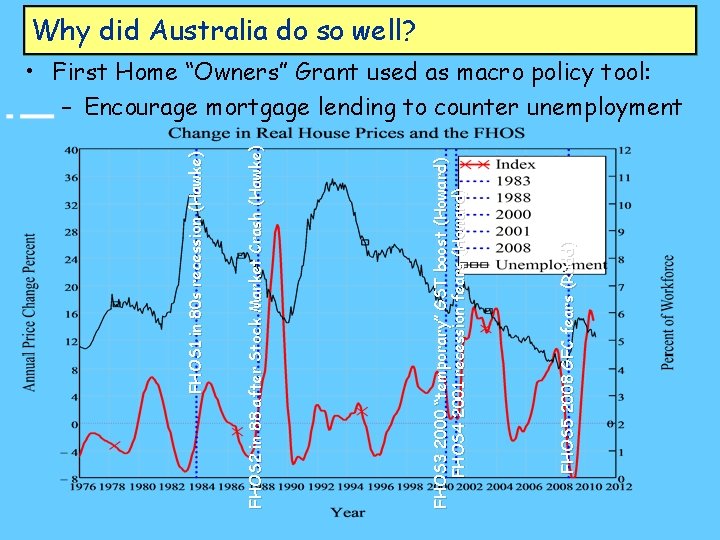
FHOS 5 2008 GFC fears (Rudd) FHOS 3 2000 “temporary” GST boost (Howard) FHOS 4 2001 recession fears (Howard) FHOS 2 in 88 after Stock Market Crash (Hawke) FHOS 1 in 80 s recession (Hawke) Why did Australia do so well? • First Home “Owners” Grant used as macro policy tool: – Encourage mortgage lending to counter unemployment
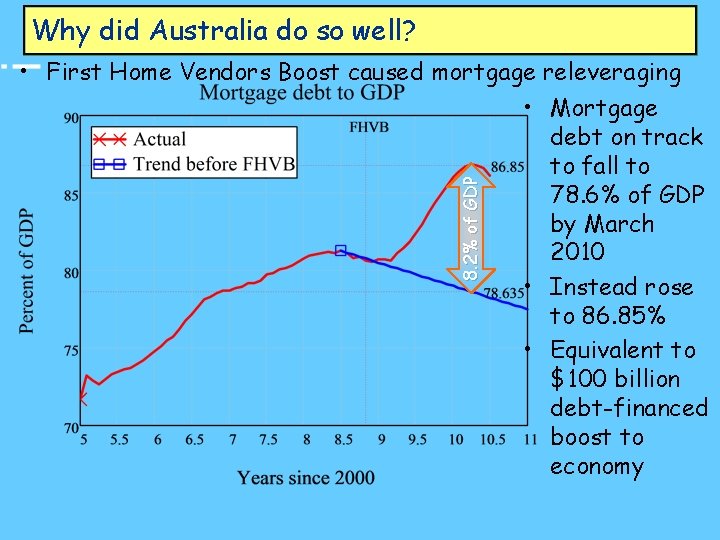
Why did Australia do so well? 8. 2% of GDP • First Home Vendors Boost caused mortgage releveraging • Mortgage debt on track to fall to 78. 6% of GDP by March 2010 • Instead rose to 86. 85% • Equivalent to $100 billion debt-financed boost to economy

Why did Australia do so well? • Only mortgage debt rose: business rapidly deleveraging
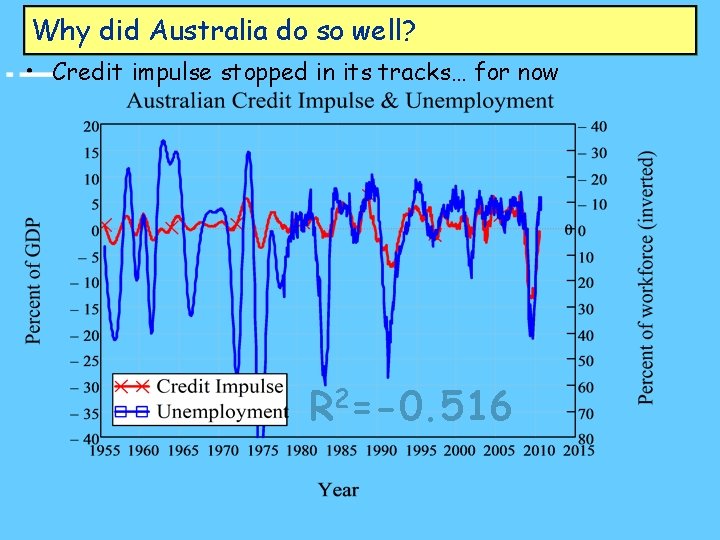
Why did Australia do so well? • Credit impulse stopped in its tracks… for now R 2=-0. 516
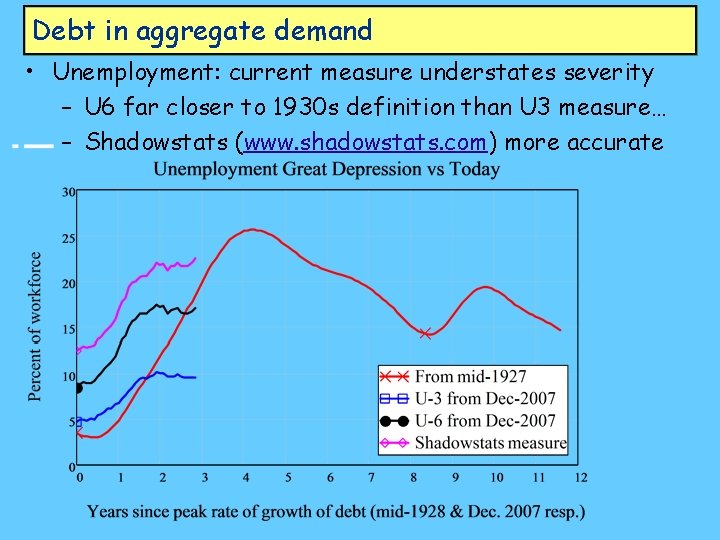
Debt in aggregate demand • Unemployment: current measure understates severity – U 6 far closer to 1930 s definition than U 3 measure… – Shadowstats (www. shadowstats. com) more accurate
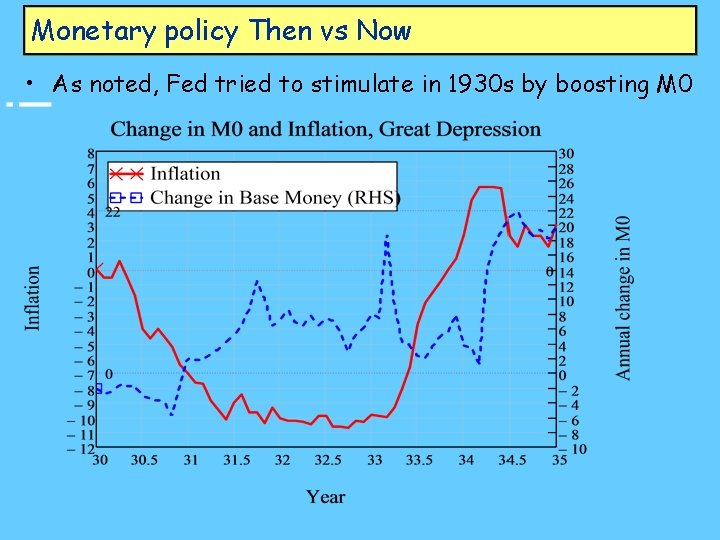
Monetary policy Then vs Now • As noted, Fed tried to stimulate in 1930 s by boosting M 0
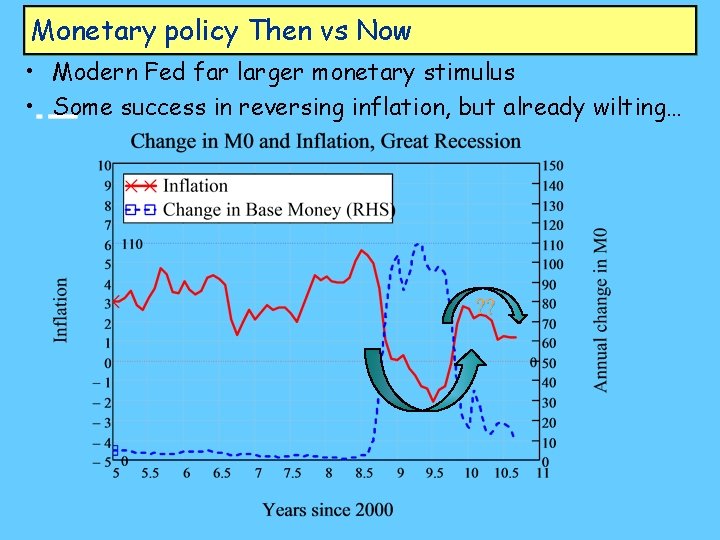
Monetary policy Then vs Now • Modern Fed far larger monetary stimulus • Some success in reversing inflation, but already wilting… ? ?
References • Bernanke, B. S. (2004). “Panel discussion: What Have We Learned Since October 1979? ” Conference on Reflections on Monetary Policy 25 Years after October 1979, St. Louis, Missouri, Federal Reserve Bank of St. Louis. • Fisher, I. (1933). "The Debt-Deflation Theory of Great Depressions. " Econometrica 1(4): 337 -357
- Slides: 52