
BEHAVIOURAL DESCRIPTIVE INTERVIEWS THE EXCITING OVERVIEW What is
BEHAVIOURAL DESCRIPTIVE INTERVIEWS

THE EXCITING OVERVIEW! What is the BDI Interview? What are the BDI competencies and why are they important? What is the STAR format? How to prepare for the interview?

WHY THE BDI? It is a province wide standard covering 6 identified competencies. It will help determine applicant suitability for a career in Policing. COMPETENCIES and the job requirements…the factors that lead to success. Designed to minimize bias from the selection process. Decisions are based on behaviour…not gut feeling, outside biases and/or stereotypes. Has a consistent grading system. Has been in use for more than 20 years through EPS.

THE BEHAVIOURAL DESCRIPTIVE INTERVIEW (BDI) Based on the principle of: “The best indicator of future behavior is past behavior”

INTERVIEW FORMAT At least one question for each of the six competencies. Option for a second question without penalty. Each behavioral question relates to an experience or event in your past. Your response must be a specific example that answers the question.

PREPARATION FOR THE INTERVIEW Where do I start? 1. Document examples & experiences that demonstrate these characteristics in a positive manner. 2. We suggest you prepare at least (2 or 3) examples for each competency. 3. Retrieve experiences from your past (3 -5 yrs) in relation to: Work experience School & volunteer Life experiences – family/social Travel
You must paint a clear picture of a particular experience, detailing how you handled the situation, and indicate what the end result was. The ideal response will let the listener ‘live’ through your experience with you as you recount what occurred. Paint the picture
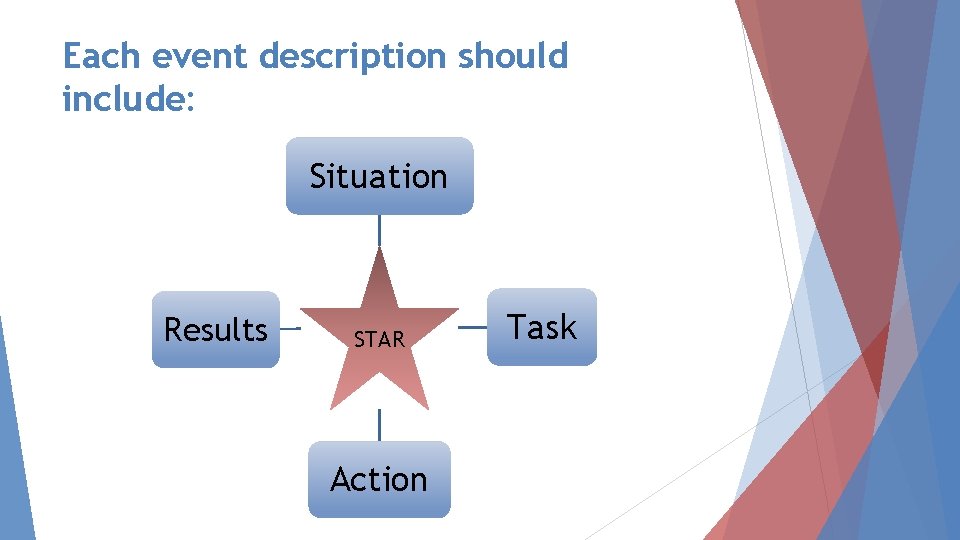
Each event description should include: Situation Results STAR Action Task
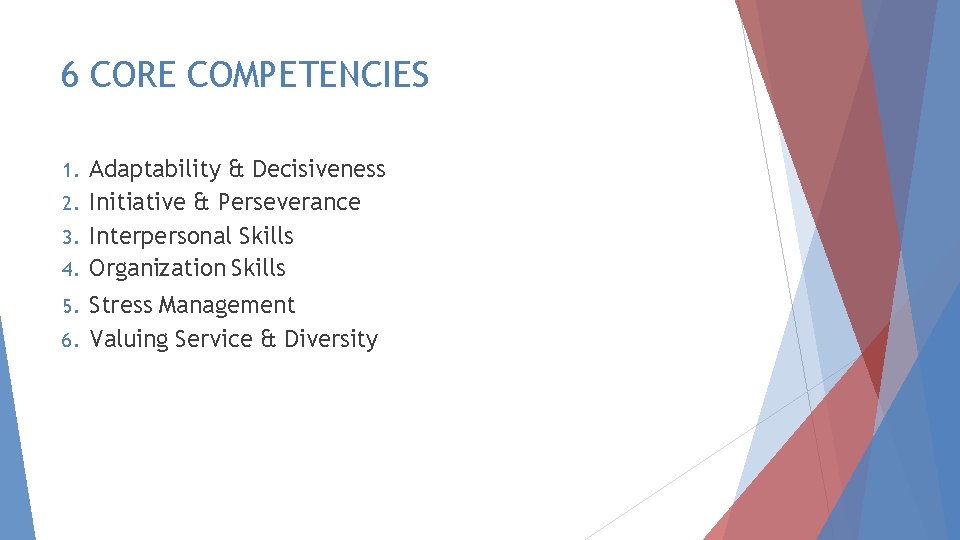
6 CORE COMPETENCIES Adaptability & Decisiveness 2. Initiative & Perseverance 3. Interpersonal Skills 4. Organization Skills 1. Stress Management 6. Valuing Service & Diversity 5.
1. Adaptability & Decisiveness Ability and confidence to vary between being flexible and holding firm on a decision, depending on what the situation requires. Showing leadership by adjusting one's approach to the demands of a particular task. By taking and maintaining a position in a self-assured manner.
2. Initiative & Perseverance Ability to be willing to take action to address needs without being requested to do so, Staying on task to completion, particularly in the face of obstacles or other trying circumstances.
3. Interpersonal Skills Ability to work effectively with different people and teams of people by putting others at ease. Acknowledging diverse opinions, addressing relevant concerns, minimizing conflict, promoting harmony. Cooperating with others and working toward consensual solutions to achieve the group's objectives.
4. Organization Skills Ability to identify and set priorities, to plan and effectively allocate appropriate resources, To attend to detail so that relevant issues are addressed and high quality outcomes result. How do you STAY ORGANIZED?
5. Stress Management Ability to work well under pressure or opposition, while maintaining effectiveness and self control in the midst of any one or combination of stressors, including emotional strain, ambiguity, risk to self and fatigue. How do you deal with the stress in your life?
6. Valuing Service & Diversity Ability to be sensitive to client and community needs and perceptions by providing prompt, efficient and equitable service. Involving clients and community in the resolution of problems that affect them. Sensitivity to the diverse Social, Cultural and Ethnic Groups within our culture.
TAILORING EXAMPLES TO COMPETENCIES Each example should be able to target multiple different competencies Take time prior to answering the question to ensure you are using your best example When composing your examples write which example is primary to your example and have a secondary example for each as well
Key points to remember! Keep to the STAR format Date first and scene set up first Experiences from last 3 – 5 years Names of people (first and last name) “I” statements should be heard throughout Specific example only – concise and chronological form
FALSE STARS Avoid using phrases like: “I always take the time to find out what the citizen wants, and I’ve had a lot of compliments because of doing that. ” (Theoretical) “There weren’t many times that I wasn't able to figure out what was wrong with a computer system. ” (Opinion) When it looked like we wouldn’t make our quota, we all pitched in and got it done…. just in time. ” (Vague and “we”)
HOW TO PREPARE Ensure your success! Preparation and practice of your responses to anticipated interview questions is critical to your SUCCESS! Flip chart or outline examples into STAR format. Practice in front of the mirror, video yourself, find “objective” people to practice with and time it! Compose a mock interview. Practice tailoring to different questions. Use people other than family/friends if possible.
COMMON GENERAL INTERVIEW ERRORS Tardiness – Always get there 10 -15 minutes early. Poor personal appearance (clean cut/shave) Business attire. Lack of tact and/or over-confidence – swearing, inappropriate language. Lack of interest and enthusiasm. Failure to maintain eye contact. Lack of preparation for interview. Not answering the question.
TIPS Hand shake and a smile when you meet your Interviewers. Remove objects that will cause fidgeting. Maintain good posture and eye contact. It’s ok to drink water. Hand shake and smile on the way out. No notes, cell phones, sketching or drawing allowed. Details must come from memory.
RECEIVING FEEDBACK Try not to be defensive Listen with an open mind Try to gain something from the experience

QUESTIONS
Contact Information: Reg. #2319, Cst. Tanis KOLESAR 780 -719 -9745 tanis. kolesar@edmontonpolice. ca Call, Email, or text if you have any questions, thank you for your attendance!
- Slides: 24