
Behaviour Based Safety Various Stages of Safety Culture
Behaviour Based Safety
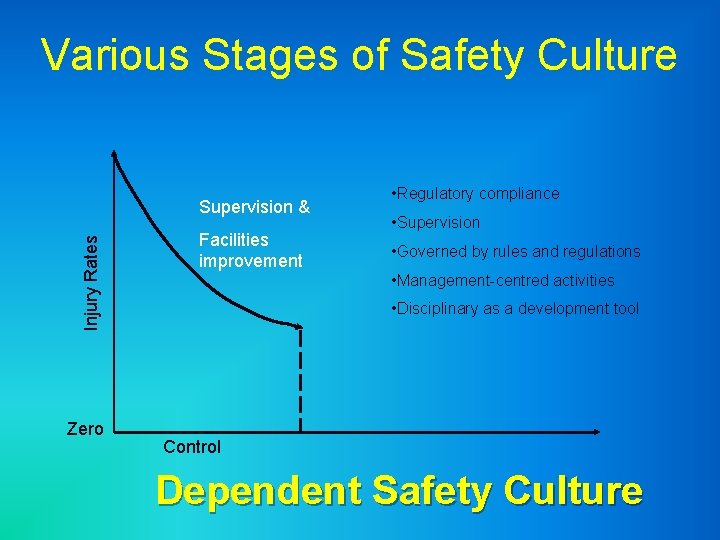
Various Stages of Safety Culture Injury Rates Supervision & Zero Facilities improvement • Regulatory compliance • Supervision • Governed by rules and regulations • Management-centred activities • Disciplinary as a development tool Control Dependent Safety Culture
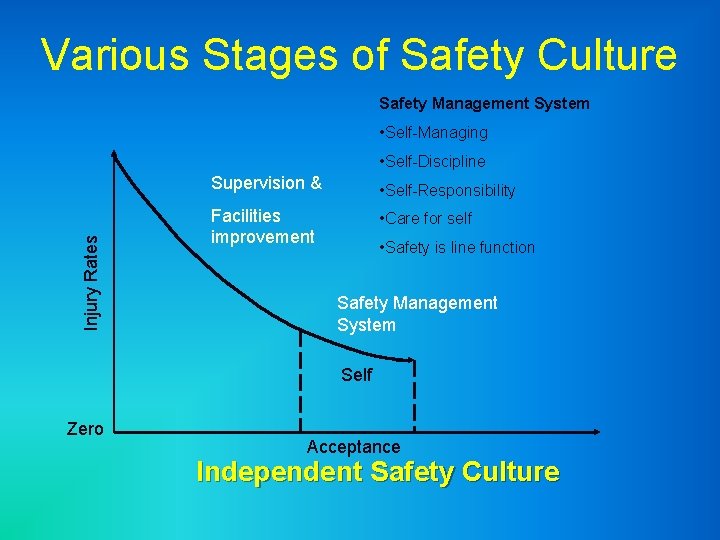
Various Stages of Safety Culture Safety Management System • Self-Managing Injury Rates • Self-Discipline Supervision & • Self-Responsibility Facilities improvement • Care for self • Safety is line function Safety Management System Self Zero Acceptance Independent Safety Culture
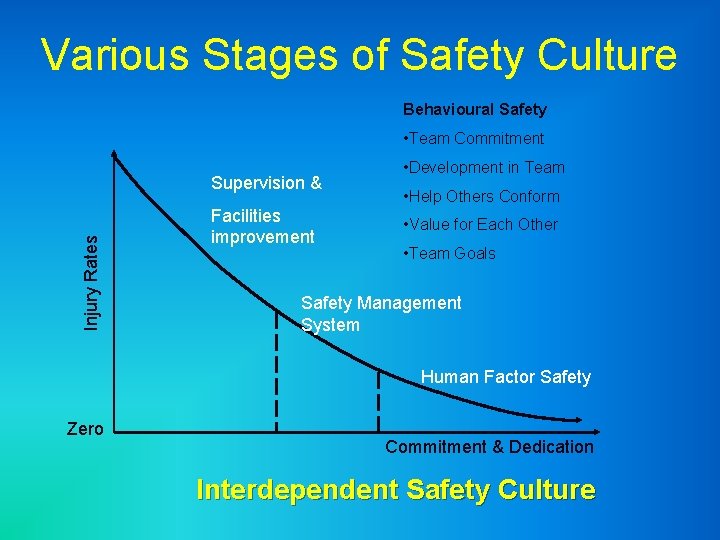
Various Stages of Safety Culture Behavioural Safety • Team Commitment Injury Rates Supervision & Facilities improvement • Development in Team • Help Others Conform • Value for Each Other • Team Goals Safety Management System Human Factor Safety Zero Commitment & Dedication Interdependent Safety Culture
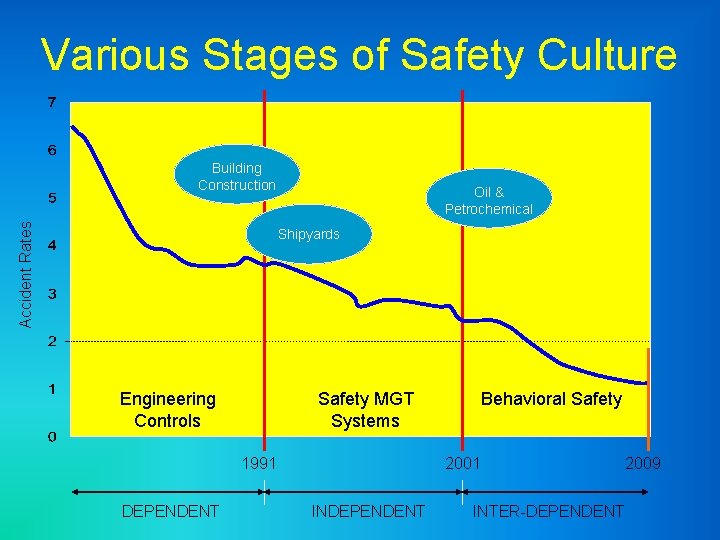
Various Stages of Safety Culture Accident Rates Building Construction Oil & Petrochemical Shipyards Engineering Controls Safety MGT Systems 1991 DEPENDENT Behavioral Safety 2001 INDEPENDENT INTER-DEPENDENT 2009
Changing from a Culture that: n n Condones unsafe practices; Reacts to accidents and concentrates on statistics; Treats safety as an extra, or add on part to the business; Sees safety as someone else’s responsibility
To a culture that: n n Observe, identifies and eradicates unsafe acts Is concerned about people and is proactive in safety Integrates safety into the greater business culture Accepts that safety is a personal responsibility for everyone within the organization
98% of all accidents are due to unsafe behaviours n n n Addressing workplace behaviour and work practices which are unsafe; Reaffirming and improving safety standards; Improving safety standard and understanding; Providing a more sensitive indicator of safety performance; Challenging and improving all cultural aspects of the organization that affect i. e. attitudes, values perceptions, behaviors and competencies.
What is Behaviour? n Behaviour is: “ The way people act”
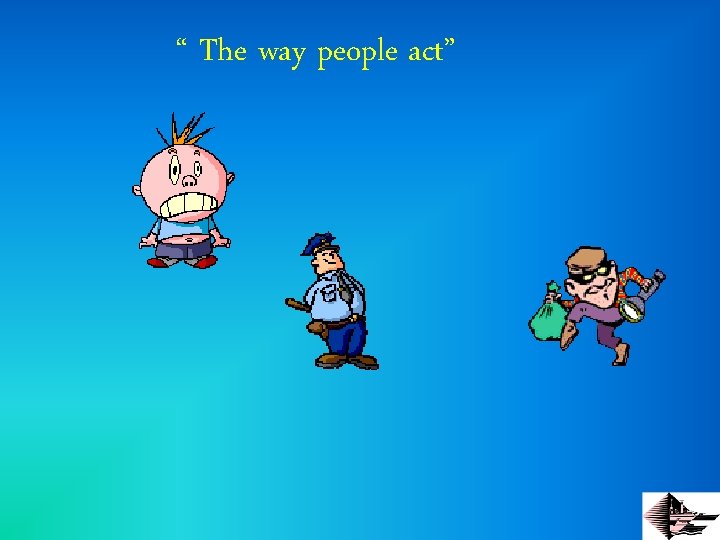
“ The way people act”
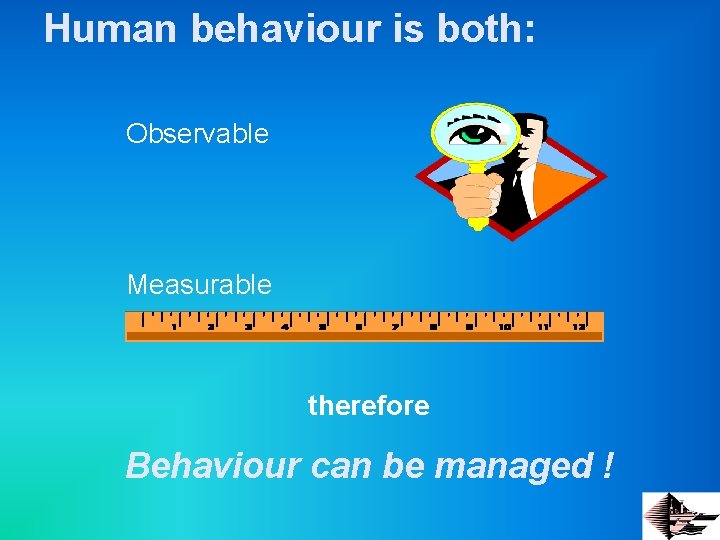
Human behaviour is both: Observable Measurable therefore Behaviour can be managed !
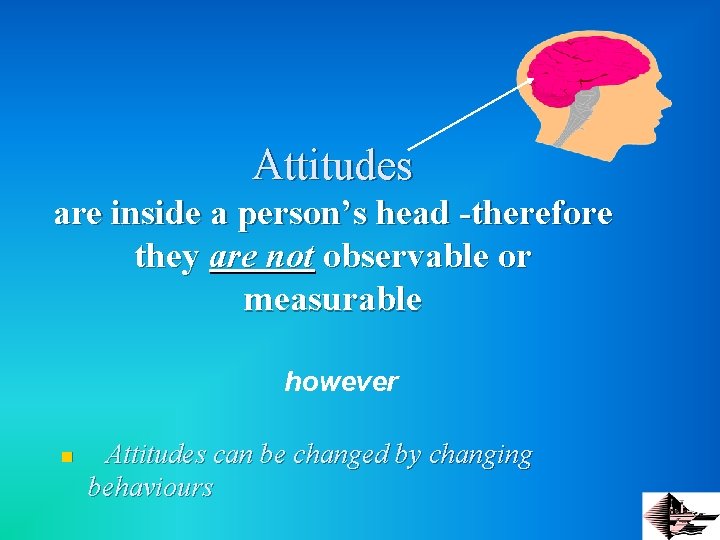
Attitudes are inside a person’s head -therefore they are not observable or measurable however n Attitudes can be changed by changing behaviours
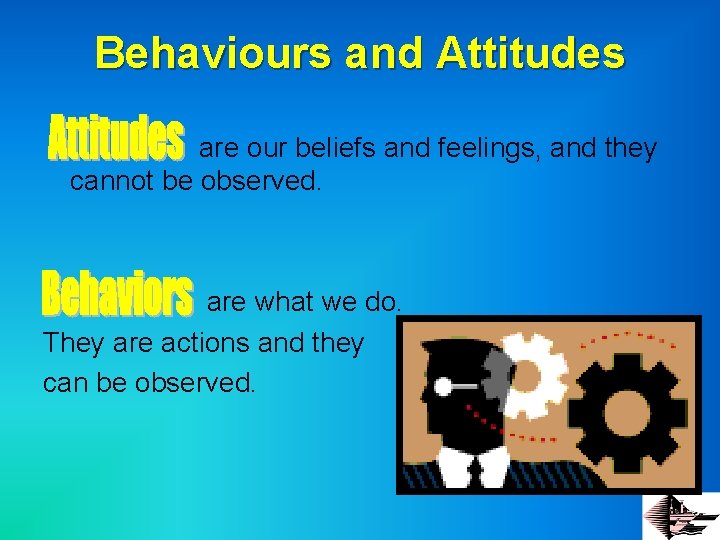
Behaviours and Attitudes are our beliefs and feelings, and they cannot be observed. are what we do. They are actions and they can be observed.
Three Natural Behaviours Laws n n n Behaviours with advantages will be naturally reinforced and become a habit - Behaviours has positive consequences Behaviours with disadvantages will be given up - Behaviours has negative consequences Behaviours are influenced by expected outcomes - Behaviour consequences need to be clear and important
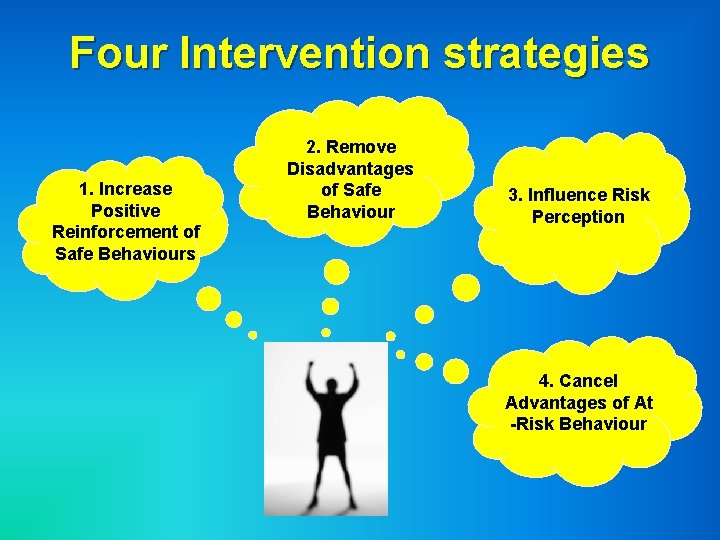
Four Intervention strategies 1. Increase Positive Reinforcement of Safe Behaviours 2. Remove Disadvantages of Safe Behaviour 3. Influence Risk Perception 4. Cancel Advantages of At -Risk Behaviour
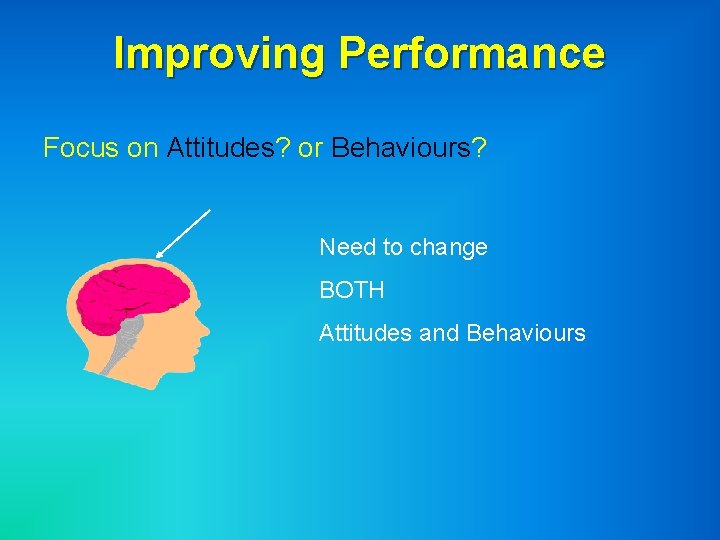
Improving Performance Focus on Attitudes? or Behaviours? Need to change BOTH Attitudes and Behaviours
Feedback “Practices” makes perfect? It’s wrong, practices does not make perfect. Practice only makes permanence. Feedback makes perfect. Without the right feedback, we cannot improve performance. We need feedback because we don’t know we are putting ourselves at risk. I call that being “Unconsciously incompetent”. We know what we should do, but we choose not to do it. That’s being “consciously incompetent”. We need feedback to motivate us to choose the safe behavior.
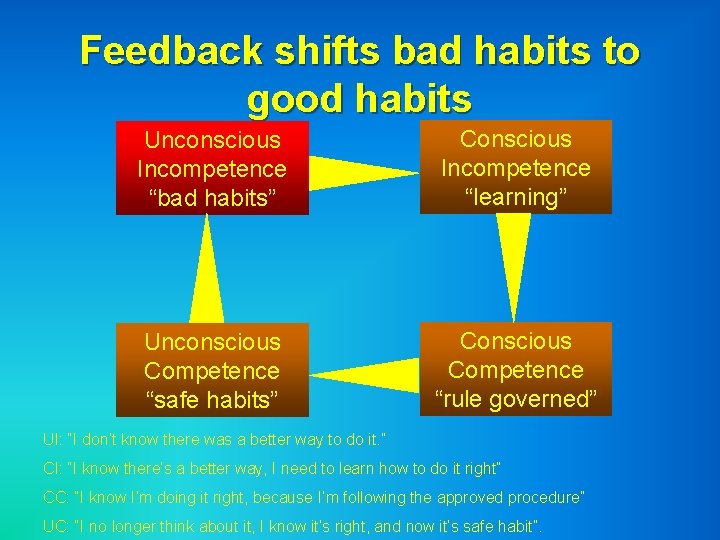
Feedback shifts bad habits to good habits Unconscious Incompetence “bad habits” Conscious Incompetence “learning” Unconscious Competence “safe habits” Conscious Competence “rule governed” UI: “I don’t know there was a better way to do it. ” CI: “I know there’s a better way, I need to learn how to do it right” CC: “I know I’m doing it right, because I’m following the approved procedure” UC: “I no longer think about it, I know it’s right, and now it’s safe habit”.
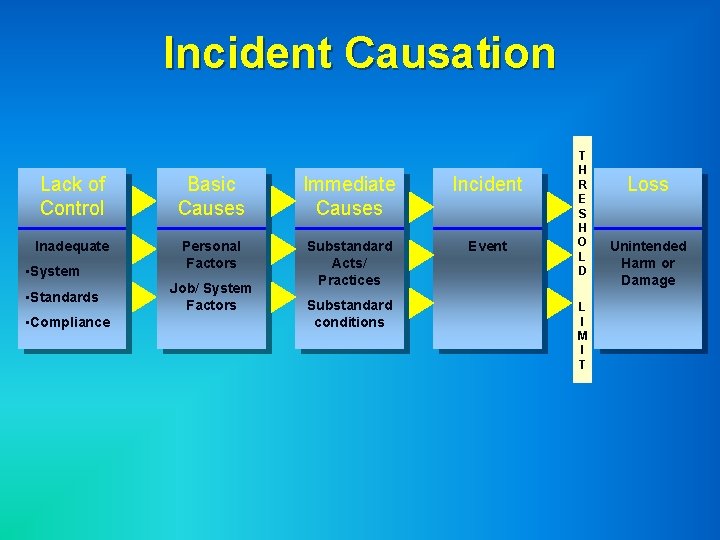
Incident Causation Lack of Control Basic Causes Immediate Causes Incident Inadequate Personal Factors Substandard Acts/ Practices Event • System • Standards • Compliance Job/ System Factors Substandard conditions T H R E S H O L D L I M I T Loss Unintended Harm or Damage
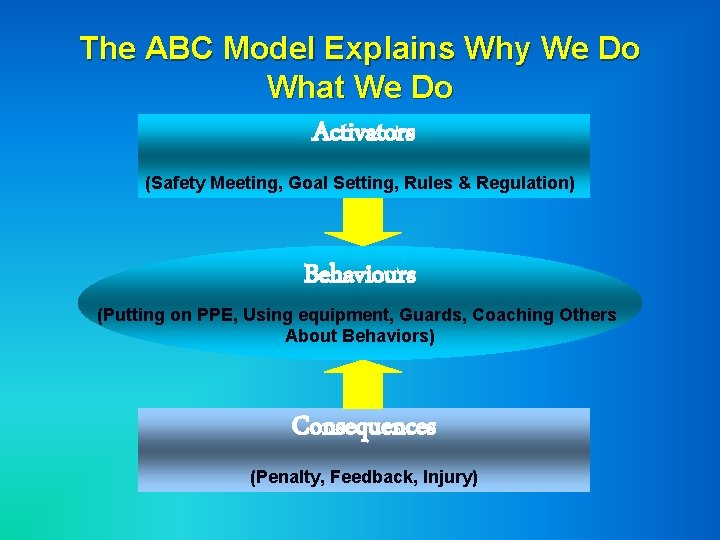
The ABC Model Explains Why We Do What We Do Activators (Safety Meeting, Goal Setting, Rules & Regulation) Behaviours (Putting on PPE, Using equipment, Guards, Coaching Others About Behaviors) Consequences (Penalty, Feedback, Injury)
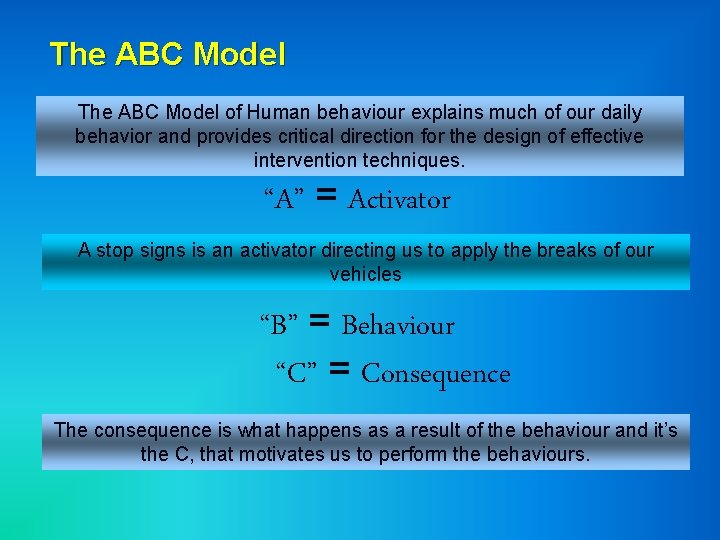
The ABC Model of Human behaviour explains much of our daily behavior and provides critical direction for the design of effective intervention techniques. “A” = Activator A stop signs is an activator directing us to apply the breaks of our vehicles “B” = Behaviour “C” = Consequence The consequence is what happens as a result of the behaviour and it’s the C, that motivates us to perform the behaviours.
Definitions: n Activators: A person, place, thing or event that happens before a behaviour takes place that encourages you to perform that behavior. n n Activators only set the stage for behaviour or performance - they don’t control it.
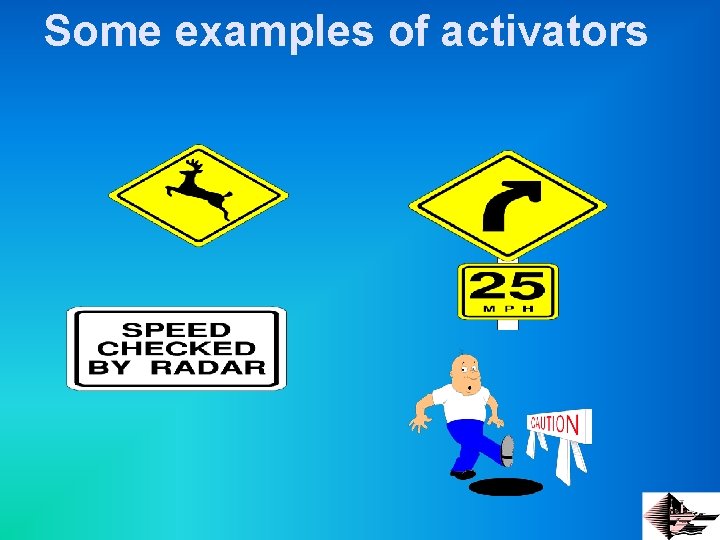
Some examples of activators
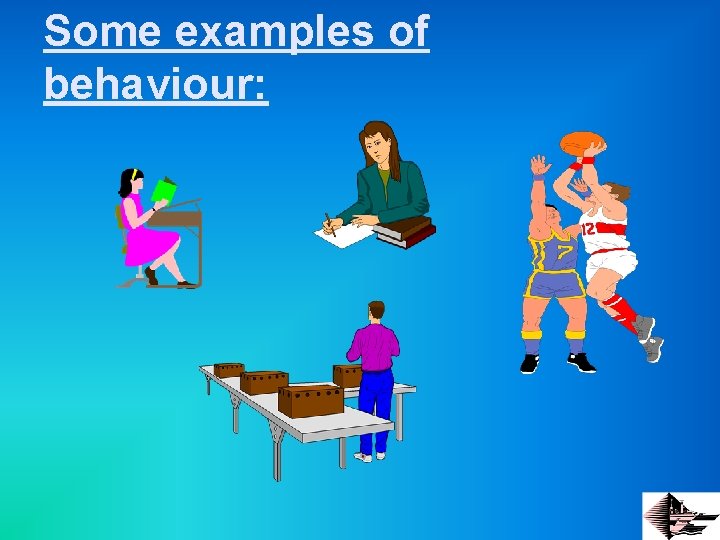
Some examples of behaviour:
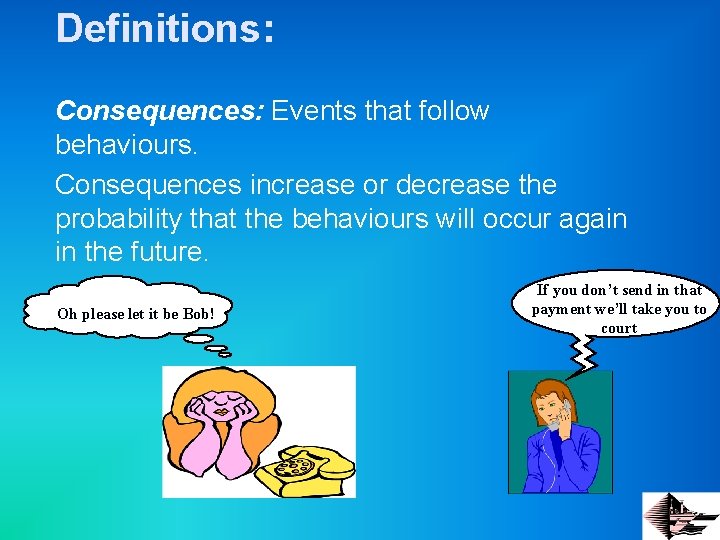
Definitions: Consequences: Events that follow behaviours. Consequences increase or decrease the probability that the behaviours will occur again in the future. Oh please let it be Bob! If you don’t send in that payment we’ll take you to court
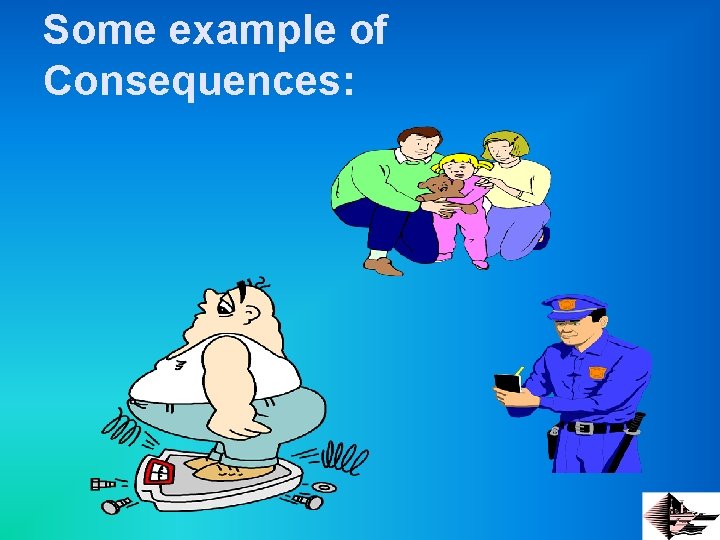
Some example of Consequences:
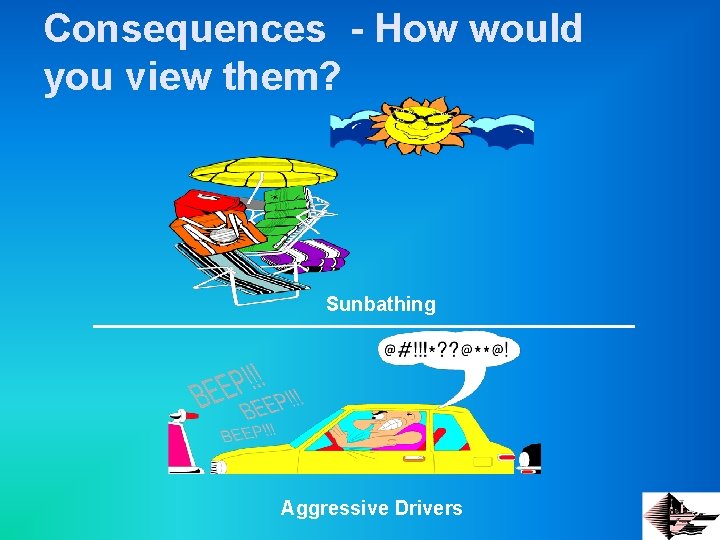
Consequences - How would you view them? Sunbathing Aggressive Drivers
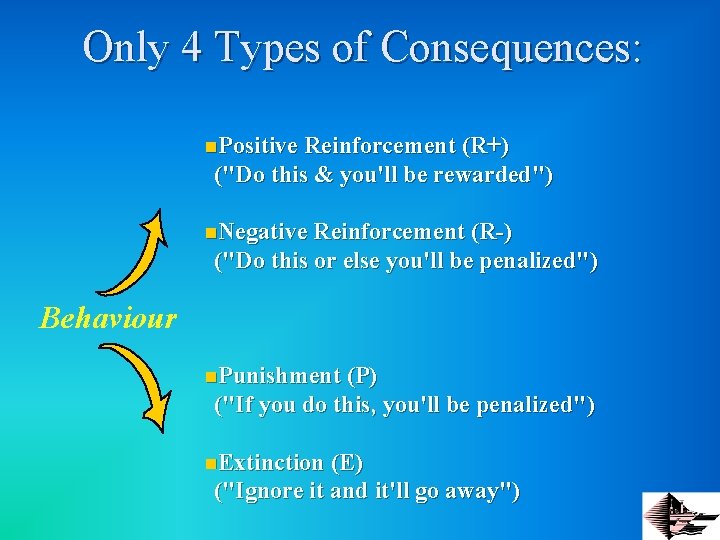
Only 4 Types of Consequences: n. Positive Reinforcement (R+) ("Do this & you'll be rewarded") n. Negative Reinforcement (R-) ("Do this or else you'll be penalized") Behaviour n. Punishment (P) ("If you do this, you'll be penalized") n. Extinction (E) ("Ignore it and it'll go away")
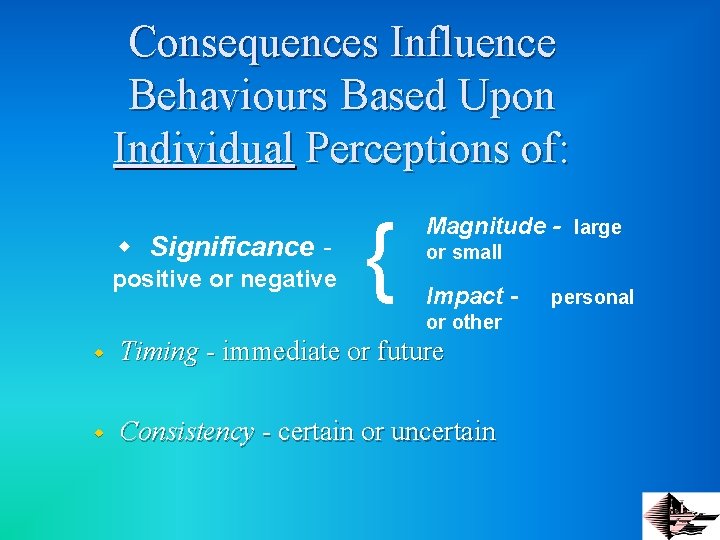
Consequences Influence Behaviours Based Upon Individual Perceptions of: w Significance positive or negative { Magnitude - large or small Impact or other w Timing - immediate or future w Consistency - certain or uncertain personal
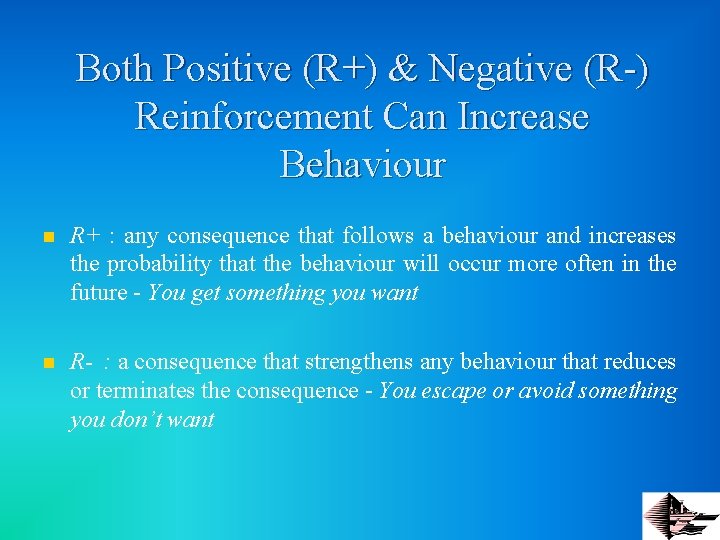
Both Positive (R+) & Negative (R-) Reinforcement Can Increase Behaviour n R+ : any consequence that follows a behaviour and increases the probability that the behaviour will occur more often in the future - You get something you want n R- : a consequence that strengthens any behaviour that reduces or terminates the consequence - You escape or avoid something you don’t want
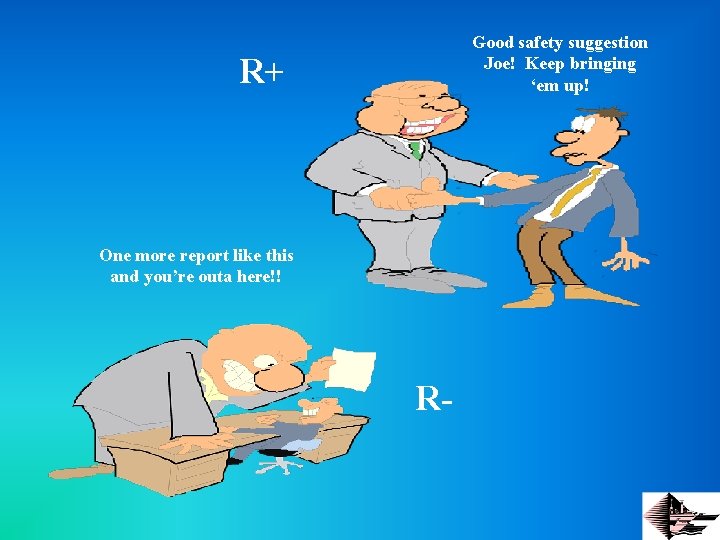
Good safety suggestion Joe! Keep bringing ‘em up! R+ One more report like this and you’re outa here!! R-
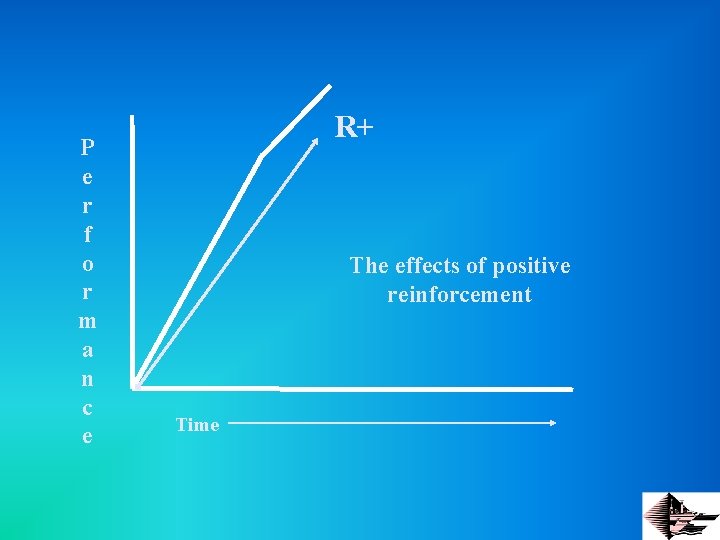
P e r f o r m a n c e R+ The effects of positive reinforcement Time
Both Punishment & Extinction Decrease Behavior n P: a procedure in which a punisher (consequence that decreases the frequency of the behaviour it follows) is presented - You may get something you don’t want n E: withholding or non-delivery of positive reinforcement for previously reinforced behaviour - You don’t get what you want
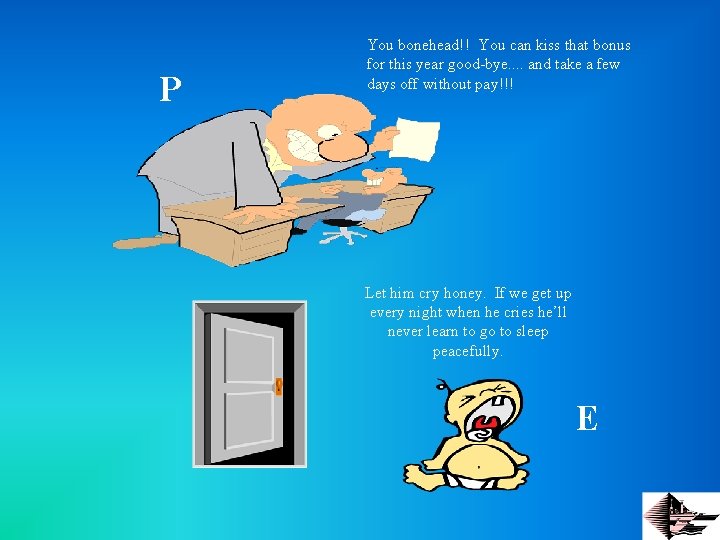
P You bonehead!! You can kiss that bonus for this year good-bye. . and take a few days off without pay!!! Let him cry honey. If we get up every night when he cries he’ll never learn to go to sleep peacefully. E
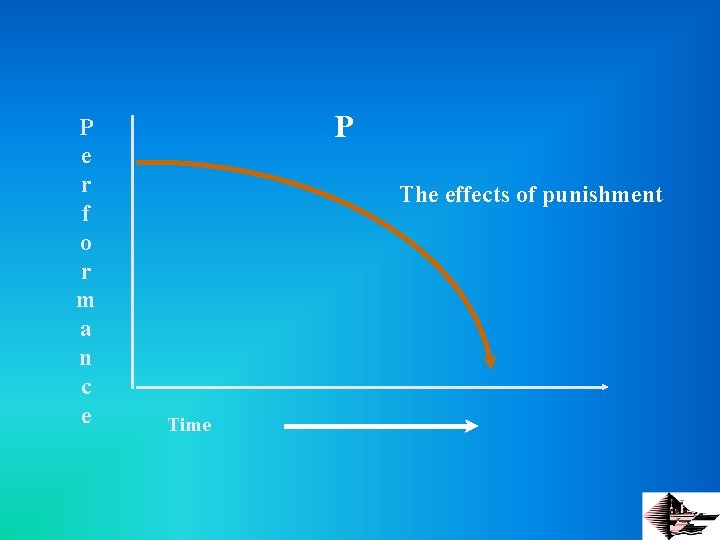
P e r f o r m a n c e P The effects of punishment Time
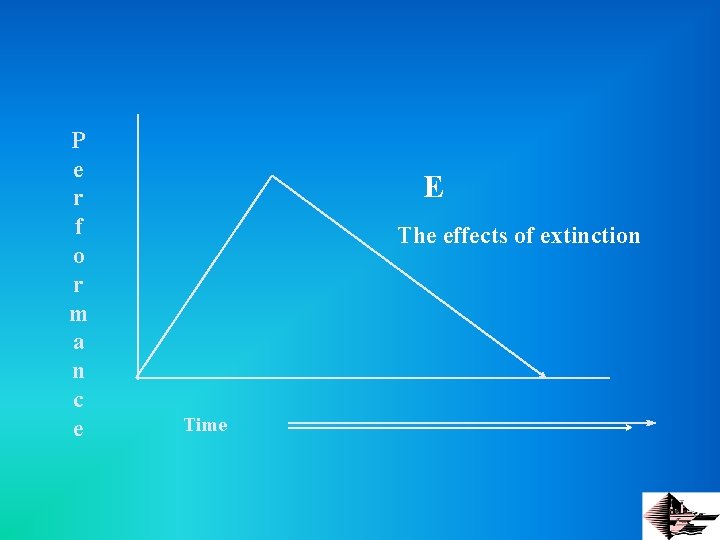
P e r f o r m a n c e E The effects of extinction Time
What Employees Want: A Safe Workplace n A Positive Workplace n To Take Care of One Another n To Stop the Hurt! n
What Management Wants: An Accident Free Workplace n Empowered Employees n Pro-active Rather Than Re-active Work Process n To Minimize Direct and Indirect Costs and Threat of Liability From Accidents n
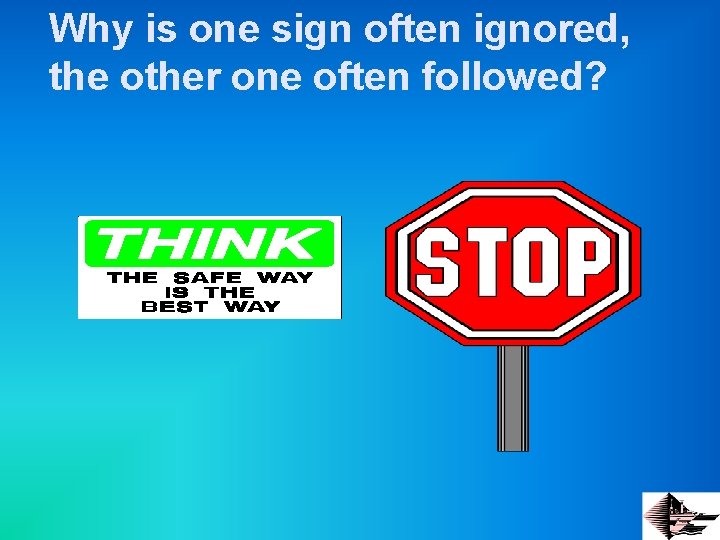
Why is one sign often ignored, the other one often followed?
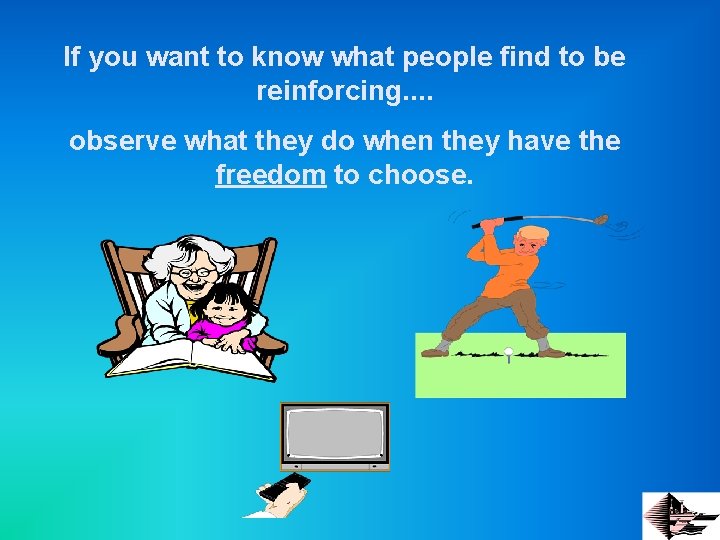
If you want to know what people find to be reinforcing. . observe what they do when they have the freedom to choose.
Activator or Consequence? The basic principle that behaviours (B) is directed by activators (A) and motivated by consequences (C). Activators influence the quality of our performance (how we do things), consequence influence the quantity of our performance (how often we do things). Feedback can be considered an activator or a consequence, depending on whether it directs or motivates behaviour.
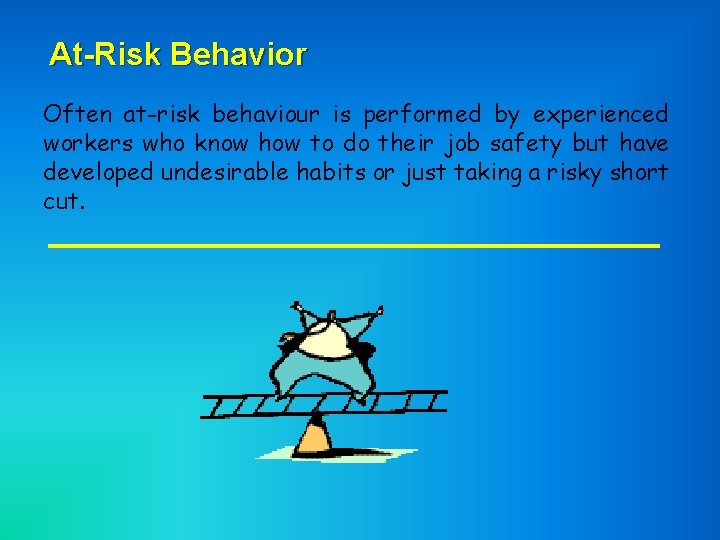
At-Risk Behavior Often at-risk behaviour is performed by experienced workers who know how to do their job safety but have developed undesirable habits or just taking a risky short cut.
Guidelines To Reward Safe Behaviour and Correct At-Risk Behaviour Give it One-on-One Make it Timely Identify The Observed Behaviour Rewarding Safe Behaviour Correcting At-Risk Behaviour • Give personal praise and thanks • Specify the desired behaviour • Listen to reaction • Reaffirm approval and offer encouragement • Solicit potential solution • Request commitment for change • Express concern and caring
Total Safety Culture -The ultimate vision for safety improvement mission -A work culture in which everyone feels responsible for safety and pursues it on a daily basic -At work, employees go beyond “the call of duty” to identify environmental hazards and at-risk behaviors. Then they intervene to correct them and safe work practices are supported with proper recognition procedures.
Total Safety Culture- Safety is my value §Safety is my value; §I am responsible for the safety of my co-workers as well as myself; §I will “GO BEYONDTHE CALL OF DUTY” on behalf of the safety of others; §I will perform active caring and safe behaviours for the benefit of others at all times;
What is BBS? § Behaviour- Based Safety Ø Use of scientific psychology to promote safety Ø Ø Typically involves creating a systematic ongoing process that clearly defines a set of behaviours reducing people’s risk of injury Managing “above the shoulder” based on what people think, feel and do
BEHAVIOUR-BASED SAFETY PROCESS Objective No incident / accident The objective is that ALL people working in our Yard can come to work and go back home as healthy and in the same condition as when they came in (no injuries or other incidents).
Behaviour-Based Safety Observation Process What? - an observation and feedback process When? - during normal work activities Why? - to improve workplace How? - by focusing on acts Who? - by workers
Behaviour-Based Safety Observation (BBSO) Process SUMMARY 1. Process focuses on acts/behaviours, not conditions; 2. Process is run by and for workers; 3. Very proactive in that it addresses all unsafe acts, not just those which result in accidents; 4. Process provides positive feedback and reinforcement since most acts are safe acts; 5. There is no discipline or negative consequences associate with the process; 6. Process is an excellent employee awareness and education tool
Behaviour-Based Safety Rationale: üAll injuries & occupational illness are preventable üBest achieved by: v. Having a Total safety Culture where each person feels responsible for their OWN and EVERYONE ELSE+SAFETY
BBS Key Concepts Key Principles 1. Safety awareness is being alert to what you are doing and what is going on around you; 2. Safety awareness is a part of every employee’s job; 3. Safety awareness must be learned; 4. The action people can cause an accident or injury; 5. The At-risk acts of people are the major cause of injuries; 6. At-risk acts can create unsafe conditions in your work area; 7. We are responsible for safety in our work area BBS-An extension to existing safety system
Essential Tools For BBSO 1. Understanding Behaviours, Feeling & Attitudes 2. Appreciating Habits, Beliefs & Values and Eradicating Bad Attitudes 3. Communication and Listening Skills 4. Motivation Techniques and Persuasion Skills 5. Workplace Observation and Feedback Skills 6. Behaviour Intervention Strategies for Managing Different Situations
Characteristics of Good Communication 1. Reduce the number of steps that messages must pass through to reach their destination; 2. Keep messages short and simple; 3. Use examples and repeat your main points; 4. When speaking, slow down; 5. Use a variety of media in communicating
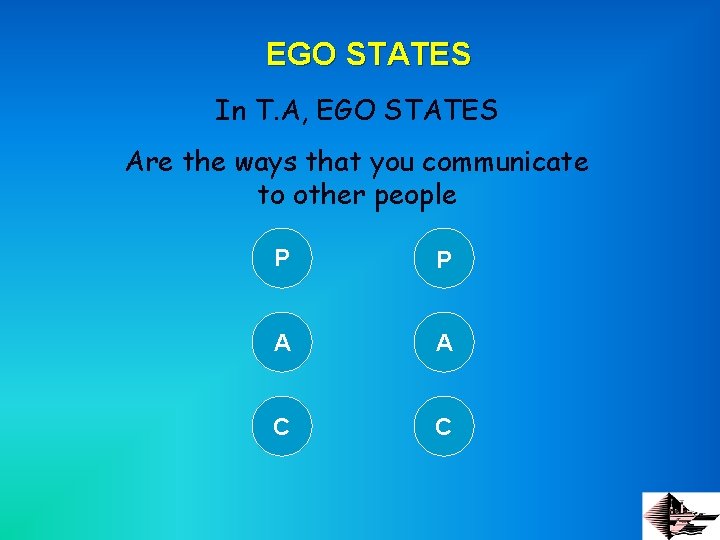
INTERVENTION What can we all do when we see an unsafe act or atrisk behaviour ? Intervene ! • Intervene using the Adult-to-Adult intervention style (Logical, reasonable and rational. It deals with facts and thinking instead of feeling, attitudes and opinions. ) • Identify the at-risk behaviour, and the hazard/likely safety incident resulting from it • Suggest what should be the correct behaviour in which to perform the task
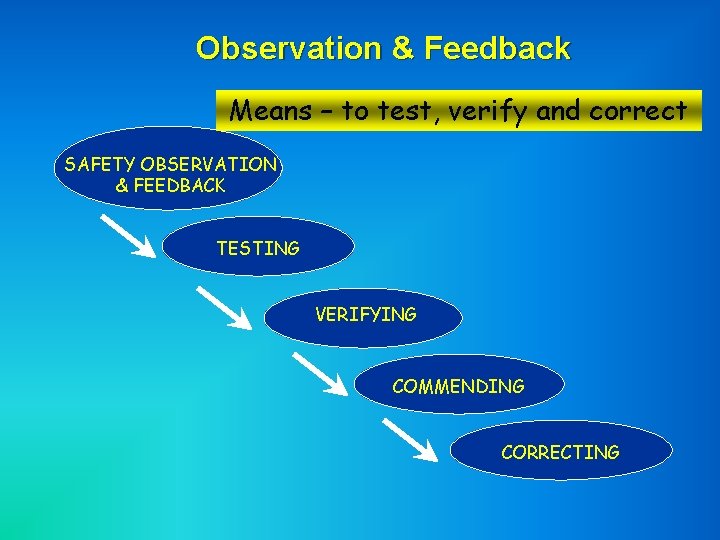
Observation & Feedback Means – to test, verify and correct SAFETY OBSERVATION & FEEDBACK TESTING VERIFYING COMMENDING CORRECTING
PURPOSES OF BBS OBSERVATION & FEEDBACK BBS Observation & Feedback are carried out by managers & supervisors during systematic tours of the workplace, enabling them to : - 1. Demonstrate their commitment to safety 2. Sensor the safety climate 3. Recognize and encourage safe behaviour 4. Help in the identification and correction of unsafe work practices and procedures. The majority of workplace injuries are caused by the at-risk behaviours of the people. Observation is the key to improved safety performance and identifying ‘accidents’ before they happen
PURPOSES OF BBS OBSERVATION & FEEDBACK Unsafe acts are not simply committed by workers. Managers and supervisors are just as capable of unsafe acts in their own roles – failing to full fill their safety responsibility through their action or inaction can often have more far reaching consequences affect more people, than the unsafe acts of those individuals in the workplace.
PURPOSES OF BBS OBSERVATION & FEEDBACK Injuries & accidents are simply a product of unsafe acts. Accidents investigation has proven that in any workplace for each individual injury-accident there are many hundreds of unsafe acts taking place. The greater the number of unsafe acts increases the probability of an accident occurring. BBS Observation feedback helps to identify and eliminate unsafe acts and practices before injury occurs but also brings about other beneficial results: - • Increase safety awareness • Raises workplace standards • Monitors the effects of safety awareness • Motivates others
PRINCIPLES OF BBS OBSERVATION & FEEDBACK PROCESS The process relies upon an open discussion of individuals performance in a blame – free environment in order that they should recognize their own risk behaviours and commit themselves to safer working. Good results depend on the understanding and thrust of those being observed as well as the skills and attitudes of those carrying out the observations
Observe People Working BBS Observation commences their observation when they observed people working People and their actions are the root causes of injuries. Observations should be focused upon the actions and behaviours of peoples in the workplace doing their normal job or work. During the observation period the observers are preparing an agenda – ready for their discussion with those performing the work. The observation should focus upon the aspects of the task and the factors that are critical to the safety of those involved.
Use all Senses The senses of Touch , smell, sight & hearing All have an important role to play in high quality observation.
Enter into Conservation Observation respectful must be Open, Unthreatening, By simply asking open questions and applying patience to your listening power, the knowledge, ideas, problems and solutions of the workplace will emerge from those performing the task. The aim is to openly encourage employees to participate in improving safety performance through recognition and correction of their own safety problems, whether it is their at risk behaviourintentional or not – poor system, or the unsafe conditions they cause.
Make Agreements & Give Praise The Observer will enquire about the current safety problems asking for ideas as to how the job can be done more safely and make firm agreements about how it will be done in the future. The Observer will ensure that all unsafe acts and conditions observed are discussed and correction agreed. Making agreements provides a clear route to the process of follow up and accountability. Giving Praise for the things that are done well will create an atmosphere of openness, and a willingness to repeat them and also embrace those things that need corrections.
Observation Issues • How often should we do observations ? Often, but aim for quality not for quantity • When ? Always, also during all shifts • How long does a good quality observation take? Approximately 20 – 30 minutes
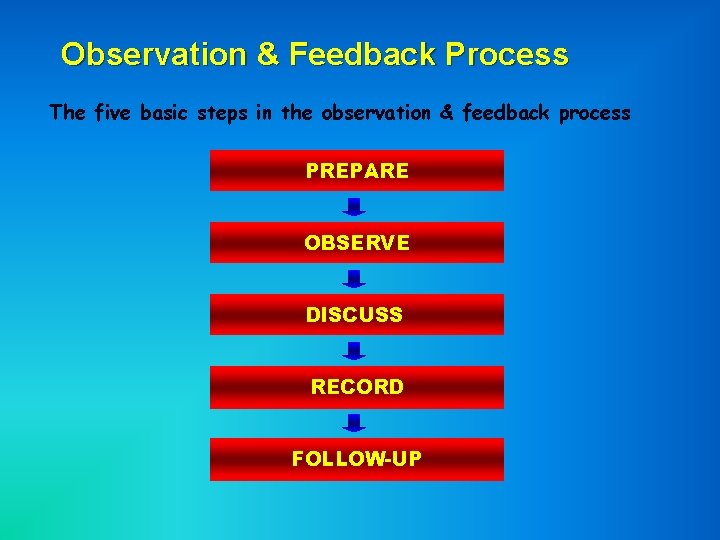
Observation & Feedback Process The five basic steps in the observation & feedback process PREPARE OBSERVE DISCUSS RECORD FOLLOW-UP
Observation & Feedback Process • PREPARE Decide to observe on a regular basis – Repeated and regular practice are the route to excellence – Excellence become a habit. Simply a way of life. Select a suitable area observe – Observe where the action is. Also observe areas of high activity low risk work. Observe regularly during periods of peak activity. Also observe shift patterns, third parties, part-time employees and activities carried out infrequently.
Observation & Feedback Process • Observe Stop when you see people working. Observe for a few minutes in order to make the best of this time. Observe a small part of the overall task or a complete cycle of small repetitive tasks. Use all the observation powers – see, listen, smell, and touch. Look below, above, behind and inside. Be alert to how people react to your sudden presence in the workplace.
Observation & Feedback Process • Observe people, s activity, their actions and surrounding environment. Look for at risk behaviours as well as good safety practices Use the observation checklist to help you focus on the safety issues. Mark the checklist – create an agenda in preparation for you discussions. The agenda ensures that you have a focused, meaningful, disciplined and efficient conversation, from which comes agreements and out of which comes actions, and accountability for those actions.
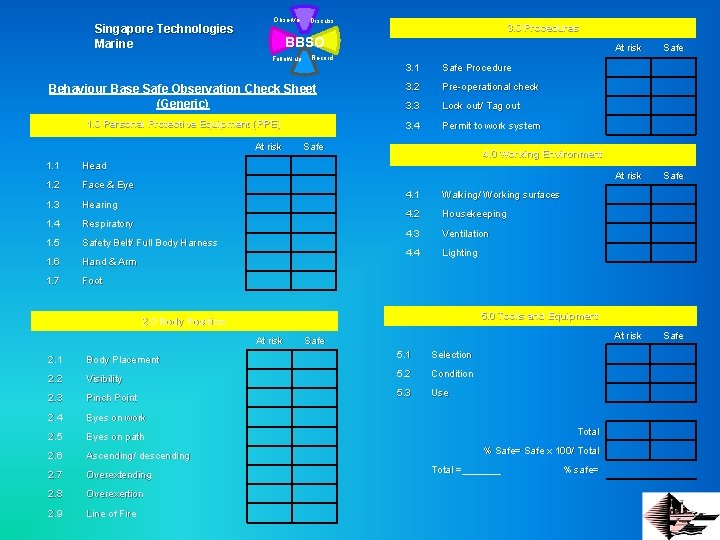
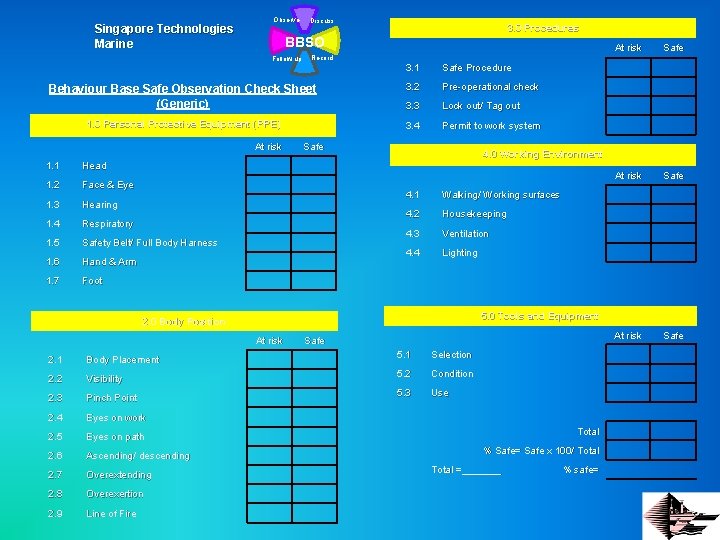
Singapore Technologies Marine Observe Discuss 3. 0 Procedures BBSO Follow up 3. 1 Safe Procedure Behaviour Base Safe Observation Check Sheet (Generic) 3. 2 Pre-operational check 3. 3 Lock out/ Tag out 1. 0 Personal Protective Equipment (PPE) 3. 4 Permit to work system At risk 1. 1 Head 1. 2 Face & Eye 1. 3 Hearing 1. 4 Respiratory 1. 5 Safety Belt/ Full Body Harness 1. 6 Hand & Arm 1. 7 Foot Safe 2. 2 Visibility 2. 3 Pinch Point 2. 4 Eyes on work 2. 5 Eyes on path 2. 6 Ascending/ descending 2. 7 Overextending 2. 8 Overexertion 2. 9 Line of Fire At risk Safe 4. 1 Walking/ Working surfaces 4. 2 Housekeeping 4. 3 Ventilation 4. 4 Lighting At risk Safe 5. 0 Tools and Equipment At risk Body Placement Safe 4. 0 Working Environment 2. 0 Body Position 2. 1 At risk Record Safe 5. 1 Selection 5. 2 Condition 5. 3 Use Total % Safe= Safe x 100/ Total =_______ % safe=
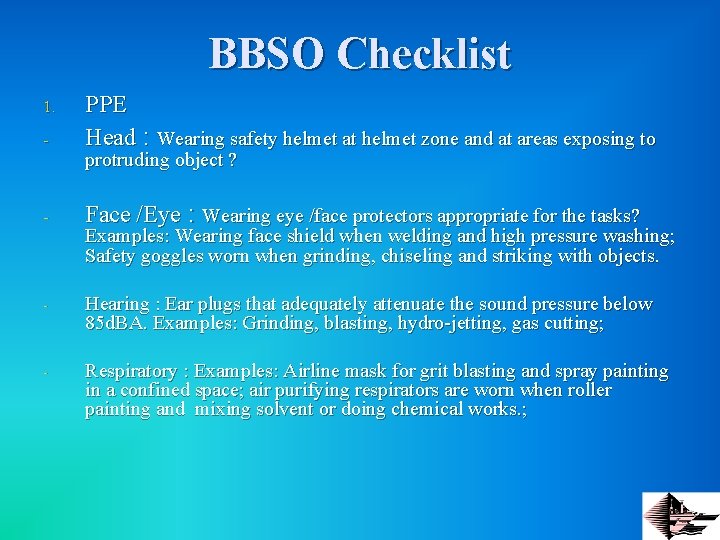
BBSO Checklist - PPE Head : Wearing safety helmet at helmet zone and at areas exposing to - Face /Eye : Wearing eye /face protectors appropriate for the tasks? 1. protruding object ? Examples: Wearing face shield when welding and high pressure washing; Safety goggles worn when grinding, chiseling and striking with objects. - Hearing : Ear plugs that adequately attenuate the sound pressure below 85 d. BA. Examples: Grinding, blasting, hydro-jetting, gas cutting; - Respiratory : Examples: Airline mask for grit blasting and spray painting in a confined space; air purifying respirators are worn when roller painting and mixing solvent or doing chemical works. ;
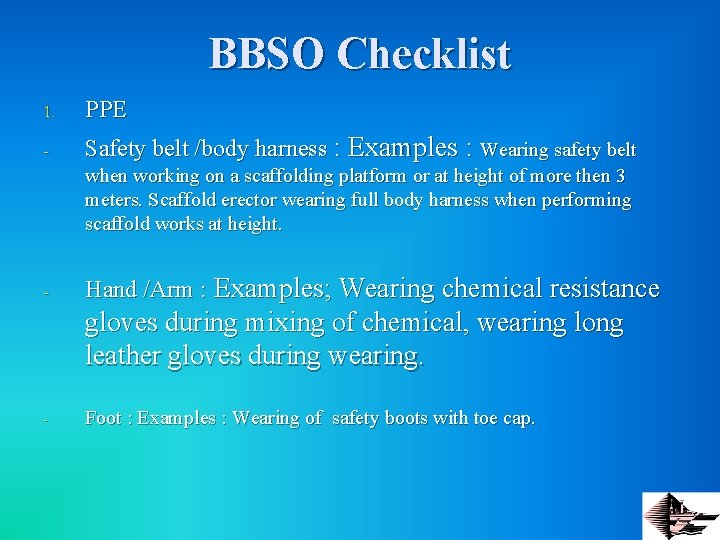
BBSO Checklist 1. PPE - Safety belt /body harness : Examples : Wearing safety belt when working on a scaffolding platform or at height of more then 3 meters. Scaffold erector wearing full body harness when performing scaffold works at height. - Hand /Arm : Examples; Wearing chemical resistance gloves during mixing of chemical, wearing long leather gloves during wearing. - Foot : Examples : Wearing of safety boots with toe cap.
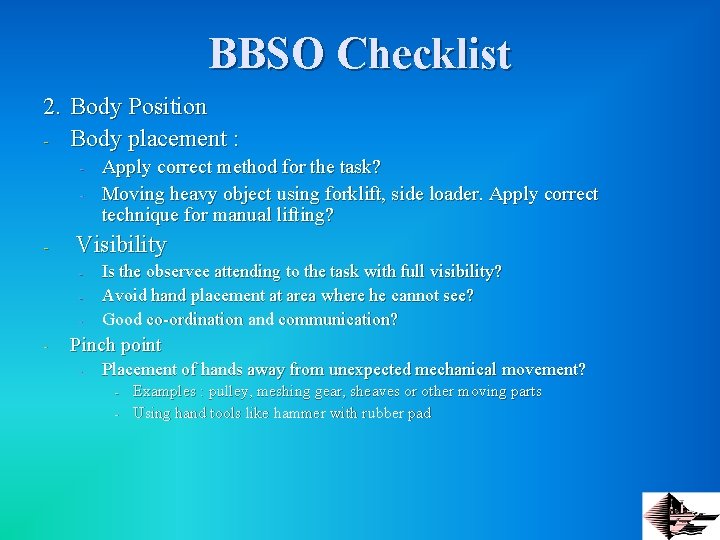
BBSO Checklist 2. Body Position - Body placement : - - Visibility - - Apply correct method for the task? Moving heavy object using forklift, side loader. Apply correct technique for manual lifting? Is the observee attending to the task with full visibility? Avoid hand placement at area where he cannot see? Good co-ordination and communication? Pinch point - Placement of hands away from unexpected mechanical movement? - Examples : pulley, meshing gear, sheaves or other moving parts Using hand tools like hammer with rubber pad
BBSO Checklist 2. Body Position - Eye on work : - - Eye on path - - Are the employee’s eyes’ focused on the task? - Watch for pinch point, hot spot, rough surface? Is the worker looking in the direction of the travel? - Watch for debris in path, elevation changes overhead hazards Ascending /Descending - IS the worker using correct techniques? - Hadnrails are used while traveling up and down; Use scaffold ladder when climbing up and down Face ladder while climbing
BBSO Checklist 2. Body Position - Overextending : - - Overexertion - - Is the employee reaching beyond personal ability? - Worker reaches beyond ability to turn on a valve. Examples : Too heavy for one person to lift; Working too long in a hot and confined area. Line of fire - IS the body of the worker positioning in the path of material and objects that may splash, fall, fly back? - Examples: working below a suspended loads; - Working in the path of flying debris;
BBSO Checklist 3. Procedure Safe work procedure : - - Is the worker observe safe work procedure? - Aware of the procedure? Wrong method? Short Cut? Ete Pre-occupational check - Is the worker taking pre-operational measures - - Tagout / lockout - Are tagout/lockout practices being performec? - - Check the tools and environment, validity date, SWL and etc Worker inspect energy source such as valves, pipes , electrical equipment. . Permit-to-work system - Comply? All stages signed? Precautions taken? Displayed? Updated? Permit returned upon completion?
BBSO Checklist 4. Working environment Walking / working surfaces - Use correct path? Opening barricaded or protected? Free from obstruction? - - Housekeeping - Is the immediate work area and exit free from obstruction? - - Examples: Cable/ hoses hung up and tools are kept in tool box. Ventilation - Work place ventilated? - - Examples : Oil water, debris Exhaust ventilation is provided during spray painting in a confined space Lighting - Sufficient lighting? - Example: flash light is provided in poorly lit area.
BBSO Checklist 5. Tool and equipment - - Selection Using proper tools? Condition Is the tool in good working condition? -Tools are clean and free from oil - Tools are free from defects Use Are tools used correctly? - Example: Crane is not used for dragging a load, Chain block is not used for slinging a load.
Observation & Feedback Process • Discuss Enter into discussion with the people doing the work, in an open, unthreatening, respectful manner. Obtain permission to observe ( Can I talk to you about safety? ) Ask about the task and how it could be done more safely. Ask Why and What could happen if…? Questioning helps to stimulate others to think about their own safety.
Observation & Feedback Process QUESTIONS Can I talk to you about safety? Can you tell me about your job? What could go wrong? How could you get hurt? What kind of injury? How Serious? How Could you prevent it? Who else could be affected? What if the unexpected happened? What worried me when I first saw you? Why do you think I stopped you? How can the job be done more safely? What would you do in an emergency?
Observation & Feedback Process • Discuss Encourage them to identify the hazards, the ways in which they can be injured, the severity of that injury and the measures they could take to prevent it happening. Ask them for ideas that will help improve their working practices and workplace. Praise good performance and safe practices. Recognise exceptional safety performance. Correct at risk behaviours immediately. Act immediately in cases of gross violation and of repeated offenders. The observer will ensure that all at risk behaviours and unsafe conditions observed are discussed and correction agreed.
Feedback what you saw and agree actions from Observation • Provide feedback immediately, and discuss follow-up at the workplace e. g. - Recognize/ re-enforce safe behaviour - Discuss how to make safe behaviour easier - Influence risk perception if needed - Correct unsafe behaviour • Summarize dialogue and agreed follow-ups that you will write on the form. • Feedback to the owner of area and workgroup supervision on how things looked in the field when you return.
Observation & Feedback Process • Record After the observation, record on the observation checklist: • The safe and at risk behaviours observed and comments • The percentage of safe observation • The time, place, date and activity • The name of the observer • Cases of exceptional safety performance • Observer follow-up actions
Observation Data from the checklist will be : • Used for immediate communication to other Workgroups if appropriate • Fed into database for weekly/monthly/annual trend analysis and schedule compliance • Used to feed the overall Behaviour Based Safety – Human Factors Diagnostic Process
Observation & Feedback Process Follow-up is a crucial step in achieving results through observation. To follow up personally and demonstrate that safety is a key value and that you mean what you say. Failure to follow up will give your subordinates the impression that you do not care and that high standards in safety are not one of the personal priorities.
Behaviour – Based Safety BBS Observation & Feedback Workshop What to observe ? Use safety observation & feedback checklist
Observation & Feedback Process • Reaction of People • Positions of People • Personal Protective Equipment (P. P. E) • Tools/Equipment • Procedures • Housekeeping
REACTIONS OF PEOPLE Observe how people react when you approach and when they see you • Changing position suddenly • Stopping/leaving job • Rearrange job • Changing tools • Applying Lockouts • Adjusting/adding personal protective equipment • Hiding, dodging (Move back and forth)
POSITIONS OF PEOPLE ( INJURY CAUSES ) Observe where people are stood in relationship to a hazard in the workplace. • Work on stable surface • Eyes on work • Away from line of fire • Away from pinch points • No rushing/short cuts • Right method of climbing • No contact with heat • No contact with electricity
QUESTIONING ATTITUDE • What if the unexpected happens ? • What injuries could occur ? • How can this job be done more safety ?
PERSONAL PROTECTIVE EQUIPMENT Observe the task in hand, identify the hazards and the appropriate personal protective equipment that should be employed. 1. Provides barrier. 2. Reflect state of mind. 3. Match the task / hazards with the protection worn. 4. Use the head-to-toe check. • Head • Eyes and Face • Ear • Respiratory system • Hands and arms • Trunk • Feet and legs
TOOLS & EQUIPNMENT Maybe tools and equipment present a major risk to the activities observed. Consider whether equipment and tools should be on your agenda. Observe employees using tools or equipment : • Right tool for the job ? • Used it correctly ? • Is it in Safe conditions ?
PROCEDURES ( STANDARDS ) Observe whether the task in hand involves activities of high risk and whether procedures would be required Evaluate standard procedures by observation: - • Available? • Adequate for the jobs? • Known and understood? • Followed? • Maintained?
PROCEDURES ( STANDARDS ) • Follow safety rules ? • Follow safety procedures ? • Use checklist ? • Provide fire watch ? • Comply to lock-out/tag-out ? • Comply to PTW system ? • Conduct pre-job inspection ?
HOUSEKEEPING & TIDINESS Maybe housekeeping and tidiness will be focus of your discussion because it presents the single most important risk to those involved with the task… Evaluate Housekeeping by observation : • Standards established ? • Standards understood ? • Housekeeping maintained ?
HOUSEKEEPING & TIDINESS • Work not obstructing passageway, ladder, platform, etc ? • Clean work area ? • Proper materials & tools storage ?
In Conclusion • What is Behaviour Based Safety Process • Behaviour based Safety Observation is part of Total Safety Culture • Safety Intervention Workshop is to equip you with the skill which will come in useful when you conduct BBSO • Active participation and apply skill in your workplace
Singapore Technologies Marine Observe Discuss 3. 0 Procedures BBSO Follow up 3. 1 Safe Procedure Behaviour Base Safe Observation Check Sheet (Generic) 3. 2 Pre-operational check 3. 3 Lock out/ Tag out 1. 0 Personal Protective Equipment (PPE) 3. 4 Permit to work system At risk 1. 1 Head 1. 2 Face & Eye 1. 3 Hearing 1. 4 Respiratory 1. 5 Safety Belt/ Full Body Harness 1. 6 Hand & Arm 1. 7 Foot Safe 2. 2 Visibility 2. 3 Pinch Point 2. 4 Eyes on work 2. 5 Eyes on path 2. 6 Ascending/ descending 2. 7 Overextending 2. 8 Overexertion 2. 9 Line of Fire At risk Safe 4. 1 Walking/ Working surfaces 4. 2 Housekeeping 4. 3 Ventilation 4. 4 Lighting At risk Safe 5. 0 Tools and Equipment At risk Body Placement Safe 4. 0 Working Environment 2. 0 Body Position 2. 1 At risk Record Safe 5. 1 Selection 5. 2 Condition 5. 3 Use Total % Safe= Safe x 100/ Total =_______ % safe=
EGO STATES In T. A, EGO STATES Are the ways that you communicate to other people P P A A C C
TRANSACTIONS In T. A, TRANSACTIONS Is the word used to describe communications between people P P A A C C
You can Use These 6 Behavioural Styles The Critical Parent It communicates that you are not approving by words, gestures, facial expressions, body posture and/ or tone of voice. It often points a finger and speaks louder. It sometimes sarcastic. The Nuturing Parent It is empathetic and understanding. It is sensitive to the needs, wants and feelings of others. It is firm in a caring and non-demanding way.
You can Use These 6 Behavioural Styles The Adult It is like a computer that takes in, stores, process and sends out information. It is logical, reasonable and rational. It deals with facts and thinking instead of feeling, attitudes and opinions. It is the part of you that is used to determine whether, when and how to express yourself. The Natural child It has needs for strokes, structure, recognition and stimulation. It has wants that vary from moments to moment. If needs and wants are met, it expresses warmth. If need and wants are not meet, it expresses anger. Sadness and fear. The Natural Child look like, sound like and is in fact a spontaneous little kid experiencing these needs.
You can Use These 6 Behavioural Styles The Rebellious Child It says that it’s not going to listen to you. Agree with you, or do what you want. It tends to get angrier than the situation calls for and it says angry longer. It very negative. This may be obvious or subtle. It rebels indirectly by forgetting. Procrastinating and doing things differently, half-way or poorly. The Compliant Child It communicates; “I’m not okay” in subtle (or not s-subtle) ways. It speaks with a softer voice, use wishy-washy words and rarely makes eye contact. It tends to whine. It’s behaviour is to be very careful and self-protective.
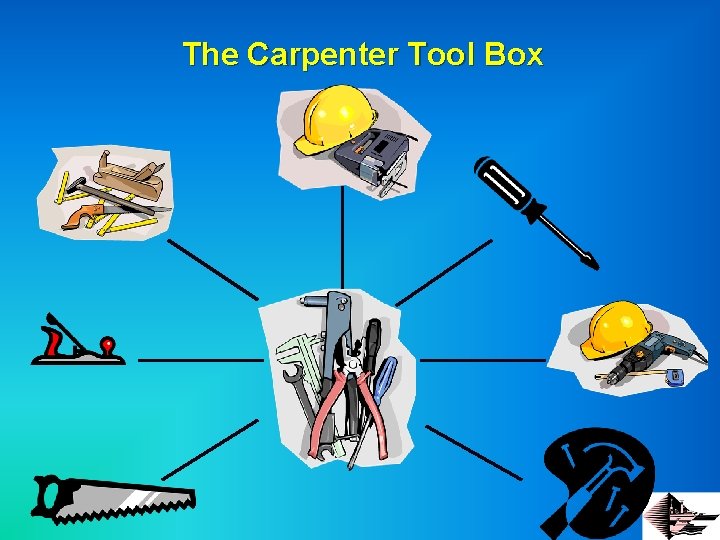
The Carpenter Tool Box
MOTIVATION STRATEGIES 1. Analyse the need of the people involved in the situation. 2. Determine the underlying causes, work out the alternatives available to resolve the problem and make the final decision ( viz satisfy, frustrate or persuade strategy. 3. Implement the strategy chosen by adopting the appropriate communication style.
- Slides: 104